Amber Batts was sentenced to more than five years in prison after pleading guilty to sex trafficking in the second degree Monday afternoon. Batts is the former head of “Sensual Alaska”, a prostitution business that served people around the state.
Batts connected sex workers with clients who were pre-screened for safety concerns, then she took a portion of the fee. She already has two felonies on her record.
State Assistant Attorney General Adam Alexander prosecuted the case. He says the case was not about the morality or legality of prostitution.
“Our hope in prosecuting broader sex trafficking enterprises is to create a safer environment for individuals who are caught up as workers in that trade and in an environment that people feel comfortable disclosing when they’re being victimized,” Alexander says. “And unfortunately our experience working on the ground here in Alaska, more often than not the people who are working in the sex trade are victims of exploitation.”
Alexander says many participants in the sex trade are vulnerable and have experienced trauma.
But sex worker advocate Tara Burns says members of the industry are being prosecuted for actions that make the sex trade safer.
“So we work indoors instead of out on the street. And that is being called ‘having a place of prostitution’ now, which is felony sex trafficking in the third degree,” Burns says. “We share clients and we communicate with each other about clients to see if they’re safe – “Have you seen this client? Is he safe?” and that is now called a sex trafficking ring or a prostitution enterprise. And that’s felony sex trafficking in the second degree.”
Burns has worked in the industry for 20 years, and her organization Community United for Safety and Protection is lobbying to change the state’s laws. More than 30,ooo people have signed an online petition in support.
“We’re asking the Alaska legislature to repeal the new sex trafficking laws. We want to be able to go to the police to report crimes like sex trafficking without having to worry about being charged with felonies now instead of just prostitution.”
The laws passed in 2012. The human rights group Amnesty International recently adopted a resolution supporting the decriminalization of consensual sex work saying that it will make it safer for the workers.
A Japanese Air Self-Defense Force airman directs a taxiing C-130H Hercules on Joint Base Elmendorf-Richardson, Alaska, Aug. 11, 2015. (Photo by Alejandro Pena/U.S. Air Force)
Seventy years ago this month, the U.S. dropped two atomic bombs on Japan, prompting its surrender and the end of World War II. Now, the two nations’ armed forces are collaborating in Alaska.
As part of the Alaskan Command’s Red Flag exercises this summer, two dozen Japanese paratroopers are training with Army soldiers based at Joint Base Elmendorf-Richardson. After 10 days of exercises, the group flew north in cargo planes before jumping into the Donnelly Training Area near Fort Greely.
It’s not the first time the Japanese Ground Self Defense Force have partnered with Alaskan troops. Lieutenant Colonel Alan Brown says in the past, soldiers have gone through cold weather training at the Army’s Black Rapids site.
“The airborne capability is something that Japan has been developing in recent years. Our first experience with it recently is jumping with them over in Japan as part of an exercise this February.”
Brown says the goal is building a firmer partnership with one of the U.S.’s most important Pacific allies.
“The deeper the foundation, the more readily we’ll be able to integrate with them in an emergency situation–a contingency like a human disaster, where we need to assist in concert with that country for Recovery operations or Search and Rescue, those types of things.”
The U.S. is increasingly shifting its military focus to the Pacific.
According to the Army, Tuesday’s jump was a success, with no reports of injuries.
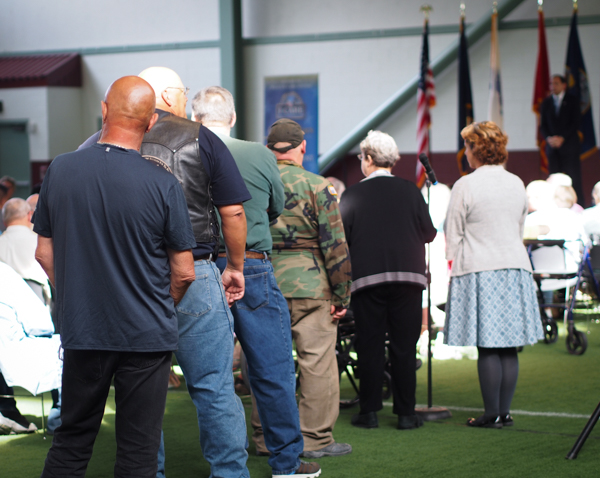
Dozens of people lined up during Thursday’s listening session to speak on concerns and experiences with the VA. Though overwhelmingly critical, many laid out positive experiences receiving care in Alaska. (Photo by Jillian Rogers)
A listening session held Thursday night in Wasilla by the head of the Department of Veterans Affairs was dominated by complaints about the healthcare system for veterans. The VA is struggling in Alaska to rebuild trust as policy changes unfold from Washington, D.C. all the way to the state’s most remote clinics.
On the green AstroTurf soccer field at Wasilla’s Menard Sports Center, a crowd of hundreds — mostly older — turned out to talk about the VA.
“Obviously the Department of Veterans Affairs had a crisis,” said Secretary Robert McDonald from a stage, not using notes or a script as he gave an overview of the massive problems hampering service in recent years. “The primary reason, as I looked at this situation, was the aging of the American Veteran population.”
There are more veterans coming on the rolls, and also more recognition of ailments like post-traumatic stress, Agent Orange exposure and Hepatitis C from Vietnam-era blood transfusions. Just as needs are ballooning, there’s a compounding shortage of staff.
“We didn’t have enough doctors or nurses,” McDonald said of when he took over. “When I first testified in front of Congress I said ‘I need to hire 28,000 medical professionals nationally.’”
At the heart of the crisis, according to McDonald, are Congressional budgets that cap spending on veteran health. But where to lay blame for such enormous problems was one of the many things the crowd pushed back against.
“One hour, with all of us? Come on, let’s get real,” said retired Air Force Sergeant Mike Kuntz ahead of a heated exchange with McDonald.
“I thank Dan Sullivan for making you come up here,” Kuntz said.
“Wait, wait, wait, let’s be clear: nobody made me come here,” McDonald shot back.
“Dan Sullivan had a lot to do with it,” Kuntz replied.
“No he didn’t. He had nothing to do with it,” McDonald said, before the subject moved on.
Testimony was overwhelmingly critical of the VA, filled with stories of personal misfortune and professional misconduct — some stretching back decades.
James Perkins is a recent vet from the 10th Mountain Division, and drove up from his home on the Kenai Peninsula to explain that in spite of efforts to overhaul the system in Alaska and across the country, it’s still vastly inadequate measured against the need.
“I’ve lost over six brothers that I’ve served with, in less than a year, to suicide. And I’ve almost been a victim of veteran suicide myself,” Perkins said. “The struggle is real.”
Stories of suicide, over-medication, and VA staffers too overworked or indifferent to help received cheers of agreement from the audience.
Army veteran Joe Oswald Jr. began his fiery remarks noting that many local veterans are afraid to raise problems they’ve experienced.
“Me speaking here is going to get me retaliation from VA,” Oswald said. “And VA is part of the reason veterans commit suicide — because they suggest suicide. And nobody is addressing it, sir, everybody is just passing the buck and hoping you go away.”
As Secretary McDonald listened, he would periodically refer people to VA staffers set up at tables in the back of the event.
Scott Harrison is a Marine Corp vet who lost his home from spiraling health problems. He doesn’t expect any one person to solve all his health issues, but believes the frustration for many, himself included, is wrangling complex paperwork just to get plugged in to their benefits.
“Nobody knows who I’m supposed to talk to,” Harrison said, emotion creeping into his voice. “They cannot find my records. I was at so many different duty stations, so many different bases, so many different operations — there’s absolutely no way that every record along the path is lost.”
McDonald interrupted him to flag down a staffer to get the marine’s info. Harrison spent about 15 minutes talking with a VA employee as she scribbled down notes.
Afterward, Harrison explained that in spite of struggling to find enough care, he does see folks trying hard to help within a flawed system.
“I think people are emotional on all this, and I think maybe people are maybe wanted to blame the secretary or hold him to task,” Harrison said, pausing to add, “The man’s doing a job.”
“We follow up on everything,” the Secretary said during an interview after the event. He stayed late taking questions, and had to hustle out the door in order to make his flight, but called from the road. He insists the listening sessions are more than a show. His staffers take notes during testimony and follow up with every individual case to see if it’s valid, and if so what can be done.
Asked whether that was a general goal or a literal protocol, McDonald replied quickly, “Every single thing.”
The Secretary’s visit also included a trip to Kotzebue, and a headstone ceremony on Wednesday in Point Hope.
The Anchorage Assembly is trying again to add sexual orientation and gender identity to the city’s anti-discrimination ordinances. Assembly member Bill Evans filed the amendments Thursday. The ordinances prohibit discrimination by the municipality, employers, businesses and renters.
The proposed ordinance includes exemptions for religious organizations and says that no person should be forced to participate in an event that conflicts with sincerely held religious beliefs.
Another provision says that people will be required to use restrooms and locker rooms appropriate to their gender presentation regardless of their assigned sex at birth.
In a press release, Evans wrote, “The ability of every person in society to be judged based upon their skill, accomplishments, and talents, and not because of some immutable characteristics, is a result we should encourage.”
The Assembly will take public comments on the ordinances on September 15. Previous attempts to pass a similar ordinance were vetoed by former mayor Dan Sullivan and rejected by voters.
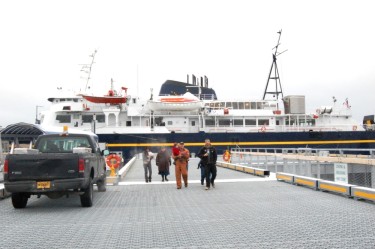
The ferry Aurora docks in Gustavus in 2010. It’s now in Ketchikan for hull repairs and its annual overhaul. (Photo courtesy Alaska Department of Transportation)
The ferry Aurora is out of service a week earlier than expected.
A small crack was found last week in its hull. The Coast Guard ordered repairs before resuming passenger service on its Prince William Sound route.
“The vessel was going out of service on Aug. 14 to enter its annual overhaul period. Because of that, knowing that we had to do some extensive repairs to the area where the crack was noticed in, we sent the vessel to Ketchikan to have those repairs done,” he says.
The 38-year-old ship is scheduled to resume service in October. It’s not yet known what caused the damage.
Woodrow says the crack did not immediately compromise vessel safety.
“It’s large enough that water is coming through it, but it’s not so large they couldn’t sail the vessel down to Ketchikan from Prince William Sound,” he says.
The Aurora connects Whittier, Cordova and Valdez. It sometimes sails Southeast routes, mostly filling in for its sister ship, the LeConte.
The attendees of the Stop the Violence rally pose for a photo. (Photo by Anne Hillman/KSKA)
After two recent shooting deaths of local teenagers, more than 60 people marched through the rain in East Anchorage Sunday afternoon to raise awareness of violence in the community.
The crowd sang “Keep calm everybody, and put your guns away. Stop the violence!” The sentiment was echoed on their matching black t-shirts as they marched near the site where 19-year-old Preston Junior Clark Perdomo was shot dead last week.
Among the crowd was resident Allie Hernandez, who moved to Anchorage in 1997 because it was a safe place to raise her kids. She says now, she’s scared.
“This is why we’re walking,” she says between deep breaths. “We have a lot of parents here walking because we’re scared for our kids. We don’t want to see them dead. We don’t want to bury our kids no more. So if we have to walk five miles or six miles, even though I’m not in shape, girl, we’re doing it!”
Summer Yancy walked wearing a set of charms representing friends and family who were impacted by violence. She said Anchorage is so close-knit that everyone is affected by the recent shootings. One way to stop it is to speak candidly with youth about gun violence.
“Let’s have real scenarios of what this looks like when you’re in a real situation,” she said. “With[in] a group of kids and there’s one person in that group that wants to be irresponsible with their gun and all the sudden everybody is sucked in … it can happen to very good kids as well.”
Nineteen-year-old Brennan Gregiore-Girard said he grew up on the east side of town and gun violence doesn’t faze him.
“I mean when I hear about it, it doesn’t shock me anymore, which is sad to say because we shouldn’t be in an environment where kids should feel that way, but it’s the sad truth,” he says.
He said he thinks kids need to take responsibility for their actions and for the situations they place themselves in.
“I’ve always felt like I could talk things out. My mom raised me that way and my dad raised me that way. And I’ve always wrestled and done combat sports, so it’s not one of those things where I’m scared and all that,” he explained. “But why should I put my hands on someone to stop the violence? Because when you kill someone, you’re not only killing them.” You’re killing a piece of everyone they knew, he said.
The community group We Are Anchorage organized the walk to show a unified front for saying no to violence. They hope to encourage people to start actively watching out for their communities and speaking up.
Close
Update notification options
Subscribe to notifications
Subscribe
Get notifications about news related to the topics you care about. You can unsubscribe anytime.