Ride-sharing service Uber has agreed to pay the state $77,925 because they misclassified drivers as independent contractors instead of employees.
The company operated in Anchorage for six months then pulled out in March because it could not come to an agreement with the Municipality of Anchorage to legally operate in the city. The municipality said the company was violating the taxi ordinance. Now, the company is also prohibited from operating in the state until they comply with the state’s classification laws.
According to a statement from the Department of Labor and Workforce Development, labeling workers as contractors lets companies avoid paying unemployment insurance taxes, and worker compensation premiums. It also violates the Alaska Workers’ Compensation Act. The money will go toward covering uninsured injured workers claims.
Similar lawsuits have been brought against the company throughout the country.
A growing, wind-whipped wildfire continues to burn out of control in Chiniak.
Around 10 a.m. Friday, officials reported that while the Chiniak library has burnt down, the nearby Chiniak K-8 School survived.
The blaze began sometime around 9 p.m. Thursday and may have been sparked by downed power lines. Darron Scott of Kodiak Electric Association said that reports of outages in the Chiniak area began coming in before 9 p.m., though there were no reports of downed power lines. The power is still out past the Chiniak post office.
Flames from the rapidly growing fire were clearly visible all night long from Kodiak City, 10 miles across Chiniak Bay. Kodiak City Manager Aimee Kniaziowski, who serves as the joint city-borough emergency management coordinator, said winds gusting to 60 mph caused the fire to quickly grow, forcing an evacuation of the small community.
“We don’t know where the fire is at. We don’t know how big it is. At about 4:30 this morning it was about 2,000 acres,” she said on the KMXT Morning News. “And that was just an unprofessional estimate, so we expect that it’s even larger than that now.”
She said the U.S. Coast Guard was planning to send a helicopter to the scene to make an aerial survey of the area burned.
Air travel to, from and around Kodiak has been hampered by strong westerly winds that stirred up ash from the Katmai-Novarupta volcanic explosion over 100 years ago, just across the Shelikof Strait. Numerous commercial airline flights were canceled Thrusday evening and Friday morning.
“We were concerned about the ash in the air; that was why when we contacted the state operations folks requesting assistance, they knew they couldn’t send any firefighters or anybody out,” Kniaziowski said. “At least certainly last night because of the ash.”
Several school buses were sent to Chiniak last night to help evacuate residents. A few were brought to the Kodiak Middle School and spent the night. Kniaziowski said many others, about 75 people, checked in and nobody is reported missing.
Kodiak Fire Chief Jim Mullican told KMXT’s Pam Foreman early Friday morning that people are not being allowed past a certain point.
“We have a roadblock set up at Roslyn Beach. Residents will not be allowed beyond that point,” Mullican said. “We are encouraging residents to not even to go out to that area. The fire is still burning and is still out of control.”
Residents of the nearby community of Pasagshak have been warned to prepare for evacuation if the winds change. The forecast calls for westerly winds calming a bit today, but still gusting to 40 mph. A small chance of rain is in tonight’s forecast, with a slightly greater chance Saturday.
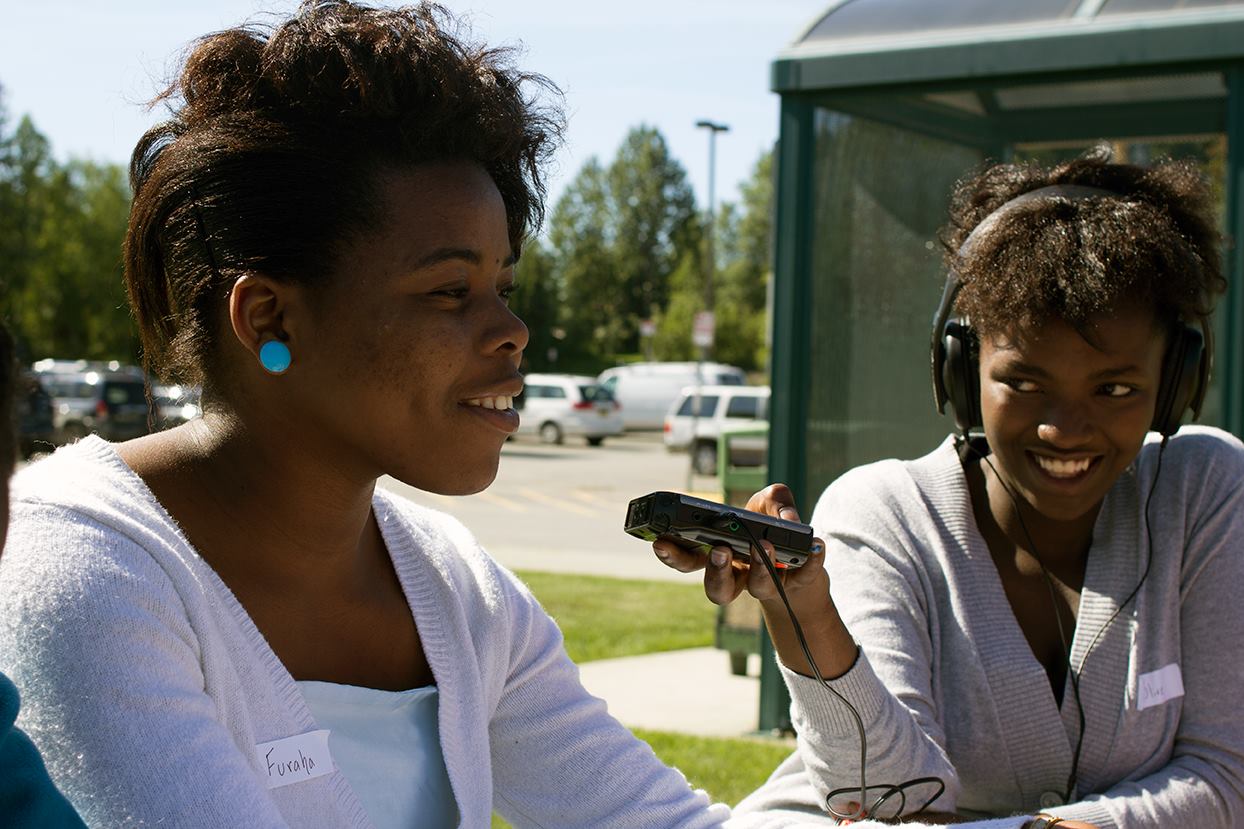
Olive Mtoni records Furaha Sefania outside of UAA. (Photo courtesy of Alaska Teen Media Institute)
Everyone has a story to tell, but it may not be the story you’d expect. An Anchorage non-profit called StoryWorks is helping teenagers find their stories, and this summer they focused on students who arrived in the state as refugees.
A group of students and their story-telling mentor lounge on couches at the University of Alaska Anchorage telling each other about their lives.
“Did you learn something from that day?” Rosey Robards asks 17-year-old Furaha Sefania. Robards is a story coach and also the director of the Alaska Teen Media Institute.
Sixteen-year-old Olive Mtoni interjects in Swahili, translating for her new friend. Both girls are originally from the Congo, but Mtoni’s family fled the war-torn nation to Rwanda before she was born. Sefania’s went to Mozambique. They met for the first time at East High in Anchorage late last year. But that’s not the story Sefania has chosen to share…
“Wakati nilikuwa nacheza mpira na rafiki zangu, na mdogo …” Sefania says, telling her story.
She’s talking about a time when she was 12 years old and playing soccer with her friends back in Mozambique. Her little sister calls her to come eat and she refuses to go. When she finally heads home two hours later, the food is gone. Her sister laughs because she received extra, and her mother admonishes her – if you like soccer so much, than you can eat it! Sefania says she learned to listen to her mother. So why tell this story?
“Niliona tu, tuongee.” She just thought of it when chatting.
And that’s the whole point – stories are just moments to help people understand each other. That’s why 11-year-old Khalil Edais participated in the program. He was born in Anchorage but he loves storytelling and wanted to learn about the other kids.
“A lot of the kids have stories to tell, so this is like a big camp for them because they have big stories from their countries that they told here, so it’s pretty big for me to come here.”
Edais learned about a girl who climbed a tree, was distracted by a monkey, and ended up at the hospital getting shards of wood pulled from her arm. A boy told about the disappointment of leaving home for a cold place but eventually making new friends.
Jessica Kovarik, the program director of Refugee Assistance and Immigration Services, says these stories can help the community understand people from other nations.
“We really wanted to give the youth an opportunity to have some voice and to learn to tell their stories and recognize how powerful their stories are and how much they have to share with the community.”
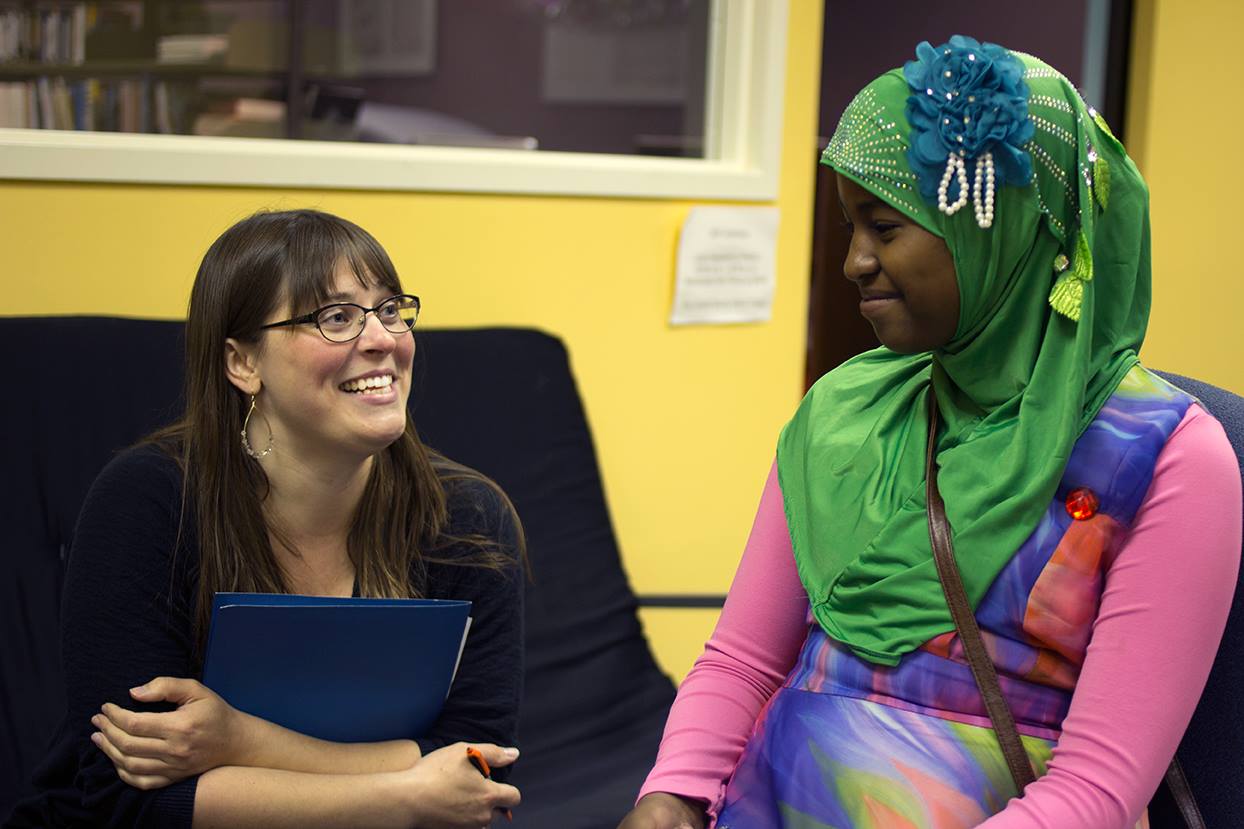
Alaska Teen Media Institute director Rosey Robards chats with Iqlas Dubed. (Photo courtesy of Alaska Teen Media Institute)
Twelve-year-old Iqlas Dubed shares the story of her first bee sting – just a month ago, near the Campbell Creek Science Center.
“Then I ran around, ran around, ran around. Then came, I was out of breath, so I was just like ‘It hurts! It hurts!’ And the bee was still on my hijab so I took it off.”
The sting taught her what goes around, comes around. She laughed at other kids who were stung on previous days, and then she was stung. But telling the story taught her
“Don’t be scared to tell others. Other people that you don’t know.”
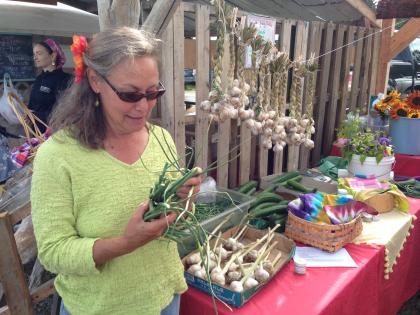
Lori Jenkins of Synergy Gardens holds garlic scapes her WWOOFers helped harvest. (Photo by Shady Grove Oliver/KBBI)
Every summer, Homer and the surrounding area is inundated by a transient population that’s come to work for eco-friendly businesses. They’re called WWOOFers and they spend weeks in different places around the world learning how to live sustainably.
Across Kachemak Bay from Homer, in the small community of Little Tutka, Emma Bauer is setting up kayaks on a beach.
“Today we have a bigger group of guests,” says Bauer. “I think they’re all a big family but it’s seven people. Like the other day we just had a tour of two people. So sometimes the guides and the volunteers outnumber the guests but today we have to take out the majority of our kayaks. So it takes us a little bit longer to get everything ready.”
She’s a college student from Huntington, West Virginia, who has spent the last several weeks working for an eco-friendly lodge and tour company as an all-purpose helper. She assists with kayak tours around the bay, washes dishes, collects seaweed for organic soup, and turns down bedding when guests leave. She’s not paid, but in exchange she gets to stay in a cabin with an ocean view nestled in a scenic coastal forest, and do things she otherwise wouldn’t have the opportunity to do.
“I had not traveled much before, so this is my first big adventure,” says Bauer. “I had never flown commercially so that was a big thing. This whole trip was a bunch of firsts for me.”
She’s part of the WWOOF program, which stands for Worldwide Opportunities on Organic Farms. Emma is one of the nontraditional WWOOFers doing something aside from farming.
“I thought it would be really neat to learn about sustainable living,” says Bauer. “I’d like to do another WWOOFing experience where I’m farming because here it’s a little different where I’m doing the kayak tours with them but I’m still learning a lot about the environment and things that go on here.”
Most of the WWOOFers here are like Noel Krasomil. He’s been working at Synergy Gardens on the Homer side of the bay. Today, he’s helping out at the farmers market booth.
“Today we are selling our wonderful garlic, first of the season harvest braids,” says Krasomil. “We have scapes. We had tomatoes, they’re about out, cucumbers, flowers, everything — really great stuff all-around.”
He says he’s wanted to learn how to farm organically his whole life. For the past three weeks he’s seen the inner workings of an independent growing operation from every side.
“Oh, it’s different every day,” says Krasomil. “It all depends on the needs of the farm. Some days I’ll harvest kale and arugula. I’ll harvest garlic, hang it to dry. I’ll run around town getting beer waste for the compost. I’ll go grab manure. I’ll dig ponds … any number of things — whatever they need me to do.”
“A lot of people think WWOOFers just weed, but it’s just way more,” says Lori Jenkins, owner of Synergy Gardens and Noel’s host. “Each person’s going to have different strengths and different weaknesses. So I ask them every day, ‘What do you want to learn today?’ And then I have my goals of what I need to achieve, as far as whether we’re replanting, what needs irrigating, what needs harvesting, what needs weeding.”
She says she likes to have WWOOFers in residence for at least two weeks, so they get the rhythm of day-to-day operations. That may sound like a very short time, but quick turnover is one of the ideas behind WWOOFing.
It was started in the 1970s by an English secretary named Sue Coppard who lived and worked in London. She wanted to spend more time in the country without leaving her job, so she coordinated with a farm in Sussex to let her come out for the weekend. Thus began Working Weekends on Organic Farms, its first title.
Since the seventies, it’s spread to more than 50 countries, from Ghana to Poland, New Zealand and Bangladesh. In 2010, the most recent year with WWOOFing stats, nearly 12,000 host organizations filled more than 80,000 positions. Many of the WWOOFers jump from farm to farm every few weeks to spend an entire year traveling and working.
Jenkins says having new people in the house every few weeks has taken some adjustment.
“I’m getting used to communal living, and that’s been a shift,” says Jenkins.
It’s also not free. She says she’s done the math and it costs her about $500 per month to house, feed, and provide water for her WWOOFers.
Despite the cost, Jenkins says it’s worth it.
“So here, I have an educated college grad, coming to my place, and then they’re often world traveled. It’s not for everybody, but with the attitude of give and take, I think it’s awesome,” says Jenkins.
It’s like-minded people coming together for a common cause and mutual benefit. And Jenkins asks, really, what’s better than that?
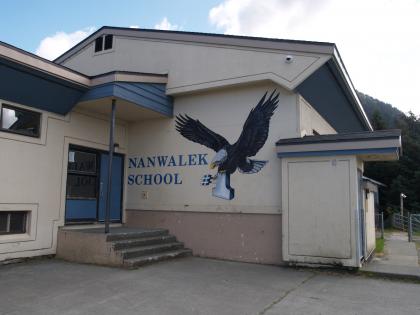
Nanwalek School. (Photo by Shady Grove Oliver/KBBi)
For students and teachers in the village of Nanwalek, this academic year will likely be very different from years past. They are the recipients of a technology grant from Apple that could change the face of education in the village entirely.
Sally Ash is sitting in her large classroom at Nanwalek School. She grew up in Nanwalek and is now a Sug’stun language teacher.
“I think it gives them a background of who they are, where they come from, and the knowledge that’s sitting right here where they’re living. It enriches their life as they get older too, how to live and get along in the world but do it the right way,” says Ash.
She says it’s intertwined with values and culture.
“There [are] a lot of studies being done that [say] if you know more than one language, it makes you smarter. And not only if a speaker wants to go outside of Nanwalek or somewhere else and become a rocket scientist, they could. Or, if they want to stay home and they just want to stay home and be a subsistence [person] or help out with the fish here or things like that, they could. They have a choice so they’re not stuck with one thing,” says Ash.
Like all of the teachers in the school, for years, she’s made due with aging instructional materials like her yellowing, dog eared dictionary, and too few copies of important textbooks. But now, one wall of her classroom is filled with a Smart Board, an interactive piece of technology that takes the place of the traditional chalkboard.
“I was so scared when we first got it. I was like, how is it going to benefit in my class? How am I going to use it?”
But school Principal Nancy Kleine says Apple isn’t leaving anything to chance.
She was contacted by Apple last year to apply for the special grant program. Apple started the program to bring technology into schools in low income areas in response to President Obama’s ConnectEd initiative.
Nanwalek was the only school selected in the state of Alaska, and one of only 114 in the country. As a result, it’s receiving an iPad for each one of its 80 students and every teacher and aide. In addition, all teachers are getting MacBooks. There are now Apple TVs in every instructional area, an iMac for the front desk, storage carts for the student’s pads and charging stations for every classroom.
“They’ve given us 17 days of professional development,” says Kleine. “They’ve given us three years of support. They’ve had team after team come out to test the infrastructure and work with us to develop a strategic plan so it really will be successful for our instruction.”
They’ve also provided funding for teachers to purchase apps specific to their classes and subject areas. Kleine says that’s the key- it’s about more than just technology. It’s about changing the whole learning environment at all levels.
“We really have a lot of hope for this. With the students and the parents and the community being partners, I think we’re truly going to be able to transform teaching at Nanwalek School,” says Kleine.
Sally Ash already has big plans for her students and their new gadgets this year, both in the classroom and in the village as a whole, starting with the old books.
“The pages are really torn, well used books that we want to put on the board so the kids will be able to see. And, we’ll be able to record the elders. And, we can take our iPad out and take pictures of things, identify them and write the name, and that sounds exciting to me too,” says Ash.
She also wants to set up regional speaking sessions with other schools in the Prince William Sound area using a video program.
“It really makes me happy,” says Ash. “I get really emotional because it’s one of my passions is that the kids- I want them to learn Sug’stun. And to hear them, is just a joy to my ears and my heart. Thank you very much, Quyana.”
And like Sally Ash, Kleine says she thinks this grant could have lasting benefits for the entire community far into the future.
“I just think this is an opportunity for these kids to grow and one of the things I’m really hoping that it does is that they will want to come to school and be engaged and be partners in this learning and attendance will grow,” says Kleine. “We are just totally launched for one of the most fabulous years you can possibly imagine.”
Mike Hindman at the Brother Francis Shelter. (Photo by Anne Hillman/KSKA)
People don’t usually plan to experience homelessness; life just takes unexpected turns. But for some guests of the Brother Francis Shelter in Anchorage, like Michael Hindman, the experience leaves them with more hope than anything else. When KSKA’s Anne Hillman spent the night at the shelter late last month, he greeted her and other guests at the door.
“All right, anybody and everybody who wants inside, please line up on the right hand side,” 26-year-old Hindman says as he opens the self-locking door to the shelter. He greets a guest. “How you doing, sir?”
It was an unusually calm summer evening. Hindman was monitoring the entrance area to the shelter and checking for contraband like weapons or alcohol.
“Anything inside of your pockets I can see?” he asks a woman as she gazes a bit past him.
Burly and tall with a goofy smile, the name of an ex-girlfriend tattooed in delicate script on his arm, Hindman never saw himself in a place like Brother Francis. He was young, strong, making good money.
“In the back of my mind I thought, ‘Why are people homeless? And I’ve always had a job. Why don’t people work and why don’t people do this?’ Maybe I didn’t have compassion or sympathy at first,” he recalled.
But a few years ago, he made a mistake.
“This is the part of the story where I’ve got to tell the truth, OK? This is my big blip. I was in Dutch Harbor, Alaska, working as a longshoreman …”
Hindman got involved with drugs, was busted for buying narcotics for an undercover cop, pleaded guilty to a felony, and went to prison.
“I learned my lesson right off the bat. My first 30 minutes in jail I realized this is not for me and then besides that 30 minutes I had another 18 months to learn the same lesson thinking, ‘This is definitively not for me.’”
As part of the plea deal he gave the state everything he owned. He was released this spring with nothing but purple prison underwear, donated clothing, and a quarter in his pocket. After sleeping rough for a couple of nights, someone told Hindman about Brother Francis. He began volunteering as a door monitor in exchange for secure housing at the shelter and help finding a job. Hindman said it completely changed his perspective.
“I no longer pass judgment when I walk by somebody, its more what can I do to help? Because whether the person, maybe they are an alcoholic or maybe they do have a temper problem, or maybe they do have a flaw, but I think all of us do. What I worry about now is, is that person cold?”
Working at the door lets him see people’s lives turn around, he said. One day they’re tired and stressed and a few weeks later they have a job and are looking bright. That’s his story, too. He was recently hired as a cook on the North Slope.
But during his off weeks he’ll be back at the shelter, helping out, and saving money to rent a place of his own. Hindman sees beauty in the echo-filled concrete halls.
“I’ve seen people with nothing to their name but they give everything they can to the next guy who also has nothing,” he said, recalling people offering up their only jacket to protect others from the rain. “I know people that make $100,000 a year that probably wouldn’t let you borrow their jacket, you know?”
He says he stays positive and hopes it helps others stay that way, too.
Close
Update notification options
Subscribe to notifications
Subscribe
Get notifications about news related to the topics you care about. You can unsubscribe anytime.