Southcentral

King of fermentation brings together microbiology, food & community

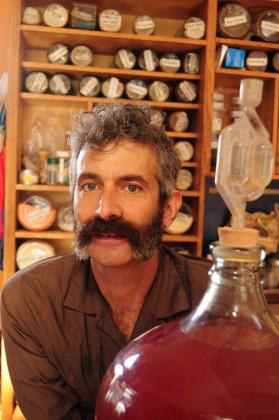
Author and fermentation expert Sandor Katz. (Photo by Sean Minteh)

A fermentation specialist recently visited Homer. He’s making his way through Alaska, teaching about the crossover among food preservation, microbiology and community. He taught an intensive fermentation workshop on a local farm.

It’s a sunny day over the Caribou Hills. A group of more than 50 people are milling around a large, green farm, lunch plates piled high with pungent food that saturates the summer breeze.

Sandor Katz is sitting on a log near some chickens, wearing a white shirt with a pattern of bright red radishes. He’s the King of Fermentation.

“I ended up being given the nickname ‘Sandorkraut’ because I was always showing up with sauerkraut and evangelizing about the healing powers of sauerkraut,” says Katz.

Yes, sauerkraut.

“You can make it in dazzlingly bright colors, or contrasting colors, or different sizes and shapes of cutting up your vegetables. It’s actually an incredibly versatile food,” says Katz.

Despite the teasing for always being that guy, the one who brings fermented food to a dinner party, he truly has a deep passion for this process. Through his eyes, the complex world of microorganisms and bacteria at work take on new and beautiful life.

“Before I see anything, I smell this delicious sourness,” says Katz. “I taste this sourness that speaks to me in this very deep way. What I see is last season’s garden that’s still feeding us and nourishing us. It’s actually never occurred to me that sauerkraut could be ugly.”

And his art is gaining popularity. In the pushback against processed and packaged foods, do it yourself preservation methods are becoming more popular.

“People are waking up to the fact that a lot has been lost by severing our connection with producing food and so they’re interested in figuring out how they can play a role in producing their own food,” says Katz.

Charles Meredith, who goes by Chaz, is active in the local farmers market and independent growing community. He says he’s seen a resurgence of traditional food ways, like canning, pickling, dehydrating and fermenting.

“I feel like in rural places, in general, the older traditions stick around more and are more appreciated by people in those areas,” says Meredith. “So, I think it’s partially holding onto the past where you can obviously see it slipping away.”

Like many people in Homer, he’s comfortable with lots of types of food preparation. Over by the picnic tables, Marcee Gray is scooping up sticky sourdough starter with a spoon.

She finishes packing it into a mason jar, picks up some lunch at the buffet and settles down in the shade with friends.

“In our culture we do have a little bit of a fear of things like mold and bacteria,” says Gray.

Gray’s friend, Mary Lou Kelsey, says she likes the mystery of fermentation.

“I was somebody who asked him, ‘So how do you know what organisms are in there?’ If you were really worried about trying to identify all the organisms, it would be difficult … so you kind of have to [accept] that it tastes good and it’s a great mystery,” says Kelsey.

Katz says in fermentation, microorganisms exist in communities — kind of like the people who are once again taking an interest in these complex processes.

“If you think the baker and the cheesemaker and the sauerkraut maker as some archetypal fermenters, and we can’t forget the beer makers, then these are all products that give rise to exchange and informal barter and economies of community,” Katz says. “I think the revival of local food systems is all about building and strengthening community ties.”

That revival can be seen in Katz’s own work. He brings people with common interests together, to eat communal meals, to trade containers of their homemade concoctions, and he does it all through his teaching of the art of fermentation and one jar of sauerkraut at a time.
Rain or shine, Dave Seaman delivers the mail to Kachemak Bay communities

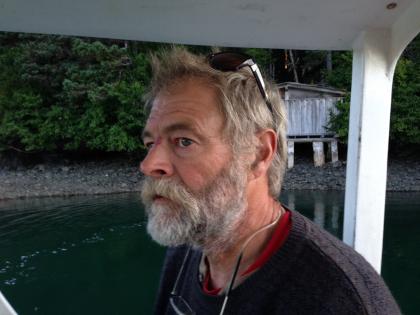
Dave Seaman has been delivering mail to small communities around the Kenai Peninsula for 30 years. (Photo by Shady Grove Oliver/KBBI

Like many rural areas, the south side of Kachemak Bay doesn’t get traditional mail service. Instead, communities rely on a mail boat to deliver the mail. It’s the kind of job that attracts a special type of person who’s willing to make the voyage across the bay — rain or shine, snow or ice — twice a week year-round. Dave Seaman is the man who’s been doing just that for the last 30 years.

Seaman lives up to his name. He’s a lanky 60-something fisherman. He wears durable pants and old sweaters and sets his week around the days when he delivers the mail.

“I wouldn’t know what day it was if it wasn’t Tuesday or Friday to hang it on,” he says.

We meet at the Homer post office to pick up the mail. He doesn’t really like coming to town; that’s why he lives across Kachemak Bay in Little Tutka, his one stop on today’s mail route.

When he shows up, he brusquely walks in the back door, punches his time card and heads straight for a tray marked “RED MOUNTAIN” — the name given to Little Tutka’s mail drop back before the old chrome mine shut down.

In recent years, the name has been reduced to the code RDO, a casualty of modern technology.

He tosses mail in different piles. He knows to forward a few letters to Homer addresses for Tutka residents summering in town.

“Oh, I know everybody,” he says. “I know where they are in the summer and in the winter and everything else.”

He stuffs everything into a large yellow mail bag and hightails it out the door.

“All right, that’s it. We got all our stuff; we can go head across the bay. The fun part begins,” he says.

We head down to the harbor and onto his old, green and white beast of a boat. As soon as we’re out on open water, he relaxes and starts to smile.

“I started it in 1987, so that makes almost 30 years. It’s kind of the thing that holds my whole life in line, really,” he says.

Less than an hour later, we arrive in Little Tutka Bay. Seaman grounds the front of his boat on the rocks and like a seafaring Santa Claus, tosses the mail sack over his shoulder and jumps off the bow.

The mail shed is a shack-like cabin haphazardly perched on a steep incline not too far above the water.

“Well you stumble up the beach, and then you climb up on a rock, and then you go up on top of this log and then there you are — you’re right in the back door, which the bear tore off,” he explains.

Inside the shack, there’s a big fish tote.

He’s lucky that today there’s only a handful of mail. He once served as the de facto moving company for a family coming from Bethel, hauling everything from the boat to the shack.

“That was fun. That was the biggest collection of Blaz-o boxes I’ve ever seen,” he says.

Once he’s done, he hops down. Back on the beach Seaman stops and looks around.

“Listen, there’s no noise here. There’s no noise here — no noise of tires on the highway. That’s the main thing, it’s just quiet and beautiful,” he says. “I lived over here for 20 years when I first got to the Homer area, raised a family here and always missed it when we moved to town to put the kids in school and all that. So I lived 20 years in town and now I’m back. This is my home.”

He says his job pays for his boat habit, keeps him connected to his neighbors and friends, and allows him to give back to his community.

“If I didn’t have somewhere I had to go, I’d stay back here and never go out, probably turn into a hermit,” he says. “It’s just fun. I’d probably do it for nothing, but don’t tell them I said that.”

And he believes in the mail. It’s more personal, perhaps more genuine, and it’s managed to hang on through the hustle and bustle of modern life. Little Tutka resident Gregor Welpton agrees.

“David provides a vital link for us here. He’s the guy who, no matter what’s going on in the bay, in the middle of winter, or in the beautiful days of summer, goes across and provides the link for us to pay our bills and get what comes in the mail,” Welpton says.

Back on the shore, it’s time to head out. Seaman still has some letters for his neighbors that he’ll hand deliver on his way back home to his little cabin.

We haul ourselves back onto the bow of his boat. As he starts it up, he bemoans the loss of the old Little Tutka mailing address once again — Red Mountain via Homer replaced by plain old RDO, the code for the nearest airstrip miles away.

“It’s not a really good fit, but it’s what we got. Maybe we could get it changed back. I always thought it would be fun to have our own ZIP code and get a stamp so we could be one of those places that people collect postal stamps from,” he says. “Maybe that would put us on the map.”

He reconsiders.

No … I don’t want us on the map. What am I saying?”

He says he’ll do this job until the day he dies — providing an important connection for the folks who live out here and hoping they won’t have to get too much more connected as the years go by.

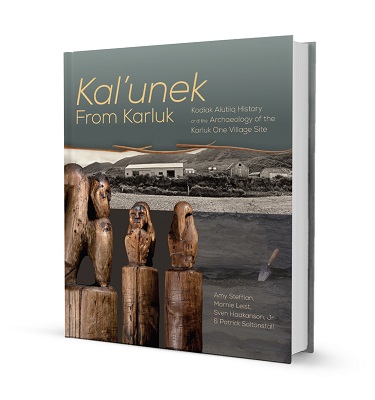
Kodiak’s Alutiiq Museum Releases Book About Karluk Archaelogical Site

The Alutiiq Museum recently published a book called “Kal’unek” with the University of Alaska Press. The nearly 400-page volume focuses on archeological discoveries near the community of Karluk and delves into the site’s lasting effects on those involved.

The museum’s director of research and publication, Amy Steffian, says the site at the mouth of the Karluk River — Karluk One — opened to excavation in 1983 when few people knew about Kodiak Island’s Alutiiq history.

The Alutiiq Museum's newest publication,  “Kal’unek”. The book focuses on archeological discoveries near the community of Karluk. (Image courtesy of the Alutiiq Museum)
The Alutiiq Museum’s newest publication, “Kal’unek”. The book focuses on archeological discoveries near the community of Karluk. (Image courtesy of the Alutiiq Museum)

“Many people would not even claim their Native heritage because there was so much disenfranchisement and disrespect, and there was this sense that the prehistoric culture … was impoverished,” Steffian says. “[It was thought] that these were poor people who suffered and who didn’t have a vibrant artistic life, and certainly when we set out to study this site, it became pretty clear that that was false.”

Steffian says it became extremely exciting to the Alutiiq community to see the objects coming out of the ground and to have access to them. She says the book is really about two different stories.

“It’s the story of the site and its contents and it provides an ethnography; it talks about how people lived [hundreds of years ago] … but it also tells how this kind of anthropological, archaeological study, when done in partnership with the community, when done with support and involvement, can be a very powerful experience,” she says.

Steffian says that the museum worked on “Kal’unek”with the help of many contributors, from researchers to people who had excavated the site. She says they’ve built a picture about Alutiiq life using a variety of resources, from oral history to Russian texts. Many of the artifacts are especially well-preserved.

The museum’s director, April Laktonen Counceller, says the freshwater that leaked into the site helped prevent oxygen from touching the artifacts until excavators could unearth them.

Counceller says she was involved in the project through the Kodiak Alutiiq New Words Council, which draws on the knowledge of Alutiiq elders. She says the members who had helped create words for modern technology turned their attention to ancient objects.

“By creating words for items where the words were once lost, we were able to kinda put our mark back on that prehistory and say, ‘This is our prehistory,’” she says. “Our people have long been discussed by outside archeologists and anthropologists. For the elders, it was really important to claim ownership over the past by giving back new words to those old items.”

She says they didn’t always invent new words or combine existing ones. For instance, they use applied the modern word for “knife” to an ancient one.

“That helps show the cultural continuity,” explains Counceller. “That we don’t need to come up with a completely unrelated word. We can use an existing word so that people can leverage the language they already have.”

Counceller says there are many more words listed in the book. Steffian says “Kal’unek” is a thorough study of Alutiiq culture and that “the goal was to make it a joint project where everyone was involved and people of all heritages and interests had access to the material.”


Bird death reports are up In Homer, food sources possibly to blame

The Alaska Maritime National Wildlife Refuge is receiving multiple reports indicating a significant increase in dead and dying birds found on beaches in the Homer area over the last two weeks. The reports are coming from beach walkers and local citizen scientists dedicated to surveying seabird populations. Leslie Slater is the Gulf of Alaska Unit Biologist for the Alaska Maritime National Wildlife Refuge. She says the number of birds reported is in the dozens.

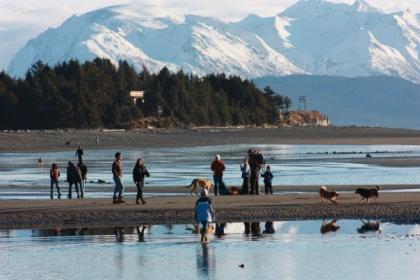
Bishops Beach. (KBBI file photo)

“So it’s hard to give a real exact number of the normal number. I would say on a given stretch of beach we normally don’t find more than one within a couple of miles stretch.”

Slater says there are a lot of potential reasons for the increase in fatalities but the prevailing cause is likely tied to the birds’ food sources.

“What we’re seeing more precisely is that birds seem to be starving. That’s sort of the ultimate cause of their deaths but something might be happening before that. We might be having a PSP (Paralytic Shellfish Poisoning) outbreak or another situation called domoic acid where these biotoxins can build up through the food chain and ultimately cause the deaths of these birds.”

These deaths don’t seem to be isolated to Homer’s beaches. There are reports of similar deaths down the Alaska Peninsula and the eastern edge of the Aleutians. Slater says it’s possible they could be related to dead whales found near Kodiak. To narrow down causes of death Slater says the refuge will send carcasses of Homer’s birds to the National Wildlife Health Center in Madison, Wisconsin.

“There they have a whole team of expert epidemiologists and other wildlife disease specialists who will be able to examine them and probably come up with a real good conclusion.”

Slater expects the center to receive the carcasses by the end of this week and believes there could be a reply within two weeks. She asks that people continue to call in dead birds with the species name and specific directions to the bodies’ location. She warns the public not to touch dead birds because they could be carrying disease.


Former NICU parent helps other families navigate a stressful time

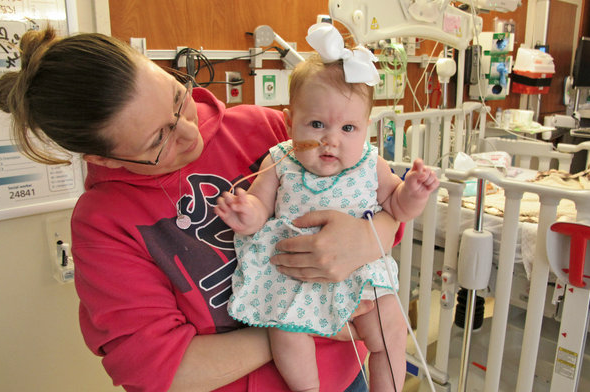
Emily Bressler spent 127 days in the NICU at the Children's Hospital at Providence. Her mom liz stayed in her room the whole time. (Photo by ANnie Feidt/APRN)
Emily Bressler spent 127 days in the NICU at the Children’s Hospital at Providence. Her mom liz stayed in her room the whole time. (Photo by ANnie Feidt/APRN)

Most people working in a Newborn Intensive Care Unit have some type of advanced medical degree. But one employee at The Children’s Hospital at Providence in Anchorage has a very different set of qualifications. Ginny Shaffer spent more than three months in the NICU as a parent, with her daughter who was born at 23 weeks. Now she helps other parents through one of the most stressful times of their lives as a Parent Navigator.

A mini chalk board outside Emily Bressler’s NICU room playfully charts her ‘escape attempts’ from the hospital. Her mom Liz says she’s come close to going home at least a dozen times in the last four months.

“Someone would come into the room and they’d say well you could be outta here in two weeks, she’s doing good right now,” Bressler says. “And then at the end of two weeks, something would happen, I called them her medical temper tantrums and it was just enough to keep her here.”

Emily had her first medical temper tantrum the day after she was born- a hearty eight pounds, one ounce- in Fairbanks. She started vomiting, couldn’t poop and was medevaced to the Providence NICU in Anchorage. Emily was diagnosed with Hirschsprung’s Disease, which affects the colon. She needed surgery- three in all- to be able to pass stool.

Bressler’s husband had to stay home in Fairbanks, caring for the couple’s three other young kids.

“I kind off keep my sanity by cracking jokes. And we make the best signs,” Bressler says. “Emily has one that says ‘kiss my little red wagon’, and ‘if you wake me, you take me.’ And it’s great to have that lightness.”

The other half of that ‘we’ Bressler is talking about is NICU Parent Navigator Ginny Shaffer.

“If I can make her smile with a sign, then we’re going to make as many signs as possible,” Shaffer says.

Shaffer has also helped Bressler find a spot for her espresso machine, a vital piece of equipment when your home is a hospital room. And then there’s the tougher stuff. Shaffer is someone Bressler can talk to when Emily has surgery or a setback. She also helps Bressler advocate for Emily’s unique care needs with doctors.

Shaffer says every family needs help in different ways.

“I want to walk into a room and I want somebody to see that there’s somebody that’s going to help them and it’s just their needs I’m looking to support,” Shaffer says.

Ten years ago, Shaffer was the one who needed support. She was 23 weeks pregnant with twins- a boy and a girl, when she felt funny and went to the hospital. Her tiny babies (both weighed less than 1.5 pounds) were born five hours later. Her son Bryson experienced seizures, brain bleeds and problems with internal organs. When he was 45 days old, Shaffer and her husband made the difficult decision to remove life support.

The day after Bryson died, a nurse suggested a first bath for their daughter, Holland.

“And they got out this little bitty pink hospital basin, this little tub that was too big for her and this heat lamp and we got this really great photo,” Shaffer remembers. “The nurse said, ‘how many people does it take to give a two pound baby a bath?’ And we’re all smiling- ‘five!’ And that was a really pivotal moment in our life because I didn’t really know how to go forward.”

Holland spent 99 days in the NICU. After that experience, Shaffer was glad to be home, but she missed the daily connections with hospital staff and other NICU families. When Holland was two years old, the NICU Parent Navigator job opened up and it seemed like a natural fit for Shaffer, even though her background is in real estate, not healthcare.

Eight years later, Shaffer’s office- with huge glass windows, is the first thing you see walking into the unit. It’s filled with stuffed animals, infant clothes and a bowl of chocolate to entice parents to sit down and talk. Shaffer also works to get families connecting with each other:

“We try and get creative with some of our offerings,” Shaffer says. “We’ve done National Fried Chicken Day- a quirky celebration, but it kind of creates a giggle and then people are curious, ‘the NICU’s celebrating National Fried Chicken Day? Let’s go see what it’s about.’ And connections are made.”

Another piece of Shaffer’s job is advocating for families with hospital administrators. She helped design the new NICU that opened two years ago to be as parent- and baby- friendly as possible. Right now, she’s pushing for a more relaxed visitors policy. No visitors are allowed at shift change, when confidential information is exchanged. It’s a holdover from the days when the unit was open, with no private rooms.

“If my neighbor is here and she’s my best friend and she can help me or get me a tissue or a drink, then why not let her stay? You can shut my door and give me some privacy and then I won’t overhear the confidential exchange of information that happens at shift change,” Shaffer says.

But one of best job perks for Shaffer is celebrating family milestones. And a recent day brings a big one. A parade of doctors and nurse are stopping by Emily Bressler’s room to say goodbye and take pictures. After 127 days in the NICU, she is finally making her escape.

Bressler is thrilled to be going home to her husband and kids, but sad too- to say goodbye to the support network of Shaffer and all the NICU staff. She says it’s a little like trading one family for another.


Prominent anti-Pebble activist among four charged with stealing oysters from Kachemak Bay farm

The fourth and final person charged with stealing oysters from a farm on the south side of Kachemak Bay has been identified.

Alaska State Troopers have identified Homer resident Anders Gustafson as one of the four people charged with criminal trespass in the first degree and fourth degree theft. Gustafon is the executive director of the Renewable Resources Coalition, which is financially supported by Alaska millionaire Bob Gillam, who is a leading opponent to development of the Pebble Mine. RRC helped lead the ballot initiative known as “Bristol Bay Forever” that was adopted at the polls last November.

The other three have been identified as Homer Deputy Harbor Master Matt Clarke, his wife Rebecca Clarke, and local resident Christine Kulcheski.

Troopers received a call from an oyster grower in Jakolof Cove on July 13. The grower had reportedly pulled up nets and found product missing. A review of recent security footage led to the identification of the four individuals, who were seen on the property on Fourth of July.

Troopers say they then contacted Kulcheski, Gustafson and both Clarkes, who cooperated with the investigation.

The number of oysters and their monetary value have not been disclosed yet.

Site notifications
Update notification options
Subscribe to notifications