Southcentral

Blue Crest energy expands operations in Cook Inlet

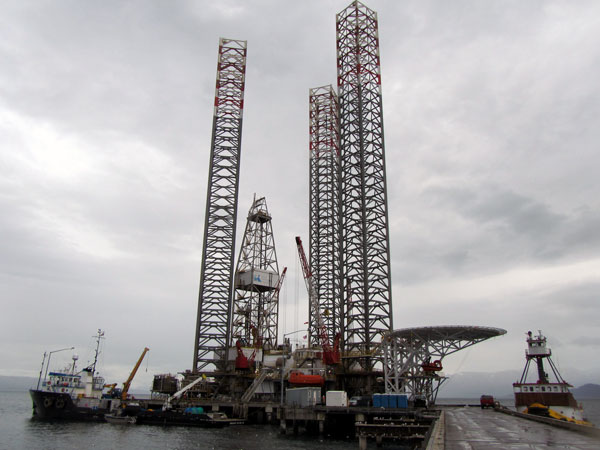
The Buccaneer jackup rig drills for oil and gas just north of Anchor Point, in Cook Inlet, Alaska. (Photo by Bill Smith)

A relative newcomer to Cook Inlet’s oil and gas scene is charging ahead with big development plans, which could equate to oil production at 17,000 barrels a day, and the creation of more than 400 jobs.

In the Cosmopolitan Unit off Anchor Point, it appears that the sixth time’s the charm. BlueCrest Energy is full-speed ahead with an ambitious development plan on its enticing prospects at the site.

Larry Burgess, health, safety and environmental manager for the relatively new independent on the Cook Inlet oil and gas scene, said at a Kenai Chamber of Commerce presentation Wednesday that first oil is expected by second quarter of next year.

“Probably sometimes in April of next year, which is very aggressive since there are no buildings on the site or anything right now other than some gravel and some piles that we’re driving right now,” Burgess said.

BlueCrest is the sixth producer to attempt to make good on the Cosmo Unit’s promise, following Pennzoil, which discovered the field in the 1960s, ARCO Alaska, which became Phillips, and then ConocoPhillips, Pioneer Natural Resources Alaska and Apache Corporation. BlueCrest and a partner acquired two leases from Pioneer, and BlueCrest picked up three more from Apache in 2013.

And that partner?

“Now, I’m going to mention the partner, but I don’t want anybody to throw anything at me,” Burgess said. “That partner was Buccaneer.”

Following its financial troubles, Buccaneer sold its 25 percent share in the project, making BlueCrest the 100 percent owner. But before its financial implosion and withdrawal from Cook Inlet, Buccaneer drilled a delineation well at the Cosmo Unit that proved quite promising.

“That single well that they drilled through the heart of the formation discovered several different pay zones of which was not known about before,” Burgess said.

The small, privately held, Fort Worth, Texas-based company formed in 2006, and once it became full owner of the Cosmopolitan leases it quickly established an Anchorage office and got to work devising a plan to develop oil reserves found at Cosmo, while also exploring possibilities for the shallower natural gas finds sitting on top of the oil.

“We’ve so far spent well over $100 million, we’re at about $112 million right now on the Cosmo project, with much more to go,” Burgess said.

A 38-acre gravel pad has been constructed about six miles north of Anchor Point, at Mile 151 of the Sterling Highway. BlueCrest would like to drill at least one more delineation well to determine the extent of the reservoir next summer with a jack-up rig. Meanwhile, an onshore drilling rig is under construction in Houston, Texas, and will likely arrive via barge by September or October.

“We’ll drill down and then out, and we’re going to drill out about 2.5 miles offshore, at a total vertical depth of around 7,500 feet,” Burgess said. “Total well length can be up to 25,000 feet, which requires a fairly significantly sized rig onshore to drill. And these are not easy wells to drill, either. They’re about $30 million apiece.”

The potential production at maximum is estimated at 17,000 barrels of oil per day, with the drilling phase lasting five years. The plan is to truck the oil from Anchor Point to the Tesoro refinery in Nikiski, at least for the first couple of years while other options are considered. At peak production, that could mean a truck leaving Anchor Point every 45 minutes to an hour.

The construction phase is ramping up now and is expected to employ 200 people through at least next March or April. The drilling phase will see 80 shift workers on site at any one time — so, 160 jobs there. The operations phase, with the expected life of the field stretching 30 years to about 2046, will employ as many as 70 people.

“So there will be some good employment during the rest of that timeframe and some good short-term employment for local,” Burgess said.

A preliminary project design to extract natural gas has been developed but isn’t being actively pursued by BlueCrest at this point. Still, the plan would be to drill for the gas from two offshore, monopod platforms because the gas zones are too shallow to drill from shore. BlueCrest estimates being able to produce 60 to 70 million cubic feet of gas per day.

But what to do with the gas is the challenge. BlueCrest is discussing a partnership with WesPac Midstream LLC, which is exploring an LNG project to supply communities in Interior Alaska that currently only have diesel fuel.

Transporting the gas is the biggest hurdle. The natural gas distribution system can’t currently accommodate the volume of gas BlueCrest could produce.

“Right now they can accept around 30 million cubic feet a day from us, but Enstar is not the only owner of the pipeline distribution system and there are some constraints to go over that that we would have to overcome,” Burgess said. “BlueCrest would be responsible for putting in compression, probably.”

For now, BlueCrest is plenty busy focusing primarily on Cosmo’s oil.

State concerned about costs as Anchorage hospitals vie for more ER beds

Entrance to Anchorage’s Providence Hospital emergency room. (Photo by Josh Edge/APRN)

State Health Commissioner Valerie Davidson is granting Providence Hospital in Anchorage permission to build eight new emergency room beds. The decision also denies Alaska Regional’s plan to build the first freestanding emergency rooms in the state. The commissioner hopes the decision will help discourage inappropriate use of an expensive healthcare option.

Providence Hospital had hoped to build 14 new emergency rooms at its Anchorage facility, designed mostly for pediatric patients. Commissioner Davidson agreed to about half that number.

Jared Kosin is executive director of the state office of rate review. He says allowing eight new emergency rooms in Anchorage will meet the current need, but not exceed it.

“There’s obviously a need. We can’t move forward with nothing, and Providence shows with its trend numbers and data that they have need for eight additional rooms right off the bat.”

In Alaska, hospitals need approval from the state to build big new projects. The idea is to prevent hospitals from building too many facilities and then passing the cost onto consumers. Kosin’s office concluded Anchorage could support 13 new emergency rooms between now and 2022 but then recommended Davidson approve only 10 new rooms for Providence.

The state’s health department is working hard to reduce emergency room visits, and the costs that go along with them. Kosin says the commissioner decided adding any extra capacity would work against that goal.

“Emergency room visits are expensive,” Kosin says. “A lot of the cases that present can be handled in a less expensive, appropriate setting like an urgent care clinic or a primary care office. So the idea that we want to anticipate growth for emergency room services … we’d rather try our efforts at reform and try to curb that growth.”

Alaska Regional Hospital wanted to build two freestanding emergency rooms in South Anchorage and Eagle River. The hospital argued all of the city’s emergency rooms are currently concentrated in a two-mile area and it made sense to expand access to other parts of the city.

But freestanding ERs have been criticized for driving up health care costs by increasing inappropriate emergency room use, and Kosin says that was a big factor in the decision.

“Does it make sense to have a freestanding entity create access to emergency room services? And for the emergency services that do walk through the door, they may not be equipped to meet that demand,” Kosin says. “So does it make sense to create this access point? And I think … it really doesn’t.”

Alaska Regional CEO Julie Taylor is disappointed with the state’s action. She thinks the health department focused too much on markets where freestanding emergency rooms aren’t successful, instead of paying attention to areas where they work well. Taylor says during the public comment period, the hospital had a lot of support from community members in outlying areas of Anchorage.

“Eagle River in particular was very vocal and especially when you look at the distance involved between their community and ours and the Glen Highway, the challenges that come with that when there are accidents and weather hazards, it really is a safety issue for patients and to have access in their own community I think is very important.”

The hospitals have 30 days to appeal the decision and both Regional and Providence are considering that option, although Providence Alaska Chief Executive Dr. Dick Mandsager says he is generally happy with the state’s action. He says it’s too early to say how the hospital will revise its expansion plan to account for adding eight new rooms instead of 14.

Providence says it will take about a year and a half to open its new emergency rooms.


Willow residents outraged over Sockeye Fire’s reckless ignition

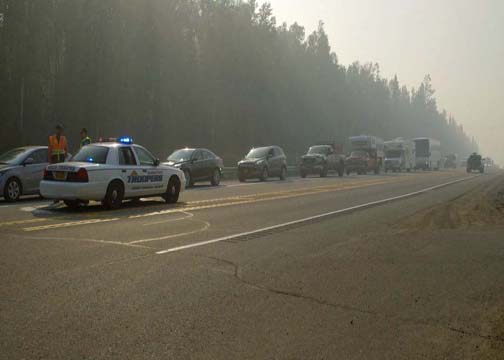
Troopers stop traffic on the Parks Highway as part of traffic control during the Sockeye Fire. (Photo by John Norris - Alaska Public Media)
Troopers stop traffic on the Parks Highway as part of traffic control during the Sockeye Fire. (Photo by John Norris – Alaska Public Media)

News that the Sockeye Fire was caused by negligence on the part of two Anchorage residents has hit the Willow community hard. Anecdotal evidence pinned the Sockeye Fire on fireworks, but now that it is known that an unattended, illegal burn pile sparked the blaze, many Willow residents are outraged.

Mahlon Greene is the Willow fire service area chief. He says the first crews on scene were there within five minutes of the call to find a fire spotting ahead of itself and spreading rapidly. He said no one in its path could survive a fire like that.

“The major concern at that point is to evacuate the area, get everybody out, and call in extra resources,” Greene says.

“We had 90 degree temperatures and it was just super dry. Once that fire gets up into the trees and starts moving, it kind of creates its own weather, it causes the wind behind it, and it just spreads so rapidly, to try to get in front of something like that, it doesn’t really matter how many fire trucks you have on scene, or how much water, you’d never want to get in front of a fire like that.”

Anchorage residents Greg Imig and Amy Dewitt have been charged with multiple misdemeanors in the case. A burn pile on Imig’s Willow property sparked the wildfire that drove residents from their homes and eventually destroyed 55 houses.

Vern Halter, who represents the Willow area on the Matanuska-Susitna Borough Assembly, says finding the exact cause of the fire is important.

“To me it’s really important, because in the Miller’s Reach fire 19 years ago there was speculation on what caused the fire … so I’m just glad they did the investigation,” Halter says.

The cost of fire suppression alone tops $8 million dollars, according to the state Division of Forestry, and if convicted, Imig and Dewitt could be required to pay back twice that amount. But the costs to the borough have not been tallied yet, according to borough spokesperson Patty Sullivan.

Nickolas Spiropolous, Mat-Su Borough attorney, says he cannot comment on any legal action the borough may be considering.

Imig and Dewitt have been charged with one count of criminally negligent burning and three counts of reckless endangerment. Those are Class A misdemeanors, which are punishable by up to one year in jail and a $10,000 fine. Four additional misdemeanor counts have been charged related to their lack of burn permits. Arraignment for Imig and DeWitt is scheduled for July 28 in Palmer. Phone messages left for Greg Imig were not answered.

Assemblyman Halter says people who got burned out have the option of asking for a tax reassessment from the borough. Halter says the criminal element of the fire is out of the borough’s hands

“All the charges and all the court procedure are going through the State of Alaska … There’s due process requirements attached to the defendants, so that’s just something you have to let go it’s course, and try not to pre-judge too much,” Halter says.

For the Willow fire service area, it may be a while before things get back to normal, according to fire chief Greene.

“We’re out there catching hot spots every day. This fire took a month out of our lives and we are still on it.”

Greene says a wildland fire the size of the Sockeye Fire taxes a small fire service area, and takes resources away from duties that need to be taken care of in the summer months.

State sides with Providence in competition to build new ER beds

State Health Commissioner Valerie Davidson is granting Providence Hospital in Anchorage permission to build eight new emergency room beds. That’s fewer than the hospital was hoping for. Providence submitted plans to build 14 new rooms, 10 that would have focused on pediatric patients.

Commissioner Davidson denied Alaska’s Regional Hospital’s proposal to build two freestanding emergency rooms in South Anchorage and Eagle River. They would have been the first freestanding ERs in the state.

In Alaska, hospitals need approval from the state to build big new projects. The idea is to prevent hospitals from building too many facilities and then passing the cost onto consumers. The state had decided Anchorage could support 13 new emergency room beds between now and 2022.

This story is part of a reporting partnership between APRN, NPR and Kaiser Health News.


State says Sockeye fire sprung from burn pile, 2 face charges

Troopers stop traffic on the Parks Highway Monday morning as the Sockeye Fire spreads. (Photo by John Norris/ Alaska Public Media)

On Monday, the State of Alaska filed charges against two Anchorage residents for starting the debris burn that turned into the 7,200-acre Sockeye Fire. The fire destroyed fifty-five homes and damaged forty-four other structures, according to the state.

In a press release issued Monday afternoon, Division of Forestry spokesman Tim Mowry says that charges were filed against 59-year-old Greg Imig and 42-year-old Amy Dewitt. Charges include three counts of reckless endangerment, negligent burning, failure to obtain a burn permit, not clearing the burn area, and, ultimately, allowing the fire to spread unattended.

The Division of Forestry and Alaska Fire Marshal’s office say that Imig and Dewitt were burning debris on the evening of June 13th near their cabin at mile 77 of the Parks Highway. The state claims that the fires were left unattended, and one continued to smolder, igniting the nearby forest the next day.

The charges facing Imig and Dewitt are all misdemeanors, four of which carry maximum penalties of $10,000 and a year in jail, each. Forestry spokesman Tim Mowry says that individuals responsible for starting a wildfire can be held accountable for two-times the cost of fighting the fire. The state’s latest estimate on the cost of suppressing the Sockeye Fire is $8 million.

Clients say bullying is a problem at Anchorage homeless shelter

Clients of the Brother Francis Shelter in Anchorage are agitating for change. They are frustrated with the way they are being treated at the shelter and with some of the policies. Catholic Social Services, which runs the shelter, is trying to work with them to improve the situation.

Celia Harrison started staying at Brother Francis back in March, when she felt like she could no longer safely stay in her housing in Soldotna. Since then, the former nurse has been writing about her experiences extensively on Facebook. Her posts include positive things, like small kindnesses, and detailed stories of staff being loud in the middle of the night or her belongings being soaked by flooding in the shower room.

“For a very long period of time, I would write at least one incident report every day about things that went on,” she said. “Things that the staff were doing and other problems.”

Mats laid out at the Brother Francis Shelter in Anchorage. (Image courtesy of Catholic Social Services)

Harrison says her complaints made a difference: people are no longer allowed to bring food into the sleeping areas and mats are laid out to give people more space. But Harrison says one thing has not improved. She says some staff members at the Brother Francis Shelter bully the clients.

“I’ve even witnessed them setting people up to get a reaction so that they can use that reaction to throw people out. And it’s not all of the staff. It’s the bullies.”

Harrison lists incidents of individuals being accused of drinking when they haven’t and others being given special privileges. She is not alone in her concerns. Mari Burt and a half a dozen other individuals who use the facility started discussing the problems weeks ago. Burt says they tried to contact Catholic Social Services staff and received some follow up, but not enough.

CSS Executive Director Lisa Aquino says the organization takes every complaint seriously. They log them and try to respond to them as best they can.

“We never want our clients to feel bullied, period,” she states. “When we have heard complaints about bullying or about questioning actions that our staff take, we always follow up on that. We always address that if it’s with a specific staff person, our management addresses that with them. And we also talk about the larger issues as a group and as a staff.”

Aquino says in the past they have terminated staff members if they are not a good fit for the program. But the director says the staff is working with a very diverse population with different mental and physical health needs. In the shelter, they have to find a balance of respect and safety for the 240 people who sleep there every night.

“We face the challenge of trying to support all of our guests at the Brother Francis Shelter and treat them with dignity and respect, and to provide them with the individual care that they need as a person while at the same time thinking of the overall health and well-being of all of the clients at the shelter.”

To help do that, they train staff about the culture of poverty, mental health issues, trauma informed care, and de-escalating conflicts. But Aquino says with fiscal, legal, and social constraints, they can’t monitor all areas at all times.

Mari Burt says she has sent Aquino an email on Wednesday requesting a community dialogue at the shelter about the guests’ experiences with bullying. If it does not happen, they’ll hold a public protest. Burt and Harrison have already contact the mayor’s office.

Site notifications
Update notification options
Subscribe to notifications