Southcentral

Cleaning Alaska’s remote beaches, one piece of debris at a time

“Super-sacks” await pickup on Montague Island. (Photo by Hanna Craig/Alaska Public Media)

Big, white plastic bags called “super-sacks” line a beach on Montague Island in Prince William Sound. The sacks are filled with marine debris like fishing nets, water bottles and Styrofoam. This summer, the team from Gulf of Alaska Keeper has spent 50 days on Montague so far collecting the debris, as part of a multi-year effort.

The trash that accumulates on the shoreline of Montague Island, from one day to another, is only the tip of the iceberg. There’s more where it came from, and it will keep coming back. It has been like this for decades.

“What you see on the beach is a fraction of what’s out there. Either being it floating on the surface or sunk on the bottom of the water,” Ryan Pallister says. Pallister has spent 10 years working for a nonprofit: Gulf of Alaska Keeper.

A helicopter lands on Montague Island in Prince William Sound. (Photo by Hanna Craig/Alaska Public Media)

The “goAK” crew goes all the way down the shorelines of Southcentral Alaska, from Kodiak to Kayak Island. Pallister says the weather can be extreme. The team also has to keep a close watch for brown bears. And then there’s the challenge of the work itself.

“Basically, it comes down to human muscle; I mean, we use chainsaws and knives… And the heli, of course; now that we have the heli we can use the heli to pull, and lift, and…but yeah, it comes down to men hour.”

The 10-person-crew receives help from volunteers like Hanako Yokota, who works with the Japan Environmental Action Network. Yokota has a very special duty: recognizing the marine debris from Japan that may be from the 2011 tsunami that swept millions of tons of debris into the ocean. She points at the mass of trash next to her:

“With this, I can never say that it is from Japan. I mean, it is from Japan, but I can never say if it is from the tsunami, because it doesn’t really state it is from the tsunami.”

However, Yokota can read Japanese and she’s able to recognize the logos and names some fishermen write on their buoys to distinguish them. Although she now lives in Vancouver, when Yokota visits Japan fishermen ask her to bring their buoys back, if she finds them.

“It will be very interesting if I actually get to take something back and return it.”

The marine debris that ends up in the beaches of Montague comes from remote places such as Japan, but also from Russia, China, Korea, Vietnam and Malaysia, Yokota says.

“It doesn’t really matter where it comes from; we’ll just have to clean it up.”

“The more we collect and the more we remove, the more gets off this island and gets recycled.”

Crewmember Scott Groves is standing next to a few super-sacks of trash and he seems satisfied: they have reached their goal of around 20 to 25 super-sacks a day. He writes the numbers down in his notebook.

“As far as numbers are concern, you kind of forget how much you actually do out here. It’s like every day you still get your mind blown by how much garbage is actually on these beaches.”

Ryan Pallister says that after a decade cleaning this coast, he’s still surprised by the amount of marine debris.

“Out there, is dirty forever. And almost it’s hard to finish it in my lifetime but…more people would help, more resources.”

So why keep coming back to clean something that will be dirty tomorrow? Pallister has a simple answer:

“If your neighbors are throwing trash in your yard, just clean it up or say something to them … it’s kind of the same situation.”

Pallister believes a change in people’s behavior is needed to stop the contamination problem, but he’s not very optimistic about it. In the meantime, the helicopter will come down soon to collect the bags of trash and sling them onto a barge.

Governor, delegation rally to stymie JBER cuts

The reduction of 2,600 soldiers from Joint Base Elmendorf-Richardson isn’t expected to begin for more than a year; Alaska officials hope that will be enough time to stop it, or at least mitigate the loss. Gov. Bill Walker Thursday pledged a campaign to retain Alaska’s military forces and attract new ones.

U.S. Sen. Dan Sullivan raised the issue at a confirmation hearing Thursday for the nation’s top military officer, the chairman of the Joint Chiefs of Staff. Sullivan told the nominee, Marine Gen. Joseph Dunford, the Pentagon still has to write a military strategy for the Arctic.

“Does it make sense to cut any of America’s limited number of cold-weather trained warriors in the Arctic before this congressionally mandated strategy is completed?” Sullivan asked.

Dunford said he’d look into it.

“And the commitment I’d make to you is we will in fact develop an appropriate role for the military in support for our economic and political interests in the Arctic,” Dunford said.

Sullivan said this week he is blocking the confirmation of one assistant defense secretary until he gets answers from the Army about the troop cuts. Sullivan, though, said yesterday he’d support the joint chief’s nominee.

On a mission in Australia, JBER soldiers receive news of cuts from family, social media

Members of the 4/25th Airborne Brigade of JBER load up on a C-130 during exercise Talisman-Saber. (Photo by Zachariah Hughes/KSKA)

The Army will be cutting thousands of positions from Joint Base Elmendorf-Richardson, with the majority expected to come from the 4/25th Airborne Brigade. This week hundreds of troops from that unit are in Australia on a training mission. Many of the soldiers heard about the cuts  for the first time from family or on social media.

Specialist Jesse Reed hasn’t really been keeping up with the news. After 19 hours of flying from JBER, he jumped into a remote corner of eastern Australia near Shoalwater Bay as part of joint exercise Talisman Saber, a training mission. After spending the night in a field next to an airstrip — he learned about the cuts Thursday afternoon.

“Just got a text message from my friend leading me to a news article talking about the cuts for U.S. Army Alaska.”

Reed’s been at JBER for two-and-a-half years, and though disappointed, he says this isn’t the end of the world for him.

“Not out of a job tomorrow. Finish out my time here, do my re-enlistment, then go wherever I choose to go or the Army sends me.”

By the time all 2,631 positions are cut 2017 the brigade will be left with just under 1,000 personnel — too few for a full combat brigade. But according to Captain Chase Spears, a veteran of 4/25 assigned to US Army Alaska, the reduction won’t happen overnight.

Members of the 4-25th Airborne Brigade congregate under a rainbow during exercise Talisman Saber. (Photo by Zachariah Hughes/KSKA)

“No one is showing up and being told ‘hey your position has gone away.’ It doesn’t work that way.”

In a drawdown, the Army tries to eliminate positions through attrition — leaving slots unfilled after soldiers move on to new postings. But some soldiers will likely have to be let go through what are called “involuntary separations,” to hit target goals over the next two years. By then, according to a Pentagon press conference Thursday, the brigade will be reconfigured as a battalion-sized task force. They’ll still be the only Army unit that’s able to do airborne operations in the Arctic, along with partner missions in the Pacific like Talisman Saber. But not at the level they’re currently able to do.

Even with some unknowns, the cuts will hurt soldiers who have put down roots in Alaska and can’t easily head on to a new posting, like Sergeant First Class Frank Petitta, who heard the news in the gym. When Petitta moved from North Carolina with his family, they saw appreciating home values and a community filled with military retirees in Wasilla.

“I wanted my family and my kids to enjoy Alaska, and I think that’s best done off-post, and so we decided to buy a house.”

According to the Army’s studies on economic impacts, a cut this size means a drop of $358 million from Anchorage’s economy — $182 million in loss of sales, $176 million income loss, according to Lt. Col Alan Brown of U.S. Army Alaska. Part of that loss is salaries going away for soldiers like Petitta who are further along in their careers and more likely to own property.

“The guys that have the equivalent rank of myself, that I would say the vast majority own houses—and I’m talking 70, 80 percent easy.”

One such guy is sitting a few feet away, Staff Sergeant Josh Schneiderman, who moved to Eagle River specifically for the good schools.

“We’re extremely worried, especially now. I mean, I’m very close to retirement and this drives a lot of things — because the ultimate goal for us was to move to Alaska and retire. And now with the close down it’s going to affect our decisions drastically.”

Now that worries from the last few months over whether or not cuts would come to JBER have been answered, Schneiderman says there’s a whole new set of concerns once he gets back to Alaska.

“I’m going to go home now and my wife’s probably going to inform me of the closure that everybody’s aware of. However — what am I supposed to tell her? That we’ll figure it out? I mean it’s hard, because you don’t know who’s going and you don’t know who’s staying.”

But before anything else, this airborne battalion from the 4/25th has one more day in Australia, a 19-hour plane ride, and another parachute jump back onto base.

Army to cut 2,600 troops from Anchorage base

The Army said Wednesday it plans to cut 2,600 troops from Joint Base Elmendorf-Richardson in Anchorage and another 75 soldiers from Fort Wainwright in Fairbanks. That would still leave JBER with more than 9,000 service members but it slices two-thirds of the personnel from the 4/25th, the only airborne brigade in the Pacific.

Alaska’s U.S. senators got the news Wednesday morning from the Army’s vice chief of staff. Sen. Lisa Murkowski vowed to fight it.

“This is a decision that was made by the Pentagon that needs to be reversed by this president, needs to be reversed by the Secretary of Defense,” she said. “And we’re going to work to educate folks as to why it should be reversed.”

Alaska’s congressional delegation, at multiple hearings, has pressed Pentagon officials to acknowledge Alaska’s strategic location on the globe and the importance of having troops who are Arctic-ready. Murkowski says Army’s decision doesn’t just harm the local economy.

“This is bad from a national security perspective,” she said. “This president made that decision that he was going to reduce force strength. And I think it was done at a time when the world was not as volatile as it is now.”

Sen. Dan Sullivan says the decision hurts American credibility overseas and damages the Army’s ability to operate in the Arctic.

You cannot take troops anywhere – Marines, Army — and put them in the Arctic and say ‘Operate.’ You have to have a culture. You have to have years of training. We have that and we’re removing it,” Sullivan said. “The only guy who’s going to be happy about this decision right now is Vladimir Putin and maybe Kim Jung Il — or Jung Un in North Korea.”

The reductions are part of the Army’s effort to reduce its force by 40,000 troops. The Army also announced Wednesday it’s downsizing in Georgia and Hawaii.

Sullivan says the Army should cut fat from the budget, not personnel.

“There are other ways, and I’m going to start probing,” he said, “whether it’s bloated headquarters, whether it’s missions that seem to be redundant of other services, like the Army’s Pacific Pathways mission, which looks an awful lot like the Marine Corp’s mission.”

Sullivan says he’s put a hold on a Pentagon confirmation until he gets more information from the Army. If there’s a silver lining, Sullivan says it’s that part of the brigade will stay.

“The entire unit’s not being removed. There’s still going to be, you know, it’s going to be removed by two-thirds,” he said. “But there’s still going to be that capability to be able to build on if we get to what the Army sees as funding levels (where) it can rebuild what is a very strategic force.”

Joint Chiefs Chairman Martin Dempsey said at a hearing this week the troop cuts have to come from somewhere. Dempsey blamed Congress and its budget cuts.

“I will tell you this, senator,” Dempsey said, after listening to Sullivan make the case for keeping the JBER unit. “We’re used to the Congress telling us ‘no’ on the reforms that we’re making, not because we’re trying to cut ourselves apart, but because we’ve got a trillion dollars … less in budget authority over 10 years. We’ve said from the beginning, it’s a disaster.”

Murkowski says the Alaska personnel cuts won’t begin for another 18 months. She says she was told the Army hopes the reductions can come mostly from attrition, but the senator says that doesn’t seem realistic.

Study: Ocean acidification threatens future of Alaskan shellfish hatcheries

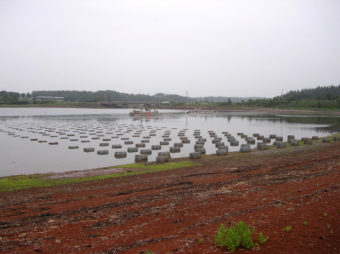
Alutiiq Pride Shellfish Hatchery in Seward. (Photo courtesy of Wiley Evans/NOAA)

New research paints an unsettling picture of the future of shellfish in coastal Alaska. The effects of ocean acidification are worsening and could mean the end of hatcheries in the next 25 years if costly mitigation efforts aren’t put in place.

2040: that’s the date put forward by researchers in the ongoing study.

“It is dire,” says Wiley Evans, research associate at the NOAA Pacific Marine Environment Lab in Seattle and the University of Alaska Fairbanks Ocean Acidification Research Center.

He led the project, based at the Alutiiq Pride Hatchery on the Kenai Peninsula. Right now, the hatchery has only a 5-month window where ocean conditions are right for production.

“You know, I have young children and when I’m talking to the public about this, I typically will say that my kids are going to be graduating college when this optimal growth window potentially closes for the Alutiiq Pride Shellfish Hatchery,” says Evans.

“It was very, very alarming. Not knowing much about ocean chemistry, I know a lot more now than when we started, that’s for sure,” says Jeff Hetrick, owner of Alutiiq Pride, which is situated at the head of Resurrection Bay in Seward. “Right now we have blue and red king crab, roughly 6 million sea cucumbers, 2 million cockles, 7 million little neck clams, 100,000 butter clams, roughly 300,000 purple-hinge rock scallops, abalone as well, and we have oysters and geoducks, too.”

It’s currently the only full-time commercial shellfish hatchery in the state, with on-site personnel, which made it a logical choice for data collection.

“We had the opportunity last year to install a state-of-the-art system that could monitor the water chemistry of the seawater that they were pumping in to the hatchery on a continuous basis and it would report out to us in what we call real-time,” says Jeremy Mathis, a NOAA oceanographer who helped choose the site.

Ocean acidification is the name for certain changes in the ocean’s chemistry due to higher levels of carbon dioxide. When seawater absorbs CO2, there’s an increase in hydrogen ions, leading to more acidic water, and lower levels of carbonate ions.

Carbonate ions are crucial for organisms like clams and mussels to develop hard shells. And, without shells, they aren’t protected and can’t survive.

Mathis says Resurrection Bay is in a particularly vulnerable position because of certain environmental factors.

“It gets a lot of freshwater input from not only the streams and little freshwater runoffs that come through there but also quite a bit of meltwater from glaciers. And that unique water chemistry can actually exacerbate or worsen the ocean acidification effect,” says Mathis.

Cold water, which is quicker to absorb CO2, combined with the presence CO2-rich glacial melt put Alaska as a whole at particular risk. Evans says those factors are natural and it’s a delicate balance. But as for the levels we’re seeing here now-

“It’s not natural and it’s a large problem,” says Evans.

Humans and their carbon footprint have added serious amounts of CO2 to the atmosphere very quickly.

“And that little bit of additional carbon dioxide can just push the system past thresholds to where you can’t produce shellfish perhaps anymore without very serious mitigation strategies,” says Evans.

That’s what worries Hetrick when he thinks about the future and the 5-month production window at his hatchery that’s on track to close completely in 25 years.

“We don’t really know what the full costs are going to be. There’s going to be some. There’s going to be capital costs and there’s going to be some operational costs. It’s just going to be another thing we’re going to have to do to produce shellfish.”

Figuring out exactly what to do next is tricky but Mathis says Alaska has to put in the effort, immediately.

“Unfortunately, Alaska is the canary in the coal mine for ocean acidification. We’re seeing changes in water chemistry faster in Alaska than really any other place around the world. So, it’s our job now in the next few years to figure out what the magnitude and impact of those changes are going to be.”

And he says find a way to protect our fisheries before it’s too late.

Inspector General finds service to veterans lacking at Mat-Su VA clinic

The Inspector General for Veterans Affairs has verified a host of problems at the VA’s Mat-Su outpatient clinic.

The clinic opened in 2009, but since 2012 the VA has had trouble retaining physicians or other practitioners to fill the two provider slots at the clinic. The report released yesterday says the lack of providers left some patients unable to get timely appointments, resulting in poor quality of care.

Forty patients assigned to the Mat-Su clinic died in the year ending in mid-2014. The inspector general found eight of those patients did not receive adequate access to care.

Sen. Lisa Murkowski, who requested the report, called its findings “devastating and disappointing.”

The report says the situation has improved more recently. Since 2013, more than 1,000 VA patients have been seen at the Southcentral Foundation clinic in Wasilla, at the VA’s expense.

Site notifications
Update notification options
Subscribe to notifications