Southcentral

Alutiiq Museum named state’s first natural and cultural history repository

The Alutiiq Museum in Kodiak. (Photo courtesy of the Alutiiq Museum)

The Alutiiq Museum in the city of Kodiak preserves and exhibits many Alaska Native artifacts from the Kodiak Archipelago region and other areas, and now the State of Alaska’s Division of Libraries, Archives & Museums has designated it as the state’s first natural and cultural history repository.

Marnie Leist is the Curator of Collections at the Alutiiq Museum and says the recognition is especially significant because they’re the second nationally accredited tribal museum in the United States.

They play a part in keeping and protecting Native history.

“Almost 80 percent of our collections are on loan to the museum,” says Leist. “It is our responsibility to help care for other tribal organizations, federal state agencies, to care for the collections in perpetuity. And, because we have a dedicated, professional staff, maybe a 1,000 years from now those 7,000 year old artifacts are still around for future generations.”

She says that takes physical upkeep of the objects.

“I try to put things in micro climates if they’re sensitive to help preserve them. Large objects, we do dust them and we actually just had a great workshop with the conservators from the Peabody Museum of Archaeology and Ethnology from Boston come and teach us more about how to vacuum objects, like kayak frames and other types of skin objects,” says Leist.

Part of maintaining artifacts is making sure they can survive in their environment. Here’s a very Alaskan example.

“Right now, we’re doing a paper test, so in our long, sunny, bright summer days we have lots of light. Well, UV damages objects, so I created this little test really quickly and here in another couple of weeks, we’ll see how much the paper bleached out in just those few weeks,” says Leist.

Scott Carrlee is the Curator of Museum Services at the Alaska State Museum in Juneau and says granting the Alutiiq museum repository status was easy. He says that’s because it’s one of the seven institutions in the state accredited by the American Alliance of Museums.

“That means that they’ve been through a review process. A very rigorous review process,” says Carrlee. “What we are concerned about is this designation is really strictly the collection’s care, collection’s management portion of what the museum does, so the fact that the Alutiiq Museum is already accredited, that gave the committee a comfort level with designating them as a repository.”

Amy Steffian is the director of research and publication for the Alutiiq Museum and refers back to the year she first joined the staff.

“I’ve been with the museum since it opened in 1995 and I’ve seen the repository grow from a young organization learning professional practices, and to see us achieve both national and now state recognition for our practices is really lovely,” says Steffian.

The Alutiiq Museum’s collection holdings range from bone and ivory objects to photographs and historical documents.

The Museum will hold its annual Community Archaeology dig from July 13 to 31where volunteers from around Kodiak can work on an archaeology site to build that collection.


Youth start community talk about homelessness in Homer

Homeless in Homer event - (Photo by Shady Grove Oliver/KBBI)
Homeless in Homer event – (Photo by Shady Grove Oliver/KBBI)

Community members from across the Kenai Peninsula packed the Homer Theatre earlier this month for the Homeless in Homer film screening and discussion panel.

The Homeless in Homer forum was the first of its kind.

It was the brainchild of local participants in the statewide Lead On! Program, sponsored by the Alaska Network on Domestic Violence and Sexual Assault.

Lily Johnson was one of the evening’s emcees.

“So, we went to Lead On! in November which is this giant, big conference that youth and our adult chaperones go to,” said Johnson. “We learn from all these great people and we sit down and come up with an idea that we want to address in our community. And we decided we wanted to address homelessness and that is where Homeless in Homer was conceived.”

When they came back to Homer, the students made a film highlighting youth, teen and student homelessness and the resources available to them.

Representatives from the R.E.C. Room, Haven House, the police department, several formerly homeless youth and others comprised the discussion panel after the movie. They all agreed on a few points – this problem is huge, not much is being done about it and it’s time for change.

Jane Dunn is the Homer area liaison for the Students in Transition program through the school district. She covers all schools from Ninilchik south.

She says she handles cases for 31 unaccompanied youth, or students who are not living with their guardians. She has 68 students total. And district wide, there are 246 students who are recognized as being homeless.

“That doesn’t mean there aren’t a lot more. I know that there’s a lot more that are not receiving services who are scared to come to me because they’re afraid of a label or something or nobody’s noticed they need help.”

Audience members and panelists spent more than an hour hashing out the issues that contribute to the severity of this problem.

For example, many homeless youth don’t get help because they aren’t living on the streets. They move from place to place each night, crashing with friends or where they can, and aren’t automatically identified as homeless.

Also, right now, there aren’t any dependable shelters for homeless youth. That’s according to Krista Schooley, who works with The Habitation in Soldotna.

“After three days, there’s nowhere on the Kenai Peninsula for any teens to go.”

There are also a number of factors that don’t have to do with shelter. Area food pantries aren’t open seven days a week, so kids may not have access to after-hours food for most of the week.

The list goes on and on. And up until now, the whole issue hasn’t really been talked about much.

During the community panel, someone in the audience asked the speakers what is being done to address it.

The answer? This is it.

Doug Koester, with the R.E.C. Room, says this is an incredible first step. And it’s important not to lose momentum now.

“I know you guys are all so into this issue and we need to push on from here. So, we really ask you to give us your email so we can get together as a group and take the next step because obviously this is just the beginning of it. Let’s keep it going and we’d love to see you all again at our next thing or at least on email so we can keep this tribe strong and help with this issue.”

For now, the Lead On! students are working with the Rec Room to collect school supplies and donations to go to local kids in need.

But that’s just a patch. Each speaker reiterated that this is the kind of problem that won’t be solved overnight. It will take the whole community coming together to help those who need it most and fix the problem once and for all.

Soldotna lodge opens doors to fire victims for second year in a row

Hooligan’s Lodging and Saloon in Soldotna. (Photo courtesy of tripadvisor.com)

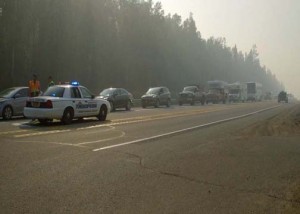
The Card Street fire near Sterling is diminishing and many evacuees are returning to their homes this week. Across the Central Peninsula, hotels and restaurants that helped with relief efforts are getting back to business as usual. But for one hotel in Soldotna, this isn’t the first time they’ve stepped up and the community now knows where to turn for help, year after year.

Hooligan’s Lodging and Saloon is an unassuming, vaguely frontier-themed hotel off the Sterling Highway in Soldotna.

Frances DeLisle is sitting in the middle of a puffy couch in the lobby. She’s tall and thin and is being leaned on by an enormous, panting, scruffy black dog.

“This guy here is my service dog. His name is Maximoose. He’s a labradoodle with a bad hair day,” says DeLisle.

Normally, you’d find DeLisle and Maximoose in their converted school bus house in Sterling.

But for the time being, she’s calling Hooligan’s home. She’s one of more than a dozen people who found shelter here after the Card Street fire evacuations began.

She says she got the notice at 2 am. She grabbed all of Moose’s toys and food and her own medications.

“It was funny because I was packing stuff up and throwing it out the backdoor of the bus and I couldn’t believe it, I was going ‘I gotta get my mom’s ashes’ and I just stopped for a minute and thought, ‘that’s ridiculous,’” says DeLisle. “Why do you get ashes to leave something that’s going to turn to ashes. But I just couldn’t leave her behind.”

She spent the first night at the emergency shelter at the Sterling Community Center. It was there that they heard about free rooms at Hooligan’s for evacuees.

“It was nice to know because I’m alone and that’s a scary feeling when something like this happens,” says DeLisle.

April Strand is the hotel manager. She’s been working here for almost 10 years and credits owner Molly Poland with the idea to open it up as an emergency shelter.

“She’s got a really big heart. I mean, I couldn’t ask for a better boss. She’s just got a really big heart,” says Strand. “She tries really hard to help everybody not just here but in our community. She’s awesome for the fact that if you look at all this woman does. She’s a home and hotel owner, raising a family, has a bar, has a restaurant, she supports motocross, her kids in their band. She does a lot of amazing things that I don’t think she gets enough credit for.”

Poland says she was raised to think of others.

“It’s such a blessing to me that I can help people when they need help,” says Poland.

Last year, she took in more than a hundred evacuees and put them up, free of charge, for days. She gave them meal vouchers for her restaurant and set up a collection point in her lobby for shampoo, deodorant, toothbrushes, books, kids’ toys, and pet food.

She makes it a point to welcome pets.

“And I get it, they’re your family. So, you can’t leave your family behind. You have to bring your family with you when you go,” says Poland.

That led to some unexpected situations last year, including a pregnant dog who birthed a litter the day after she arrived and a litter of kittens.

“Someone had a goat and I was like no, that’s where I draw the line. The goat can hang out outside your room but the goat’s not going inside your room,” says Poland.

And it wasn’t easy. She says there were some damages that came along with the animals. She had to replace some carpets, shampoo many others, and fix scratches on the walls.

This year, she lost quite a bit of potential income. Guests like DeLisle know what she’s giving up.

“This is peak season. She’s right here by the river. I mean, she could be making a lot of money off of our rooms and she’s letting us have them for free. And I think that’s just an amazing blessing for us. She’s got a heart of gold and I know God is going to watch over her and really help her for her helping us.”

Poland says she lets the little things go, because helping her community in times of trial is the most important thing and she says, maybe, it’s meant to be.

She’s been trying to sell Hooligan’s for years and hasn’t been able to. So, she says, maybe this is just what she’s supposed to do.

And she’ll do it again if there’s a need, though she and all of her guests hope she won’t have to.

‘Northern Edge’ gets mixed welcome in Alaska

The Gulf of Alaska. (Creative Commons photo by Eli Duke)

For the last week and a half, the military has been conducting Northern Edge, the largest training exercise regularly held in Alaska.

About 6,000 troops from all four branches of the military are in Anchorage and the Gulf of Alaska. Lt. Col. Tim Bobinski says the price tag, around $11 million, goes towards getting soldiers experience with vital equipment in unfamiliar terrain.

“It sounds like a lot of people and a lot of assets to make that effort, but it’s truly worthwhile. And in a lot of ways it’s a bargain to make sure we’re prepared for anything we’re called upon to do,” Bobinski says.

The exercise normally happens every two years, but was canceled in 2013 due to budget sequestration. That time gap is part of the reason critics say communication from the military has been inadequate, leading to protests in several Southcentral communities last month.

Conservation biologist Rick Steiner says he started requesting information about the exercise in April, but didn’t get it until going through a Freedom of Information Act request.

“The miscommunication on Northern Edge has been extraordinary. And it’s caused a lot of concerns, unnecessary and some necessary, in coastal communities. So I think things just slip through the cracks. But my first query was to the Navy and they were not extremely forthcoming with exactly what was planned–which we finally determined through the FOIA process,” Steiner says.

Part of the controversy stemmed from confusion over environmental documents from 2011, which allow the Navy to use large amounts of ordinance in the Gulf of Alaska. After the protests, Capt. Anastasia Wasem says officials visited Homer, Kodiak and Cordova to explain the actual exercises would involve only a small amount of the munitions allowed.

“I think most people, once they heard what we were actually doing in Northern Edge verses what it stated was allowable in the EIS I think it did lessen their concerns a lot, it definitely did help, and especially having someone there in person,” Wasem says.

Wasem says community dialogues will begin earlier for Northern Edge 2017.

Innovative summer school class helps students succeed together

Students working on presentations at Central Middle School. From left: Edward Hazelton, Draven Maynard, Alissa Steinbich, and Kayleigh Godbee. (Photo courtesy of Aura Beatty)

What happens when you throw a mix of middle school kids who all learn at different levels into one class then hand them a couple of college-level texts? An innovative, collaborative approach to teaching that gets students to pay attention. That’s what happened at a summer school class at Central Middle School.

Soon-to-be ninth grader Draven Maynard didn’t choose to go to summer school.

“I failed social studies, and my mom said that I should go to summer school,” he admits. “I’m guessing as kind of a punishment rather than actual keeping up with classes, I guess.”

It’s the start of the second week and Maynard acts low-key, almost apathetic. He says forced writing isn’t his thing but for this summer….

“I like the writing class because it’s actually– most of the stuff that they are covering are things that I don’t mind writing about.”

The topic? Omnivore’s Dilemma–how do humans decide what to eat, especially in a world with factory farms, huge variety, and a changing food culture.

Two weeks later, Maynard’s apathetic front has trickled way. He’s taken over editing the PowerPoint slides for a group presentation on the merits of genetically modified foods.

“I’ve been the person who’s been going to each one and re-writing them to sound better, I guess,” he says while typing on his school laptop.

“He’s a hard worker,” chimes in Edward Hazelton, his new friend.

The pair had never met before this summer because they go to different schools. “I didn’t know them. I just imposed upon their group of friends,” Hazelton quips.

“He’s a good friend, though. Don’t worry,” Maynard assures me.

The students are a mix. Some are on the gifted track. Others have individual learning plans. Some just fly under the radar. But in summer school it doesn’t matter. Everyone has the same lessons, the same expectations.

The class is working from the young readers edition of Michael Pollen’s Omnivore’s Dilemma, though some kids are sneaking in chapters of the adult version on the side. They’re also reading articles that challenge Pollen’s arguments.

Teacher Aura Beatty says the material is sparking conversations. “And they don’t always all agree with each other, but they’re still talking and thinking about their world. And they’re making connections about their world and their role in it.”

Reading teacher Amanda Brueschke, who is collaborating with Beatty, says the high level of interest from the mixed up group of kids is pulling the disengaged students into conversations because they see value what they’re doing.

They’re also asking the students to read chapters from a college-level book about the history of uranium.

“And I have kids who are no where near that as far as their reading level, but they’re so interested because the other kids are talking about it,” Brueschke says.

The two teachers say their high expectations are helping the kids take ownership over their work and their group presentations. But some students, like Hazleton don’t really realize it.

“There’s always the freeloaders and then there’s the really hard workers and then there’s the middlemen,” he says, reflecting on typical school group dynamics.

He says he falls somewhere between the middlemen and the freeloaders, Maynard, the self-appointed group leader, doesn’t see Hazleton that way.

“He does try,” Maynard says assuredly as Hazleton chats with another classmate. “And we really appreciate it. He’s a problem solver. He thinks of things that could help him do better work, and I think it’s a good trait to have.”

Though the material is complicated, Maynard thinks its good for everyone.” I think everyone of every variety can be in this class and actually learn something.”

But some students, like Madison Hill, will never agree. She says she would never take a class like this again.

“I actually don’t like language arts,” she confesses, though she tests very highly in the subject. “I mean, I don’t have a problem with it. It’s just not my thing.”

Anchorage Middle School Summer Academy ends this week.


Conflicting water rights at the heart of Chuitna coal mine debate

Chuitna Coal Mine. (Graphic Courtesy DNR)

PacRim Coal is proposing a strip-mining operation on the west side of Cook Inlet, in the Chuitna watershed. The company proposes completely removing the water from a tributary of the Chuitna River, which is a salmon stream.

On August 21, there will be a public hearing in Anchorage about the reservation of water applications for the area near the proposed mine. The decision that follows could determine the future of the watershed.

Alaska is a prior appropriation state when it comes to water rights. Basically, the first person to take water from an area for beneficial use gets the rights. David Schade is the Chief of Water Resources for the Department of Natural Resources.

“In 1984, the legislature allowed reservation of water applications or what some people call in stream flow reservations,” says Schade. “Part of that was that a traditional water right, as long as you perfect that right and use that water, is a perpetual right. Reservation of water rights are reviewable.”

So, one is perpetual, one is reviewable.

Bob Shavelson, executive director of Cook Inletkeeper, says it was through this process that local citizens first showed their opposition to the mine.

“There’s been a very strong effort to understand how can we protect this resource without getting sucked into a process we know has a predetermined outcome. So local citizens with the Chuitna Citizens’ Coalition, on the west side of Cook Inlet, filed to keep the water in Middle Creek,” says Shavelson. “It’s called a reservation of water or in stream flow reservation. It’s simply there to say the water belongs in the stream for salmon and other wildlife.”

On the other hand, PacRim Coal has filed for traditional water rights. Schade is currently considering the three applications from the citizens’ coalition.

“So what we have now is a traditional water right that is behind a reviewable water right and it creates a little bit of conflict.”

The purpose of the public hearing is to gather more information on objections to the applications. On one side, there will be people who believe DNR underestimated the value of the fisheries that will be lost if the stream is destroyed in its initial analysis.

Two of the applications are in the footprint of the proposed mine area while the third is not, which speaks to this group, says Schade.

“In those instances, there’s a direct conflict between reservation of water, leaving the stream there and the ability or not to mine,” says Schade.

On the other side, there are those who believe it’s not in the public interest to grant any reservation of water at this point in time.

The timeline isn’t standard says Schade. Typically, DNR would look at reservation of water versus traditional water rights at the end of the permitting process, once the mine is given the go-ahead.

“So unfortunately, I’m having to make certain assumptions that these permits will be granted and I will clearly lay out what those assumptions are,” says Schade. “But I’m going to have to assume that these things are going to be able to be put in place as part of my decision, or if I think they’re not going to be put in place because of any further information I get.”

In 2013, the Superior Court ruled that DNR had violated the citizens’ coalition’s right to due process and hadn’t followed the law when they allowed their water applications to sit for four years without consideration. Hence the accelerated timeline.

As part of that, DNR received more than 7,000 public comments on the applications. The majority, like Coalition member Judy Heilman, wanted protection for salmon habitat.

“There’s never been a salmon stream that’s been restored that’s been destroyed like that. I can’t tell you how important it is for us to stop this before it starts,” says Heilman.

But others were insistent DNR follow the standard permitting process.

“What I see in the discussion is you have various groups with very specific viewpoints. You have the fisheries viewpoint and they’re very focused on that and that’s a very viable viewpoint to have. You have industry on the other side that has the viewpoint of trying to be able to develop resources,” says Schade.

After the hearing, Schade will make a decision on the applications. That will come by October 6th.

“So it’s a challenge. DNR is a multi-use agency. We have to balance all the uses. The good news is I have a statute which gives me criteria.”

He says he’ll follow that and, because reservations of water applications are reviewable, will possibly return to the decision once again down the line.


Site notifications
Update notification options
Subscribe to notifications