
Southcentral

Palmer taxidermist devotes a lifetime to still life

In taxidermy lingo, a display with more than one animal is called a "dynamic mount." They're especially difficult because the animals' body language should compliment each other. This piece by Larry and Micah Golden is on display at Sportsman's Warehouse in Wasilla. (Photo by Monica Gokey/KSKA)
In taxidermy lingo, a display with more than one animal is called a “dynamic mount.” They’re especially difficult because the animals’ body language should compliment each other. This piece by Larry and Micah Golden is on display at Sportsman’s Warehouse in Wasilla. (Photo by Monica Gokey/KSKA)

At its worst, a bad taxidermy job is gaudy and unsettling. At its finest, taxidermy turns animals into art, preserved for a lifetime or more. Where a specimen falls on that spectrum is up to the skill and ardor of the taxidermist.

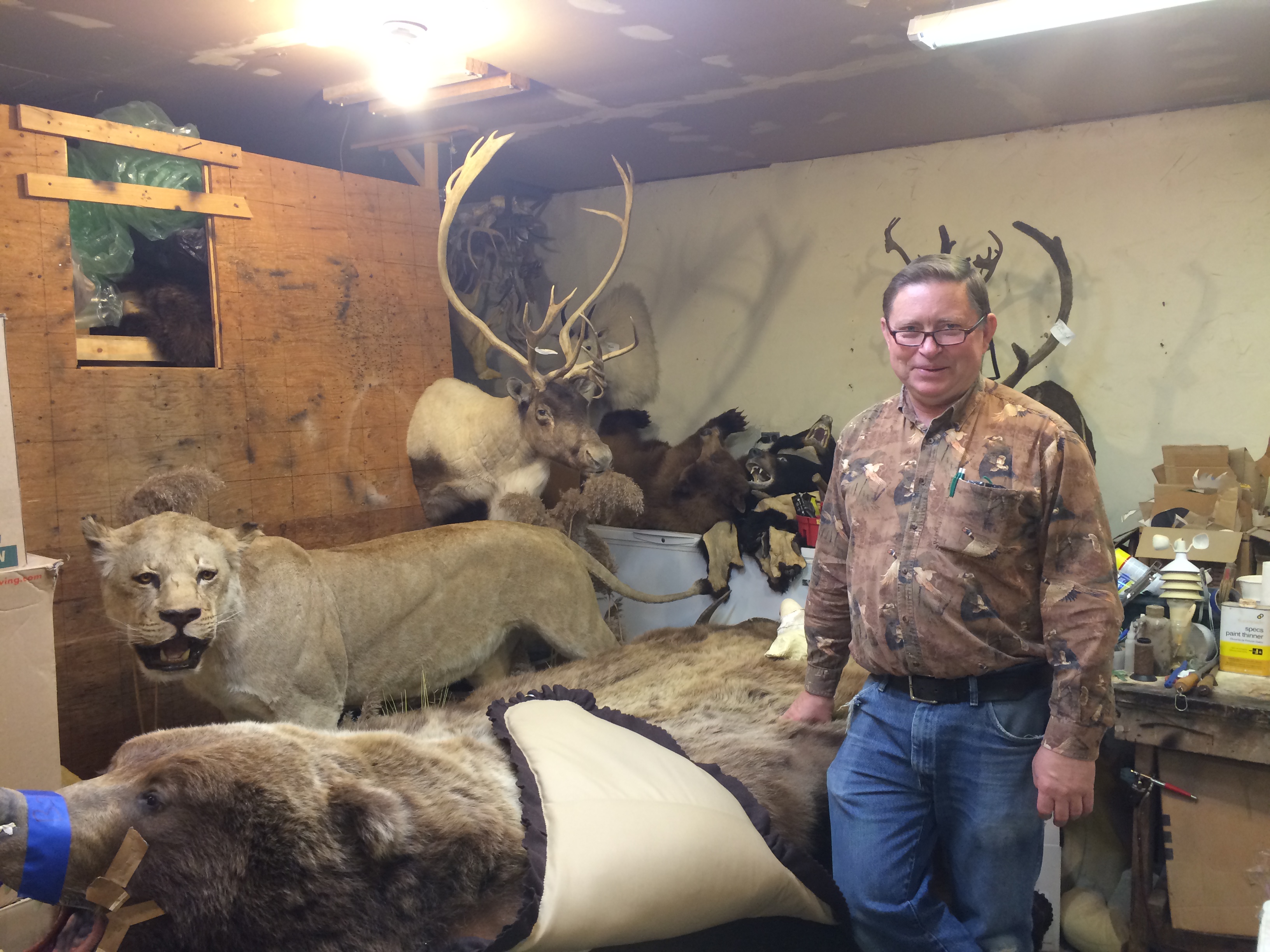
When you step into Larry Golden’s workshop near Palmer, it’ll remind you of that scene in Ace Ventura where the pet detective gets home to his animal kingdom. But in Larry Golden’s animal kingdom, all the animals are dead. And that’s why Larry has a really difficult job — to make them look alive.
Larry Golden taxidermist
Larry Golden has been a taxidermist since he sent off for a $10 how-to kit when he was 10. (Photo by Monica Gokey/KSKA)

Fortunately, Larry is really good at his job. If you’ve been to a sporting goods store in southcentral Alaska, like Cabela’s or Sportsman’s Warehouse, odds are you’ve seen his work. He’s been at it a long time. And like a lot of taxidermists, Larry’s self-taught.

“It was $10, I think, to send off for these little booklets, this home course,” he remembers. “And so at about 10 years old I started playing around with frogs and birds and squirrels and what have you.”

Larry grew up in Missouri. By the time he was 16, he’d gotten his brother into taxidermy, too.

“So My dad said, ‘Well ya’ll seem like you’re doing pretty good. Why don’t you let me run you a little ad in the phone book?’ And so he did. And we happened to be the only taxidermists in the yellow pages and we were in business overnight,” he says. “I’ve been doing it ever since.”

For the Goldens, taxidermy is a family affair. If you think Larry started early, his son Micah started even earlier.

“He was actually playing around the shop when he was in diapers,” Larry says. “By the time he was about 6 years old he’d be skinning deer heads for me for the commercial customers.”
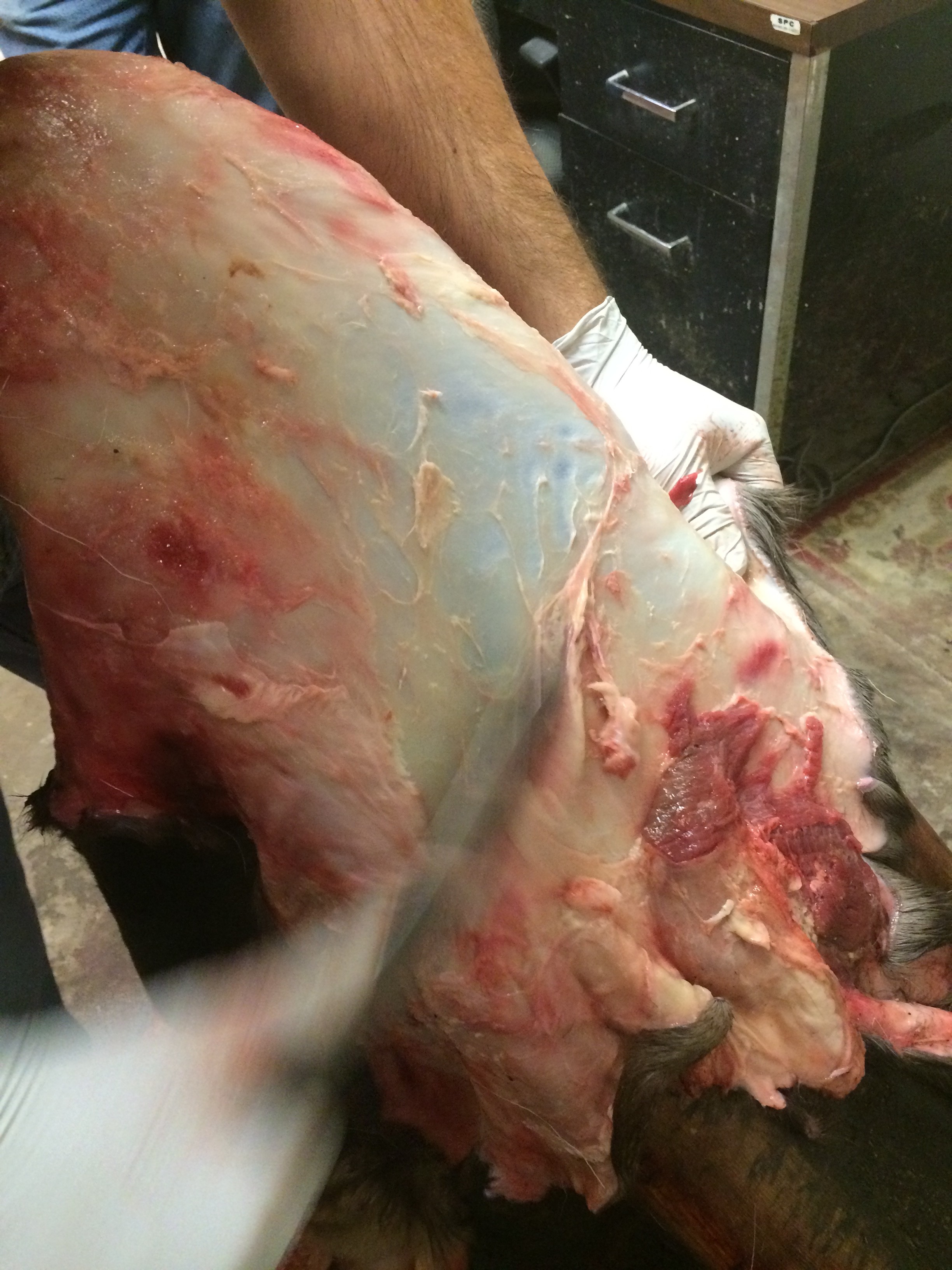
Taxidermist Micah Golden scrapes a caribou hide clean of excess bits of fat and meat. He's so fast at skinning that he picks up extra work from other taxidermy shops in the area. (Photo by Monica Gokey/KSKA)
Taxidermist Micah Golden scrapes a caribou hide clean of excess bits of fat and meat. He’s so fast at skinning that he picks up extra work from other taxidermy shops in the area. (Photo by Monica Gokey/KSKA)

At 34, Micah is still the best flesher in the shop.

“He’s probably one of the fastest with a knife I’ve ever seen,” his dad says.

Micah unfolds a frozen caribou hide a hunter dropped off the night before.

“All this fat here has to come off. … All this meat,” he says.

If there are bits of fat and flesh left on the skin, it could cause the mount to rot down the road.

Micah slings the hide over a skinning post, sharpens his knife. Stroke by stroke, he deftly cuts off the fat until the hide looks translucent and almost white.

“Then we’ll put salt on that and hang it to dry. And then it’s ready to go to the tannery,” Micah says.

Micah can do a caribou hide in about 30-35 minutes. Having tried this myself on an elk hide — a mediocre job that took many hours — I can tell you that Micah’s pretty much the Usain Bolt of skinning.

So that’s step one. The skin.

We move on to another project Larry’s working on, a sheep. It’s a shoulder-mount, which is just an animal’s neck and head. Larry pulls out a mannequin, which is the taxidermist’s equivalent of a blank canvas. It’s got the general shape of a sheep, but it really doesn’t look sheep-like. Not yet.

“Before we glue the skin to it we have to rough this up,” he says. “And this is the technique we use. It’s a special little tool for scratching the slickness off of the foam. You rough it up so the glue will stick good. The hide dries to that. It’ll conform to all the contours of the mannequin.”

And after the skin’s securely on, “Screw the horns on here, put the eyeballs on here, the eyes are made of glass of course.”

Larry Golden may have a lot of eyes in his eye-drawer, but he knows which animal each belongs to. (Photo by Monica Gokey/KSKA)

And this brings us to one of the coolest parts of Larry’s shop. A tackle-box full of eyes.

“Yeah, a drawer full of eyes,” he laughs. There are all kinds of eyes in here. Bear eyes, deer eyes, cougar eyes, giraffe eyes, even crocodile eyes.

Eyes are everything. In the world of taxidermy, anyone can slap a hide on a mount and call a job done. But expression is the mark of a master taxidermist. Even though most taxidermists use eyes from the same supply stores, how they’re mounted makes all the difference.

“You can change the total expression on an animal with its eyes,” Larry says.

For our sheep, Larry says they’re going for a soft, but fully alert look.

“You don’t want that blank stare look, you know.”
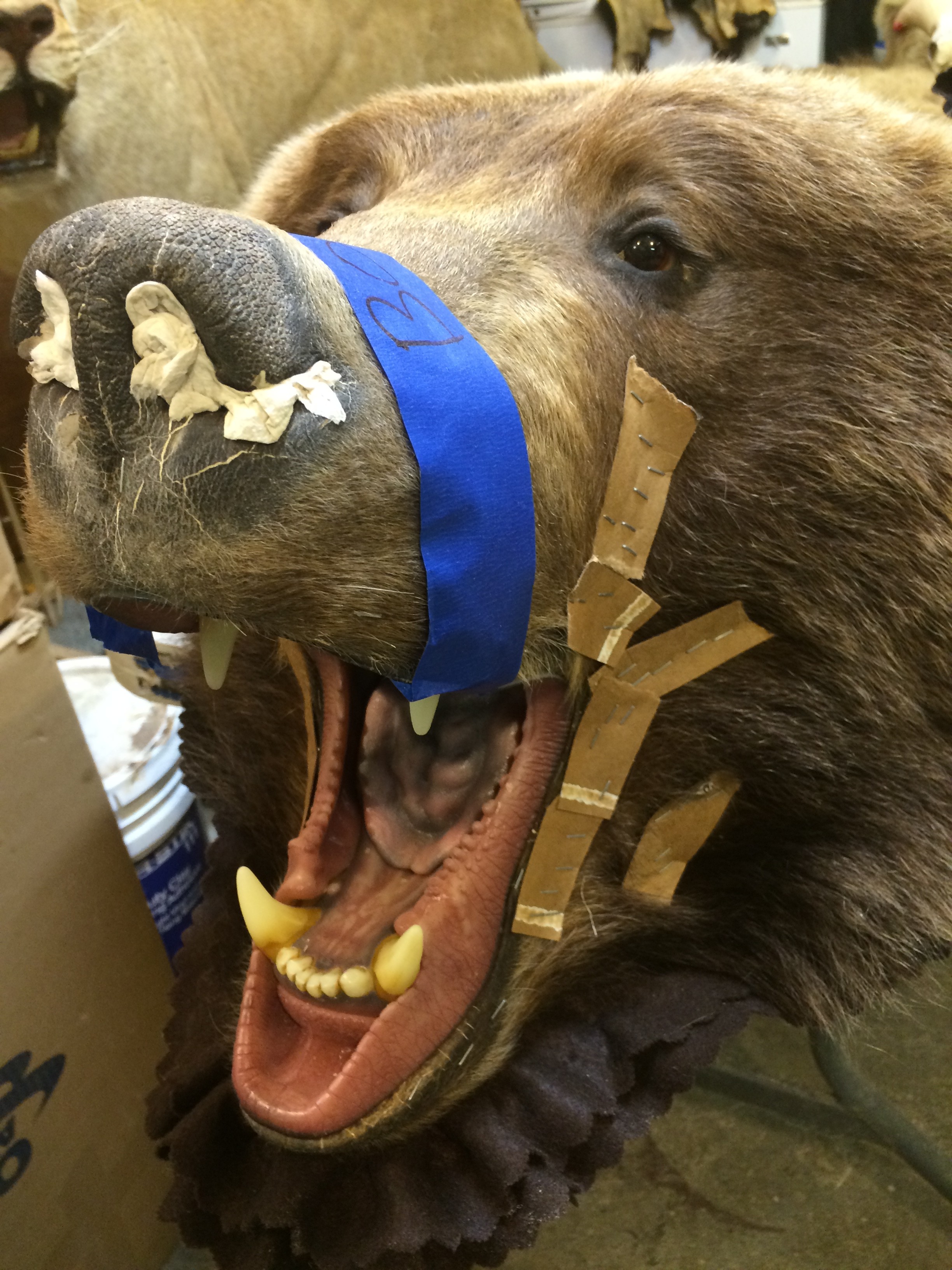
Golden Taxidermy is famous for their bear rugs, hand-stitched by Larry’s wife. (Photo by Monica Gokey/KSKA)

Giving the sheep the right expression gives the mount authenticity. When you look at it, you should feel like you’re seeing this sheep in the Chugach, looking up from his grazing to scan the landscape for predators.

Larry’s gone to great lengths to make his work authentic. One time, for example, he was working on an African mount.

“In Africa a lot of the dirt is reddish-brown, and you don’t find too much reddish-brown dirt up here,” he explains.

He happened to be on vacation in Texas, saw the right shade of red.

“I stopped on the side of the road, I scooped me up a bunch, went to the post office and mailed it to myself!”

He used it on the mount’s base, along with some Texas stickler bushes, which look like the dry, thorny shrubbery you might find in a desert a continent away.

Authenticity is Larry’s Holy Grail. He’s been at it a lifetime, and he says he has no plans to quit.

“I tell people I’ll probably die at my workbench,” he jokes.

With hunting season underway and a freezer full of animals to mount, it better be long time before Larry goes the way of his subject matter.

 

New drug reduces heroin cravings, may reduce recidivism

A new program in Anchorage is trying to get prisoners with substance abuse issues–a common cause of recividism–treatment quickly using a new, little-used drug called Vivitrol. But not all providers are convinced it’s the best option.

Vivitrol

Vivitrol is a monthly injection that stops cravings for opiates and alcohol. If you use heroin or drink liquor while you’re on it, you won’t get high. Family nurse practitioner Jyll Green’s goal is to get people on the drug as soon as they leave the prison system.

“Keeping them on the Vivitrol calms down the brain so that they’re not constantly thinking about where’s that next hit coming from,” she explained.

Green says that way, they can focus on getting jobs, housing and treatment. As part of her doctorate program in nursing practice at the University of Alaska Anchorage, Green is working with the Partners Re-Entry Center to help people get the medication as quickly as possible. For those who have chosen to participate, she’s been able to get them the injection within two hours at her clinic.

Similar programs are popping up all over the country. Some are administering Vivitrol in jails, others in drug courts.

Fred Moses is a municipal judge in Hocking County, Ohio, a rural area in Appalachia with high heroin usage and limited access to treatment facilities. In 2012 he created a drug court where offenders were given monthly injections of Vivitrol along with drug abuse treatment and had to follow other court mandated requirements. Since then, 90 different people have come through his Vivitrol court. Only one has re-offended.

“These are not first time offenders. I’ve taken the hard-core users,” he said. “And what they tell me is, ‘I want to read a book.’ Why that’s significant is their brains are clear. They’re not going through withdrawal. They don’t have a need for a narcotic. So what we see is the treatment goes much better.”

Moses said the program is so successful that judges from around the country are visiting to learn more about it. One of his participants actually traveled from a nearby urban area and purposefully committed a crime so he could get help through the Vivitrol court.

Within three to six months on the drug, Moses said his participants have all of the narcotics out of their system. They are clear-headed enough to really respond to treatment and focus on the causes of their drug addictions.

“The shot’s a great tool, but the key is still treatment. And I won’t ever change my mind about that,” he said.

And that’s part of what makes it complicated. Green said people on Vivitrol who are not court mandated to use it, like the group she’s working with, have to be willing to get treatment at the same time and to come back to the clinic to get their shot again the next month.

“Vivitrol, if you don’t take the shot, well you can just go out and use again,” she said. “There’s no harm in coming off Vivitrol. It’s not painful (like with other drugs), you don’t feel anything, you just don’t go and get your next shot.”

Psychiatrist Aryeh Levenson has run an opiate addiction clinic for five years at Southcentral Foundation. He thinks Vivitrol works well for some patients, but it has limitations. People have to detox before they can use it, which scares some people away, and sometimes Vivitrol causes flu-like symptoms. But one of the biggest hurdles is that patients on Vivitrol don’t always come back.

“I think when folks are not craving or not experiencing a missing of the drug, there’s often a sense that ‘I’ve overcome this, I’ve cured my problem, I don’t need treatment anymore,’” Levenson said.

And then they relapse. So Levenson often uses another more popular alternative, Suboxone, which combines a synthetic opiate with another drug that also blocks the cravings. Levenson said he requires his patients receive substance abuse treatment and work on getting their life in order before he’ll give them another prescription.

“And for people who said they were willing and started on Suboxone and then did not follow through with their commitments, we did not continue giving them their Suboxone,” he says. “We had a very tight, as you might say, carrot and a stick approach.”

He says they also monitor Suboxone users to make sure they are taking the drug and not selling it on the street, which is a common problem.

Alaska Wellness Court Program Coordinator Jennifer Fredericks says that in the Alaska drug courts, they prefer to use Vivitrol or the pill form of the same drug, naltrexone.

“We have tried to work with participants who are on Suboxone, but we’ve found it difficult given how addictive that medication is.”

She says drug court participants on Suboxone often come to court high and that triggers the other participants. The program has only been using Vivitrol for about a year, so they don’t have data on success rates yet. But Fredericks says she sees positive changes, especially with young heroin addicts.

Because Vivitrol is so new, it’s unclear how long people have to use it. Recommendations range from three months to a year depending on the individual. Shots can cost around $1,000 per month or more, but can be paid for with some insurance and Medicaid.

Kachemak sea otter sickness, deaths under investigation

Sea Otters
Sea Otters. (U.S. Fish & Wildlife photo)

It’s Friday night and Marc Webber, with the U.S. Fish and Wildlife Service in Homer, has already had two calls for sick otters.

“Well I just was out on the spit having dinner with my family and a call came in as I was coming into the station of two otters ashore on mariner this evening,” he said.

Webber is part of a group trained to respond to sick and injured marine mammals. He’s Deputy Refuge Manager for the Alaska Maritime National Wildlife Refuge which runs the Alaska Islands and Ocean Visitors center in Homer.

“And so I was able to get to one of them down below the rock wall along the spit road and that individual is in very bad shape,” Webber said. “It is in a somewhat depleted condition, but demonstrating something we’ve also seen a little bit of which is a set of neurological conditions where it was twitching.”

Webber says he’s responded to around 50 calls for dead and dying otters over the past couple of months, and what he’s seeing seems different than what he’s seen in the past.

“Something is hitting them harder and faster, in addition to the disease that we’re familiar with seeing, something else seems to be involved,” Webber said. “That’s just speculation, we don’t have any evidence yet, but that’s what we’re seeing on the beach.”

Webber and trained volunteers try to keep people away from sick otters and get a vet to euthanize them when necessary.

Large numbers of dead or sick sea otters are turning up in the Kachemak Bay region. Officials with the U.S Fish and Wildlife Service say the agency has received about 200 reports of sick or dead otters over the past couple of months.

“We’re finding otters all over the Homer area,” he said. “They’re found from outer Bishop’s Beach all the way around the spit on both sides and around the shores of Mud Bay, so pretty wide spread.”

The wildlife service has teamed up with the Alaska SeaLife Center in Seward and they’re running tests to try to find out the cause. In the meantime, they’re asking for the public’s help.

Report dead or dying sea otters and other marine mammals to the Alaska SeaLife Center’s Marine Mammal Stranding Network hotline at 888-774-7325.

Otters play an important role in their ecosystem, Webber notes, so when something is going wrong with them, something is likely affecting the entire ecosystem.

Otters were nearly hunted to extinction during the fur trade of the 1700s and 1800s and suffered again after the Exxon Valdez oil spill.

The sea otters in Kachemak Bay are part of a population that stretches from Cook Inlet to Prince William Sound. In the 1970s they received protection through the Marine Mammal Protection Act and remain protected. At last count in 2012, the Kachemak Bay otter population was around 5,900.

Cari Goertz is a veterinarian with the Alaska SeaLife Center. She’s been examining sick otters.

“This summer started off fairly typical with a couple of otter carcasses or few otter carcasses being found every week,” Goertz said. “However as the summer went on into august and September we were getting up over 20 carcasses or moribund animals each week.”

“And it’s in those animals that we’ve seen different presentations.”

She says they’ve been tracking a streptococcus illness in Kachemak Bay area otters for some time and those otters usually appear sickly and emaciated. But the otters that have died since August seem different.

“Most recently what we’ve seen more of is animals in a healthier condition that seem to have been taking care of themselves well but have died acutely and that has become more common in the ones that we’ve been seeing in the last couple of months,” Goertz said.

If you see a beached live otter or a dead one, officials want to know about it. They’re asking people to call the Alaska SeaLife Center Stranded Marine Mammal Hotline.

They say otters shouldn’t be approached because streptococcus related illness can be passed to humans. Dogs should also be restrained, as the illness can be passed to them too. In addition, a sick otter could get defensive.

Officials with the Fish and Wildlife Service and the Alaska SeaLife Center say they’re waiting for lab tests to get back in the next few weeks.

After pause, Anchorage software boondoggle back on line

After a two-month “pause,” Anchorage Mayor Ethan Berkowitz has announced the city will continue working to implement the costly and contentious SAP software program.

An external audit review of the project presented Friday found no fault with the software system itself, but instead identified a number of missteps putting the program into action.

“It was a train wreck from the beginning, frankly,” said Assembly member Elvi Gray-Jackson, who chairs the committee in charge of reviewing the SAP program, and has been a longtime critic of how it was handled. Members of the Anchorage Assembly and administration were told Friday that after so much money and time has been invested, it doesn’t make sense to walk away from the project.

“It was clear that keeping SAP was probably the only choice to make,” Gray-Jackson said. The contractor hired by the assembly to study what’s worked and what hasn’t determined the software itself is salvageable, but institutional disorganization and mismanagement have been the chief obstacles.

The audit did included a number of recommendations to not repeat past mistakes.

“First off the city–and I’m talking about the past administration–did not understand the full scope of the project and what they were about to undertake,” Gray-Jackson said of the report’s findings. “Leadership wasn’t appropriately engaged and didn’t take ownership of the project or the outcome. The contractor supplied inadequate resources, governance and oversight.”

The original estimate was that the SAP software would be up and running across municipal departments by 2011 at a cost $10.6 million. To date, the city has spent more than $36.2 million dollars with full implementation now optimistically forecast for early 2017.

Gray-Jackson says she’s encouraged to see Berkowitz taking responsibility for the project.

The administration has not released an updated cost estimate yet. Deputy Chief Financial Officer Alden Thern said the administration will spend the next few weeks restaffing consultants who have previously worked on the project, though about a third of them, including members from leadership, have moved on. Those teams will work on finalizing blueprints for the software by March as the administration prepares an implementation strategy.

Alaska teen wins White House honor, receives appointment as poetry ambassador

First Lady Michelle Obama honored five young American poets at the White House on Thursday, including one Alaskan: 17-year-old Anna Lance of Eagle River. She represents the West.

“I look forward  to this event every year,” Mrs. Obama said, at a ceremony in the oval-shaped Blue Room at 1600 Pennsylvania Ave. “Time that we honor the 2015 National Student Poets. Don’t they look good? They look good!”

She describes President Obama as “crazy about poetry.” They launched the program, she said, to spread the joy and freedom of poetry to more young people, and this year, more than 20,000 applied.

“This is a pretty competitive pool, too, just so that you know,” the First Lady said to the poets flanking her. “You weren’t just given this.  You competed hard for these spots.”

National Student Poet Anna Lance
Poet Anna Lance of Eagle River speaks to reporters outside the White House, Oct. 8, 2015. (Photo by Liz Ruskin/APRN)

Anna Lance, a student in the Highly Gifted Program at West High in Anchorage, read a poem called “Unfiltered,” which begins:

“i should be happy to be here, they tell me. after all,
we’ve got the cleanest and best-tasting water in
the country, thanks to the glaciers
that sacrifice themselves down mountainsides while we sleep
until they fit into bottles that take 450 years to decompose.”

The poem has a water theme, but Lance says, like most of the poems she submitted for the competition, it’s also about loving Alaska yet wanting to leave.

“i tasted the tap somewhere down in dallas
and it was like kissing sidewalk. i knew there were no glaciers
in its history”

Lance wears her hair in a cap of glossy purple, a hue that sets off her gray-green eyes.

“Today was amazing!” she said, giving interviews outside the White House. “I’m a poet but I don’t think I have the words to describe it.”

But being named a National Student Poet isn’t just about glory. It comes with an obligation, too. She, like the four other National Student Poets, will receive a $5,000 scholarship and attend arts events throughout the year. They must also do a project, a year of service as a national poetry ambassador. Past student poets have brought their art to inmates, military families, Alzheimer’s patients and communities in trauma. Lance will chose her mission this fall.

“The LGBT community is a big part of my life, so I’ve been thinking about constructing a program that would allow me to work with LGBT youth,” she said. “But I really love working with kids, and both of my moms are childcare providers, and I’d love to do something with children. Children have incredible minds and the things I’ve heard even my sisters say and write, I’ve thought ‘Wow, I could definitely turn that into poetry.’”

Both of her moms were at the White House ceremony. Carrie Lance says Anna was composing poems before she could write. She crafted one at age 3.

“She drew pictures for me on a poster board and she brought it into me, and I said, ‘Oh great pictures!’ And she said, ‘No mom. It’s a poem,’” Carrie Lance recalled. “And I said, ‘Oh, can you read it to me?’ And so she read the pictures and read me a poem.”

Anna is finishing high school and applying to colleges. Her eyes are on New York.

Defense bill passes with measure Sen. Sullivan hopes will halt JBER cuts

JBER soldiers return
Five hundred soldiers from the 4th Brigade Combat Team (Airborne), 25th Infantry Division, returned to Joint Base Elmendorf-Richardson after a 10-month deployment to Afghanistan in October 2012. (Photo by Justin Connaher/U.S. Air Force)

The U.S. Senate on Wednesday passed the annual defense authorization bill, with a provision by Alaska Sen. Dan Sullivan requiring an “Arctic Operation Plan.”

The O-PLAN is a key part of Sullivan’s effort to stave off the Army’s announced cut of thousands of troops from Joint Base Elmendorf-Richardson. Sullivan argues the Pentagon can’t make the JBER cuts before it has a plan to identify which assets it needs to defend the region.

Lt. Col. Joe Buccino, an Army spokesman, says the chief of staff of the Army will review the Arctic Operation Plan once it is complete, and it will “help inform how and if” the troop reduction will take place. In the meantime, Buccino says the plan to cut troops from JBER has not changed and is not “on hold.”

The cuts, announced this summer, are scheduled to take place over the next two years.

The White House has issued a veto threat for the defense bill, part of a larger budget dispute with Republicans in Congress.

Site notifications
Update notification options
Subscribe to notifications