The world watched in horror today as the attack in Paris seemed to get worse by the hour. For one Anchorage woman, it hits close to home.
“Yeah, we just got back Monday night from Paris. We were going to see my family I have relatives over there,” said Caroline Miller.
She’s a dual U.S. and French citizen. From her home in East Anchorage, she’s keeping in touch with her cousins on Facebook.
A screen capture of Facebook’s safety check for the Paris attacks.
“So far everybody’s OK. One is hunkered down in a restaurant near where some of this is happening. One is out in the suburbs but she has a lot of friends who are actually being held in the Bataclan, in the nightclub there,” Miller said.
Miller lived in Paris in the ’80s and ’90s and she’s been to that nightclub. She spoke to APRN Friday afternoon, while the siege was still underway. Later, Miller said her cousin was posting about friends who were at the hospital with gunshot wounds and others not accounted for.
“Obviously everybody is just sick about it over there. And worried.”
Miller was in contact with another cousin while he was holed up at a restaurant in Les Halles, near the 10th arrondissement, where at least 11 people were killed.
“I said, ‘Go home!’ He said, ‘No, I feel safer here right now.’ I think that they kind of just don’t even want to get out, because who knows what could happen next.”
Miller said she and her husband are now reviewing their time in Paris, thinking about the spots where they were vulnerable. Mostly, she said, they just feel awful, as heartbroken as everyone else, whether they’ve been to Paris or not.
Many parks and museums boast at least one bronze statue to honor a famous figure. Maybe it’s a noble steed and its rider, or a symbolic figure like New York’s Statue of Liberty. As for Kodiak, the city has a statue honoring the Kodiak brown bear.
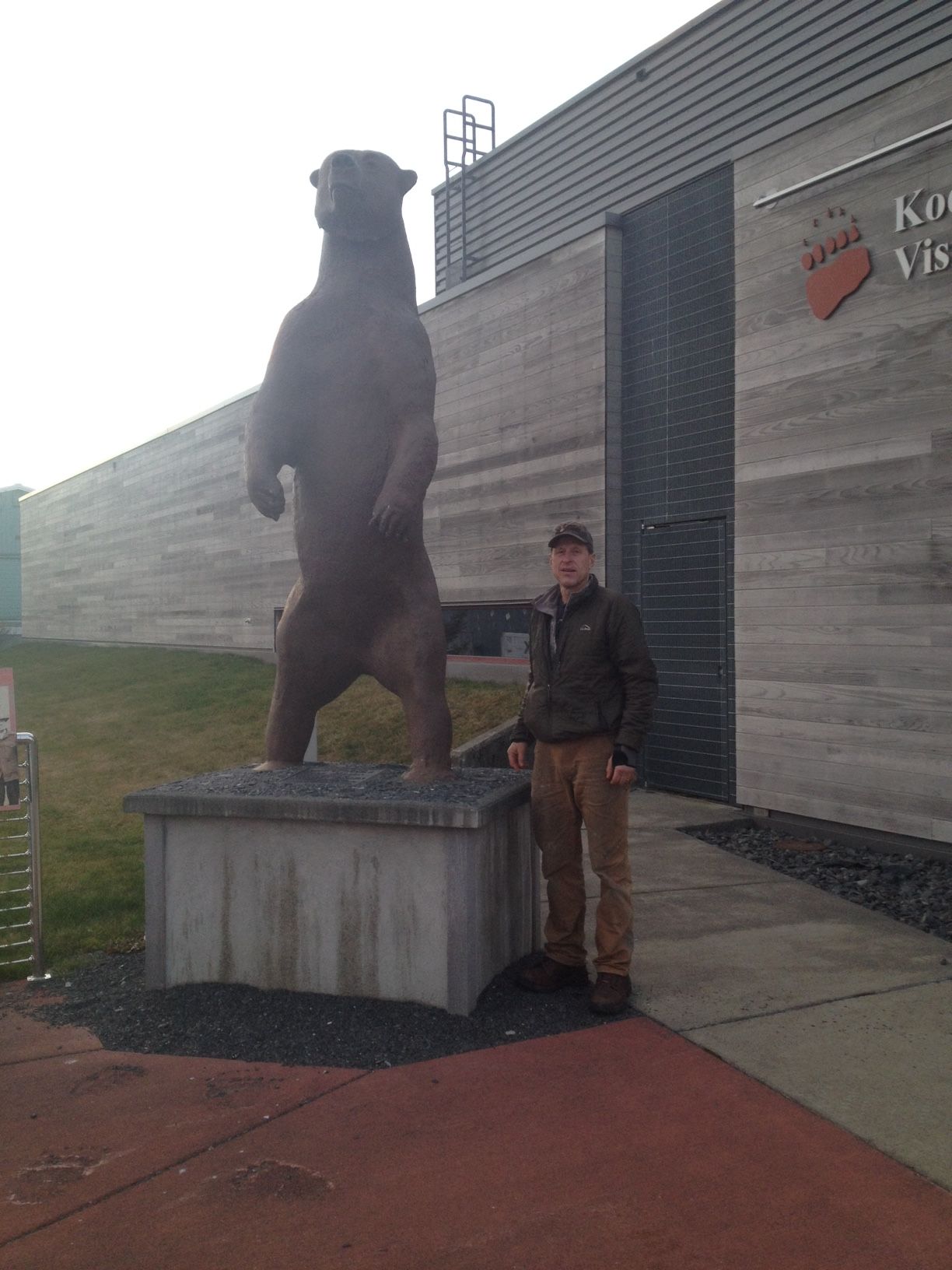
Chairman Paul Chervenak of the Kodiak Brown Bear Trust with the Madsen Bear. (Photo courtesy Paul Chervenak)
Right now, a life-size fiberglass bear is located outside the Kodiak National Wildlife Refuge Visitor Center. It’s about 60 years old, and it looks its age according to Paul Chervenak, the chairman of the Kodiak Brown Bear Trust, a nonprofit that works toward Kodiak brown bear conservation.
“Of course, just sunlight would do it, but wind and rain, salt, so the actual statue itself is cracking. There’s been some vandalism and damage, or maybe just accidents, people wanting to have pictures taken with it, so they’re climbing on it and breaking the claws off, etc. And we’ve tried to repair it and keep it up, but it’s sort of (a) losing battle,” he said.
There’s a price tag, but as with a lot of the statues in other communities, this bear is more than a piece of art.
The statue commemorates Kodiak’s first registered bear guide, Charles Madsen, one of the people to encourage the protection of the Kodiak brown bear after the popularity of hunting in the early 20th century started having an effect.
Chervenak, who guides big-game hunters, sport fishermen and wildlife viewers, said he can relate to the significance of the Madsen Bear.
“I am a firm believer in giving back, especially to what I derive my business from,” he said. “This particular project is special to a lot of us, but it really represents what guides and sportsmen have done for the Kodiak bear.”
Chervenak said the Brown Bear Trust has gotten involved in a project to replace the aging statue, which has moved all around town over the years — from the old Kodiak hotel to the spit.
Chervenak said the replacement project is called Rebuild the Bear.
“We started talking about it about a year ago and we started checking into the cost of — potentially bronze would be the nicest and most durable. The cost was pretty high. We happen to have a very wonderful offer from an artist who would help do a lot of it. So, it actually made it a potential reality,” he said.
The Kodiak Brown Bear Trust is negotiating with the artist, Stan Watts, and Atlas Bronze Casting, the foundry he owns in Utah.
Chervenak says the group has an idea of the steps it takes to make a bronze sculpture.
“They make a clay replica and so, this bear is gonna be life-sized or bigger than life-sized, probably close to 10 feet tall,” he said. “They’ll do it out of clay, they’ll let us view it, make any changes we want so we get a true Kodiak bear, and then after they have the clay sculpture, they then cast it in bronze.”
Chervenak says the Kodiak Brown Bear Trust has turned to social media and corporate donations to cover the $40,000 it will contribute through fundraising.
Chervenak says they launched an online fundraising campaign on IndieGoGo. So far, they’ve raised more than $8,000.
“The artist is trying to line up donors through people he knows to cover the rest of it. I mean, the total project will probably be $100,000 to $125,000 by the time you create it, ship it here and install it, and so he’s covering that end of it,” Chervenak said.
Chervenak said the Kodiak Brown Bear Trust will probably sign a contract with Watts this week.
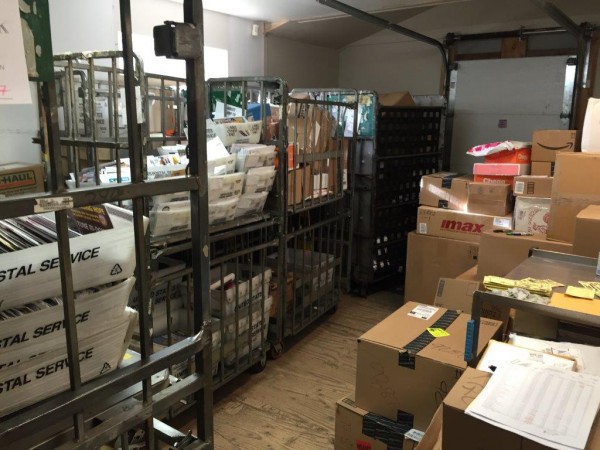
Mail room at Knik contract postal facility. (Photo courtesy Chuck Spinelli)
U.S. Postal Service officials remain mum on the reasons behind an investigation into operations of a contract post office in Knik, but residents of the area formerly served by the facility are demanding answers.
When the Knik contract post office closed without warning in September, about 1600 mailbox – holders in the area were forced to drive into downtown Wasilla to pick up their mail general delivery. Many Knik residents commute to Anchorage for work during the week, so just picking up the mail became a time-consuming chore.
Ralph Winterrowd II is a legal researcher and a Knik resident.
“I have to drive in an additional six to eight miles to Wasilla. I stand in line, initially it was up to two hours and I finally walked out one day. So I have to go in there every day, and stand in line with everybody else, so we have 650 people, getting general delivery at one window.”
Winterrowd has collected about one thousand signatures on a petition to get the facility at Knik reopened. He says there is no legal basis for the Post Office’s action.
US Postal Service officials in Alaska will only say there is an “ongoing investigation” into slow mail delivery provided by the Knik contract facility. Lead investigator Sarah Harland would not comment, nor would Wasilla postmaster Eric Schuller. Post Office media liaison John Masters sent a printed release indicating quote:
“No additional information related to this investigation is available for public release due to Privacy Act considerations and the ongoing status of the USPS OIG’s [office of inspector general] investigation.”
Tell that to Chuck Spinelli.
“We are just kind of in the dark, waiting for somebody to tell us something, ” Spinelli says.
Real estate developer Spinelli held the contract on the Knik facility for eleven years until it was abruptly shut down.
Spinelli says since postal officials shut the Knik facility and then informed him that he was part of an investigation six weeks ago, he’s heard nothing.
“Absolutely nothing that I’ve heard of. I’ve tried to contact them, I’ve tried to find out if they have an inventory of what they took if there’s a date certain when they conclude their investigation, or give us some advice as to what they are actually investigating, but we can get very little information out of them.”
Since the shutdown, postal officials have taken the mailboxes out of the building that housed the contract post office, Spinelli says.
A couple of years ago, the Knik contract facility started handling the mail for Goose Creek Correctional Facility. That’s anywhere from 400 to 900 pieces of mail a day, Spinelli says. And on top of that, the contract facility was handling FedEx and UPS shipments at no extra charge to customers. Spinelli says he had given the Postal Service written notice that he wanted to end the contract next spring because an increase in the amount of mail the facility was responsible for was boosting the costs of running the facility. He says a contract postal service is not a lucrative business, but more like “indentured servitude.”
“We started off with 600 boxes and increased it to 1700 boxes. And increased the revenue. We doubled the revenue for the post office.”
He says the post office responded to his request to renegotiate the contract by giving him one day’s notice on September 30 that his contract was canceled. Spinelli admits that when he visited the Knik facility in mid September, there was a great deal of mail stacked there, undelivered.
“When I went out there in September, it looked like December 24 to me, you know just packed to the gills with mail.”
And with the winter holidays coming soon, along with an uptick in mail, is there a solution in sight?
Dawn Peppinger, a marketing manager with the Postal Service’s Alaska district, says the service has taken steps to help facilitate mail delivery for Knik customers
“We extended the hours for pickup, and we have extra staff dedicated to serving our Knik customers.”
Peppinger, who made it clear she was not speaking for the postal service’s Office of Inspector General, says three entities have submitted bids to operate the Knik contract facility, but she would offer little more information.
Two ferries dock at the Ketchikan Shipyard in 2012 while one is drydocked. Four of the marine highway’s ships are slated to be tied up for the 2016 season. (Photo by Ed Schoenfeld/CoastAlaska News)
Budget cuts and mechanical breakdowns left many of this year’s passengers stranded, dropping destinations or switching to air travel. Town leaders say that hurt tourism, especially small-town excursions, restaurants and bed-and-breakfasts.
During Wednesday’s schedule teleconference, Wrangell Economic Development Director Carol Rushmore said she’s being asked whether it will happen again.
“It’s just so critical from an economic standpoint for our businesses and communities that if we have all these cancellations in July and August, it’ll just be disastrous,” she said.
Small communities dependent on the Alaska Marine Highway were hardest hit, since they had fewer alternatives.
Pelican Mayor Patricia Phillips said officials need to have backup plans when ferries break down.
“It’s essential to reschedule canceled service due to mechanicals or scheduling changes. We have freight out here waiting to ship out, so it’s important to reschedule that service,” she said.
Pelican isn’t in the draft schedule, though officials say it will be. But it, Sitka and many other communities will see reduced service .
The schedule is a worry for more than Southeast. Prince William Sound, for example, faces significant service cuts with its fast ferry tied up next year.
Transportation Department Deputy Commissioner Capt. Mike Neussl oversees the Alaska Marine Highway System. (Photo courtesy Department of Transportation)
“The changes to the schedule last summer resulted in a 14 percent decline in non-resident travel on the ferry. And members told us that they lost thousands of dollars in business due to the rebookings and cancellations,” she said.
Alaska Marine Highway officials said they’re doing their best to design a schedule that can be maintained.
That’s the reason for the deep reductions proposed for next summer, which reflect a $25 million budget cut.
Transportation Department Deputy Commissioner Mike Neussl said everything depends on legislative funding.
“There’s always risk and uncertainty there. I will do my best in testifying and communicating that it’s important that we lock that schedule in and fund the schedule we publish,” he said.
Neussl and other ferry officials say they’ll make some changes in the draft schedule for next summer. It should be complete in December.
Last weekend, some 40 Alaskans journeyed down to Louisiana for the Blackpot music and food festival. The two-day festival is in its tenth year and takes place in and around the city of Lafayette in the south central part of the state. The weekend included a cook off, 25 bands, camping, jamming and lots of dancing.
Many of the Alaskans are musicians, music appreciators and friends who know each other through the Alaska music scene, and their trip has become a tradition.
Hear their voices and music from the Pine Leaf Boys here:
“I love how the Cajun culture marries love of food, love of dancing, love of community, and it reminds me of home.” –Kate Consenstein, Anchorage
“The energy is just so positive. I feel like if you come here it’s like getting a cultural hug.” –WeeBee Aschenbrenner, Cantwell, Alaska
“We got Cajun music. We got blues. We got rock and roll. We got zydeco.” -Paul “Bird” Edwards, Eunice, Louisiana
“One of the things we have a lot of at our festival is food—from everything and anything deep fried, to some of the great Cajun dishes like gumbo and jambalaya and étouffées.” –Derek Landry, Lafayette, Louisiana
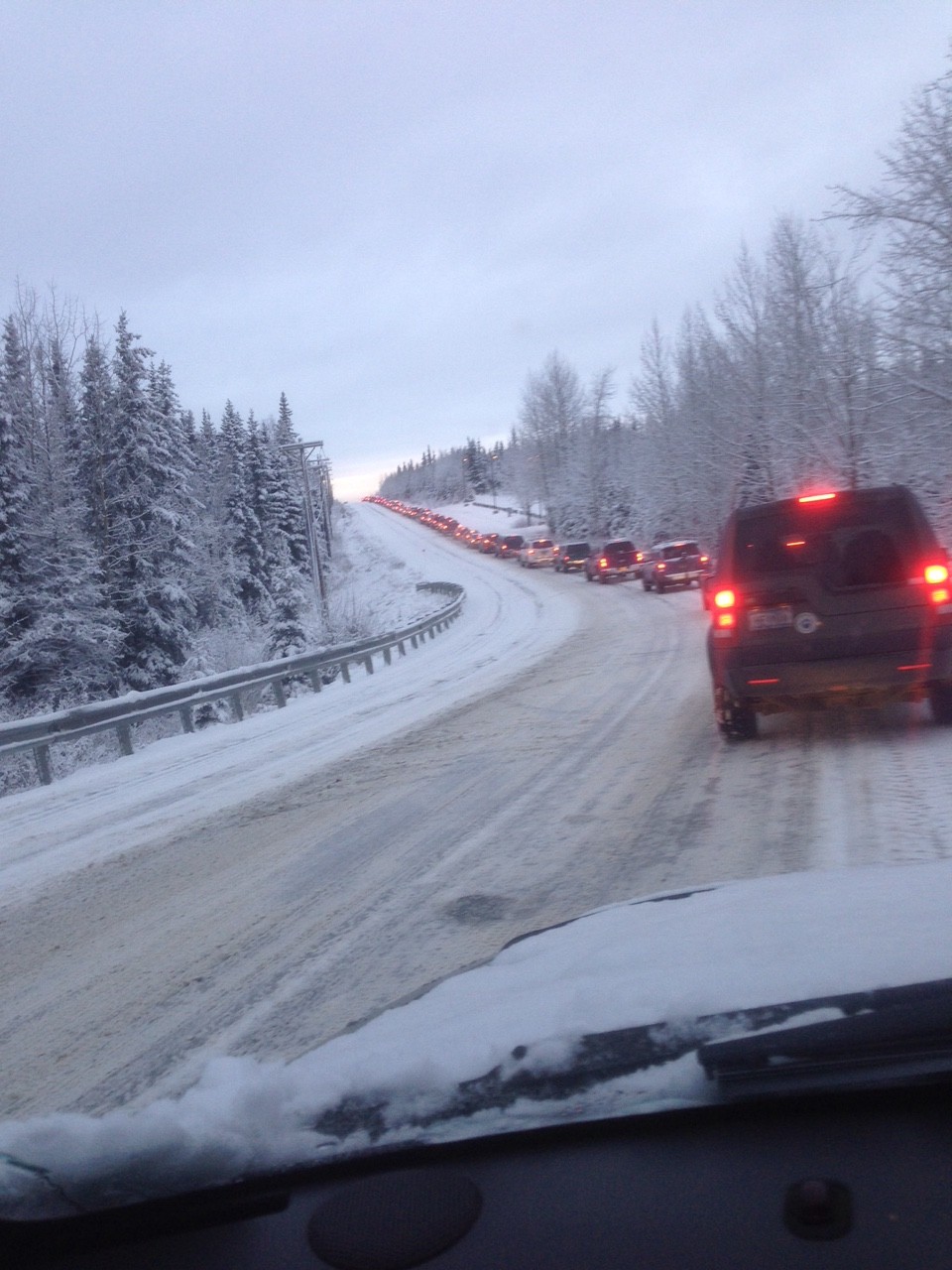
Slick ice and a dusting of new snow made commuting on the Glenn Highway treacherous Monday morning. Alaska State Troopers responded to 31 vehicle incidents on the Glenn in their Matanuska Valley jurisdiction Monday, according to spokesperson Megan Peters.
Anita Shell with the Anchorage Police Department said since midnight, Anchorage police responded to 87 collisions and more than 90 vehicles in distress throughout APD’s jurisdiction. Only 10 involved non-life threatening injuries. APD patrols the Glenn Highway from the Knik River bridge to the city.
Alaska Public Media employee Ron Zastrow said his normal 50-minute drive time was stretched to 3 hours. He commutes to Anchorage from Wasilla.
“Everybody that I saw on the southbound lanes was driving very slow. I didn’t see as many vehicles in the ditch as I thought I was going to see,” Zastrow said.
Zastrow didn’t see sand trucks heading south, either.
“There was no sand on the highway that I saw,” he said.
The Glenn is a priority one traffic artery, according to Jill Reese, media liaison with the state Department of Transportation.
“Level one is of course the major highways, safety corridors, major urban and community routes,” she said. “These can take up to 24 hours to clear after a winter storm. We try to get all the major traffic through, commuters and those sorts of things through first, then we go on to the lesser priorities.”
She said DOT’s sand trucks went to work at 5 a.m., although the trucks go where they are most needed and are not tied to any particular route.
“It’s normal, Alaska winter ice. People sometimes forget how to drive on this ice when we first get hit. Every year it is the same,” she said.
Reese said the weather conditions are worsened because warm tires melt the ice underneath them, and then it freezes again, so there is continuous cycle of ice and thaw. And even if the road is sanded, that doesn’t solve all the traffic woes.
“It’s not DOT’s practice, even in year’s past, to sand the entire length of a highway. We sand the approaches, the curves, intersections, those sorts of things,” she said. “We rely on motorists to drive for the conditions of the road. And we will put sand on those areas as we can.”
Reese said DOT’s budget has been cut by 25 percent, along with other state agency budgets, due to the state fiscal shortfall.
Close
Update notification options
Subscribe to notifications
Subscribe
Get notifications about news related to the topics you care about. You can unsubscribe anytime.