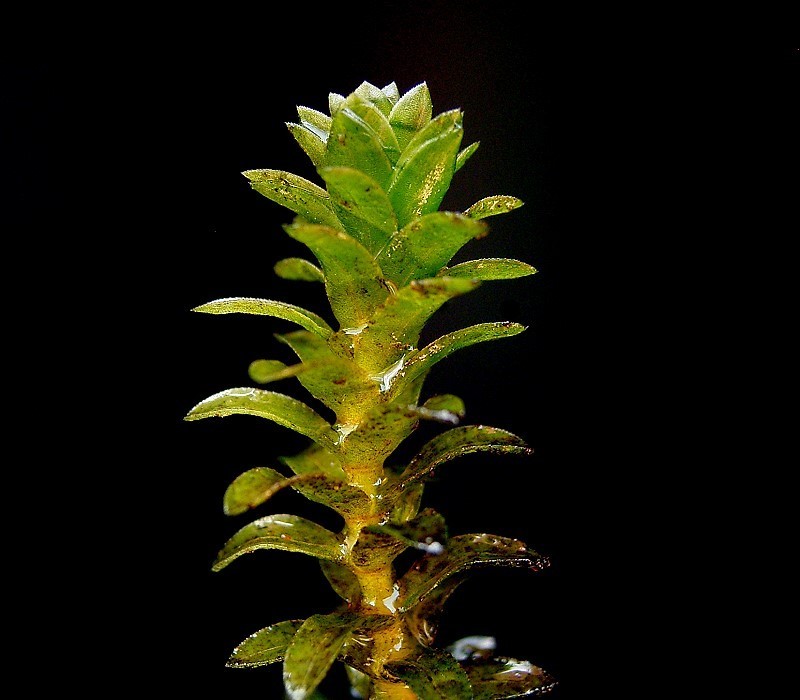
Elodea canadensis. (Creative Commons photo by Frank Vincentz)
One wee fragment of it can flourish into a swath of green growing strands that entangles float planes and boat engines. Across the state, it has been found in 18 freshwater lakes and rivers. Many people decorate their fish aquariums with it.
It’s called Elodea.
Last week, the aquatic plant was a topic of discussion at the Alaska Invasive Species Workshop in Juneau. Researchers have traced the beginning of the invasive plant’s transmission around Alaska to people dumping out their aquariums into nearby lakes. An aggressive hitchhiker, Elodea will cling to float planes and spread further.
Tom Heutte, an aerial survey coordinator with theU.S. Fish & Wildlife Service, described one encounter in Cordova.
“We were flying along and one of our aerial surveyors looked out the window and sees a bunch of weeds stuck to the rudder of the float plane,” he said.
Elodea outcompetes native plants by blocking sunlight and degrades salmon habitat. The plant has been found from Fairbanks to Cordova, but not in Southeast. Heutte hopes that the region has avoided invasion.
He surveyed the float plane pond at Juneau’s airport for Elodea and found none. Heutte said that saltwater is a likely Elodea killer, one reason Southeast may have avoided the plant invasion. He also believes that lack of a road system, and difficulty of access to remote lakes, may have kept Elodea from spreading here. Over the next two years Heutte plans to survey lakes throughout the region in order to find out for certain.
It all begins with one plant fragment, he said.
Experts discovered a weapon against Elodea called fluridone. The herbicide disrupts Elodea’s capability to photosynthesize. It prohibits the plant’s ability to produce its own food, killing by starvation, yet harms few native plants. In some parts of Alaska scientists have completely eradicated Elodea with fluridone, said John Morton, supervisory fish and wildlife biologist at the Kenai National Wildlife Refuge.
Elodea is just one front in a battle against invasives.
“We are only at the beginning of the invasion curve for novel species,” Morton said.
A 2010 federally sponsored study is the first to deliver a reliable count of the Kenai Peninsula’s brown bear population. Last week a Kenai National Wildlife biologist explained the study during a presentation at the Pratt Museum in Homer. The Museum is preparing to launch a new summer exhibit all about bears, specifically brown and black bears.
The number of brown bears on the Kenai Peninsula fell from about 582 to fewer than 500 between 2010 and 2015. That’s according to John Morton, a Kenai National Wildlife Refuge biologist.
“It has to do with the fact that harvests have been liberalized by the Board of Game since 2012. So our harvests [have been] higher in the last couple of years, particularly in 2013 and 2014,” said Morton.
The U.S. Fish and Wildlife Service and the U.S. Forest Service paid for Morton and his team to spend part of their summer counting brown bears using a method called mark recapture. Mark recapture is pretty much what it sounds like. The researchers caught the animals, marked them, released them and then they tried to recapture the animals they’d marked. Morton’s team marked the bears by collecting their hair and analyzing their DNA.
“And the key here is it’s not the number of animals we detect with DNA it’s actually our recapture rates. That goes into a model and we base our population estimate not on the number of bears we detect but actually on the number of bears we mark,” said Morton. “Obviously you can see from the slides it was pretty complicated both logistically and statistically.”
Morton says before this count there had never been an “empirically based population estimate of Kenai brown bears.” The dense tree cover on the peninsula made “conventional” aerial surveys impractical.
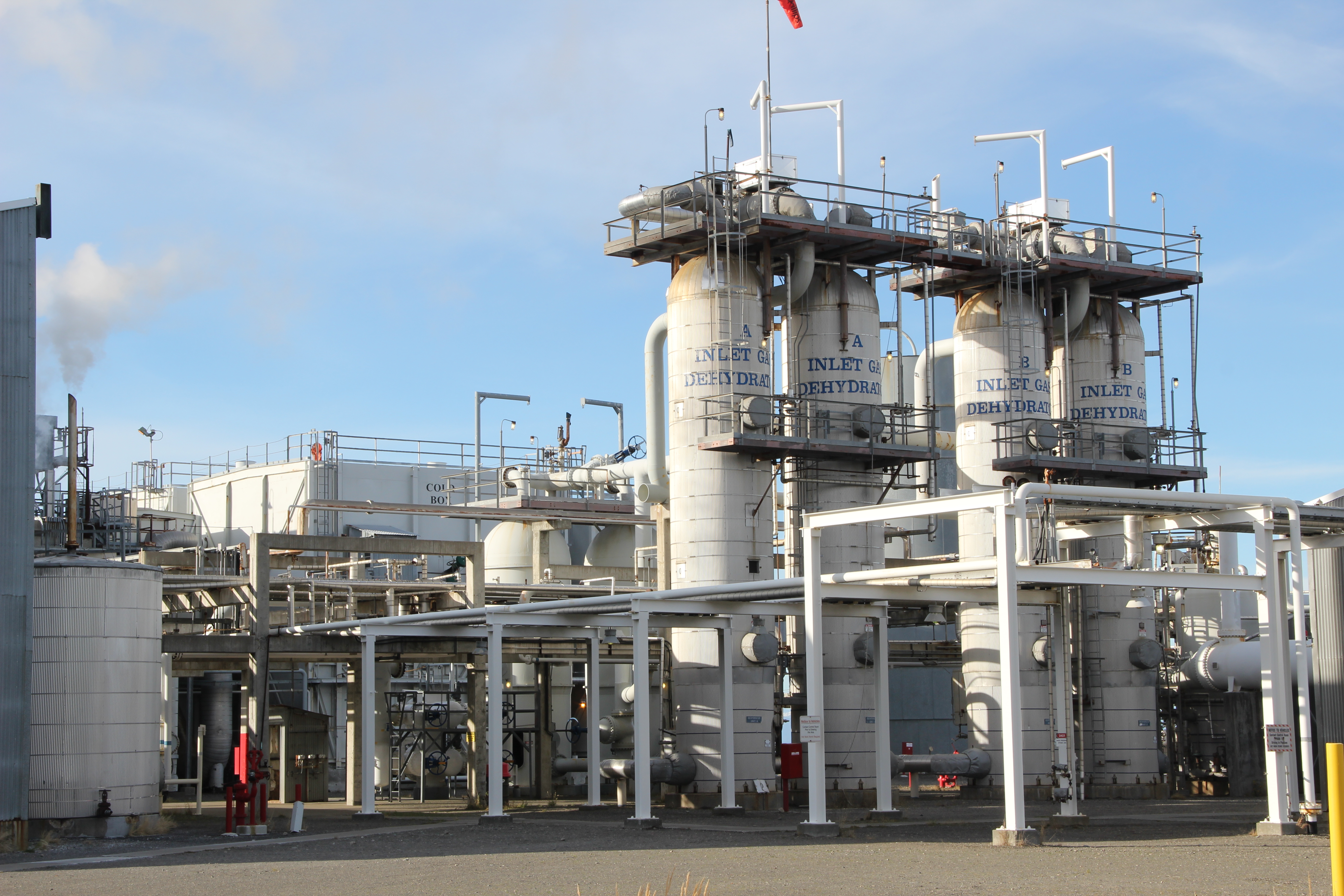
When gas arrives at the plant, it is first “dried” to remove liquids and impurities. (Photo by Rachel Waldholz/APRN)
Lawmakers gathered over the weekend in Juneau for the start of a special session on the Alaska LNG project, which would carry natural gas from the North Slope down to the Kenai Peninsula for export.
If it goes forward, it’s expected to cost a whopping $45 to $65 billion — and roughly half of that cost would be a giant liquefaction plant, where natural gas is turned into a liquid.
In the second half of our series breaking down the project, I visited an LNG plant to find out what all the fuss is about.
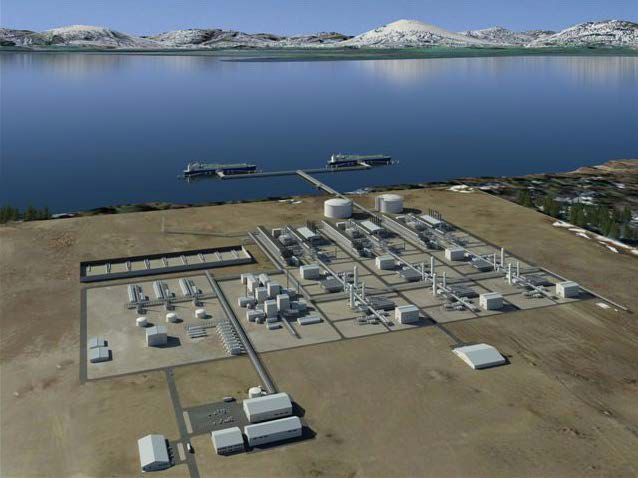
The Alaska LNG project calls for a giant plant on some 600 acres in Nikiski.
And as it happens, there’s already a liquefaction plant there — ConocoPhillips’ Kenai LNG plant. Right now, it’s the only plant in North America that exports LNG — and it’s been operating in essentially the same way since 1969.
Plant manager Ray Chumley gave me a driving tour. It’s a modest looking operation — like most hydrocarbon processing plants, it looks essentially like a series of pipes and holding tanks. It’s not small, but it’s nothing close to the plant required for the Alaska LNG project. At full capacity, this plant can process 1.3 million tons per year. The Alaska LNG project hopes to produce up to 20 million tons of liquefied natural gas per year.
But it’s still the same basic concept.
The gas for the Kenai plant comes from operations in Cook Inlet — on a clear day you can see the platforms out on the water.
First the gas goes through a drying process — it pulls out any last remaining liquids, any carbon dioxide. What you’re left with is mostly methane.
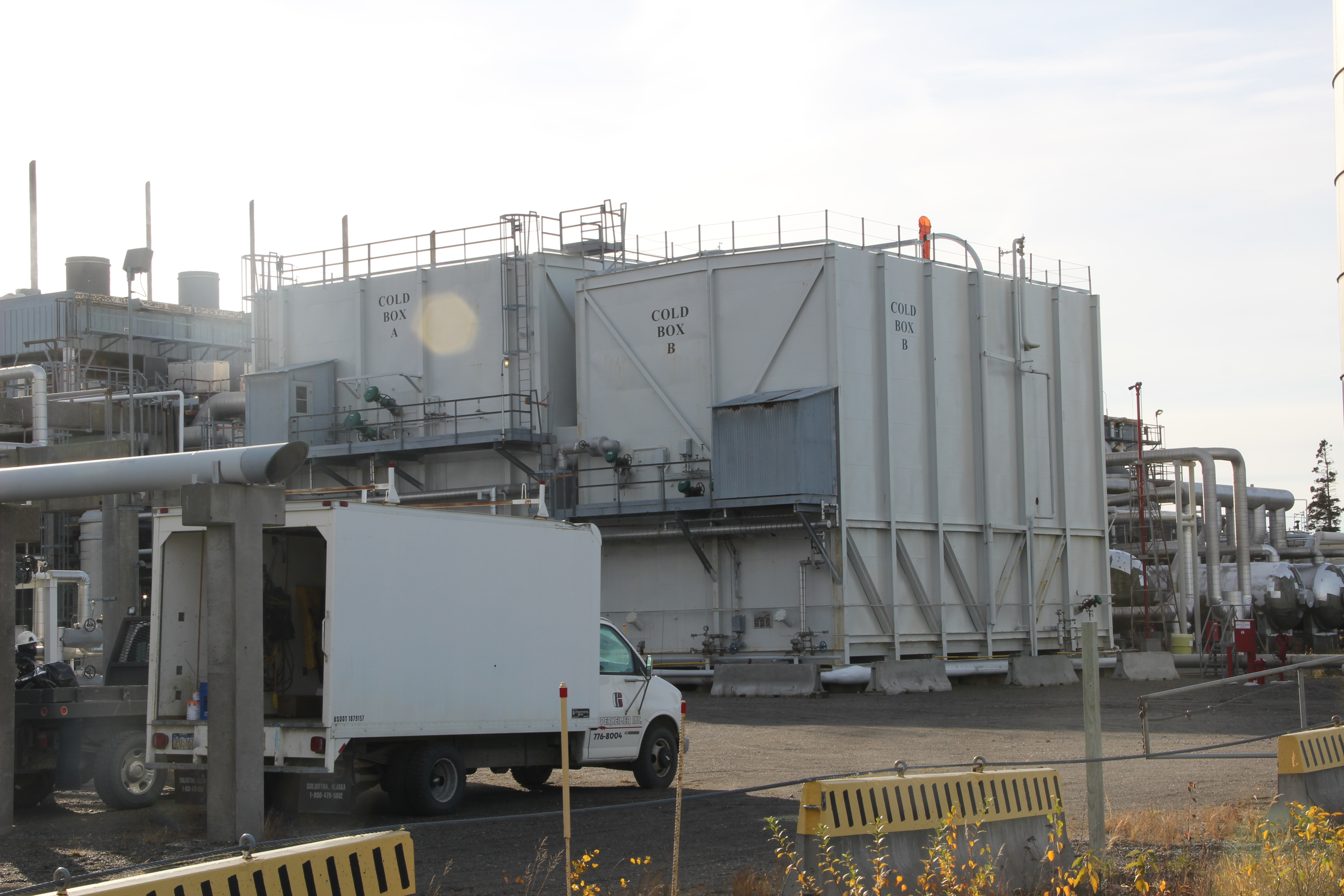
And that methane then goes into the proverbial black box — except in this case, it’s a white box. Actually, two white boxes, with some very technical names.
Inside these “Cold Boxes” at the Kenai LNG plant, natural gas is chilled to -260 degrees F. (Photo by Rachel Waldholz/APRN)
The boxes are labeled “Cold Box A” and “Cold Box B.” What’s happening in there?
“Well, that is our proprietary process for ConocoPhillips,” Chumley said. “So that is actually where the liquefaction happens. I can’t go into detail on what the process is, but that is where the liquefaction happens.”
Chumley can’t disclose because ConocoPhillips is one of the few companies in the world that has this technology. But it’s essentially a giant refrigerator. And it chills the gas down to -260 degrees Fahrenheit. As the gas cools, it transforms it from a gas to a liquid and shrinks down, becoming 600 times smaller.
The end result looks pretty familiar.
“If you pour LNG in a glass, in a clear glass, you would be very hard-pressed to tell the difference between that and water. It’s that clear. You could see right through the glass,” Chumley said.
But if you touched it, “You can imagine touching something at -263 degrees. It would freeze your finger. Absolutely,” Chumley said.
Once it leaves the box, the gas has to stay that cold. That means all the pipes and holding tanks have to be made from materials that can withstand that kind of temperature.
“Carbon steel won’t handle that. It just turns brittle. If you dipped a 1-inch piece of carbon steel pipe in a glass of LNG, you can take a hammer and just shatter that piece of pipe,” Chumley said.
And it’s one reason that liquefaction plants are so expensive. Not only do you have to buy the special technology to chill the gas into a liquid, you also have to build your plant so it can handle the cold. Everything after the cold box is the “cryogenic” side of the plant. Yep, cryogenic. As in real cold.
From the cold boxes, the LNG is piped into three tall storage tanks. But, again, these are nothing compared to what’s proposed for the Alaska LNG project. These three tanks are equal to one ship load, and the Kenai LNG plant loaded about six ships this year. The Alaska LNG project hopes to load 15 to 20 ships a month.
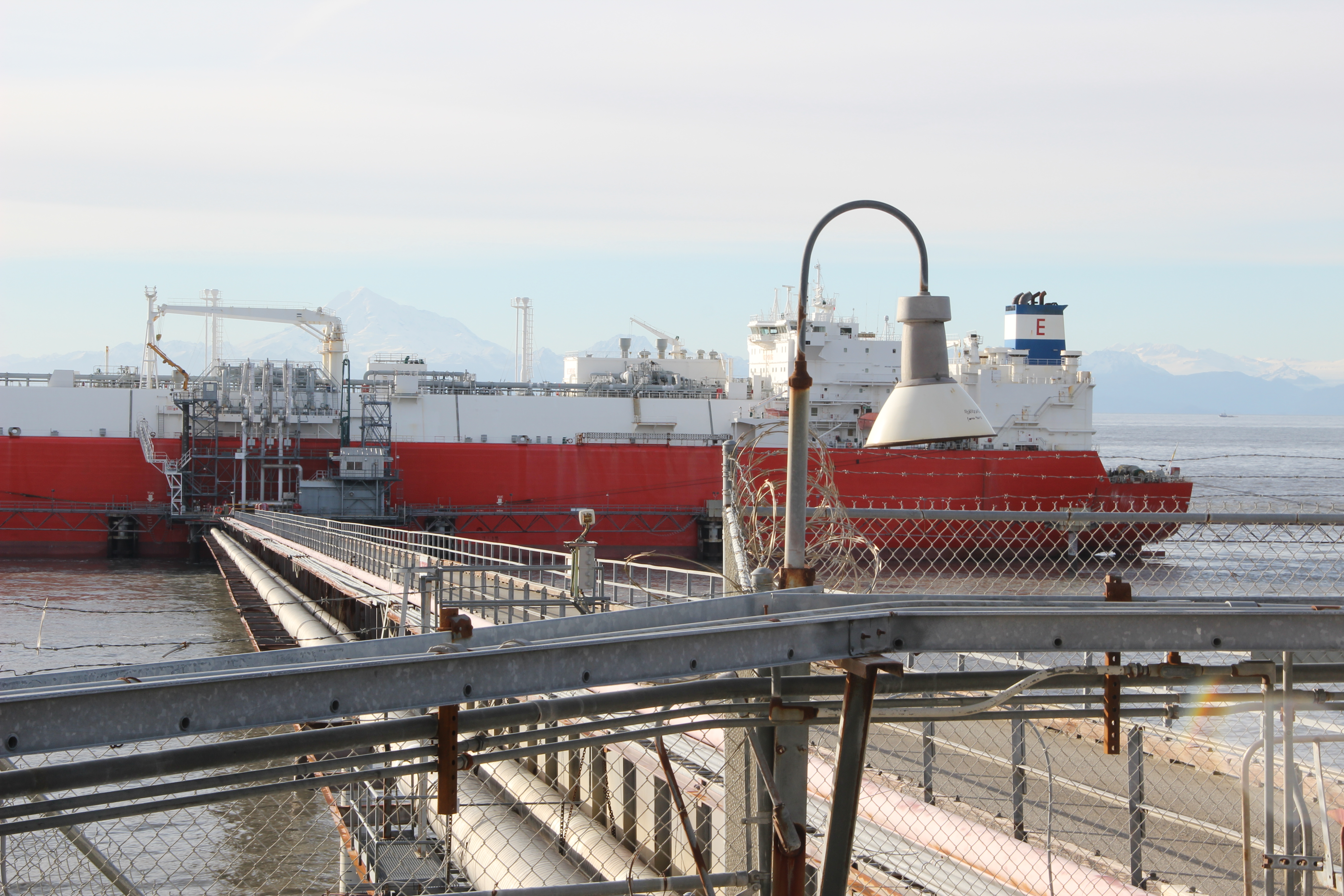
A tanker taking on a shipment at the Kenai LNG plant in October 2015. (Photo by Rachel Waldholz/APRN)
One of those ships is sitting at the end of the jetty. There’s a really nice view from the plant. The ship sits with Cook Inlet behind it, framed by the white peaks of the Alaska Range.
This ship is essentially a floating thermos — specially designed to transport the LNG across the Pacific to Japan or China.
And that’s the whole point of liquefying it. If the gas were being transported over land, it could just be fed into a pipeline, in gas form. But to fit it in a ship or a train or a truck it has to shrink down to liquid form.
Once it arrives in Asia, it’s warmed up and turned back into gas. And then it enters the pipeline system there — going to power factories to heat homes and businesses in, say, Tokyo.
And it’s decisions in Tokyo and elsewhere in Asia that will decide if this project ever goes forward. For now, the project is in the early design and planning stages. There likely won’t be a decision on whether to break ground until 2018 — and that will depend on whether there’s demand for the gas across the Pacific.
If there is and all goes according to plan, the Alaska LNG project would ship its first gas in 2024.
This illustration shows what a liquefaction plant could look like. (Image courtesy of Alaska LNG)
Lawmakers around the state are packing their bags and preparing to head to Juneau for their third special session of the year. This session will focus on one thing: the Alaska LNG project. That’s the giant pipeline the state hopes to build, along with ExxonMobil, BP, ConocoPhillips — and maybe TransCanada — to bring natural gas from the North Slope.
But if you’re like a lot of Alaskans, you might be a little fuzzy on the details.
I wanted to find out what Alaskans know about this project, so I parked myself outside the Fred Meyer on Northern Lights Boulevard in Anchorage.
“If I say liquefied natural gas, do you know what that is?” I asked.
“No? Liquefied natural gas, no,” one woman said.
“It’s something they’ve been talking about for 30 years! It’s just one of those pipe dreams,” a man said.
We shared a laugh over how it literally is a pipe dream. I also asked if people knew what LNG is, and why it’s liquefied.
“I’m thinking it’s liquefied for easier transport … it’s easier to transport a quantity of liquid versus the same quantity of gas,” a second man said, which was exactly right.
Here’s the short version: the Alaska LNG project will bring natural gas from the North Slope down to Nikiski, on the Kenai Peninsula, for export to buyers in Asia. In order to load the gas onto the ships that will carry it across the Pacific, it has to be liquefied.
And it’s a huge project. The estimated price tag is $45 to $65 billion.
Lydia Johnson works for ExxonMobil. She’s the technical manager for the Alaska LNG project.
“This is way bigger than TAPS (the trans-Alaska pipeline system),” she said. “This is one of the largest, most complex projects in the world today. … Right here in Alaska.
The key point — if you remember just one thing — is that the Alaska LNG project is not just a pipeline. It actually has three big pieces. First, there’s a gas treatment plant on the North Slope, to prepare the gas for the pipeline. Then there’s the pipeline itself, running some 800 miles down to Cook Inlet. And then there’s a giant liquefaction plant in Nikiski.
Johnson said each one of the components is a megaproject in its own right.
“You put them all together, that’s a gigaproject. That’s our term,” Johnson said.
That’s right. A gigaproject. And one that could bring in more than $2 billion a year in state revenue.
So let’s walk through this gigaproject.
“If I’m a natural gas molecule, natural gas is found below ground, so we’re looking at the fields of Point Thomson and Prudhoe Bay,” she said.
The gas at Prudhoe Bay has been tempting pipeline builders for decades. For some 40 years, the state has fielded different proposals, most recently to connect the North Slope to the Lower 48. The shale gas revolution put an end to that plan — suddenly, nobody needed more gas down south. That’s why this plan would ship the gas to Asia.
But before it can go anywhere, it has to be treated. The project calls for a gas treatment plant on the North Slope, to strip out impurities like carbon dioxide.
“This would be the largest gas treatment facility in the Arctic,” Johnson said. “Ever. Huge project.”
From that huge project into the next one. From the gas treatment facility, the gas would go into a pipeline rivaling the trans-Alaska pipeline in length.
There are some key differences. The existing pipeline carries crude oil, which comes out of the ground warm. Johnson compared it to syrup.
“Syrup going through a pipeline needs to be very hot,” she said.
That, by the way, is why much of the trans-Alaska pipeline is above ground. You don’t want to build a hot pipeline in permafrost.
“Now you think of natural gas,” Johnson said. “It’s very cold; it comes out of the ground naturally very cold.”
So the gas pipeline will be buried.
The plan calls for the line to run alongside the trans-Alaska Pipeline until about Livengood. From there, it would break off and head south to Cook Inlet.
Along the way, the line would need eight compressor stations to provide pressure and move the gas along. There are also plans for five off-take points. The idea is to deliver natural gas to Alaska communities along the route, with the hope that it would lower local energy costs.
The line would cross under Cook Inlet, perhaps near Tyonek, and end at a brand new liquefaction facility at Nikiski. That’s where the magic happens — and it’s expensive magic. Roughly half the cost of this $45 to $65 billion project is just the liquefaction plant.
The point of liquefaction is to shrink the gas to a manageable size. When the gas is chilled and becomes a liquid, it becomes 600 times smaller.
“If you took natural gas without liquefying it, you would need huge ships,” Johnson said. “And it would be basically a floating bomb, which you don’t want.”
But loaded with liquefied natural gas, those ships then become, essentially, floating pipelines, carrying the gas to markets around the world.
Here’s the catch, however: liquefying natural gas requires cooling it to -260 degrees Fahrenheit. There are only so many places on earth where that can be done.
As it happens, one of those places is already in Nikiski — ConocoPhillips’ Kenai LNG plant.
And that’s where we’ll go in part 2 when we get to use the word cryogenic in a non-sci fi context.
Alaska Statute only allows general law cities to tax the same items taxed by their borough unless the borough makes an exception.
Kenai Peninsula Borough voters repealed an ordinance this year that gave general law cities the power to tax non-prepared foods year round. The voter decision means the cities of Soldotna and Seldovia will be forced to deal with a decrease in tax revenue.
Everyone likes a deal, especially at the grocery store. For that reason, it’s probably not too surprising that borough residents voted against a year round grocery tax for the third time in a row.
Kenai Peninsula Borough voters decided in 2008 to stop taxing non-prepared foods between September 1st and May 21 of each year. And the voters stuck by their decision in 2011. The vote did not affect the home rule cities, Kenai and Seward. It would have restricted the general law cities of Homer, Seldovia and Soldotna, but the borough assembly gave those cities an out.
The assembly passed an ordinance giving them the power to ignore the voters’ decision.
This year Proposition 1 called on peninsula voters to strike down that ordinance. James Price is one of the proposition’s sponsors. Price fought the borough in the Kenai Superior Court and in the Alaska Supreme Court to prove his right to start a referendum petition.
“August of 2014 we collected about 1800 signatures and that’s what put Proposition 1 on the ballot for 2015,” said Price.
The repeal passed with 58% of the vote. The borough assembly enacted the decision during its October 13th meeting.
The vote doesn’t immediately affect Homer. Homer City Manager Katie Koester says it does mean one less revenue option the city could’ve used to rectify an estimated $1 million budget shortfall.
“That being said the council voted in 2009 to not collect [a] tax on non-prepared foods. So they decided to follow the wish of the voters,” said Koester.
The repeal also indirectly kills a city ordinance passed this year that expanded the definition of taxable prepared foods to include a variety of snacks. Seldovia and Soldotna are the only cities directly affected. Seldovia charges a 4.5% tax on non-prepared foods during the summer and a 2% tax during the rest of the year.
There was confusion in Seldovia on the vote’s impact. Kenai Peninsula Borough Finance Director Craig Chapman says the vote affects Seldovia the same as Homer and Soldotna. Seldovia City Manager Tim Dillon says he was originally told the vote wouldn’t affect Seldovia. Dillon and borough officials re-examined the situation and he says the ultimate impact to Seldovia’s tax revenue will be minimal. Soldotna’s city council and administration were the most vocal opponents of Proposition 1. Newly elected Soldotna Mayor Pete Sprague says the city appropriated $7500 to fight the repeal.
“[Of] course it wasn’t a very large amount of money but we felt we had to do something to try to influence the vote,” said Sprague.
Sprague estimates the city will lose about 10 percent of its budgeted revenue or between $1 and $1.2 million. He says the city is in good financial shape, but they have to make up that money. He’s already canceled a planned renovation of the city council chambers and he says more cuts are needed.
“Also I think we’ll be looking at user fees. We’ll be looking at a property tax increase. We’ll be looking at using our fund balance to help make up the difference,” said Sprague.
Sprague says the grocery tax helped Soldotna capture revenue from non-city residents who use the city’s services regularly. James Price believes the city was wrong to tax food because it is an indispensable resource and he says Soldotna’s grocery tax unfairly targeted people living outside city limits.
“Soldotna has the lowest tax rate of any jurisdiction within the borough,” said Price. “I don’t think it’s unreasonable for them to carry a little more of the tax burden. I think they’re raising enough money and they won’t need to raise property taxes. I think they just need to tighten their belts a little bit.”
Price won’t stop with his latest victory. Next he plans to help Kenai residents end the year-round tax on non-prepared foods in their city.
The National Transportation Safety Board has released the results of an investigation into a 2013 airplane crash in Soldotna that killed 10 people.
The NTSB says too much unbalanced weight is the likely cause of the crash that brought down the DeHavilland DHC-3 Otter in July of 2013.
Pilot Walter “Willy”Rediske, 42, of Nikiski and his passengers, Milton and Kimberly Antonakos and their three children and Dr. Chris and Stacey McManus and their two children, all of Greenville, South Carolina, died when the plane crashed shortly after takeoff.
The new report confirms the preliminary studies the agency conducted, that found the weight of the passengers and cargo wasn’t properly accounted for ahead of takeoff. A video retrieved from a smartphone found at the scene helped investigators patch together what happened. The center of gravity for the plane at takeoff was too far aft, or toward the rear of the plane. The end result was an aerodynamic stall, and the plane crashed 2,300 feet after takeoff.
Officially, the NTSB says the probable cause of the accident was due to the operator’s failure to determine the actual cargo weight. Additionally, the Federal Aviation Administration’s failure to require weight and balance documentation also contributed to the crash.
Close
Update notification options
Subscribe to notifications
Subscribe
Get notifications about news related to the topics you care about. You can unsubscribe anytime.