Southeast

Cave sediments found on Prince of Wales Island could help scientists understand Earth’s climate history

Paul Wilcox descends into Devil's Canopy Cave on Prince of Wales Island. (Photo courtesy of Jessica Honkonen)
Paul Wilcox descends into Devil’s Canopy Cave on Prince of Wales Island. (Photo courtesy of Jessica Honkonen)

Listen to this story:

An unlikely discovery in a cave on Prince of Wales Island could help scientists understand Earth’s climate history. A small pile of sand and stones tells the story of formidable glacial meltwater floods that washed through Southeast Alaska during the last Ice Age. 

Paul Wilcox is a paleoclimate researcher at the University of Lapland in Finland. While looking for stalactites and stalagmites on Prince of Wales Island in 2022, he stumbled across something odd in Devil’s Canopy Cave. 

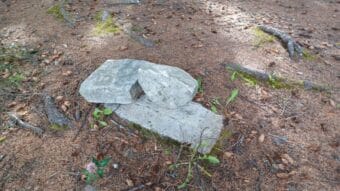
“I found this very impressive pile of sediment in one of the cave rooms,” he said.

The pile is made of rounded cobbles and pebbles on top of sand, which is unlike what he usually finds in most caves. 

“It often is either like a goopy mud or the rocks are very sharp-edged,” Wilcox said.

The rounded and weathered rocks looked like they traveled a vast distance over land, and the layers gave Wilcox a clue that the sediments could have been transported by multiple floods. 

He and his colleagues dated them using a method called optically stimulated luminescence that traces when quartz crystals were last exposed to sunlight. They found that the sediments were preserved in the cave like a time capsule between 17,000 and 20,000 years ago.

The researchers say the pile is evidence of enormous glacial meltwater floods coming from the Cordilleran Ice Sheet that covered much of British Columbia and parts of Alaska, including Southeast, South Central and the Aleutian Islands, during the last Ice Age. 

“These meltwater events were a common occurrence during the height of the last Ice Age,” Wilcox said. 

The finding could help researchers unravel the mystery of how Earth’s climate rapidly fluctuated thousands of years ago. 

Maureen Walczak, a researcher at the University of Washington, named these prehistoric floods Siku events, an Iñupiaq word for ice. 

She said this pile is significant because Siku sediments are a rare find on land. The glacial ice usually destroys everything in its path when it advances forward. 

Paul Wilcox samples Siku sediments inside Devil's Canopy Cave. (Photo courtesy of Jessica Honkonen).
Paul Wilcox samples Siku sediments inside Devil’s Canopy Cave. (Photo courtesy of Jessica Honkonen)

Walczak didn’t work on this cave study, but she and her team discovered evidence for Siku events in the Gulf of Alaska in 2020. 

“The ice basically picks up the rock, and it gets mixed up with the ice, and then the icebergs float out to the middle of the ocean and drop it,” she said.

Along with boulders at the bottom of the ocean, she found glacial silt fanned far out from the coast of Alaska. Radiocarbon dating revealed these floods started around 40,000 years ago. 

Walczak said that the timing is key. It could shift how scientists understand the chain reaction that led to prehistoric climate swings.

The same sort of glacial calving and flooding events happened on the other side of the globe, in the North Atlantic Ocean. They’re named Heinrich events after the scientist who discovered them in the late 1980s. 

The tremendous influx of cold freshwater into the North Atlantic is thought to have changed the ocean’s circulation. Ocean circulation affects climate, so many climate scientists think that Heinrich events could have played a big role in abrupt climate fluctuations during the last Ice Age. 

But Heinrich events started after the more recently discovered Siku events. 

Paul Wilcox explores another cave on Prince of Wales Island. (Photo courtesy of Jessica Honkonen)

Walczak suggests that Siku events may have even triggered Heinrich events, or they just responded to the same trigger earlier. What could have set them off is still a mystery. But once they were in motion, researchers say they could have created a feedback loop that further destabilized Earth’s climate. 

“We’re talking about shifting a paradigm here,” Walczak said. “This is right in the beginning of changing how we’re thinking about the role of the Cordilleran [Ice Sheet] in the global climate system.”

Historically, the Pacific Ocean was seen as a relatively passive entity in climate systems. When it came to driving global climate, the North Atlantic got the most research attention. 

“Probably because it’s the easiest thing to study, and it’s ringed by a bunch of big, illustrious academic institutions,” Walczak said. 

But she said that’s changing, especially since scientists understand the Pacific and Southern Oceans play important roles in shifting global patterns now. 

Walczak said that understanding climate changes in Earth’s history can help us prepare for the effects of future warming now.

“We don’t have in historic times any kind of analog. So we have to go back, you know, over 10,000 years ago to understand what this might look like,” she said.

Sometimes, to understand Earth’s history, digging around in Alaska’s caves can help. 

$28M state contract kickstarts Cascade Point ferry terminal despite local pushback

A blue-and-white Alaska ferry traveling through an inlet, with steep forested hills in the background.
The Alaska Marine Highway System ferry Hubbard approaches the dock in Skagway on July 28, 2024. (Eric Stone/Alaska Public Media)

The state of Alaska is pressing forward with a controversial plan to build a ferry terminal it says will streamline service in the Upper Lynn canal.

But communities in the area that depend on the ferry system aren’t on board. They say they need more information about the project, known as Cascade Point, and are concerned the new terminal could make getting to and from Juneau even more complicated than it already is.

“I think we’re all looking for the same thing, which is some definitive answers before we start on construction of this,” Haines Borough Mayor Tom Morphet said during an assembly meeting in July.

The state Department of Transportation signed a $28.5 million dollar contract last week that kickstarts a plan to build a new ferry terminal about halfway between Juneau and Haines, the Anchorage Daily News reported last week.

The contract went to K&E Alaska Inc. and will pay for the first phase of the project. According to the state’s request for proposals, the first phase will entail design work plus the construction of an access road to the terminal site, a new bridge over Cascade Creek, a gate and an upland staging area – but not the ferry terminal itself.

The company should be able to begin the design phase this summer, with construction starting next summer and stretching into September of 2027, DOT spokesperson Sam Dapcevich said. The terminal will be located on land owned by Goldbelt Inc., a Juneau-based Alaska Native corporation.

Cascade Point is roughly 30 miles farther north of Juneau than the current terminal in Auke Bay. That in theory could cut about two hours off the round-trip ferry ride, but passengers would then have to drive or take a bus to Juneau from Cascade Point.

Haines, Skagway and the ferry advisory board all question the plan

Community leaders and a ferry system’s advisory board say the state has yet to make a strong case for the project – and that it’s premature to be awarding contracts.

Among them: the Alaska Marine Highway Operations Board, an advisory body created to consult with the Alaska Marine Highway System on short- and long-term planning, and to ensure the system adheres to those plans. The group’s concerns have centered around what they say has been the state’s failure to demonstrate why the project is necessary and how it will work.

Board Chair Wanetta Ayers said in an interview last week that it’s crucial a project of this scale is carefully thought out to avoid spending millions of dollars on a terminal that may not benefit customers.

“We don’t have the time or the money for misfiring – doing projects that either don’t come to fruition or don’t really contribute to service levels, meeting the needs of Alaskans,” Ayers said.

The Haines assembly, for its part, voted in July to send a letter to Gov. Mike Dunleavy that says they cannot support the project absent more information. Their concerns include how walk-on passengers will get from the terminal at Cascade Point to downtown Juneau.

Notably, Goldbelt has committed to running a bus service to transport passengers between Cascade Point and Juneau. A commitment letter sent to DOT in May said the service would be available for every ferry arrival and departure. Drop-off points would include the Valley Transit Center, the Auke Bay Ferry Terminal, the Cascade Point Terminal and “other possible locations.”

Officials in Skagway, meanwhile, sent DOT a letter in June that said the project has not been integrated into the ferry system’s draft long-range plan – and questioned why the state hasn’t released a feasibility study or economic analysis justifying the project.

The letter also questions how the facility will be staffed and operated and why the department is pursuing a brand-new terminal, given the state’s ongoing budget shortfalls and the reality that existing terminals and infrastructure are in what the letter calls “urgent need of repair.”

DOT says a new terminal fits the ferry system’s long-term goals

DOT responded to the letter within two days. The department emphasized that the Cascade Point project is being funded through dollars appropriated years ago for the broader “Juneau Access Project” – not from a more general pool used for existing infrastructure.

The letter notes that DOT has been conducting engineering feasibility studies and design work on Cascade Point for 18 months, but adds that cost-benefit analyses can be “limited in capturing the full community and economic benefits unique to coastal Alaska.”

Asked for comment on critics’ concerns, Dapcevich, of DOT, said one of the top issues seems to be how walk-on passengers will get from Cascade Point to Juneau. As he sees it, that shouldn’t be a problem, given Goldbelt’s commitment to operate a ticketed bus service.

“Right now, if you’re from Haines or Skagway and you take the ferry to Auke Bay, there’s no bus service there. You gotta call a cab or you gotta walk,” Dapcevich said. “And with Cascade Point and Goldbelt’s commitment, you would have bus service from the ferry terminal to town.”

Dapcevich said the public will be able to weigh in on project design during future public meetings and comment periods. He added that the department has considered other operational questions, such as terminal staffing and where vessels will be homeported, but that those details are speculative at this stage. He did say the state anticipates adjusting current snow plowing priorities to be sure drivers’ vehicles can make it to and from the terminal in the winter.

As to concerns about the ferry system’s long-range plan, Dapcevich said that while the plan may not focus specifically on Cascade Point, it does focus on the broader goal of shortening routes and boosting efficiency.

“Cutting a couple hours off of each run in each direction, it reduces the wear and tear on the machinery, it reduces the fuel costs,” Dapcevich said. “We see potential for improved service as other parts of the long-term strategy fall into place.”

He’s referring in part to a separate-but-related project called the Chilkat Connector, which has also been referred to as the Juneau Access Project. The department in March announced a study to examine the feasibility of building a road from Haines along the west side of the Lynn Canal along with other infrastructure.

There are several different ways that could take shape. But the idea is that a passenger could start in Haines and drive south along the canal to William Henry Bay. At that point, they would cross the canal on a ferry to Cascade Point and then drive to Juneau.

Dapcevich acknowledged that the journey would be more complicated not only for Skagwegians but also for those traveling without a vehicle.

“The Chilkat connector is a separate thing at this point,” he said. “There’d be a lot of permitting and securing funding. Lots of pieces to that puzzle, too.”

Annual tattoo expo brings dozens of artists to Juneau

Rick Escovar tattoos Autumn Dollison at the Ink Masters Tattoo Show in Juneau on Friday, Aug. 1, 2025. (Photo by Clarise Larson/KTOO)

In an isolated town like Juneau, access to tattoo artists can be limited. But this past weekend, dozens of artists lined Elizabeth Peratrovich Hall for the third annual Ink Masters Tattoo Show downtown. 

Demetrius Bowen was tattooing a cartoon character on the leg of his client, Connor Woodhouse.

“I was so surprised to hear about something like this in Juneau,” Woodhouse said. 

He works for a cruise line that stopped in Juneau on Friday. His new ink is a Mario character called Shy Guy. Woodhouse heard about the show through word of mouth and decided to check it out. He said he’s glad he did. 

“So many different styles, so many different artists,” he said. “You could really walk around and pick and choose who you resonate with, and who you want to get tattooed by, which is so cool.”

It was the third annual Ink Masters Tattoo Show hosted in Juneau. This year’s expo featured nearly 50 artists who traveled from all over the country — and some out of the country — to come to Alaska’s capital city. From Friday through Sunday, Elizabeth Peratrovich Hall was filled to the brim with booth after booth of artists. Each one with their own chairs, needles and art on display.

Boxer Gamez tattoos a client’s leg at the Ink Masters Tattoo Show in Juneau on Friday, Aug. 1, 2025. (Photo by Clarise Larson/KTOO)

Bowen was stationed in the center row. He’s based in New Mexico, but has been traveling with the show for about four years. He said he feels a special connection to Juneau and the people he tattoos here. 

“The fact that there’s all of these people come to this one spot, waiting for this one set event for the year — it means more than the world to me for them to trust me for whatever we’re gonna do for them,” he said. 

Theresa Bae is the host and manager of the show. She and her husband started the traveling expo nearly two decades ago in the Lower 48. They held shows in Anchorage and Fairbanks before adding Juneau to the list three years ago.  

“Each artist, even if they’re doing the same type of medium, their styles are just so different,” she said. “It just gives everybody a huge variety of artists that they have access to in one location.”

Bae says after her first visit, she realized two things: there was a huge demand for more artists in town, and that she loved Juneau.

“I’m telling you, Juneau is special,” she said. “Juneau is a special place.”

So, last year she opened up a local tattoo shop downtown and is in the process of making Juneau her new home. 

“We have four resident tattoo artists and then a piercer that comes every two weeks at the shop,” she said. “Even during off-season, we stay pretty consistently busy with our local clients.”

But even still, she said there’s always demand for more artists, and that’s why they plan to continue bringing the show each year. 

Jesse Castillo tattoos a client at the Ink Masters Tattoo Show in Juneau on Friday, Aug. 1, 2025. (Photo by Clarise Larson/KTOO)

Autumn Dollison, who works in health care, said she waited all year for the expo to come back around. On Friday, she was getting an arrow tattooed on her arm to honor her Indigenous heritage. 

“I think it means everything,” she said. “I was just sitting here thinking and looking around how he’s doing mine, and how glad I am that our Juneauites can come here and get beautiful artwork on their bodies.”

Man medevaced to Seattle after violent arrest by Juneau police officer

A Juneau police officer stands on duty in March 2023. (Photo by Clarise Larson/KTOO)

A Juneau man was medevaced to Seattle this week after being slammed to the ground by a Juneau police officer. 

According to a press release from the department Thursday afternoon, the incident took place Wednesday evening. Police say the man is 49 years old, but did not name him.

According to the department, the incident took place after officers responded to a report of a woman fighting with a man outside of the Douglas Library. It says the woman threw water in the man’s face and made racial comments. 

According to police, an officer was attempting to place her under arrest and into a vehicle when a friend of hers appeared and continued to yell at the man. Police say the man then aggressively approached an officer. 

Police say the officer attempted to place the man under arrest and into handcuffs, but he resisted and was “taken to the ground.”

A video of the incident has circulated online. It shows an officer arresting a woman, before panning to a man and another officer in front of a vehicle. 

The officer stands behind the man who is leaning over the vehicle. After a few seconds, it appears the officer wraps both arms around the man and slams them both to the ground. The video shows the man’s head hitting the concrete sidewalk. He remains there unmoving for the duration of the video. 

Police say the man was initially brought to Bartlett Regional Hospital with a head injury before being transported to Seattle. Police did not share the man’s current condition.

The department did not immediately respond to requests for more information. According to police, the incident is currently under investigation

Losses mount for timber companies in Alaska amid China’s import ban

Logs being moved from the road system to water on Kupreanof Island near Petersburg in 2013.
Logs being moved from the road system to water on Kupreanof Island near Petersburg in 2013. (Joe Viechnicki/KFSK)

The Trump administration’s tumultuous relationship with China is proving to be a major issue for some companies in Alaska’s forest products industry. That includes in Haines, where a timber sale that was supposed to kick off this spring has stalled amid China’s ban on U.S. log imports.

China announced the ban in March, citing concerns over pests like bark and longhorn beetles in U.S. shipments. The move came the same day that China imposed retaliatory tariffs on certain U.S. agricultural products amid President Donald Trump’s global trade war.

The decision has had sweeping effects on companies that harvest logs in Alaska and ship them overseas.

“We’re severely impacted by it. There’s no doubt about that,” said Eric Nichols of Alcan Timber, a Ketchikan-based company. Nichols also serves as vice president of the Alaska Forest Association, a Southeast nonprofit.

Nichols said about half of his company’s volume typically would go to China. As a result of the halt on imports, he said, the company has had to shut down at least one of its operations and make a range of other changes.

Those include shipping to other markets, including Washington, South Korea and Vancouver, British Columbia. Alcan has also shifted its focus away from harvesting areas that are best suited for the Chinese market.

Those changes have come at a steep cost.

“We’re at pretty big losses on going to other markets, just because of the transportation differential from what we’re used to,” Nichols said.

In Haines, meanwhile, Oregon-based company NWFP Inc. had been planning to move forward with a sale in May that’s been under contract since 2021. The so-called Baby Brown sale would be the area’s first major timber sale since the 1970’s.

But the company could not move forward with the sale this spring due to the loss of the Chinese market, Haines State Forester Greg Palmieri said in an email. He added that the company is seeking other markets for the sale, both within the U.S. and overseas.

“I expect that as soon as they have the ability to market the timber, operations will move forward with the sale currently remaining under contract,” Palmieri wrote Tuesday afternoon. “They are continuing the processes to obtain the required permits from State and Federal agencies to move the logs to markets as originally planned.”

The trade disputes have also hit Canadian lumber company Transpac Group. The company in March largely shut down its site on Afognak Island, just north of Kodiak, citing the ban and failed efforts to divert its product to other markets.

“We’ve been trying very hard since the announcement,” Transpac CEO Charles Kim said in an interview at the time. “And it has all failed.”

A spokesperson confirmed this week that the situation hasn’t shifted in the time since.

Nichols, of Alcan, says his company will have to weigh similar decisions if nothing changes.

“We have to make decisions, you know, a little bit like Afognak, whether we’re going to stay in business or not,” Nichols said. “The question is how long can we hold these logs before we have to sell them and generate the losses they’re going to generate here.”

Juneau and other Southeast communities broke high temperature records Monday

The sun shines on Eaglecrest Ski Area in Juneau. (Photo by Clarise Larson/KTOO)

The sunshine that Southeast Alaskans felt yesterday will go down in history. Multiple towns in the region reached record high temperatures.

The highest record breaking temperatures were in Yakutat and Juneau, which both reached 81 degrees. That broke Yakutat’s 1996 daily record by nearly 10 degrees and tied Juneau’s 1982 record.

Temperatures also broke or matched records in Haines, Gustavus and Klawock.

National Weather Service Meteorologist Grant Smith said it’s important to track record-breaking days. 

“So when we see these extremes, yes, it’s impressive,” he said. “If we see more of them in a short amount of time, then yeah, it could mean something.” 

Over decades, he says, that data can help tell the story of how the local climate is changing. But just a single day of record heat can’t alone tell that story.

This year, Alaska updated its heat advisory levels to match how temperatures feel in northern latitudes. 

In Southeast, a forecast of 80 degrees now triggers a heat advisory. Juneau just had its first one.

The new advisories reflect that hot weather often feels hotter here.

“The sun angle is so much higher, so all that light energy is much more direct on us, on the concrete, on our skin,” Smith said. 

Smith describes it as a flashlight shining down on a table. When it’s shining directly down, the light is concentrated in a small circle, so it’s more intense — that’s what Alaska is like in the summer. When the flashlight is angled, it shines as a large cone at a much lower intensity — that’s what we experience in the winter. 

Monday’s heat gave way to clouds and rain across much of Southeast on Tuesday. Aside from a few days of warmth here and there, cool weather has dominated this summer so far.

Correction: This article has been updated to specify that Yakutat and Juneau saw the highest record breaking temperatures in the region, but not the highest temperatures overall. 

Site notifications
Update notification options
Subscribe to notifications