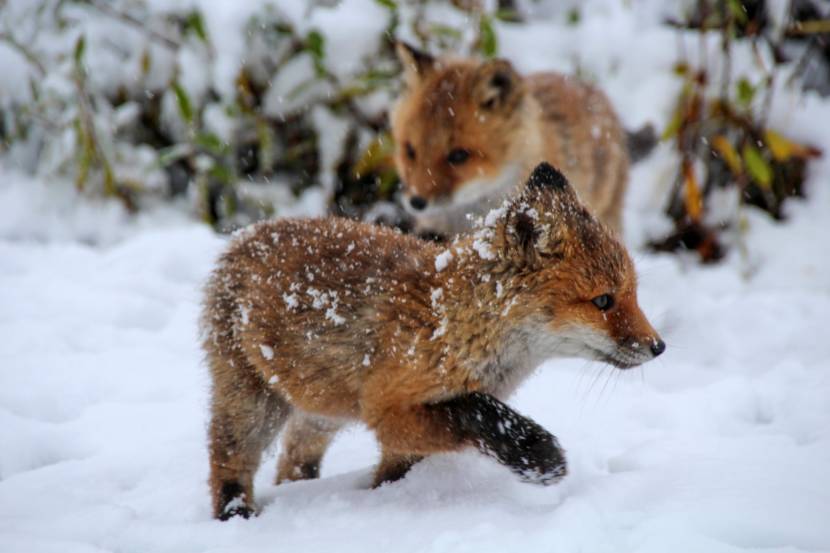
Four rabies cases have been confirmed in the Yukon-Kuskokwim Delta recently. Three rabid foxes and one rabid dog were found in Nightmute, Alakanuk and Bethel.
Public Health Veterinarian Dr. Lauri Meythaler-Mullins has been working in all three places to vaccinate pets and to diagnose and confirm cases. She said that the dog with rabies was euthanized.
“And there were three other dogs in addition that had been euthanized because they came into contact. They were bit by rabid foxes. All four of these dogs, they were not vaccinated,” Meythaler-Mullins said.
Having a vaccine against rabies can make the difference between life and death for a dog. Meythaler-Mullins said that a vaccinated dog does not have to be euthanized if bitten by a rabid animal. Instead, they are quarantined for 45 days and given another vaccine. An unvaccinated animal is not so fortunate.
“If the fox was rabid, the dog will develop rabies. So that dog will have to be euthanized. If we’re uncertain, there will be a longer quarantine for an unvaccinated dog,” Meythaler-Mullins said.
Meythaler-Mullins had one final bit of advice for people who shoot rabid animals: don’t shoot them in the head.
“This is really important because they need the brain to test for rabies,” Meythaler-Mullins said.
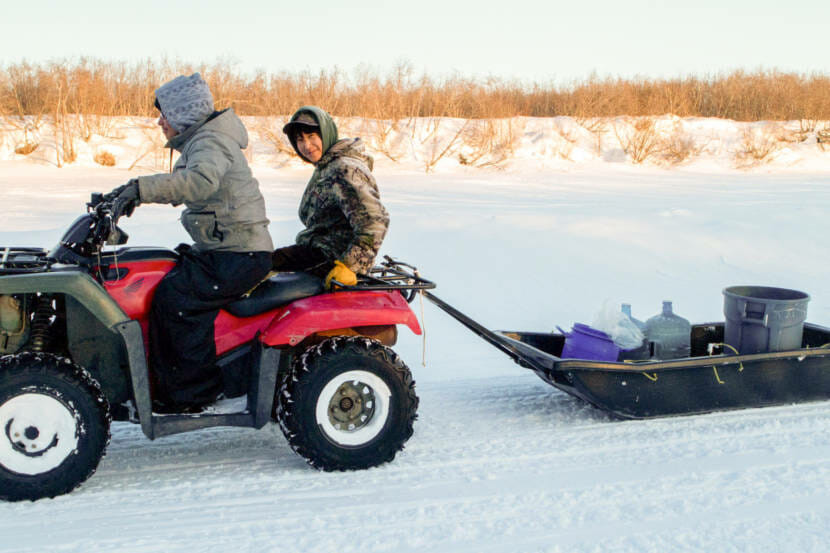
Henry Peter goes the extra distance to the Kuskokwim River, rather than the Tuluksak River, which is closer to town. (Olivia Ebertz/KYUK)
After a fire destroyed Tuluksak’s water plant in January 2021, Tuluksak residents have developed several different drinking water options. Each comes with its own pros and cons. Residents’ choices depend on what they trust — and what they have the means to access.
If you live in Tuluksak, you can pack water from a hole in the frozen Kuskokwim River, which is about 2 miles from town. You’ll need a vehicle, and if that’s a snowmachine or a four-wheeler, you’ll need a sled. You’ll need to be careful of wolves, too, as they’ve been spotted near the village lately. Plan for about a 45-minute round trip, and bring an ice pick.
But Henry Peter’s ice pick had gone missing, so he had to gamble on an open hole.
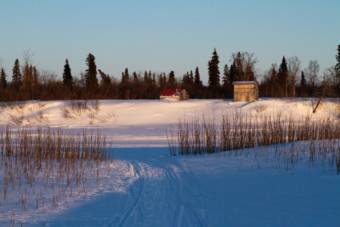
The snowmachine trail that connects the Tuluksak River to the Kuskokwim. (Olivia Ebertz/KYUK)
“I’m quite fortunate,” he said. “Somebody was there before me.”
Peter was packing water after his shift at the store.
“At least twice a week of hauling water back and forth,” Peter said.
He always packs enough for his household of five, and usually enough extra water for another family. Tonight he’s hauling 40 to 50 gallons. Peter goes down to the Kuskokwim River rather than the Tuluksak River, which is closer to town. He doesn’t trust water from the Tuluksak.
“I personally did get sick from drinking it before,” he said.
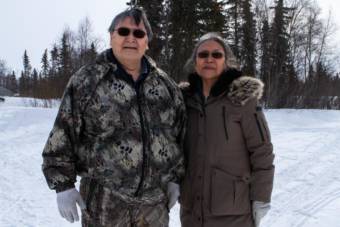
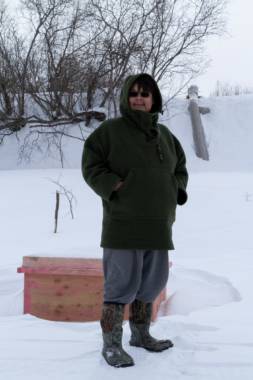
Elders Peter and Elena Gregory don’t trust drinking water from the Tuluksak River. (Olivia Ebertz/KYUK)
Elders Peter and Elena Gregory don’t trust the Tuluksak River water, either.
“We won’t drink that water,” said Peter Gregory.
“Because of the mines up there that made it, like, really coffee with milk,” Elena said.
Elena is talking about the Nyac mine, a former gold mine that sits at the source of a main Tuluksak tributary. The Alaska Department of Environmental Conservation has said that the river water is safe to drink when boiled, but most Tuluksak residents say that it makes them sick.
Even so, residents without vehicles had to get water from the nearby Tuluksak River after the water plant burned down. The Kuskokwim River was too far away to carry water on foot.
During spring breakup, the Gregorys might also have to resort to packing Tuluksak River water because ice floes will likely make the Kuskokwim too dangerous. In the summer, they’ll drink rainwater. The couple prefers natural water sources. They don’t trust water treated with chemicals, like the water from the Tuluksak school, where the Yukon-Kuskokwim Health Corporation installed a temporary water plant in early March.
Tuluksak resident Jera Peter doesn’t mind the school water.
“Granted, it smells like chlorine, but it’s better than drinking out of the river,” he said.
Jera Peter helped install the temporary water plant. He said he was lucky to get the work after he lost his job when the washeteria burned down. The temporary plant pipes water up from the Tuluksak River, and some residents are skeptical of it.
“It’s good enough to drink, even if I have to boil it,” he said.
Most people boil the water they get from the school. They say it’s brown and that once it settles, there’s a layer of sediment on the bottom.
The temporary water plant is housed in the shop area of the school and is only open for about six hours each day. That means people who work late, like Henry Peter, can’t access it most days.
YKHC Director of the Office of Environmental Health and Engineering Brian Lefferts says the brownness of the water was likely because the operators weren’t changing the filters often enough. Lefferts says he talked to the operators about it in mid-April.
“Since they’ve changed those, it’s making good, clear water again,” Lefferts said.
Jera Peter helped to install the temporary water plant. (Olivia Ebertz/KYUK)
Lefferts also says that sediment in the river usually increases in the spring, so filters may have to be changed more often.
When breakup comes, they’ll have to pull the system out of the river, wait for the ice to clear, and then reinstall it on a floating dock.
Lefferts said that’s an annual process for these systems.
“And that’s pretty typical for anybody that uses an intake system out in the river,” he said.
The community will have to prepare by filling their water storage tanks. They have a few thousand gallons of water storage available to them, which could carry them through a couple weeks.
There’s one other option for getting water in Tuluksak. Residents can pick up donated bottled water from the Tuluksak Native Community office, when it’s open. But the supply is dwindling. The tribe has requested bottled water from the State of Alaska to carry them through breakup. Bottled water is also available at the store for around $60 per case.
Tuluksak was hoping to have a more reliable water source by now — a portable water plant from YKHC. It would provide more water in a more central location, but the plant is still sitting in Bethel because it was too heavy for the ice road this winter. For a brief period, the National Guard thought that they might be able to deliver it using a similar helicopter to the one that removed the “Into the Wild” bus, but it proved too heavy even for that.
The new plant is expected to be barged up in June. Installation would likely be finished in late summer.
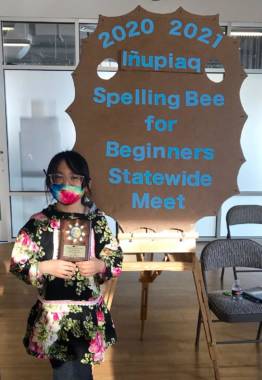
Kopeck Kaitlin Alston is the first ever winner of the Iñupiaq Spelling Bee. (courtesy Angie Alston)
Kopeck Kaitlin Alston is the first ever winner of the Iñupiaq Spelling Bee.
Competitors had a tough time getting to the Yup’ik and Iñupiaq Statewide Spelling Bee this year, having to overcome the pandemic and weather just to attend.
The competition had fewer participants due to COVID-19, and a three-day whiteout almost kept one village from making an appearance. But the statewide event began just a little later than planned, starting in the evening instead of the morning.
When the whiteout in Brevig Mission ended, the village’s team flew to Anchorage, arriving in the afternoon of April 17. At 6 p.m., they took the stage in the first-ever Statewide Iñupiaq Spelling Bee, led by coach Angie Alston.
Alston says she took on coaching the Brevig Mission spellers for the same reason that Freda Dan created the Yup’ik Spelling Bee: to help herself, her child and other children learn their Native language.
“It helps me in my work,” Alston said. “Learning how to read, and write, and pronounce Iñupiaq words and phrases, and then it primes those students to be ready to take Iñupiaq language classes when they get to high school.”
Iñupiaq language is now a growing part of the curriculum in the Brevig Mission school.
“I’ve been working with Hellen Ollana, our elder in Brevig Mission, with the translating into the Brevig Mission dialect. So the curriculum is not complete. Each year we add a little bit more, and a little bit more,” said Alston.
Brevig Mission’s efforts resulted in the first-ever Iñupiaq Spelling Bee. The coach’s daughter, a fourth-grader, was the events first-ever winner.
Kopeck Kaitlyn Alston spelled every single word correctly. For getting her spelling right, the judges used the same Iñupiaq word over and over again: “naguuzruq.”
Kimasuq Danielle Tocktoo came in second, and Kinaviaq Kyla Fahey came in third.
Freda Dan, the event’s organizer, was already looking ahead to the challenges presented by future bees. She said the biggest issue will be dealing with Iñupiaq dialects, which she said are more diverse and challenging than Yup’ik dialects. One example is the Iñupiaq word for hand, which can sound quite different across dialects but is always spelled the same way.
There are also different ways of dealing with the alphabet when writing in Iñupiaq.
“We were fortunate we were just dealing with one dialect this year. We still have an issue with the alphabet. There’s four different alphabets, and we’ll have to figure that out,” Dan said.
Afterwards, the Brevig Mission team and coach headed out for dinner while the Yup’ik spellers got ready for their match. While there were a couple of contenders missing, competition in the Yup’ik Bee was stiff. Judges needed a tie-breaker to decide third place.
The judges agreed that the result from fifth grader Kaliqtuq Natalie Mike from Stebbins was “assirtuq,” or “good” in Yup’ik. That made Mike the winner of the tiebreaker, and she took third place in the 2021 Statewide Yup’ik Spelling Bee.
Two students from Nunum-Iqua took first and second place, with sixth grader Maqaruaq Tieran Ignatius in first, and seventh grader Nacuk Wynonna Camile in second.
YKHC Mekoryuk health aides Linda Davis (left) and Shara Davis (right) have helped vaccinate possibly 100% of their community’s eligible population against COVID-19. (Yukon-Kuskokwim Health Corporation)
The Nunivak Island community of Mekoryuk has reached as close to 100% vaccination of its eligible population against COVID-19 as the Yukon-Kuskokwim Health Corporation can confirm.
Mekoryuk is the first community in the Yukon-Kuskokwim Delta — and likely the first in Alaska — to possibly reach total vaccination for everyone aged 16 and older.
The community of about 200 people possibly reached total vaccination the week of April 9, according to data from YKHC.
Linda and Shara Davis are a mother-daughter duo who work for the health corporation as Mekoryuk’s two health aides. They talked with KYUK in late March, when the community was 98% vaccinated against COVID-19.
“We’re really happy, relieved and excited. We feel more at ease,” Linda said.
“I’m really happy that our community members decided to get the COVID vaccine, and relieved, too,” Shara added.
The duo ran a constant and personal campaign encouraging vaccination against COVID-19. They made announcements over the VHF radio and called patients one by one. They also connected people who had questions about the vaccine with doctors at YKHC.
Their strategy worked: Vaccination numbers climbed quickly.
YKHC Chief of Staff Dr. Ellen Hodges called Mekoryuk’s possible total vaccination “a truly remarkable accomplishment” and attributed its success to Linda and Shara Davis. Alaska’s Chief Medical Officer Dr. Anne Zink also commended the mother-daughter team.
“Big hats off to those community health aides doing the work, the hard work, on the ground, answering questions, making sure their community feels safe and protected,” Zink said during a press conference.
In partnership with the health aides, the Mekoryuk Tribe encouraged vaccination.
“We’ll protect our tribe, our children, our elders as much as we can,” Mekoryuk Tribal COVID-19 Coordinator Mona David told KYUK in March.
David said protecting elders and children drove most residents to get vaccinated. They also wanted children to be able to return to in-person schooling. In March, that became possible.
But a deeper reason also motivated residents to get inoculated.
“Because we’re only one of a kind. We’re Cup’ig,” David said.
The Mekoryuk tribe is the only Cup’ig tribe in the world, a singular group of Yup’ik Alaska Natives with a distinct dialect. The village is isolated, located on Nunivak Island in the Bering Sea. The tribe imposed strict travel restrictions and health precautions since the beginning of the pandemic to protect residents, making it nearly impossible for non-residents to enter the island.
Mekoryuk Tribal Council President Edward Kiokun said past epidemics had killed generations of their tribe, severely reducing their population, so the tribal council did what it could to prevent that from happening again.
So far, it’s been successful. The community has had fewer than 10 confirmed cases of COVID-19, and no one has died from the virus.
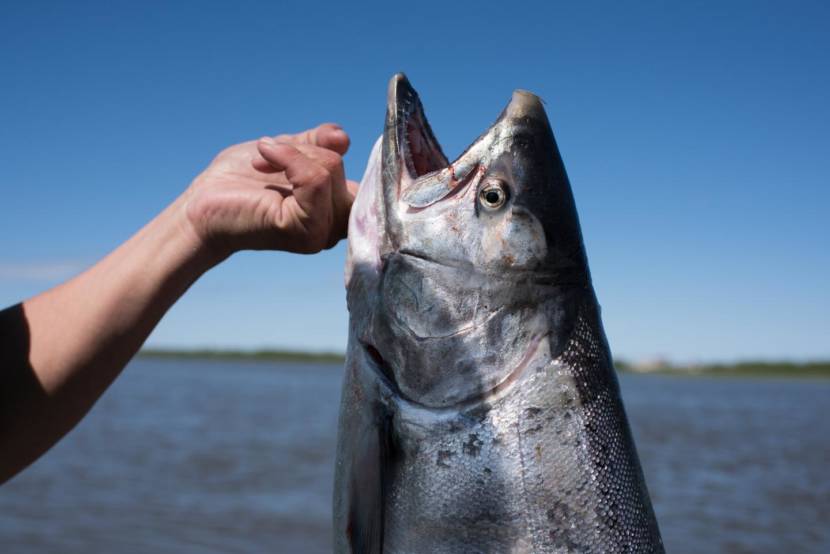
Kuskokwim king salmon caught near Bethel, Alaska on June 12, 2018. (Katie Basile/KYUK)
The size of king salmon returning to Western Alaska rivers to spawn has been decreasing over the past few decades. Researchers at the University of Alaska Fairbanks think that they’re closer to understanding why.
Peter Westley and Andrew Seitz are fisheries scientists at the University of Alaska Fairbanks who helped publish new research on king salmon in February. To answer why these salmon are getting smaller, researchers attached tags to the fish that can record the depth and temperature of the water around them. Seitz said that many of the tags on the salmon were recording temperatures above 70 degrees Fahrenheit.
“And we thought, ‘Well, where is it, you know, in the high 70s in the winter in the Bering Sea, even at depth?’ And the only place that we can infer that is that warm is in the belly of a salmon shark,” Seitz said.
Westley and Seitz’s research indicates that returning king salmon are getting smaller because the bigger ones are getting eaten. They said that predators, like salmon sharks, may target the older, larger kings because they stand out. Seitz said that predators’ preference for larger fish may have always existed, but there could just be more predators now than in the past.
“There’s sort of circumstantial evidence that salmon shark numbers have increased since the 1980s since high seas drift netting was banned,” Seitz said.
Seitz is referring to the 1989 United Nations moratorium on high seas large-scale driftnets and the global ban in 1992. He said that the 1972 Marine Animal Protection Act could also have increased the number of other predators, like seals, that also prey on salmon. Seitz said that in addition to there being more predators, they may also be roaming around in more northern waters, which is an important habitat for king salmon.
“It was thought that salmon sharks largely hang out south of the Aleutian Islands and in the Gulf of Alaska, but it turns out that people are encountering salmon sharks as far north as the Bering Strait now,” Seitz said.
Westley said that smaller fish also means fewer king salmon in future runs.
“Larger fish have more eggs and tend to have bigger eggs. And so the large, old females are the ones that contribute most to the population,” Westley said. “Harvesters have to try to catch more fish to make up for the fact that they’re smaller, and there’s not that many extra fish to be caught these days. So it has profound consequences for people.”
It’s not yet clear how much the decline in king salmon numbers and size can be attributed to predators, as opposed to increased fishing pressure or other aspects of climate change. But Seitz and Westley’s research shows the need for more research into the non-human animals that have an impact on salmon sizes and numbers.
The Alaska Air National Guard rescued the pilot of a crashed Cessna airplane near Lime Village on April 7.
Alaska Rescue Coordination Center superintendent Sgt. Evan Budd said that the pilot called the Stoney River Lodge, and someone at the lodge relayed the Cessna’s position to the center. The center dispatched a HH-60G Pave Hawk helicopter and a HC-130J Combat King II airplane, with pararescue teams on each aircraft. The plane refueled the helicopter in the air, and the chopper landed near the crash site.
The pararescue team brought the pilot out, and flew the pilot to Providence Alaska Medical Center in Anchorage. Budd emphasized that the pilot had a reliable means of communication, which was critical to getting a rescue team there quickly.
Close
Update notification options
Subscribe to notifications
Subscribe
Get notifications about news related to the topics you care about. You can unsubscribe anytime.