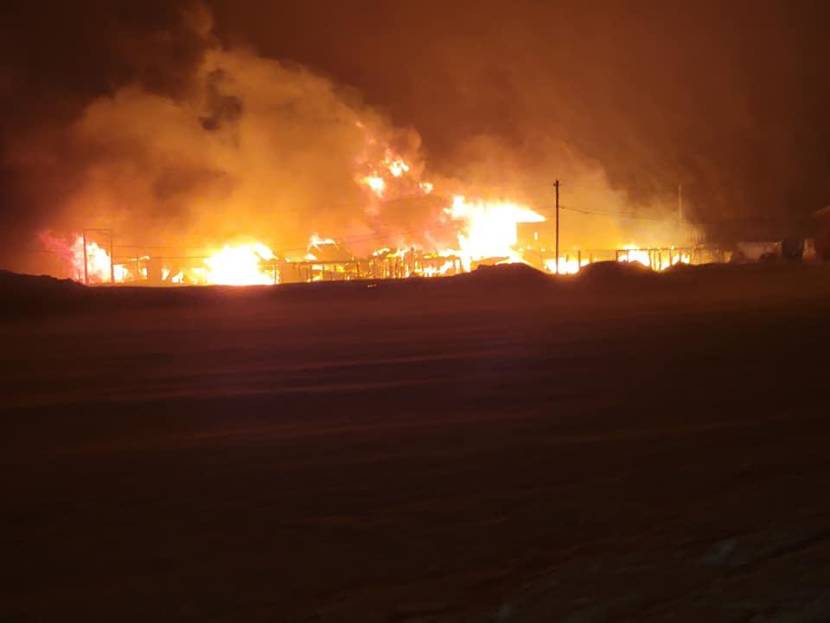
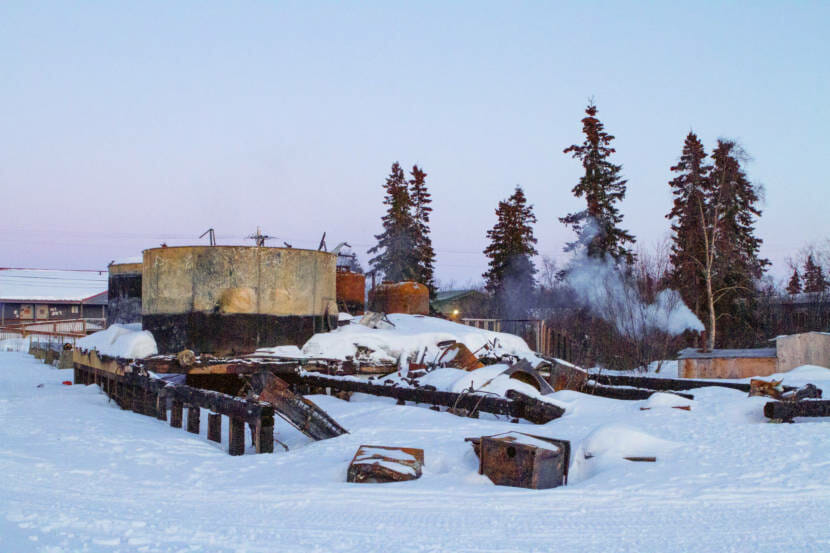
A fire destroyed the old Chevak school on March 8, 2021. (courtesy of Greg Slats)
The Dunleavy administration is dedicating money to helping Chevak clean up the debris of its old school, which burned down in a fire this spring.
According to a state press release, the $2.5 million will be used to remove asbestos and to look for the remains of two men who might have perished in the fire. The two men, James Tikiun, age 22, and Dennis Slats, age 35, have not been seen after they went missing the night the fire occurred.
The funding to clean up what’s left of the school building will come from the spill prevention and response division of the Alaska Department of Environmental Conservation. The administration plans to take the money out of the state response fund and replace it using federal money from the American Rescue Plan Act.
When Tuluksak lost its water plant to a fire on Jan. 16, grant applications for a new one were already underway. (Olivia Ebertz/KYUK)
Three and a half months after its water plant burned down, the village of Tuluksak has secured enough funding to build a new one.
When Tuluksak lost its source of drinking water to a fire on Jan. 16, grant applications for a new one were already underway. The water plant was an old building that needed to be replaced. According to a representative from the Alaska Native Tribal Health Consortium, the building had lasted 40 years, double its projected lifespan.
The Environmental Protection Agency had written the village an estimate for a new water plant and washateria back in 2018. It priced the facility out to $6.7 million. A couple months after the fire, $6.5 million of the funding had been secured through the Indian Health Service, and the remaining $200,000 was covered by the Denali Commission.
But now, according to EPA spokesperson Dennis Wagner, the state’s Village Safe Water Program recently revised that estimate, adding about $1.5 million to the cost. Wagner said the estimate went up because of high material costs following the pandemic and an accelerated construction schedule.
The EPA stepped in and forwarded the village that amount. It also waived the fund-matching requirement.
Wagner said that the plan is for Tuluksak’s permanent water plant and washateria to be built by 2023. After that, the tribe said it would like to add running water to homes as well, which the village has never had except in school-owned teacher housing.
For the residents of Tuluksak, river breakup means they’re once again losing their source of running water. (Olivia Ebertz/KYUK)
For the residents of Tuluksak, breakup means that they will once again be losing their source of running water.
After Tuluksak lost its water plant to a fire, the Yukon-Kuskokwim Health Corporation installed a temporary water treatment plant in the school. The plant pipes up water from the Tuluksak River, but that system is too fragile to withstand the ice floes released during breakup.
YKHC workers will remove the temporary plant from the river for the time being, and reinstall it when the river ice is gone. In the meantime, the community has several large water tanks that they can fill up to store water.
The Alaska Department of Homeland Security and Emergency Management has said it will supply the village with bottled drinking water from now until a larger temporary water treatment plant can be barged up and installed. So far, the state has purchased 10 pallets of water for the community. The first two pallets arrived on May 3.
This is the first time the state has purchased bottled water for Tuluksak in the three-and-a-half months since the fire occurred. In February, the state paid for the shipment of privately donated bottled water.
The funding for the purchased water and shipments is from the state’s disaster relief fund, which was freed up when Gov. Mike Dunleavy signed a disaster declaration for the village in February.
Some families in Bethel say they are considering moving if the next school year looks similar to this one. On April 29, 18 parents, teachers and students — nearly all from Bethel — called into a Lower Kuskokwim School District board meeting. Many pleaded with the district to allow students to return to in-person school five days a week and for sports to resume.
The district said it’s taking action to meet those demands.
The Lower Kuskokwim School District closed down in-person school last March and kept schools closed as the COVID-19 pandemic hit the Yukon-Kuskokwim Delta hard. Now well over half of the region’s eligible adult population has received a COVID-19 vaccine, and the number of cases is the lowest it’s been since September.
Eric Young, a teacher at Bethel Regional High School, said he and a number of parents are seeking clearer expectations from the district about what the next school year will look like.
“I think we’re starting to see a number of people who are tired of getting strung along, and not knowing what’s going to happen, and not seeing an end to this,” Young said.
Young said he’s written 10 recommendations for students who want to transfer next year to Mt. Edgecumb High School, a boarding school in Sitka. He said that’s several times more than he writes in normal years.
But the Yukon-Kuskokwim Health Corporation says that despite the improvements, most areas in the Y-K Delta still have either substantial or high transmission. YKHC also says that 59% of active cases are in children under the age of 18, many of whom are not yet eligible for the vaccine.
This March, the district allowed elementary school students and other high-need students to return to classrooms. But many were limited to in-person learning for only two days a week.
“The emotional and professional relief has been astounding with two days, but it’s simply not enough,” said Kaymbra Mortensen, a kindergarten teacher and a parent in Bethel. She’s one of many parents who are balancing their jobs and helping their children with remote learning.
Superintendent Kimberly Hankins spoke with KYUK after the board meeting. She said students in some schools were limited to two days a week of in-person learning because of physical distancing requirements.
“It’s really based on the size of the school, the size of the classes, the size of the physical space,” Hankins said.
She said in many village schools that have more space, students have been attending class four days a week. YKHC recently announced new guidance saying that students only need to keep 3 feet of physical distance between each other if they’re in the same cohort. Previously, the recommendation was 6 feet of distance. Hankins said that means more students can be in school at the same time, increasing the number of days per week each student can attend school.
“We all want students back in classrooms five days a week, as soon as possible, and as safely as possible. And we are taking steps in that direction for that to happen,” Hankins said.
Other parents who called into the board meeting on April 28 said the lack of sports and extracurricular activities was draining their kids’ motivation. Martin Smith, a parent in Bethel, said his son has a chance to receive a college scholarship for wrestling, but lost the opportunity to compete this year.
“For him wrestling isn’t just a sport, it’s a way of life. For my whole family, it isn’t just a sport, it’s a way of life,” Smith said tearing up. “My son has an opportunity to make family history. And he only gets that opportunity if he gets to wrestle this year.”
The school board asked student representative Jordan Wheeler, an 11th grader in Bethel, what she thought the board should do regarding sports.
“I think that students really want activities,” Wheeler said. “And for me personally, if we don’t get activities, I’m considering not going to school in our region.”
The board responded by taking action on April 28 to allow both indoor and outdoor sports activities to resume along with travel for competition. Parents and local advisory school boards will get to weigh in on whether they want their students to participate. Allowing sports indoors goes against YKHC’s recommendations.
Doug Boyer, the district’s operations director, said that some schools plan to begin sports practices as early as the weekend of May 1. He also said that students would be able to attend the state tournaments for wrestling and track and field if they qualified.
Hankins said that testing would be a big component of participating in sports. She said a third to a half of school sites have implemented routine testing for students and staff. She also said that while there are only a few weeks left in the school year, the board’s action to allow sports would set the stage for the next school year.
“Definitely for the fall, this is the direction we’re heading, and it’s really exciting,” Hankins said.
Regina Lieb, who grew up in Bethel and is raising her kids in Bethel, said her family is also considering moving.
“I love Bethel. I love the school. I love what my kids should be getting from it. But they can’t go through another school year like this one,” Lieb said.
Superintendent Hankins said she wished she could provide the guarantees that parents are looking for.
“I don’t think anyone can promise what the pandemic is going to look like a month down the road. If they could I’d love to know them,” Hankins said. “With the addition of the youth vaccine for ages 12 through 15 that should be available soon, I have even greater hope that we are trending in the right direction.”
On May 2, Hankins told KYUK that she communicated with YKHC following the board meeting, which provided her more clarity on what the next school year will look like. She said that the district will release a draft of a plan by the June 3 board meeting.
“That plan for August will include a full return to in-person learning, as well as student activities,” Hankins said.
For now, Hankins said that graduations this year would look similar to the way they did last year, with outdoor ceremonies and parades. She also said that many sites will be offering some form of summer school to try to offset the learning lost over the past year.
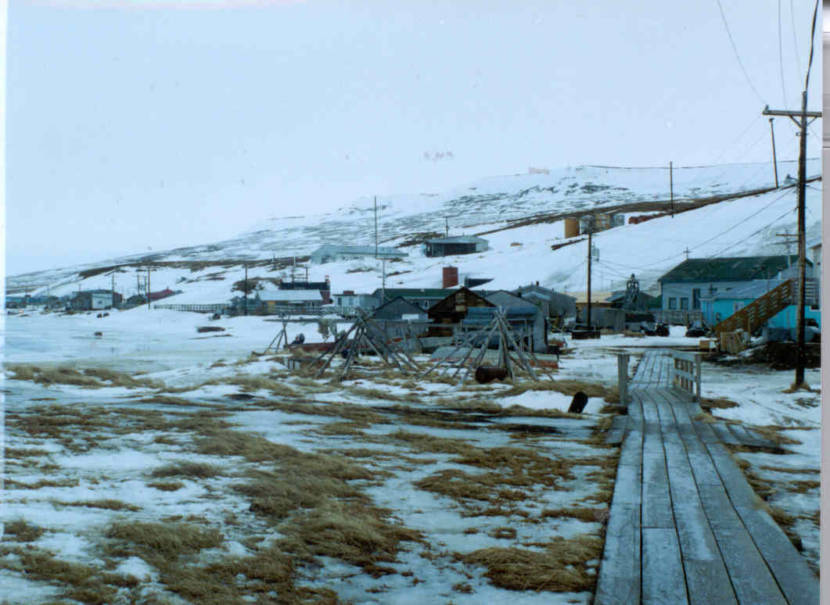
Nightmute in 1997 (Alaska Department of Commerce Community Photo Database)
Content warning: This story includes details of a shooting death.
An 18-year-old died when he was shot while bird hunting with two other young people in Nightmute on April 26.
“Joseph George was shot in the head at close range by a minor as a goose flew by,” Alaska Department of Public Safety spokesperson Gretchen Weiss-Brooks wrote in an email to KYUK.
She said the three young people were “hunting a few hundred feet from the Nightmute airport.”
Village health aides responded to the scene, and “for the death to be officially declared,” the health aides contacted the Yukon-Kuskokwim Health Corporation to confirm George was dead.
Troopers received a call at 7:20 p.m. that evening alerting them to the death and arrived in Nightmute the next day at noon. Troopers are classifying the incident as a hunting accident and continuing to investigate. Weiss-Brooks said troopers do not suspect suspicious activity and have not issued any citations related to this case.
George’s body has been sent to the State Medical Examiner’s Office in Anchorage for autopsy.
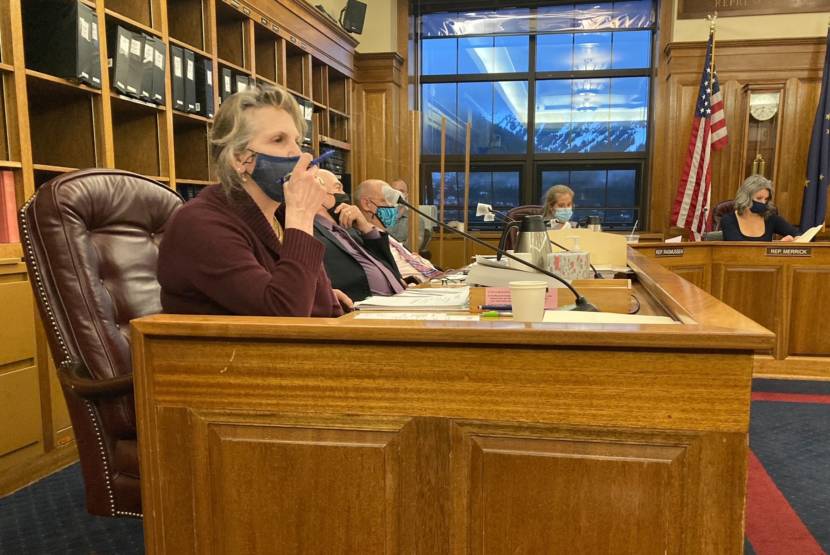
Palmer Republican Rep. DeLena Johnson pauses before commenting on her budget amendment to pay $3,000 dividends on Thursday in the Alaska State Capitol in Juneau. The amendment was defeated by a vote of 8-3. Rep. Adam Wool, D-Fairbanks; Rep. Andy Josephson, D-Anchorage; a committee aide; Rep. Sara Rasmussen, R-Anchorage; and Rep. Kelly Merrick, R-Eagle River, are behind Johnson. (Andrew Kitchenman/KTOO and Alaska Public Media)
The Alaska House Finance Committee rejected a proposal on Thursday that would have paid out permanent fund dividends of roughly $3,000 this year.
It was the first salvo in the annual argument over whether the state should follow the formula in a 1982 state law or follow a different law that limits how much can be drawn from permanent fund earnings.
Palmer Republican Rep. DeLena Johnson proposed the amendment to pay $2 billion for PFDs. She said lawmakers have avoided making other difficult decisions by not paying full dividends the past five years.
“By not paying the full, statutory PFD, it’s allowed us to kick the can down the road,” she said.
Her amendment was defeated by a vote of 8-3. Along with Johnson, Nikiski Republican Rep. Ben Carpenter and Nome Democratic Rep. Neal Foster voted in favor of the statutory PFD. Johnson proposed another amendment that would have used some federal American Rescue Plan Act money for full dividends, but it was defeated by the same count.
One of the votes against Johnson’s amendments was Anchorage Republican Rep. Sara Rasmussen. She had proposed making full dividends this year dependent on changing the formula for future dividends.
After Rasmussen’s proposal was voted down, she said she was concerned that the state would pay full PFDs until the permanent fund’s earnings reserve is emptied.
“I’m willing to have the conversation about the one-time, last statutory dividend, if we can find resolution,” she said. “But until we can reach a consensus, I will not be supporting it.”
The committee finished its budget amendments and moved the bill out of committee Thursday night. This sets up the budget debate in the full House this weekend.
This story has been updated to reflect that the committee finished its work on the budget amendments later on Thursday night.
Close
Update notification options
Subscribe to notifications
Subscribe
Get notifications about news related to the topics you care about. You can unsubscribe anytime.