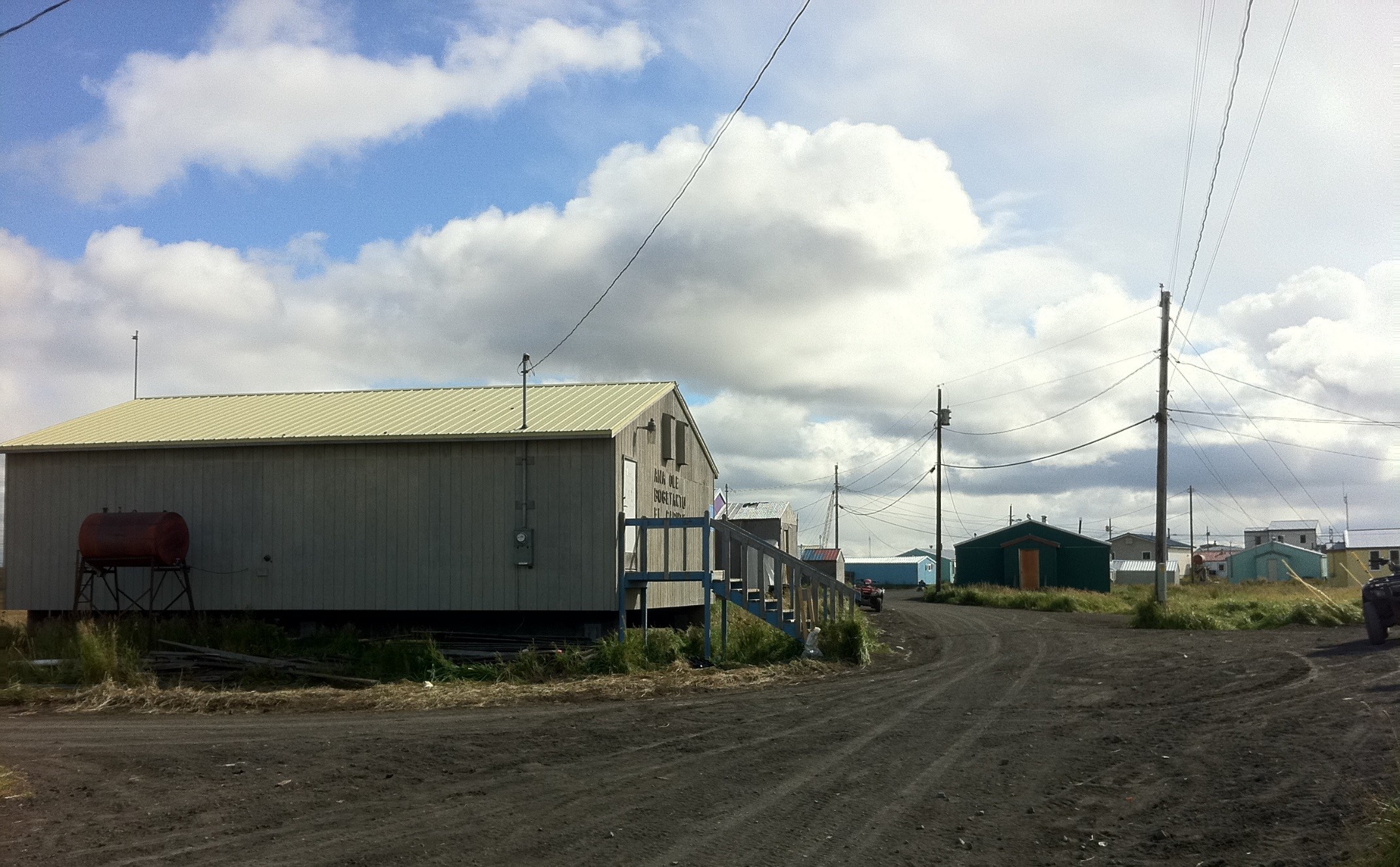
The village of Stebbins (Alaska Division of Community and Regional Affairs)
An outbreak of COVID-19 has led to a lockdown in the Western Alaska village of Stebbins, as cases continue to rise in the region.
There are currently 31 active coronavirus cases in the community of roughly 600 people, according to a statement Tuesday from the Norton Sound Health Corp. Stebbins is about 120 miles southeast of Nome.
The Stebbins Community Association decided to put the village in lockdown until it goes 14 days without a positive case.
That means a 10-person limit at the local store, a five-person limit at the laundromat and a 10 p.m. curfew. Visiting is no longer allowed between households, there will be no bingo, and everyone must wear a face mask in public, indoor spaces, the community association said.
The health corporation said Stebbins residents 12 and up who aren’t vaccinated against COVID-19 should immediately go to the clinic for their first shot.
Roughly 41% of Stebbins residents have been fully vaccinated, according to KNOM.
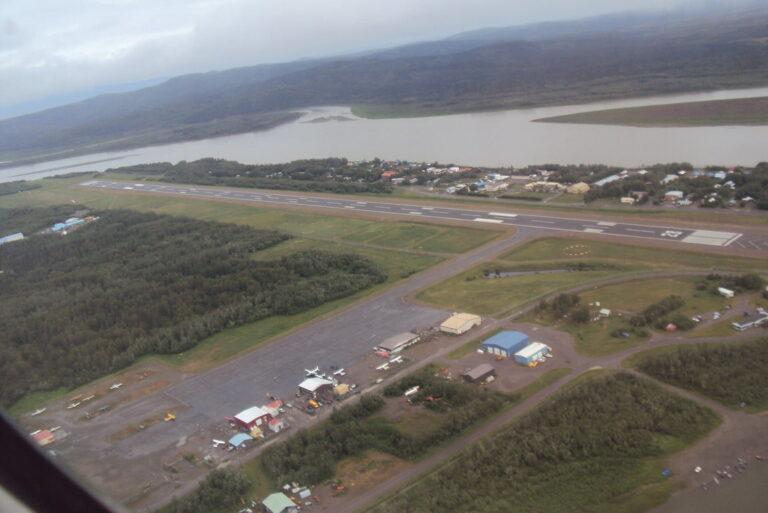
The Aniak airport. (Amazon River Adventure photo via Creative Commons)
There were some tense moments on a Ryan Air flight from Bethel to Aniak on July 7 when a passenger tried to take control of the plane. The other passengers restrained the man, and the pilot was able to land the plane safely.
A Ryan Air Cessna Caravan with six people on board was traveling from Bethel to Aniak on July 7 around 2:44 p.m.
Troopers said in a written statement that during the flight, 18-year-old Bethel resident Jaden Lake-Kameroff got up from his seat and took control of the yoke and attempted to crash the plane.
Lee Ryan, president of Ryan Air, said that the nosedive lasted only a moment.
“Our pilot relied on his training and professionalism, was able to just push the passenger backwards, retook control of the aircraft. Passengers helped restrain the unruly passenger, and they landed the plane without incident. Further incident,” Ryan said.
Troopers arrested Lake-Kameroff when the plane arrived in Aniak. He is being charged with terroristic threatening in the second degree, attempted assault in the first and fifth degrees, and assault in the third and fourth degrees.
Ryan said that the pilot and passengers did not sustain any injuries.
“We’re very thankful for the safe outcome, and extremely grateful for our pilot and the passengers on board,” Ryan said.
He called the incident damaging for air travel in the region.
“You know, we rely so heavily on aviation in Western Alaska. There’s no roads, it’s the only way in and out. And when a scenario happens like this, it’s very unfortunate for not only industry, but everybody, everybody in Western Alaska,” Ryan said.
Ryan said that this is the first time a passenger on a Ryan Air flight has attempted to take control of the plane. But he said the airline will be considering ways to prevent an incident like this from happening again, and he’ll be calling other airlines for ideas.
This story has been updated with information from Ryan Air.
Generators at the Bethel power plant in 2016. (courtesy of Lenny Welch/AVEC)
This year’s state budget, which went into effect July 1, does not include funding for the Power Cost Equalization program. Power Cost Equalization, or PCE, lowers the cost of electricity in rural Alaska to make it comparable to more urban areas like Anchorage, Fairbanks and Juneau. Here’s what residents in rural Alaska can expect in their next utility bill.
The Alaska Village Electric Cooperative delivers electricity to 58 communities in rural Alaska, 20 of which are in the Yukon-Kuskokwim Delta. All of them rely on PCE. AVEC CEO Bill Stamm said that without PCE credits, the cost of electricity for those residents will shoot up.
“It’s probably going to be the difference of about $100 a month for those accounts on average. It’s going to be a substantial jump,” Stamm said.
To break it down further, he said that AVEC customers in Y-K Delta villages could expect their electricity bills to double, while bills in Bethel would go up by about one-fourth. That’s because fuel prices in Bethel are cheaper than in the villages.
Stamm said that higher electricity costs have a trickle down effect on other utilities as well. He said that water plants and sewage treatment centers use large amounts of energy to operate.
“That is going to put a huge pinch on community facilities that are anticipating a much lower electrical cost to keep their water and sewer running,” Stamm said. “Those systems might start getting shut down fairly quickly if they realize they can’t afford to pay the electrical bill.”
Stamm could not definitively say whether customers’ electricity bills for July would reflect the higher prices without PCE credits. He said that AVEC’s billing system is not set up to charge customers without PCE credits, but he said that the company is currently working on making that change.
“Whether we’ll be able to accomplish that by the time we would typically send out our July billing in early August is in question,” Stamm said.
Stamm’s advice for his customers is to prepare for the worst.
“Brace yourself,” Stamm said. “Rates can be going up. Don’t count on PCE being available until the Legislature acts.”
The next legislative special session is scheduled to begin on Aug. 2. Stamm said that if state legislators vote to fund PCE later in the year, AVEC would reimburse its customers for previous months of PCE credit.
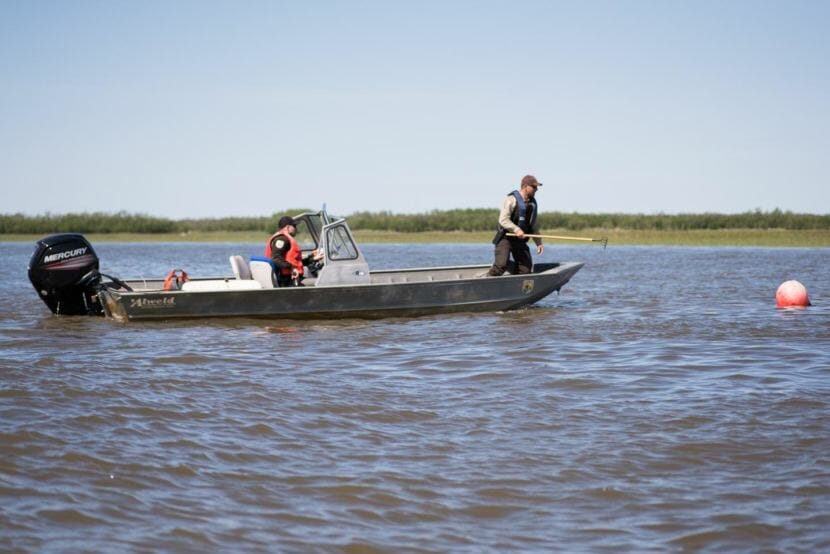
A fisherman driftnets for salmon in the Kuskokwim River near Napaskiak on June 12, 2018. (Katie Basile/KYUK)
Confusing. That word came up a lot in a meeting with state and federal managers to describe the state’s June 28 Kuskokwim River fishing opening. Both the state and the feds say that they need to work together to prevent more confusion in the future.
Six local fishermen called in to the state’s Kuskokwim River Salmon Management Working Group meeting on June 30 to express frustration with the state opener.
“The announcement was confusing,” said elder James Charles of Tuntutuliak.
“It was real disappointing to see how they were contradicting each other and making it so confusing for everyone,” said Clarence Daniel of Bethel.
They were confused because the state announced a drift net opening on June 28, but federal managers said it was illegal because the state did not have jurisdiction.
Federal managers, along with organizations like the Association of Village Council Presidents and the Kuskokwim River Inter-Tribal Fish Commission, were asking people not to participate in the state opening. Meanwhile, state wildlife troopers were visiting communities along the river, encouraging them to go fishing, Sgt. Walter Blajeski told the working group on June 30.
The contradicting information led to fewer fishermen participating in the state opener than in previous openers this season.
Federal manager Boyd Blihovde said in the June 30 working group meeting that the state and feds should work harder to come to an agreement on management actions.
“So that we’re not bringing the public into that disagreement and having to sort of have the public decipher what is legal or not legal,” Blihovde said.
Alaska Department of Fish and Game Deputy Commissioner Ben Mulligan was also at the working group meeting. He said that the state announced the June 28 opener because it has a constitutional obligation to offer subsistence fishing opportunities when there are enough salmon to meet escapement goals. Mulligan said that outside of that hard requirement, the state is willing to work with the feds to reduce confusion for local fishermen.
“I think a cooperative and collaborative relationship is what is going to be called for, because at this point in time, there’s obviously some differing opinions of legal authority. Now, this is not the place to hash that out. What is important, I believe to everyone, is that we take care of the resource while helping to provide that opportunity for the local folks,” Mulligan said.
Federal and state managers discussed having additional meetings with each other in the hopes of coming to a consensus.
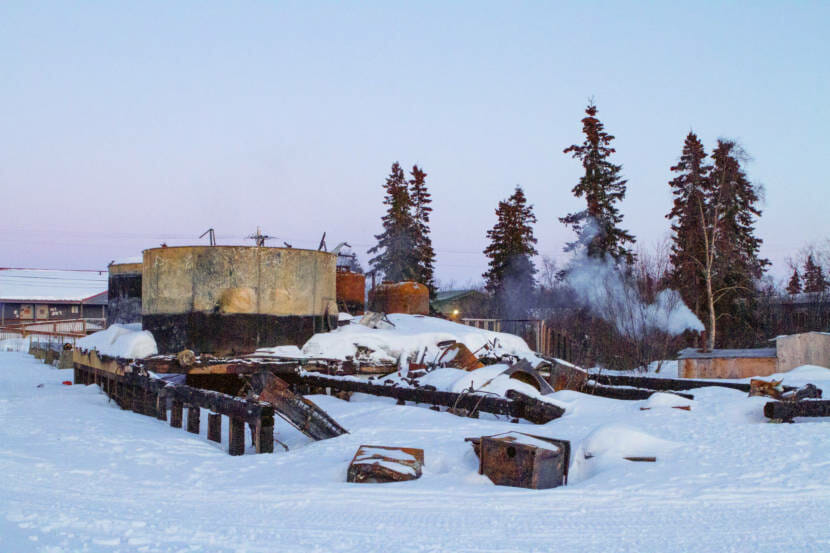
Tuluksak lost its water plant to a fire on Jan. 16, 2021. (Olivia Ebertz/KYUK)
A long-awaited water plant has arrived in Tuluksak after a fire destroyed the community’s only source of running water back in January 2021. Efforts to ship the new portable water plant to Tuluksak have been underway since the winter.
The community of Tuluksak originally expected to have the portable water plant months ago. After Tuluksak’s washateria burned down, the community was living off of donated bottled water for a month and a half. Then, in early March, the Yukon-Kuskokwim Health Corporation was able to restore access to running water.
YKHC installed a system that piped up water from the Tuluksak River to the school, but a KYUK investigation found that many people in town weren’t drinking that water. The school sits at the edge of town, and water access was limited both by the school’s hours of operation and by its storage tanks.
Courtesy of Yukon Kuskokwim Health Corporation
The community was expecting another solution: a portable water plant that YKHC would lend to Tuluksak for the next several years until a permanent water plant and washateria could be built. The new water plant promised to be in a more central location in town and provide much more water storage.
While the water plant is portable, it’s not all that easy to move. So when it came to actually transporting it, Faulkner and Walsh Constructors, the company contracted to deliver it, was plagued by thinning river ice. The ice road conditions were too dangerous for them to drive it up from Bethel. For a brief spell, the Army National Guard thought that they might be able to fly the portable water plant up using a Chinook helicopter, the same chopper used to remove the “Into The Wild” bus from a remote area near Denali National Park.
Eventually, plans were put on hold until river conditions were stable enough to barge up the portable water plant, which Faulkner and Walsh was able to do on June 10. Now, according to YKHC, workers are installing the plant and hope to have it up and running later this summer.
The next step in the process is to build the community a new permanent water treatment plant. YKHC is working with the Alaska Native Tribal Health Consortium, Village Safe Water and the CRW Engineering Group to get updated cost estimates and timelines. Previously, the agencies had estimated a figure of $8.2 million and a summer 2023 timeline.
The Yukon River Fisheries Drainage Association hosts weekly teleconferences where river residents, fishery organization leaders and government resource managers talk about what’s happening with salmon on the river.
There wasn’t much positive news during this week’s teleconference.
Yukon River Inter-Tribal Fish Commission chair Brook Woods has a dismal king salmon count from the Pilot Station sonar near the river’s mouth.
“As of Monday, June 28, just over 60,000 king have been counted at the Pilot (Station) sonar station, and that is only half the average count for this date,” she said.
Wood said the run is estimated to be about midway through, and if things don’t change, a border passage agreement with Canada and drainage-wide escapement goals won’t be met.
“If we’re not able to meet escaping goals, this will be the third year in a row,” she said.
The situation is even worse for summer chum salmon. State research biologist Fred West said just 31,000 are estimated to have passed the Pilot Station sonar as of Monday, well below the historic median of 500,000.
“That’s the lowest on record for this day. So yeah, so this is lower than the runs we saw in 2000 and 2001,” he said.
Deena Jallen, the state summer season management biologist, said managers had no choice but to close the fishery.
“I really feel that everyone is really struggling this year. We know it’s really hard. If there were a fish to be harvested I would you be wanting to let people harvest but there’s just no fish to be harvested so it has to be closed,” she said.
The Chinook and summer chum salmon fishing closure extends from the Yukon Rivers headwaters to its mouth as well as area coastal communities. Hooper Bay resident John Rivers lamented the situation.
“I’ve never seen Hooper they closed ever since I was a little boy to this day. It’s so sad to see it’s closed,” he said.
Martin Kelly of Pilot Station said communities need help filling the food void.
“Fish and Game and everybody else better be prepared to go out and get some crab or pollock or halibut and bring it to each household on the Yukon River,” he said.
Application for a federal disaster declaration is already in the works, according to Yukon River Inter-Tribal Fish Commission director for the Tanana Chiefs Conference, Stephanie Quinn Davidson.
“Just so folks know, that disaster declaration process takes a long time. We don’t anticipate that funding would be available to fishermen for at least a year, maybe possibly two years,” she said.
Quinn-Davidson said that a request submitted for a disaster declaration for last summer’s poor Yukon River salmon runs was just recently forwarded by the state to the federal government.
Close
Update notification options
Subscribe to notifications
Subscribe
Get notifications about news related to the topics you care about. You can unsubscribe anytime.