Celebration

Group seeks to prevent suicide through paddle-making

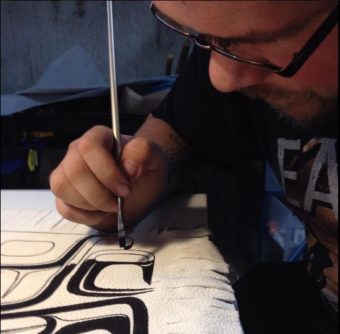
Paddle makers at the One People Canoe Society workshop. (Photo by Shady Grove Oliver/KSTK)

Alaskan communities can be very tight-knit. And suicide rates in Alaskan communities are some of the highest in the country. Last weekend, the One People Canoe Society held a two-day paddle-making workshop in Wrangell.

As part of the workshop, the participants attended a behavioral health course on suicide prevention. Its goal is to bring communities together to both learn a traditional art and talk about a contemporary problem.

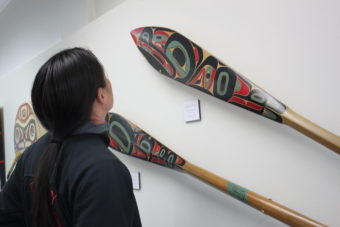
Around 15 people are hard at work in the high school shop class, sawing, sanding and shaping paddles. What started off as rough yellow cedar boards are slowly turning into streamlined paddles.

The One People Canoe Society puts on workshops throughout southeast Alaska.

Brian and Michael Chilton make their way around the Panhandle teaching communities the art of paddle-making.

Michael says he decided to learn more about the craft after one particular trip.

“It was really inspiring when we started traveling down to Washington. They have a canoe journey that they do down there. Once we saw how much people are actually involved and know about their own culture down there, we said, why don’t we do that in Juneau?” says Chilton.

His uncle, Brian Chilton, has been carving paddles since the early 1990s and painting them for even longer. And now, he passes that knowledge on.

“We travel all over, different places, different towns, different villages- Angoon, Kake, Wrangell, POW, Ketchikan. I think we’re going to do a total of a dozen paddle workshops. This is to help them, the local canoe groups, make their own paddles. They’re actually going to use them to paddle to Juneau; it’s called the paddle to Celebration.”

But these paddle workshops are a forum for more than just woodcraft.

They are sponsored in part by a behavioral health grant from the Southeast Alaska Regional Health Consortium, or SEARHC. The grant funds presenters that attend the workshops and give condensed courses on suicide awareness and prevention.

Alicia Chilton is a board member for the canoe society. She says the partnership began a few years ago.

“SEARHC, Suicide: One is too many, had a canoe and so we started working together in preparation for the paddle to Celebration in 2012. Over the years, our relationships have just grown and we think it’s important with the high suicide rates that we have here, especially in Alaska and in our southeast communities,” says Chilton.

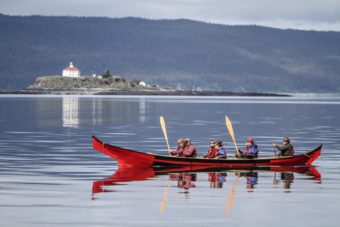
Several hundred people welcomed seven canoe teams Wednesday who paddled to Juneau for Celebration 2012. About 90 people made the trip and came from Angoon, Hoonah, Hydaburg, Juneau, Kake, Sitka, and Wrangell. They ranged in age from 10 to 70.
Several hundred people welcomed seven canoe teams Wednesday who paddled to Juneau for Celebration 2012. About 90 people made the trip and came from Angoon, Hoonah, Hydaburg, Juneau, Kake, Sitka, and Wrangell. They ranged in age from 10 to 70. (Photo by Heather Bryant/KTOO) Celebration Paddlers

Participants in the paddle workshop spend an hour each day away from the bandsaws and sanders in a quiet classroom.

Carla Mahoskey does youth suicide prevention training for SEARHC.

“Part of our grant’s mission is to try and decrease the stigma associated with seeking mental health help,” says Mahoskey.

She shows slides with possible warning signs that a person is having suicidal thoughts. She asks the room questions like, “What would you say if a friend told you they were thinking about suicide?”

At the end of the day, there’s a quiz. She hopes her students feel more confident about finding resources in the future.

“I hope that if they see a person in need, that they’re able to go and help them and refer them to someone to get professional help if that’s needed,” says Mahoskey.

Participants leave the class with keychains and business cards, which they put in their pockets before going back to making paddles.

This melding of tradition and prevention is a natural one. They both deal with fulfillment and communication.

“You know, with the paddle workshops or the canoe journeys, it provides a level of enthusiasm that comes with learning about their native culture and wanting to get involved. Also, there’s the awareness part. Unfortunately, people have friends that have attempted suicide or that have committed suicide and it’s a big impact on the community,” says Chilton.

And, bringing community together is the reason Michael Chilton travels around, helping people carve cedar boards into beautiful paddles that they’ll use to perhaps make the journey of a lifetime.

“It’s actually really important to me because it keeps the culture alive. It keeps the passion alive. Not just in myself, though. I get to help people keep passion as far as their culture goes, all over Southeast Alaska,” says Chilton.

He says it’s about transformation, for paddles and people.

Native art reflects traditions, new media and techniques

This is the closing weekend of the juried art show from Celebration 2012. Thirty-two pieces from twenty-one artists include the high-water mark of craftsmanship in Northwest Coast art. There are also pieces that go outside the boundaries of what is considered traditional art with new forms or techniques.

The art competition was held in conjunction with Celebration, the biennial Native dance event and the largest Native culture gathering in Southeast Alaska. It was held in Juneau in early June. The art show, organized and sponsored by the Sealaska Heritage Institute, is intended to encourage art creation and development.

In previous years, submissions were divided into two categories, traditional and contemporary. Masks and woven baskets would fit into the former category, while glass work would be in the latter, for example. But what is new or contemporary, or non-traditional art, may itself become traditional as more artists pick up on a change in medium, form, or a new technique.

This year, judges for the competition were told to dispense with the old categories. Instead, artwork was judged in the areas of customary or customary-inspired Northwest Coast art.

Renowned Ketchikan carver Nathan Jackson judged the customary category. He says he looks for a well-thought out concept or idea, and complete symmetry. He also looks for paint application, clean cuts, and type of wood selected.

Peter Corey, Northwest art scholar and a former curator at Sheldon Jackson museum, judged customary-inspired art. He describes Northwest Coast art as strong with the formline design that appears to be pushing its bounds, the predominate and contrasting red and black, and blue and green in recessed areas. But that’s changed a little recently.

In the Customary category, Archie Cavanaugh won first place with his Eagle Man Mask, Sonya Koenig-Johnson’s Spruce Root Hat came in second, and third place went to Ruby Hughes for her vest titled Woodworm Woman.

Sealaska Heritage officials say Koenig-Johnson only took up weaving during an instructional program in Hoonah six years ago.

Cavanaugh called his winning mask meant to symbolize a transformation from eagle to man a hard and complicated project. He started by visualizing the project, and making sure the form lines and symmetry are just right.

In the Customary-Inspired Art category, Harmony Hoss won first place for her Beaver Purse, Clarissa Rizal was second for her Argillite Totem, and Shgen DooTan George took third with her Woven Octopus Bag.

Rizal says her art was inspired by a dream. She used charcoal on canvas that is then wrapped around a custom built totem. The light spaces simulate the reflected light shining off argillite and the dark charcoal the carved areas.

George entered a Chilkat apron with cedar bark backing and button blanket that drew on traditions from the indigenous Ainu people of Hokkaido. But it was her experiment of woven Raven’s tail and cut out copper pieces for the octopus bag that caught the judges eye.

Cash prizes of a $1,000, $750, and $500 were awarded to the top three in each category.

Best of show award of $1,500 went to Arthur Nelson for his Raven Bowl.

All of the artwork selected for the Celebration 2012 juried art show are on display at the Juneau Arts and Culture Center through June.

Angoon dance group leads Celebration entrance

Xudzidaa Kwáan dance group leader Gilbert Fred takes the microphone near the start of Celebration 2012's Grand Entrance on Thursday, June 7, at Juneau's Centennial Hall. Photo by Ed Schoenfeld.


Celebration 2012 ended Saturday night with the Grand Exit, where more than 5o groups from Anchorage to Southeast to the Pacific Northwest made their final procession.

Xudzidaa Kwáan Dancers were at the lead. The Angoon group was also chosen to head up the Southeast Alaska Native cultural festival’s Grand Entrance, at the start of the three-day event.

Click here for iFriendly audio

If you were there, you would have seen dance leaders Gilbert Fred and his brother-in-law Alan Zuboff move back and forth across the stage, directing traffic as they sang and danced. From time to time, one would move toward the hall entrance, urging an arriving group to sync drumbeats with those on stage.

Fred says it was a great honor.

The Xudzidaa Kwáan Dancers of Angoon lead the Grand Entrance Parade down Juneau's Willoughby Aveue Thursday, June 7. Photo by Heather Bryant/KTOO.

“It was arduous and tiresome and it tested our fortitude and it was better than aerobics. But I think it was indeed a labor of love for our culture and for the fact that we had so many different nations coming together here and converging on Juneau to share our culture with one another,” Fred says.

The grand entrance continued for more than two hours, until everyone was in the hall.

Zuboff says the group’s strength comes from its experience, dating back generations.

“When it first began, it was just an elders’ group. But as time went on, the elders realized the young ones weren’t learning. So they did something that they had never done, and allowed (in) generations. They decided that the young ones, including the babies, should start dancing in order for them to learn,” he says.

Today’s group continues sharing those traditions. Members work with the Xootsnoowú Dachaxanx’i Yán dancers, formed through the Angoon school’s Indian Education Program.

Fred says the students are eager to learn, but have to get past their electronic distractions.

“One of the requirements in class, when they come to class, is to please turn their cell phones on silent and put them into your bag. We don’t want them dancing and then getting a ringtone and answering their phone while we’re supposed to be in character,” Fred says.

How does he keep them focused?

“We let them know that these songs and dances … carry a history connected with the people with the different clans. And it’s a part of who they are, and they have to know who they are and they will better succeed in life and they’ll better deal with peer pressure. It’s their culture that connects them to the community, to their parents and to their elders, and to one another.”

Like many traditional adult groups, the Xudzidaa Kwáan Dancers wear expertly-crafted regalia, adorned with images of their history and culture.

Zuboff wears a clan hat more than 300 years old. And he’s worn blankets handed down over three or four generations.

“It’s not just a common piece of thread or a piece of wood. It’s a bit of all the spirits of the older generation that made this and danced in them,” Zuboff says. “And sometimes you can maybe feel their energy in the dance group. Or sometimes you can hear them singing, to hear them saying, ‘Do this.’ ”

Every Celebration has a different lead dance group, chosen by a committee of the Sealaska Heritage Institute, which organizes the events.

Institute President Rosita Worl says members picked Xudzidaa Kwáan because of its strength, and its traditions.

Leaders Zuboff and Fred are thankful for the recognition. But they’re also glad they don’t have to direct such a massive group of dancers for a while.

“It’s almost like you feel your canoe get sucked into a tidal current, ” Fred says, getting a nod of agreement from Zuboff. “And we’re able to restabilize and readjust.”

Angoon dancers cross the stage during Celebration 2012's Grand Entrance. Photo by Ed Schoenfeld.

Parnell signs shellfish farm bill at OysterFest

Gov. Sean Parnell signs a mariculture loan bill at Juneau’s Hangar Ballroom on Tuesday. Watching, from the left, are Haa Aani’ mariculture coordinator Anthony Lindoff, Sealaska CEO Chris McNeil, Haa Aani CEO Russell Dick and Commerce Commissioner Susan Bell.

The state is expanding its support for mariculture.

Governor Sean Parnell this week signed a bill creating a revolving loan fund for shellfish farms.

“The fund will be capitalized and if you want to engage in and begin operating a small business of that kind, you’ll now have greater access to capital in the state to do it,” Parnell said at the Juneau bill-signing. “You will also have an opportunity for a loan from the Alaska microloan revolving fund. This is a niche where the banks don’t offer it typically as a product. But (it’s) focused on access to capital for entrepreneurs of our state.”

The bill-signing was part of the kickoff reception for the Haa Aani OysterFest.

The event is connected to the Celebration 2012 Native culture festival. Haa Aani, part of the Sealaska regional Native Corporation, has helped start several oyster farms in rural Southeast.

The legislation also provides financial support for other business opportunities.

“There are two more revolving loan funds created in here related to communities being able to buy quota, something our communities have not had access to capital for, as well as the commercial charter revolving loan fund to allow individuals to get into the halibut charter business,” Parnell said.

OysterFest features cooks demonstrating recipes using Southeast-grown shellfish. It continues through Saturday across from the Sealaska parking lot in downtown Juneau.

A grand entrance to Celebration 2012

Celebration 2012 is officially underway. Southeast Alaska’s largest Native cultural gathering kicked off in earnest this morning (Thursday) with the Grand Entrance Procession in Juneau. KTOO’s Casey Kelly has more.

Hundreds of Native Alaskans gathered in downtown Juneau for the Grand Entrance for Celebration 2012.
Hundreds of Native Alaskans gathered in downtown Juneau for the Grand Entrance for Celebration 2012. (Photo by Heather Bryant/KTOO)

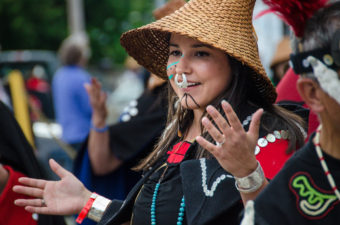
Dozens of groups, decked out in Chilkat blankets, button robes and other Native regalia, made their way singing, dancing and drumming through Juneau’s Willoughby District from the Alaska Native Brotherhood Hall to Centennial Hall.

Hundreds of spectators lined the parade route. Robert Sharclane, who grew up in Hoonah and now lives in Juneau, brought his kids.

“I’m half Tlingit, and it’s a fairly statewide, large and special event, and I just wanted them to participate in it and get an experience seeing it,” he said.

Sharclane’s nine-year-old daughter Pearl was wowed by the various dance groups.

“It’s cool to watch it and all the dresses they have,” she said.

Once all 55 groups made it into Centennial Hall, Sealaska Heritage Institute and Corporation officials formally opened the ceremony. SHI Trustee Clarence Jackson read a list of elders who have passed away since the last Celebration in 2010, including Dr. Walter Soboleff, the renowned Tlingit Presbyterian minister who helped found Sealaska Heritage Institute in 1980. Soboloeff was 102-years-old when he passed away last year.

Celebration was first held 30 years ago, after Sealaska Native Corporation founded the non-profit Heritage Institute to document and preserve the cultures and traditions of the Tlingit, Haida and Tsimshian people. The event is held every other year and has expanded to include Native groups from outside Southeast Alaska.

Representatives from the Nisqually Tribe of Washington performed a traditional welcome song at the Grand Entrance.

SHI President Rosita Worl thanked all the dance groups, which she credits for making Celebration a success.

“We owe Celebration to our dancers. We owe Celebration to our ancestors. We owe Celebration to our children,” Worl said. “We know our culture is going to be strong and carry on for the next 10,000 years.”

This year’s Celebration events run through Saturday at Centennial Hall and other locations around Juneau. Organizers estimate 2,000 people will participate, with another 5,000 attending as audience members.

Site notifications
Update notification options
Subscribe to notifications