Celebration

2,000 dancers make a Grand Entrance to Celebration

More than 2,000 Southeast Alaska Natives danced their way to Juneau’s Centennial Hall Wednesday evening for Celebration 2014.

celebration_coverageThe biennial festival is the largest cultural event in the state. Organized by Sealaska Heritage Institute, it brings multiple generations of Tlingit, Haida and Tsimshian people together to celebrate their culture.

The Saanya Kwaan, Cape Fox dancers, were chosen to lead the processional of 50 dance groups in the Grand Entrance.

Harvey Shields is the leader of the Chief welcome dance.

“We are the Saanya Kwaan people and we originate about 50 miles south of Saxman,” he says.

Like other groups here, the Saanya Kwaan range in age from about 5 years old to elders.

“At two and three years old, they put regalia on them and then they start walking around and as they get older they find their place of where they need to be,” Shields says.

The Johnson O’Malley dance group from Wrangell is further down the street.

“I was still sewing on the ferry,” Sandra Churchill says, laughing. She made two button robes this year for Celebration.

“I know we know it’s every two years, and we still put it off ’til the last minute, but it’s worth it,” she says.

Celebration started in 1982 and Churchill has been to all 16 events. Her dance group has been practicing for months for this year’s festivities.

“It’s important for the young children,” she says, “to see the elders and how much they love it and instill that so they will carry it on for us.”

Patricia and Gary McGraw came from Florida for Celebration. She grew up in Juneau. (Photo by Rosemarie Alexander/KTOO)

The sidewalks were clogged with people snapping pictures and taking videos. Patricia McGraw and her husband Gary looked like they were on a safari. They had traveled from Pensacola, Florida to Juneau specifically for Celebration.

McGraw grew up in Juneau. She chokes up as she recalls that time.

“When I was young the Native traditions were totally disrespected. And you know kids knew. I was told not to play with the Native kids. But kids know what’s right, what’s wrong, and I’ve always felt quite strongly that they needed their traditions and we needed to honor their traditions,” she says.

And as a non-Native, Celebration is a homecoming McGraw embraced.

At age 75, Ken Grant says his dancing days are over. But he’s danced at many Celebrations with the Mount Fairweather group from Hoonah.

Grant works for the National Park Service and lives in Bartlett Cove, where he has a spectacular view of the Fairweather range on clear days.

His formal Tlingit name even comes from Mount Fairweather.

“It means being proud, and having pride in the mountain and all that it stands for; the songs, the regalia and the stories that come from it,” he says.

Much like Celebration, he says.

“Most of all I think it builds in pride, it builds in passion, which I think is really important. For anything to function properly you need to have that pride and passion,” he says. “And I think that Celebration is a good source for pride and passion.”

Celebration continues through Saturday with dance performances, Native Art, Native language sessions, lectures, a parade and the Grand Exit.

Tlingit carver Wayne Price takes top honor at Celebration art show

celebration_coverageTlingit carver and artist Wayne Price of Haines took Best of Show in the Sealaska Heritage Institute’s seventh Juried Art Show and Competition.

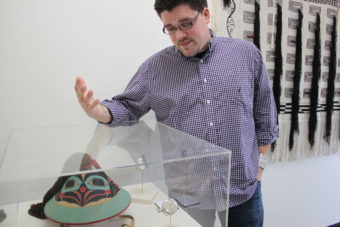
Price’s ‘Dancing Raven Hat’ is a painted hat made of red cedar and otter fur. The piece also took third place in the Formline Art category. Price’s other works – ‘Quantum Raven’ Paddle and ‘Mother Whale’ Paddle took first and second places in Formline, the show’s newest category.

Here are the complete results:

Best of Show

  • Wayne Price—Dancing Raven Hat 

Northwest Coast Customary Art

  • 1st Place—Pauline Duncan, Ravenstail Set
  • 2nd Place—Wayne Price, Quantum Raven
  • 3rd Place—Deborah Head-Aanutein, Echoing Traditions

Northwest Coast Customary-Inspired Art

  • 1st Place—Teri Rofkar, Caprini Tribal Regalia
  • 2nd Place—Della Cheney, Leadership and Change
  • 3rd Place—Lily Hope, Little Watchman

Formline Art

  • 1st Place—Wayne Price, Quantum Raven
  • 2nd Place— Wayne Price, Mother Whale
  • 3rd Place— Wayne Price, Dancing Raven Hat

Awards totaled more than $8,000.

Tsimshian carver and artist David R. Boxley was the show’s sole juror. He was responsible for selecting the 21 pieces featured in the show as well as the winners.

The Juried Art Show will be displayed at the Juneau Arts and Culture Center through June 30.

Tlingit and Haida Dancers spend weeks practicing for Celebration

The Tlingit and Haida Dancers of Anchorage practice for Celebration. (Photo by Joaqlin Estus/KNBA)

Starting on Wednesday, Juneau will be overflowing with thousands of Tlingit, Haida, and Tsimshian people enjoying Celebration, a traditional dance and cultural event hosted by the Sealaska Heritage Institute every two years.

The Tlingit and Haida Dancers of Anchorage are getting ready to go to celebration. With tables and chairs pushed aside, a couple of dozen people are singing and dancing in a large room at the Alaska Native Medical Center. Almost half of them are under the age of ten. Between songs, the kids play. Two boys ask a young man to lift them up towards the ceiling, which he does a couple times each. A girl does cartwheels across the room. A six-year-old has her arms tightly wrapped around her friend as she carries her a few feet across the room.

celebration_coverageDuring the songs, children might rest in their mother’s lap, watch from the sidelines, or join in the dancing. Austin Sumdum, a U.S. Marine on leave, says he started dancing at the same kind of free-flowing practice.

“Growing up, no one forced me to dance, so I was able to just go up on my own, cause I was just like, ‘oh, they’re doing that’ and I was just kind of jealous, cause like I was sitting down for a while. I think it wasn’t until I was four I actually got into it. I was like, ‘oh my Dad’s doing it; okay I’ll do it,’ ” he says.

The group meets once a week, and more often in the weeks leading up to Celebration, where there’ll be art shows, language classes and dancing. The schedule has dozens of dance groups on stage from 8:30 a.m. to 9 p.m., but performances often go later at night. Nae Brown, leader of the Tlingit and Haida Dancers of Anchorage, says Celebration is a liberating experience.

“Going to Celebration is a really empowering event because you get to be you for three whole days without any explanations, without having to like prove anything or say anything. You just are and that’s a really nice feeling,” she says.

No matter what else is happening in her life, Brown says she always has dance practice to look forward to, something she wants to pass on to her one-year-old daughter.

“Growing up in a dance group, I don’t know any other way of life. So to not have this, I don’t feel like I would have any kind of anchor to the life that I lead now. It’s really been my anchor throughout our childhood and I’m lucky that I’m able to pass that on to my daughter so she can grow up in the same way we did. It was a very rich lifestyle that we led,” she says.

The group holds raffles, bake sales and garage sales to raise travel money. Brown says they’ll be fundraising and practicing their dance moves right up to the day they leave. Celebration kicks off Wednesday evening and continues through Saturday in Juneau.

All Nations Children’s Dance Group fosters cultural identity

Celebration begins this evening at 6 o’clock with the Grand Entrance procession to Centennial Hall. The four-day cultural event of Southeast Alaska Natives includes 50 dance groups. Among them is All Nations Children’s Dance Group of Juneau. The group formed in 1995 and has about 80 members. I attended a recent practice and learned that singing and dancing is a foundation for much more.

It’s a Thursday evening and some 50 kids and teenagers dance their way through the Tlingit-Haida Community Center near Salmon Creek. Group founder and leader Vicki Soboleff walks up and down the line giving instructions. Soboleff says she and the group have come a long way since the first practice in 1995.

celebration_coverage“There were 12 children here and there was a group of their parents and maybe grandparents and aunts and uncles. All those children were looking at me and I was terrified. We didn’t start off singing Tlingit songs. We actually started off singing ‘This Old Man.’ I was just trying to get them to sing and plus I was nervous.”

At this practice they sing numerous Alaska Native songs and Soboleff says they’re instruments for learning.

“Knowledge of your Native culture and involvement in Native song and dance and language really helps you with your sense of self and belonging. To your tribe, your clan. I believe it’s really important for Native children to know who they are, where they came from, what their tribal clan is.”

One of Soboleff’s early dancers is now a teacher. Barbara Dude joined the group when she was seven and now, at 26, she’s an assistant group leader. She helps 15-year-old Allison Ford with her Tlingit introduction—just like Soboleff helped her. Among other things, Dude says she gained language skills, self-esteem, and public speaking skills. But the most important lessons were about something more. She says the group’s goal to help engender identity worked.

“When I started the group when I was seven I didn’t know that I was Tlingit. The group has helped me gain a sense of pride in who I am and now I am able to share that with my children who have known they were Tlingit since they were born.”

Dude is excited for Celebration, especially the grand entrance.

“We all dance in together and ahead of us are dancers from another group, and behind us are dancers from another group and we’re dancing across stage and each person gets their chance to go across stage and dance their hardest. They feel it because everyone around them is feeling it with them.”

Dude tears up and apologizes for becoming emotional.

“How powerful it is to watch them be immersed in the culture and the language. It’s beautiful. It’s beautiful.”

The All Nations Children’s Dance Group is true to its name and is open to children of all races and ages until high school graduation. Then Soboleff and Dude hope they’ll join an adult group or stick around to help children learn language, song, dance, and especially, cultural identity and pride.

The Grand Entrance procession begins tonight at 6 p.m. at Centennial Hall. You can watch it on 360 North or 360North.org.

For some, the journey to Celebration started long ago

The North Tide Canoe Kwaan left Haines at 4 a.m. on June 4. (Photo by Dawson Evenden)

Celebration 2014 begins Wednesday in the capital city. Seven thousand people are expected to attend the biennial gathering of Southeast Alaska Natives from all over the state, the Lower 48 and Canada.

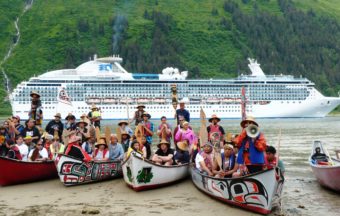
While most fly or take the state ferry to Juneau, in recent years small groups have come by traditional canoe, including a group from Haines, who left the North Lynn Canal community last week.

Helmsman Wayne Price, gave the order to leave shortly after 4 a.m. so the group could start their journey with the outgoing tide.

“We’re ready? Can I get a Hoohah? Hoohah. Let’s go to Juneau.”

The group is the North Tide Canoe Kwaan and they are paddling a dugout canoe to the Celebration festivities set to begin this week in Juneau. They are accompanied by two support boats. By Sunday night they had reached Admiralty Island where they will camp an extra day before meeting up with other canoe groups from across Southeast.

But this journey took more than just a few long days of paddling in a dugout canoe. This group has been preparing for months.

Price, a master carver, has had an attachment to the western red cedar canoe for about 10 years, when the log was first shipped to Haines for a project. That project didn’t materialize and the log languished. But last year Price took the log back up to use as a project with the Chilkoot Indian Association’s tribal youth program.

celebration_coverageSince then, Price and his students have worked on the log, carving, adzing and fashioning it into a 28-foot dugout. They steamed the canoe to widen it, fiberglassed and painted it. For the past several weeks the group has practicing paddling around Port Chilkoot in Haines. They took water safety and rescue courses including training with the Coast Guard.

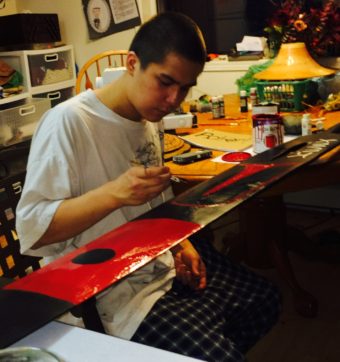
Price also taught paddle carving classes throughout the winter. Price required anyone who wanted to participate in the canoe journey to carve their own paddle to use on the trip. For him, delving into cultural activities is an avenue to make healthy lifestyle choices, and especially a choice away from drugs and alcohol.

“I thinks a worthy cause to support healthy lifestyle living and give young people, an old, something to do. Something that was done and keeping something that’s part of history alive.”

While the group officially organized through the tribe’s youth program, those on the journey to Celebration range age from 4 to 67. The eldest would be Bosch Hotch who got involved with the project from prompting from his grandkids.

“I didn’t really get into it until the grandkids said ‘Come on, come see what we’re doing,’ ” Hotch says. “I walked in there and Wayne gave me a plank and I started carving and haven’t quit since.”

With Bosch on the trip there were three generations of his family making the journey.

And for Price, this wasn’t his first canoe journey. He’s done similar projects with First Nations youth in Canada. And it’s not his first dugout canoe either – he’s done at least 10. But paddling a dugout from Haines to Juneau has been a longtime dream.

“We’re doing an adventure that hasn’t been done in a very long time, in a traditional dugout as well. So there’s a  bi g accomplishment in that. I just want to keep everyone fed and healthy and safe and make sure their journey is a good one as well, too.”

Site notifications
Update notification options
Subscribe to notifications