Celebration

Growing group of Native veterans paddles to Celebration while raising awareness

Dennis Jack, center, looks on as Doug Chilton, right, and other paddlers pack supplies into the Eagle canoe that veterans will paddle. May 29, 2018.
Dennis Jack, center, looks on as Doug Chilton, right, and other paddlers pack supplies into the Eagle canoe that veterans will paddle. May 29, 2018. (Photo by Adelyn Baxter/KTOO)

In the waters of Southeast, the members of the One Paddle Canoe Society will reach Juneau the same way their ancestors would have thousands of years ago.

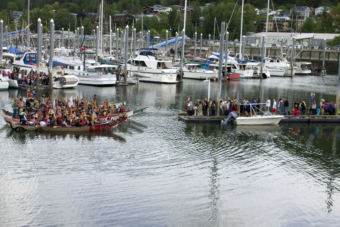
On Tuesday, canoes representing six Southeast communities and Canada will arrive in Juneau. Their landing will kick off Celebration, a four-day gathering of Tlingit, Haida and Tsimshian peoples.

Before they departed last week, a few local paddlers gathered at Auke Bay for last minute preparations. They piled bags of supplies into a long, white canoe covered in formline design with an eagle painted on the bow.

The Eagle canoe is manned by Alaska Native veterans. Aside from the desire to travel their ancestral waters, this group also paddles to raise awareness about the high rate of post-traumatic stress disorder and suicide among veterans.

Alaska has the highest concentration of veterans in the nation, and Alaska Natives make up a high number of them.

“Most every village you come into in Southeast Alaska, you’ll find a veteran,” said Dennis Jack.

He’s a combat veteran who served in Desert Storm and the Iraq War. He’s from Angoon, and two years ago, he decided to organize a veteran canoe for the first time.

“At that time we had seven veterans and this year we have over 22 that are participating,” Jack said.

According to a study released in 2016 by the U.S. Department of Veterans Affairs, the risk of suicide is 22 percent higher among veterans compared with the rest of the U.S. population.

Jack said the response after their first trip two years ago was extremely positive. The governor’s office and other state politicians reached out to ask how they could help. This year, Safeway and Fred Meyer offered support, as well as the Department of Veterans Affairs out of Anchorage and the National Guard in Juneau.

“Through the veteran canoe journey we’ve managed to get some help for a couple veterans that slipped through the cracks and they’re now getting help,” Jack said. “Even if we help just one person, it’s well worth the trip.”

Jim Kindle (left) and John Hannon (right) sit with other members of One People Canoe Society in the Eagle canoe during a supply run on Tuesday, May 29, 2018. (Photo by Adelyn Baxter/KTOO)
Jim Kindle, left, and John Hannon, right, sit with other members of One People Canoe Society in the Eagle canoe during a supply run on Tuesday, May 29, 2018. (Photo by Adelyn Baxter/KTOO)

Val Cooday is paddling for the first time. During the Vietnam War, Cooday served in the Women’s Army Corps out of Fort Sam Houston in Texas.

She’s originally from Petersburg and she’s witnessed the effects of PTSD firsthand.

“I had a daughter who went to Afghanistan twice. She came back, very extreme PTSD and it’s been a five-year struggle trying to keep her wanting to live, ” Cooday said.

Jack has his own reason for paddling.

“For me, I started out because my father was a World War II veteran,” he said. “He always wanted to be on a canoe trip, but with his age … I decided to do this in his name, in honor of my father.”

The canoes are due to arrive in Douglas Harbor between 2 p.m. and 3:30 p.m. Tuesday. There will be a welcome party waiting for them.

Editor’s note: 360 North is under contract with Sealaska Heritage Institute to produce television and online video coverage of Celebration.

Audio postcard: Wrangell paddlers begin trek as support to Celebration

The video above is from the raven canoe and veteran’s canoe Sunday.

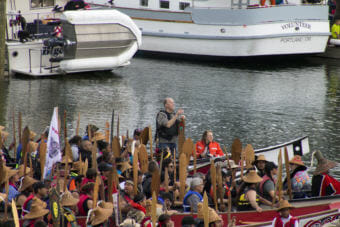
More than a hundred paddlers navigate about a dozen canoes toward Juneau for this year’s Celebration.

Those with the One People Canoe Society paddle from their Southeast Alaska towns to Juneau.

To keep everyone safe, support vessels run alongside these canoes to provide emergency care or just shelter from the storm.

KSTK’s June Leffler spoke with Alicia Armstrong and Steve Johnson, long time paddlers who are supporting Kake’s canoe paddlers.

That was Steve Johnson, Trevor Grant and Alicia Armstrong. They departed Wrangell in late May heading toward Kake.

They are scheduled to arrive in Juneau on Tuesday afternoon for Celebration.

Celebration 2018 brings 45 dance groups to Juneau

The Taku Kwan Dancers from Atlin, British Columbia, perform at Celebration on June 10, 2016. They're returning this year. (Photo by Ed Schoenfeld/CoastAlaska News)
The Taku Kwan Dancers from Atlin, British Columbia, perform June 10, 2016, at Celebration. They’re returning this year. (Photo by Ed Schoenfeld/CoastAlaska News)

Dance groups, artists, canoe paddlers and traditional food experts are gearing up for Celebration 2018, Southeast Alaska’s largest Native cultural gathering, held June 6-9 at Centennial Hall and nearby sites in Alaska’s capital city.

Celebration has happened every other year since 1982. Each Celebration has a theme. For 2018, it’s “Respect: Weigh Your Words.”

It can be hard to fully describe Celebration.

You can talk about its expected 2,000 or so dancers and 5,000 participants. Or the language, the oral traditions and the regalia. But that just doesn’t fully capture the experience.

Sealaska Heritage Institute president Rosita Worl describes one year’s grand exit, when all the groups danced out of the performance hall.

“It was like we were one people, one being, and we were all dancing,” she said. “It reminded me of a swarm of fish coming in. But everybody was kind of in unison, it was like we were part of a whole spiritual essence.”

Celebration 2018 lists 45 dance groups from Southeast and other parts of Alaska, the Yukon, British Columbia, the Pacific Northwest and California.

Every Celebration has a lead dance group representing a clan.

This year it has two: The Shangukeidí, or the Thunderbirds, and the Lukaax.ádi, or the Sockeye.

They’re from Haines and Klukwan, or the Chilkat and Chilkoot areas.

Worl said they will dance together, with clan songs from each.

The entrance song, owned by the Shangukeidí Clan, is “The Thunderbird Trade Song.” The grand exit will feature “The G̱unanaa Trade Song, one the Lukaax̱.ádi Clan bartered for with inland Athabaskan tribes.

Not all dance groups are made up of members of the same clan. Others are community, school or multi-tribal-based.

Celebration coordinator Carmaleeda Estrada said she’s enjoyed the growth of the youth groups.

Two younger cousins from Angoon formed their own dance troupe and will be part of their second Celebration this year.

“We would never have thought to start our own dance group,” she said. “So to be able to see people even younger than me taking that initiative, we have young girls in our group who are still in elementary school and they’re writing songs, they’re writing Tlingit songs. And so, just to see that from my own community is really inspirational. It really raises the bar.”

Canoes from around Southeast Alaska are formally greeted at the Douglas Boat Harbor on June 8, 2016, just before that year's Celebration. This year's canoes are scheduled to arrive June 5 between 2 and 3:30 p.m. (Photo by Ed Schoenfeld/CoastAlaska News)
Canoes from around Southeast Alaska are formally greeted at the Douglas Boat Harbor on June 8, 2016, just before that year’s Celebration. This year’s canoes are scheduled to arrive between 2 and 3:30 p.m June 5. They’re organized by the One People Canoe Society. (Photo by Ed Schoenfeld/CoastAlaska News)

Regalia, such as clan hats, vests, and button blankets, is worn by most dancers.

That’s changing, Worl said.

“Before we would only allow traditional regalia,” she said. “But we kept saying, if our culture’s going to evolve, then we have to let it and support that. So now you’re seeing a lot more Native fashion wear.”

This year’s Celebration will continue the relatively new tradition of a runway-style fashion show.

For the first time, the models will have a formal model training session.

Another new event is a seal oil contest, to be judged by taste and other factors.

Estrada said such contests will be more visible than in previous years.

“We would do that off to the side in the elders’ room and it wasn’t as prominent as it’s going to be this year,” she said. “Not only are we adding the seal oil competition to that, so now there’s three food categories, but we’re also moving that to the main stage.”

Celebration also includes a juried art show, a youth art show, a regalia care workshop, a Native artists market and the ever-popular toddler
regalia revue.

But the action isn’t all on stage. Estrada thinks back to Celebrations she attended as a child.

“You remember running around with your cousins and you don’t really realize how important and how lucky you are and what a profound event you’re at. But those things are just as fun, being able to reconnect with family and friends from all over,” she said.

Editor’s note: 360 North is under contract with Sealaska Heritage Institute to produce television and online video coverage of Celebration.

Atlin dance group reflects cross-border cultural resurgence

Taku Kwaan Dance Leader Wayne Carlick and others drum as more than 30 people take the stage during Celebration 2016 (Photo by Ed Schoenfeld/CoastAlaska News)
Taku Kwaan Dance Leader Wayne Carlick, left, and others drum as more than 30 people take the stage during Celebration 2016. The Atlin, British Columbia, group included relatives from Juneau.  (Photo by Ed Schoenfeld/CoastAlaska News)

Southeast Alaska’s Tlingit culture doesn’t stop at the Canadian border. Tribal members also live in British Columbia to the east and the Yukon to the north. An Inland Tlingit group from up the Taku River has strong connections to Alaska.

Dance Leader Wayne Carlick calls more than 30 people to the Celebration 2016 main stage.

They’re children, adults and elders clad in button blankets, beaded vests and carved and woven hats. Some wear Chilkat blankets, others wolf hides.

Taku Ḵwáan, or Taku People Dancers, came to Celebration from Atlin, British Columbia, about 90 miles northeast of Juneau.

Youth Spokesman Matthew Wesley asks the Celebration audience for a Hoo-Ha cheer during the Taku Kwaan performance. (Photo by Ed Schoenfeld/CoastAlaska News)
Youth Spokesman Matthew Wesley asks the Celebration audience for a Hoo-Ha cheer during the Taku Kwaan performance at Juneau’s Centennial Hall. (Photo by Ed Schoenfeld/CoastAlaska News)

Carlick said it started around 10 years ago when young people began asking about their culture. Before this group, there was another, the Children of the Creator.

“That dance group actually inspired our parents to join the dance group and eventually we became the Taku Ḵwáan Dancers. Our children were always a part of it and they’re the ones who actually started us getting busy and make our regalia and do all this stuff for our people,” he said.

It was a cultural revival, not unlike recent decades’ resurgence on this side of the border.

Both share some history. As in Alaska, Canada’s government-funded residential schools practiced what many call “aggressive assimilation.” The aim was to destroy traditions.

“Nobody really danced for a long time because we didn’t know about our culture. There were elders who were silent because of the schools that we went to. And to try to break through all that and say, ‘This is who we are. Nothing’s going to get in the way of it, because no matter what they do to us, we are here, now,'” he said.

The Taku people have close ties to the Juneau area.

Louise Gordon is spokesperson for Taku River Tlingit First Nation.

“It happened over a period of time. We actually migrated from the Taku down to Douglas Island, where the food was,” she said.

She said some of the Taku Ḵwáan Dancers performing at Celebration are from Douglas or Juneau.

“That’s why the wolves are part of our dance group because they were originally … people from the Taku River. But they decided to stay in Juneau and we decided to move inland. So the Celebration gives us an opportunity of reconnecting with our families” she said.

Gordon credited Carlick for the dance group’s size and success.

The former residential school student was given carving tools by elders in the 1990s. Carlick took those to Vancouver, B.C., where he studied, practiced and became a master carver.

“He actually came back into the community and inspired the whole community. He’s actually had something to do with each and every one of our blankets. And I was witness to see him make 40 drums in one month. That’s more than one a day,” she said.

Carlick said he did it by involving the community.

“It’s the same thing about learning about our regalia, learning about the spiritual part and our connection to it. I think it’s all part of it. The drum is part of it. The shoes we wear, the clothing we wear, all become part of who we are. It’s almost like or second skin,” he said.

Taku Kwaan dancers perform June 10 as part of Celebration 2016. The group is from Atlin, British Columbia, and included relatives in Juneau. (Photo by Ed Schoenfeld/CoastAlaska News)
Taku Kwaan dancers perform June 10 as part of Celebration 2016. The group is from Atlin, British Columbia, and included relatives from Juneau. (Photo by Ed Schoenfeld/CoastAlaska News)

Inland Tlingits have their own regional cultural gathering every other year. The next Hà Kus Teyea will be held in 2017 in Teslin, in the Yukon, another Tlingit population center.

Carlick said such events help maintain traditions.

“This is our Olympics. This is the biggest of the dances, the biggest of the groups and the best groups in the world are here at Celebration,” he said.

Three other Canadian dance groups performed during this month’s Celebration. Two were from Whitehorse, the Yukon’s capital city, and one was from Surrey, near Vancouver.

Video: Canoes arrive at Douglas Harbor for Celebration 2016

Hundreds of people greeted a party paddlers in their regalia today attending Celebration. KCAW’s Emily Kwong and KTOO’s Jennifer Canfield shot this video from Douglas Harbor.Here’s some video from Mark Calvert of the canoes arriving.
Live television coverage of Celebration on 360 North and 360north.org begins at 6 p.m. Wednesday. Celebration coverage continues from 9 a.m. to 10 p.m. through Saturday. For more Celebration news coverage, go to ktoo.org/celebration.Correction: A previous version of this story said the canoes landed at Sandy Beach. They landed at Douglas Harbor, which is adjacent to Sandy Beach.

Celebration 2016 aims to renew youth engagement in culture

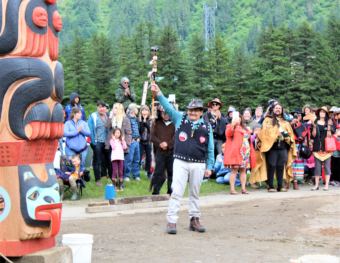
Grand Entrance to Celebration. (Photo by Heather Bryant/KTOO)
A young drummer at the grand entrance to Celebration 2014. (Photo by Heather Bryant/KTOO)

This year, in addition to Celebration’s core goal to engage Native youth, organizers in Juneau are promoting the convergence of multiple generations and cultures.

Every other year several thousand people travel to the state capital for Celebration, a four day event meant to renew appreciation for the Tlingit, Haida and Tsimshian cultures of Southeast Alaska.

The event is rooted in a desire to pass Southeast Alaska Native culture on to future generations.

Rosita Worl, president of the Sealaska Heritage Institute, said Celebration started with a group of elders who didn’t want their culture to be forgotten by their children.

Rosita Worl is president of the Sealaska Heritage Institute.

“They were so wise in knowing that our children were learning our culture in a very different way, not in a traditional clan house around the fire. They were learning it in schools,” Worl said.

Worl said the elders’ desire to adapt led to the start of Sealaska Heritage Institute and the institute, alongside community elders, held Juneau’s very first Celebration in 1982. The event is a party but Worl said it also teaches important lessons, for example:

“Songs are owned by clans. So we’re teaching about our Tlingit property law. We had a legal system that was very well developed and songs are like property. We own intellectual property. Even though you might be seeing singing and dancing, there’s a lot more that’s going on that’s being taught,” Worl said.

Worl said crests, like the designs on blankets, are also owned by clans. She said the crests, songs and stories teach lessons on Native history.

This year Celebration organizers are renewing their efforts to pass on that history to Native youth. There will be an art exhibit made specifically for young people and, Worl said, Celebration goers will see traditional Native clothes integrated into modern fashion.

“We don’t want our youth to think that our culture is a static culture (and) that it doesn’t change,” Worl said.

Worl is also excited for what she calls a promotion of “cross cultural diversity.” The Juneau Symphony will perform for the event and Worl recently found herself asking:

“’How many Tlingits do you know like Irish music?’” And somebody (said), ‘I do,’” Worl said.

An Irish group from Australia is scheduled to play throughout Celebration. Worl said sharing the event with everyone is an especially important part of the experience.

“I want our people to not only see the diversity within Alaska but also within the world,” Worl said.

Worl also hopes to share Celebration with all sectors of the Juneau community and Southeast Alaska.

Live television coverage of Celebration on 360 North and 360north.org begins at 6 p.m. Wednesday. Celebration coverage continues from 9 a.m. to 10 p.m. through Saturday. For more Celebration news coverage, go to ktoo.org/celebration.

Site notifications
Update notification options
Subscribe to notifications