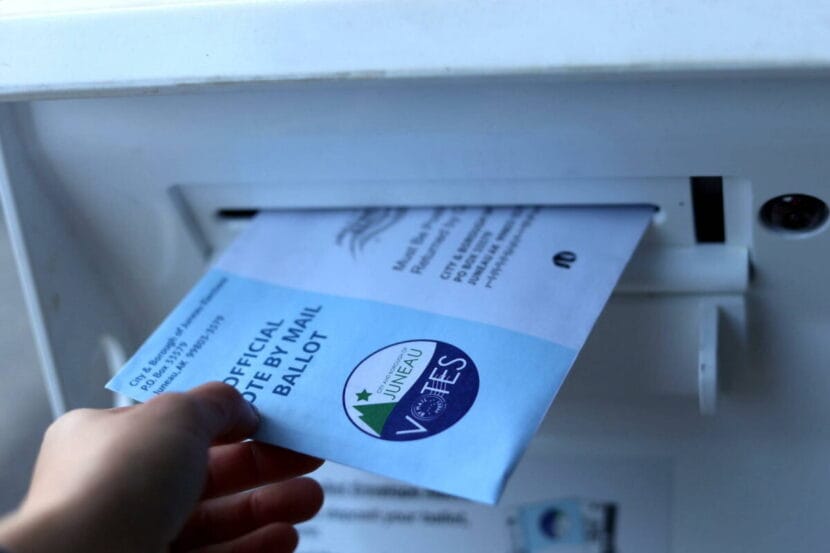
A municipal election ballot is placed in the drop box at the Douglas Library in September 2023. (Clarise Larson/for the Juneau Empire)
Ballots for Juneau’s local election are being mailed to registered voters Thursday.
It marks the start of the City and Borough of Juneau’s municipal election this year, which features three ballot propositions, two recall questions, nine Assembly and six school board candidates.
City Clerk Beth McEwen said people should start receiving their ballots in their mailboxes starting on Friday or this weekend.
“It’s a pretty long ballot. Take your time. Sit at your kitchen table and take as long as you need to research the stuff,” she said.
Voters will have a handful of ways to return their ballots once they are filled out. The city has ballot drop boxes in different locations throughout the borough. Voters can also mail ballots back, or go to one of the two vote centers in town.
Ballots sent in by mail need to be postmarked on or before Election Day and a first-class stamp is required.
This year, the city added a few more drop boxes. McEwen said that’s because it’s been a popular way for people in Juneau to return their ballots.
“People were really appreciating and having an opportunity to drop things off and drop boxes. So we wanted to make that a little easier for folks,” she said.
The five available ballot drop boxes will open on Friday. They are located at City Hall, the Alaska Electric Light and Power Company office in Lemon Creek, Douglas Library, the Mendenhall Valley Public Library and the Statter Harbor Boat Launch parking area.
The two vote centers will open on Monday, Sept. 16. They are at City Hall and the Valley Library.
Election Day is Tuesday, Oct. 1. McEwen said she encourages people to not wait until then to vote. That’s because the vote center lines can be long, and ballots turned in on Election Day aren’t counted in the unofficial results released that night.
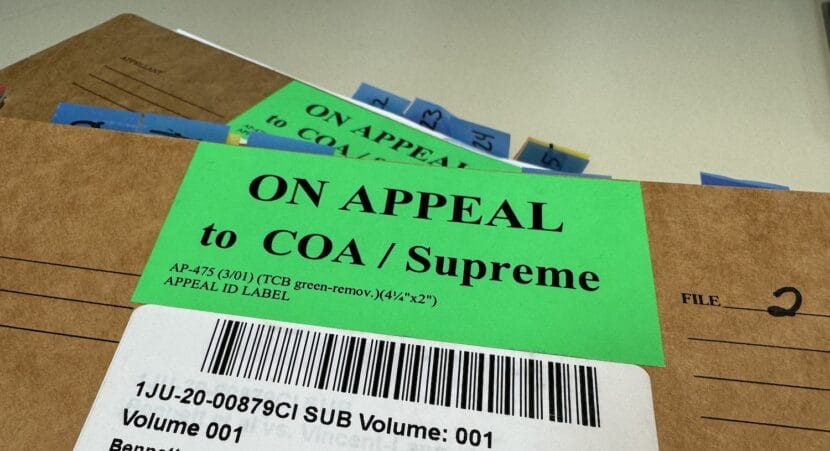
Case files for a legal matter referred to the Alaska Supreme Court are seen on Tuesday, Feb. 6, 2024, in Juneau. (Photo by James Brooks/Alaska Beacon)
The Alaska Supreme Court will hear oral arguments Thursday morning in a lawsuit seeking to remove Eric Hafner, an imprisoned, out-of-state Democrat, from the state’s November election ballot.
Under Alaska’s elections system, the top four finishers in the August primary election advance to the general election ballot. Hafner, who finished sixth, was promoted to the top four by the Alaska Division of Elections after two higher-finishing Republicans withdrew.
The Alaska Democratic Party challenged the division’s decision in court, and on Tuesday, a Superior Court judge dismissed the case, ruling strongly in favor of the Division of Elections.
Judge Ian Wheeles found that removing Hafner would require the division to redesign the election ballot, possibly delaying the federally mandated mailing of ballots to international voters.
That potential harm is greater than any harm caused by Hafner’s presence on the ballot, Wheeles said.
Wheeles concluded that Hafner, who is serving a 20-year prison sentence for threatening to kill public officials in New Jersey, has the Constitutional right to run for office, even if he is ineligible to serve.
For U.S. House candidates, the U.S. Constitution requires that a candidate be an inhabitant of the relevant state. Attorneys representing the Alaska Democratic Party argued that Hafner, who is not scheduled for release until 2036, cannot be an inhabitant as required.
After losing in lower court, the party filed an emergency appeal with the Supreme Court, which granted it Wednesday.
The Alaska Department of Law, representing the Division of Elections, is ready to defend the state again, a spokesperson said.
“The Superior Court found the Division of Elections correctly applied Alaska law and the U.S. Constitution. The Department of Law is preparing to defend this decision in the emergency appeal to prevent any disruption to the general election,” said spokesperson Patty Sullivan.
Alaska Democratic Party executive director Lindsay Kavanaugh said the party is pleased that the Alaska Supreme Court is acting quickly.
“Hafner is not our candidate and as a non-Alaskan incarcerated until 2036, he has no business being on Alaska’s ballot,” she said.
She said the state’s decision to print ballots with the issue unresolved is “another nonsensical decision made, and it’s a tired defense.”
“Election integrity also includes having candidates on the ballot that can actually take office and serve Alaskans,” she said.
The Alaska Republican Party intervened in the case on the side of the state. ARP chair Carmela Warfield did not immediately respond to a phone call seeking comment on Wednesday.
Hafner received less than 1% of the vote in the August primary, but some Democrats have expressed concerns that Hafner’s presence on the ballot could divert votes from incumbent Rep. Mary Peltola, D-Alaska. Peltola is believed to be in a close race against Republican challenger Nick Begich. Alaskan Independence Party candidate John Wayne Howe is also on the November ballot.
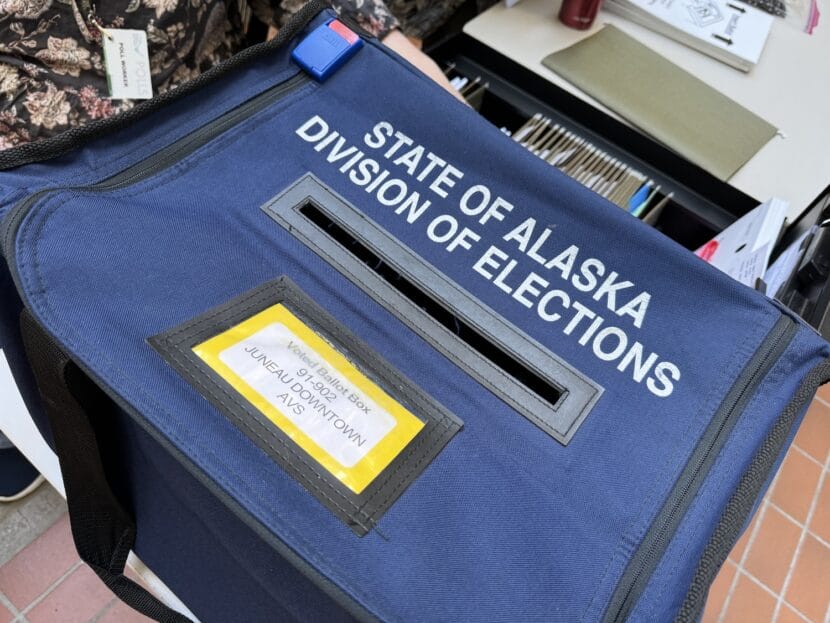
An early voting station is set up in the atrium of the State Office Building in Juneau, Alaska on Monday, Aug. 5, 2024, the first day of early voting for the 2024 Alaska primary election. (Photo by James Brooks/Alaska Beacon)
An Anchorage Superior Court judge said on Tuesday that out-of-state imprisoned Democratic U.S. House candidate Eric Hafner is eligible to appear on November‘s election ballot.
In an 18-page ruling, Judge Ian Wheeles firmly dismissed a lawsuit filed by the Alaska Democratic Party, which sought to remove Hafner from the ballot.
The ruling hinged on the idea that Hafner, while unqualified to take office, is qualified to run for office.
Wheeles’ decision clears the way for the Alaska Division of Elections to print and mail ballots to international voters. The federally mandated deadline to do so is Sept. 21, and elections officials had testified that removing Hafner could cause them to miss the deadline.
The party’s executive director, Lindsay Kavanaugh, said the party will appeal the decision to the Alaska Supreme Court.
In court on Monday, attorneys representing the party had suggested voters might erroneously pick Hafner instead of the party’s preferred candidate, incumbent Rep. Mary Peltola, D-Alaska.
Polling indicates Peltola may be in a close race against Republican challenger Nick Begich. While Hafner earned less than 1% of the vote in the state’s August primary election, some Democrats are worried that Hafner could act as a spoiler.
Wheeles, noting Alaska’s ranked choice general election system, rejected the party’s argument.
“The court does not find any reasonable argument from plaintiffs that Hafner’s appearance on the ballot is going to harm another candidate or voters,” he wrote.
Removing Hafner from the ballot, Wheeles wrote, raises the risk that the ballot redesign process would cause the Division of Elections to miss deadlines and cause confusion among voters.
“In sum, an injunction threatens a successful administration of the election process, harming the Defendants without adequate protection, while the Plaintiffs face only minimal harm,” he wrote.
Most concerning to the court is the harm to the public and the integrity of the election, which would be truly irreparable.”
Under Alaska’s elections system, the top four candidates from the primary election — regardless of party — advance to the general election.
Wheeles appeared to scold the Democratic Party for bringing the case so late in the elections process, writing that it was “very foreseeable” that two candidates from either party might make the state’s final four.
“If plaintiffs did not evaluate this possible outcome in May, June, or even July, that was a failure to plan by the plaintiffs, not the emergency that is being depicted here,” he wrote.
Wheeles furthermore concluded that Hafner is a legal candidate, even if he would be unable to take office.
The Alaska Democratic Party had noted in court that Hafner, who was convicted of threatening public officials, is not scheduled to be released from federal prison until 2036.
The U.S. Constitution requires that a candidate for office be an inhabitant of the relevant state when elected, and Hafner is imprisoned in New York.
“If ever there is a person who cannot possibly become an inhabitant of the state in which they seek elections by election day, that person is Mr. Hafner,” said attorney David Fox, representing the Democratic Party.
Wheeles rejected that argument, writing, “There is no dispute that Hafner is not residing in Alaska today. But there is no requirement under law that he reside in Alaska today, in the past, or in the future at any time prior to the day ‘when elected’ to office. That day has not yet arrived, and regardless of the probability that plaintiffs assert, the court cannot make any factual finding about the future. The court would be speculating, which it has no authority to do in this context.”
Attorneys for the Alaska Department of Law, which represented the Division of Elections, did not immediately respond to a request for comment late Tuesday. An attorney representing the Alaska Republican Party, which intervened on the side of the division, also did not immediately respond to an emailed request for comment.
“We’re disappointed by the judge’s ruling but remain confident Peltola will win in (November),” Kavanaugh said.
She noted that Hafner is on the ballot only because two higher-finishing Republican candidates — Lt. Gov. Nancy Dahlstrom and insurance adjuster Matt Salisbury — withdrew after the primary.
“Unlike the Republican Party, we don’t have to scheme to win by asking candidates to drop out until a convicted felon gets on the general election ballot who received less than half a percentage of the votes cast during the primary,” Kavanaugh said. “We have more respect than that for voters in Alaska and clearly, our candidates are more viable than theirs.”
Bernadette Wilson, a senior adviser for Begich’s campaign, said by email that the Democratic Party’s situation “is a direct result of ranked choice voting which Nick Begich has consistently spoken out against. Fortunately, Alaskans will have the opportunity to undo this convoluted system in November.”
A ballot measure seeking to repeal the state’s open primary and top-four, ranked choice general election system will be in front of voters on the general election ballot.
“In the meantime,” Wilson said, “we look forward to having a robust discussion on the failed policies of the Biden administration which Mary Peltola has unequivocally supported as congresswoman.”
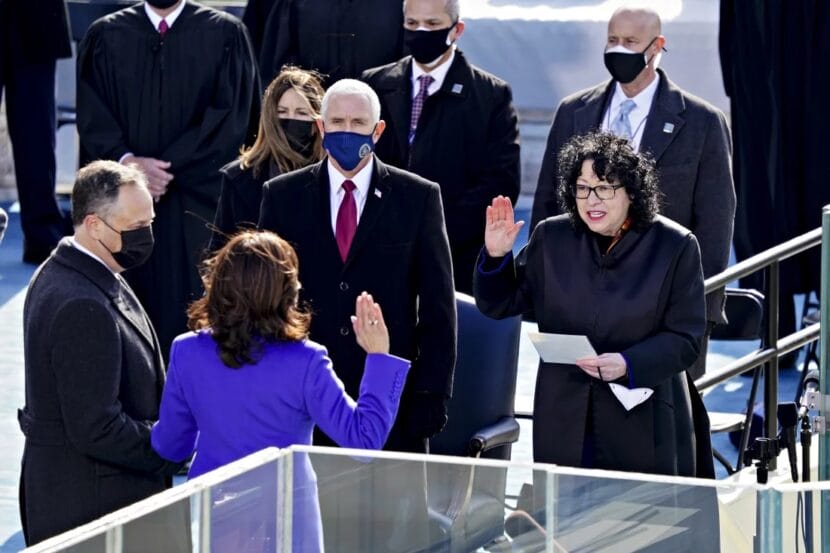
Supreme Court Justice Sonia Sotomayor (right) administers the oath of office to incoming Vice President Kamala Harris in front of the U.S. Capitol on Jan. 20, 2021, as outgoing Vice President Mike Pence (wearing blue mask) watches. (Kevin Dietsch/Getty Images)
“I was a little bit surprised, people might be surprised to hear that you have never interacted with him, met him face-to-face,” CNN’s Dana Bash said to Harris during their August interview.
Trump and Harris served in the federal government at the same time, but some logistical quirks and unusual decisions kept them from interacting directly in recent years.
Harris was elected to represent California in the U.S. Senate in 2016, during her second term as the state’s attorney general. Trump donated twice to reelect Harris as California attorney general, in 2011 and 2013, though she did not keep the money.
Trump won the presidential election the same year Harris was elected to the U.S. Senate, and both were sworn in to their respective positions in early 2017.
Presidential candidate Trump and vice presidential candidate Harris didn’t meet in person during the 2020 election (granted, the COVID-19 pandemic had forced much of the world online).
Harris did debate Trump’s running mate, Mike Pence, in October 2020. Remember the fly?
Trump and Harris might have crossed paths at President Biden’s inauguration in January 2021, two weeks after the Capitol riot that Trump is accused of stoking. But Trump decided not to attend, becoming the first former president to skip his successor’s inauguration since Andrew Johnson in 1869.
KTOO will carry the debate live on the radio starting at 5 p.m. AKST.
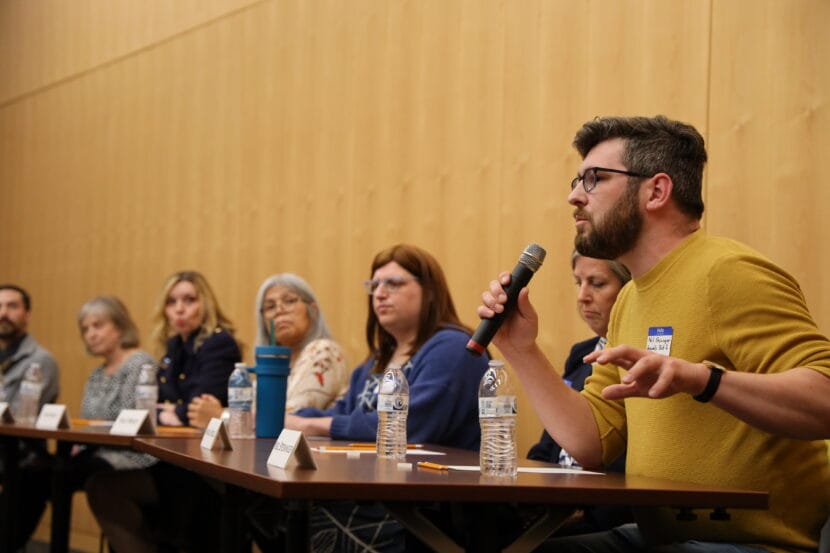
Assembly candidate Neil Steininger speaks to the audience during a forum at the Alaska State Museum on Thursday, Sept. 5, 2024. (Clarise Larson/KTOO)
The candidates who win the three open seats on the Juneau Assembly this fall will make critical decisions about the safety of residents. From figuring out how to mitigate natural disasters to hiring enough first responders — not all candidates are on the same page on how to tackle these issues.
Last week at the State Library and Museum, candidates participated in a public safety forum hosted by local first responders. The event focused on key health and safety issues that police, firefighters and dispatchers face in Juneau.
Issues like natural disasters, child care, staff shortages and wages were common themes. Assembly District 1 candidate Neil Steininger said the city needs to increase wages for first responders as the police department struggles to fill more than a dozen vacant jobs.
“You don’t attract quality workers unless you are willing to pay what it costs to attract a quality worker,” he said.
Steininger said getting those positions filled is critical. That’s as emergencies, like this year’s record-breaking glacier outburst flooding in Juneau, will likely continue to be looming problems.
At the forum, while all candidates said they support mitigation efforts for future flooding being sought by the city, District 2 candidate Nano Brooks was more pressing. He said the city needs to take immediate action instead of waiting on movement from the state or federal government.
“We need to be building levees downstream on city-owned land. We need to be cutting diversion channels into unpopulated areas and be looking at what it takes to engineer stilted homes for construction of the future,” he said.
Alongside candidates on the ballot, there is a proposition that asks voters whether to pass $12.7 million in bond debt to help cover the cost of replacing the radio system used by police and firefighters.
Police say the current system they use is outdated and its expected lifespan expired a decade ago. While all candidates present at the forum said they would be voting yes on the measure, some like mayoral candidate Angela Rodell, said she isn’t a fan of the way the city wants to pay for it.
“One of the things I’m very concerned about is why this bond issue is coming this year,” she said. “Why it hasn’t come before now? To me, this is something that should have been taken care of a long time ago, and we need to focus on making sure that essential services are covered in current operating budgets.”
The lack of affordable housing and limited resources for people experiencing homelessness was also an issue brought up. District 2 candidate Emily Mesch said she wants the city to expand its collaboration with local social service providers.
“I think CBJ has a leadership role, in terms of making sure that all of our social services providers are working well with one another, that when there are gaps, they can work together to fill them, and make sure that if there is a need, that it’s provided for,” she said.
Seven out of nine Assembly candidates attended the forum. District 1 candidate Connor Ulmer and incumbent Mayor Beth Weldon did not attend. Five candidates are running for a District 2 seat, two are running for a District 1 seat and two are running for mayor.
But, more election forums are coming up. Ballots for Juneau’s by-mail election will be mailed to residents on Sept.12. Election Day is Oct. 1.
The Juneau League of Women Voters, KTOO and the Juneau Empire will co-host candidate forums on Sept. 17 and 18 at 7 p.m.
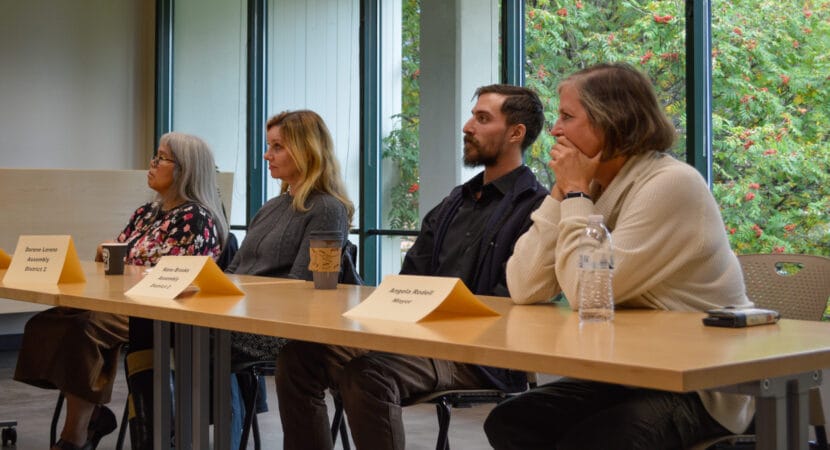
Juneau Assembly candidates Mary Marks, Dorene Lorenz, Nano Brooks, and mayoral candidate Angela Rodell at a forum at the Douglas Library on Sept. 8, 2024. (Photo by Yvonne Krumrey/KTOO)
Candidates running in Juneau’s local election shared their stances on issues that affect Douglas Island residents Sunday at a forum at the Douglas Library.
Answering a question about the still-unpaved roads in Douglas, including one next to Sayéik: Gastineau Community School, District 2 Juneau Assembly candidate Nano Brooks said the roads are an example of the way the City and Borough of Juneau has handled other issues in Douglas, which was incorporated into Juneau in 1970.
“There’s no reason that it’s not paved right now,” he said. “I’ve seen it in so many fields. It seems like Douglas doesn’t get a priority on very many things.”
District 1 represents Douglas Island residents, but the two candidates from that race — Connor Ulmer and Neil Steininger — weren’t there in person. District 2 candidate Emily Mesch and incumbent mayor Beth Weldon also didn’t attend.
District 2 candidates Dorene Lorenz, Brooks, and Mary Marks attended in person, as well as mayoral candidate Angela Rodell. District 2 candidate Maureen Hall didn’t attend or submit answers.
The moderators asked candidates about the graveyards in Douglas that volunteers have been maintaining for decades. Most candidates said they should be at least in part taken over by the city, but current Mayor Beth Weldon said via a written statement read by one of the moderators that she doesn’t support the acquisition.
“I am in a unique position from other candidates, as I have relatives buried in one of the cemeteries,” Weldon wrote. “But with the burden on staff time and the funding involved to resolve ownership, I am unable to support CBJ taking ownership of the cemeteries.”
Several candidates, like Mary Marks, said caring for the graveyards shows respect for Juneau’s ancestors.
“It’s hard, you know, it’s hard to handle death,” Marks said. “And if we have our community working together to help each other handle it, I think it’d be more soothing, and it would begin to heal, heal each other.”
Another question concerned capping spending on Eaglecrest’s Gondola project, and whether the municipally-owned ski area should be self-sustaining after the gondola is up and running.
No candidate offered a hard cap on spending, and most said they would want more information on how the gondola contributes to revenue before weighing in on Eaglecrest’s long-term fiscal plan.
Rodell said she wants to see the outcome of the vote on “Ship-Free Saturdays” before making assumptions about the gondola’s revenue.
“That’s going to have an impact on whether or not Eaglecrest can be sustainable in the time frames people are talking about, because it’s going to limit the number of visitors who are going to be able to go out to Eaglecrest,” Rodell said.
Every candidate was in favor of a second crossing that would connect North Douglas to Juneau’s mainland. But they didn’t weigh in on where exactly that crossing should be built.
Emily Mesch’s written statement commented on the potential environmental impacts.
“I highly value our wetlands area,” Mesch said. “And believe that we should ensure they are affected as little as possible, with the foreknowledge that having a zero effect isn’t possible.”
In a written response, Weldon said the crossing will provide redundancy and added safety for residents of the island, since one bridge leaves them vulnerable in the event of a closure. And Weldon used her answer to give an update: the routes will soon be evaluated by the National Environmental Protection Act standards.
“The main purpose of the crossing is to provide redundancy and safety,” Weldon said. “After having the bridge hit twice by cranes, we realize our vulnerability with only one crossing.”
Ballots in Juneau’s by-mail election will be mailed out later this week. Voting ends Oct. 1.
Close
Update notification options
Subscribe to notifications
Subscribe
Get notifications about news related to the topics you care about. You can unsubscribe anytime.