Alaska Native Arts & Culture

Bill would boost Native-language immersion schools

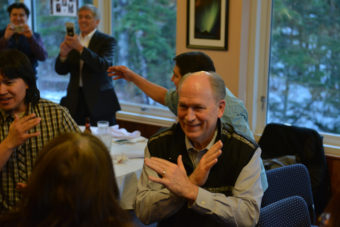
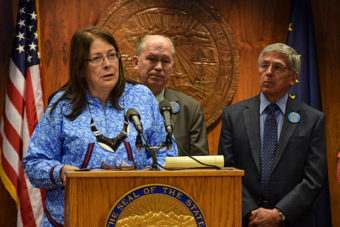
Sitka Democratic Rep. Jonathan Kreiss-Tomkins talks about Native language immersion charter schools Tuesday at the Native Issues Forum in Juneau. (Ed Schoenfeld/CoastAlaska News)
Sitka Democratic Rep. Jonathan Kreiss-Tomkins talks about Native language charter schools Tuesday at the Native Issues Forum in Juneau. (Ed Schoenfeld/CoastAlaska News)

New legislation will propose a system of encouraging and supporting Native language charter schools in Alaska.

Sitka Democratic Representative Jonathan Kreiss-Tomkins says the bill will be introduced this month.

He says it will follow in the footsteps of successful programs in New Zealand, Hawaii and Israel.

“The takeaway is very simple. To revitalize a language, you need immersion language education. You need children to be surrounded by an immersive language environment from a young age. And that is how you create a new generation of fluent speakers. That is how you turn the tide of language loss,” Kreiss-Tomkins says.

Immersion programs are already offered in several Alaska communities.

Kreiss-Tomkins says the bill will propose a special designation for charter schools following that model.

“It includes what is an academic policy committee, which is basically the school board for the charter school. It would include tribal representatives and elders and fluent speakers in order to ensure that school successfully embodies the culture of the language that that school is teaching,” he says.

The effort follows last year’s legislation establishing all Alaska Native languages as official. Kreiss-Tomkins led that effort, which was supported by tribal organizations statewide.

The new bill will also change rules about donated food.

“We want schools, especially these Native language charter schools, to be able to take subsistence foods that members of the community might donate and allow that to be part of the school lunch program,” he says.

“Simply put, salmon’s a lot more healthy than some deep-fried corn dog from goodness knows where.”

The Sitka legislator announced plans for the bill Tuesday at the Native Issues Forum in Juneau.

Why some Alaskans are learning the Tlingit language

Participants of the Tlingit Language Learners Group point to the ceiling during an exercise called Total Physical Response. (Photo by Lisa Phu/KTOO)

A group of people in Juneau spend an hour every Monday practicing Tlingit. They bring dictionaries and flashcards, look at handouts and do language exercises. But this isn’t a class.

An informal group that meets at the Downtown Public Library was started by Tlingit language students who understand that learning the language also means teaching it to as many people as possible.

Richard Radford (right) is one of the founding members of the Tlingit Language Learners Group. (Photo by Lisa Phu/KTOO)

Seventeen people sit around a table practicing sounds of the Tlingit language. They’re watching a YouTube video made by X̱’unei, or Lance Twitchell. He teaches Tlingit at University of Alaska Southeast and is a vocal proponent of language revitalization.

But Twitchell’s voice over the speakers is the only trace of a Tlingit language teacher in the room.

The group was formed last spring, a result of a brainstorming session on how to bring Tlingit language and culture to the community in an accessible way. One of its founders Richard Radford has been studying Tlingit for two and a half years.

“We’re all learners and so it is kind of like a class of students getting to sort of call the shots,” Radford says.

Which means the group can go in many different directions.

“Anybody can share pretty much anything. We learned how to introduce ourselves in Persian a little while ago from someone coming in. We’re really open to that. Multiculturalism is a really a big part of this,” he says.

Radford says the group relies heavily on books, dictionaries, YouTube videos and handouts made by more experienced Tlingit speakers.

“There are elders and linguists and artists and culture bearers and professors and other language learners and all sorts of people from all over the place who provide us with so much. We’re just standing on the shoulders of giants,” Radford says.

The group is made up of regulars and others who drop in because they’re curious.

Nancy Keen holds out Tlingit flash cards. (Photo by Lisa Phu/KTOO)

At age 56, Nancy Keen has made it a goal to learn Tlingit. Her grandfather was fluent, but her mother never spoke a word. Keen’s been drumming and singing clan songs with Southeast dance groups for five years and that’s spurred her interest.

“You have to want to know what you’re singing about. And you have to want to know that you should pronounce this stuff correctly because the language is just so subtle in nature that it’s really easy to say something wrong when you don’t mean to,” Keen says.

Tlingit is a tonal language. Similar sounding words that mean drastically different things are distinguished by an inflection of the voice. The group practices these similar sounding words:

“Eech” means reef while “éechʼ” describes something compact and heavy.

Keen says she can’t put full sentences together yet so she’s working hard on memorizing sounds and pronunciations.

She appreciates the group’s passion for making the Tlingit language so available.

“There was a lot of talk about building language nests and now it’s starting to actually come to light, and so that’s how we’re going to make sure we can continue and nurture this language,” Keen says.

The end of the hour comes quickly. A group participant suggests another activity.

“So if anybody wants to stick around and do some extra stuff for another 5 minutes or so, there’s some stuff that we can do that’s kind of more interactive,” says David Sheakley. He’s running an exercise called Total Physical Response, or TPR.

“Instead of just listening to the words and saying them back, you actually have to act them out with your body. It makes connections between your muscles and muscle memory with what you hear and also with what you say,” Sheakley explains.

Sheakley’s family on his father’s side is all Tlingit. Many of them spoke the language and helped spread it. Now, Sheakley sees it as his responsibility.

Like Keen and Sheakley, some in the group are Alaska Native. Radford is not one of them

“I’m definitely European descended. There’s a term dleit káa that gets used sometimes,” he says.

But, as someone living in Alaska, he feels a responsibility to learn the local language.

“We live in a very multicultural state and sometimes people lose sight of that, myself included. I mean we live in Lingít Aaní and I think that we should be learning the language of this place,” Radford says.

Outside of the learners group and class, Radford says he speaks Tlingit “mostly to my cats. I talk to them a lot. I’ve branched out to humans, too.”

Most of the time, he speaks to other learners.

“When we see each other in public it’s pretty much required. We do things online, there are a lot of things on social media. Not as many public events, like we’d like to do this, ideally, every night of the week in town, have this keep going. This is just a Monday,” Radford says.

After the TPR exercise, the group session ends, but the conversation carries on.

The Tlingit Language Learners Group meets 6 p.m. tonight, and every Monday night, at the Downtown Public Library.

The Governor’s Awards for the Arts and Humanities is tonight

Yada Di will perform at tonight's Governor's Awards for the Arts and Humanities. From left to right, Yada Di is Allison Warden, Yngvil Vatn Guttu, and Lena Lukina. Photo courtesy Yada Di.
Yada Di will perform at tonight’s Governor’s Awards for the Arts and Humanities. From left to right, Yada Di is Allison Warden, Yngvil Vatn Guttu, and Lena Lukina. Photo courtesy Yada Di.

The Juneau Arts and Culture Center hosts the Governor’s Awards for the Arts and Humanities tonight. Ryan Conarro will emcee, and Gov. Bill Walker will present awards. Two of the winners are based  in Southeast. The Arts Organization award will go to the Sitka Fine Arts Camp, and the Alaska Native Arts award will go to Sealaska Heritage Institute.

Performers will entertain the audience throughout the night. They include Juneau’s Alaska Youth Choir, the Juneau GIANT Puppet Project and a rap-jazz-funk fusion improvisational band from Anchorage called Yada Di.

Allison Warden, a.k.a. AKU-MATU, is Yada Di’s lead singer. Her stage name is an abbreviation of her two Iñupiaq names, Akootchook and Matumeak.

“Part of what I do in Yada Di is rap. We play all genres. We listen to each other. We explore the edges of what is possible in terms of music, and we take the audience on a journey in a very bold way,” Warden says.

Tickets are still available on the Alaska State Council on the Arts website. The awards will also be broadcast on 360 North beginning at 7:30 p.m. Tune into A Juneau Afternoon today for more information. Alaska State Council on the Arts Executive Director Shannon Daut will have more details on the festivities.

Hoonah cultural organization gets new director

Sarah Dybdahl has been hired as executive director of  the Huna Heritage Foundation. (Courtesy Huna Heritage)
Sarah Dybdahl has been hired as executive director of the Huna Heritage Foundation. (Photo courtesy Huna Heritage)

The organization supporting Tlingit culture and traditions in Hoonah has a new executive director.

Sarah Dybdahl takes over as the Huna Heritage Foundation’s top official next month. It’s the nonprofit arm of the Huna Totem village corporation, which owns and operates the Icy Strait Point tourist attraction.

“I’m really hoping to look for opportunities for the youth and look into ways to preserve the language and the history that they have already documented over the years,” she says.

William “Ozzie” Sheakley, chairman of Huna Heritage Foundation, says Dybdahl was the clear choice.

“She has such strong experience through her previous positions and we are confident she’ll be an innovative leader for the foundation,” he said, in a press release.

Hoonah is on northeast Chichagof Island, 30 miles west of Juneau. About three-quarters of its 800 or so residents are Tlingit. Huna Totem has about 1,360 shareholders with ties to the village.

Dybdahl is from Klawock on Prince of Wales Island, and serves on its Klawock Heenya village Native corporation’s board of directors. Her husband, Travis, is a descendant of Huna Totem shareholders.

She’s spent the past 15 years working for the Sealaska Corp. and its cultural arm, the Sealaska Heritage Institute.

“One of my main responsibilities was working for Celebration and being the kind of the overall coordinator there. And it really was being able to work with and communicate with numerous people with very different backgrounds and needs,” she says.

In her new job, Dybdahl will work with the recently created Huna Traditional Scholars Council. It was set up to address the community’s continued loss of traditional language and other knowledge.

She will also oversee Huna Heritage’s scholarship program, its annual clan conference and ongoing fundraising efforts.

Dybdahl begins work at the foundation’s Juneau office Feb. 9. The previous executive director, Kathryn Hurtley, resigned last year.

Early study shows surprising optimism among homeless Alaska Natives

Grand Entrance to Celebration. (Photo by Heather Bryant/KTOO)
A University of Washington researcher says a strong desire to pass down traditional knowledge may be related to high levels of optimism that he’s found among homeless Alaska Native elders. (Photo by Heather Bryant/KTOO)

A University of Washington professor has found high levels of optimism among homeless Alaska Native elders living in Seattle, and he’s connected the finding to a strong desire to pass on knowledge and experiences to future generations.

As an Aleut who grew up in Naknek, Jordan Lewis knows a little something about Alaska Native culture. Whenever he’s back home, Lewis says he likes to talk to elders and soak up traditional knowledge.

“They tell stories about how Naknek used to be when they were kids, because it’s changing so much now,” he says. “And I think just the fact that they talk to you and share their experiences, and pass on recipes, or how they used to make things, or where they used to pick berries, is this idea that they are hopeful that you’ll take that knowledge and use it to benefit your own life, but then pass it on again.”

Lewis is an assistant professor at the University of Washington’s School of Social Work. His research focuses on Alaska Native communities and generativity, a concept developed by psychologist Erik Erikson. It says that as we grow older, humans tend to want to pass on their experiences and knowledge to future generations.

“The first generative act most people have in their lives is having kids,” Lewis says. “That’s going to secure your future. But as you grow older there’s this need to pass on your legacy, write your memoirs, storytelling for elders, and passing down stories you heard to your grand kids.”

Lewis has studied how generativity helps Alaska Natives age well and become role models, as well as overcome addictions.

He says he became interested in the homeless because it’s an underserved and often overlooked population. Years ago, he says, his family had a relative involved with the Chief Seattle Club, a nonprofit that provides meals, housing assistance and other services to low-income and homeless Alaska Natives and American Indians. That’s where he and a student interviewed 14 Alaska Native elders last year. He says the results surprised even him.

“All of the elders talked about the importance of giving back and teaching others,” he says. “Whether it’s through sharing a sandwich, giving extra change if they had extra change to someone who wasn’t doing as well as they were. Volunteering at the Chief Seattle Club was almost everybody’s response. That’s what made them happy, that’s what got them up every day. And they all said that they did that because it’s going to come back to them in a positive way.”

He says other themes of the interviews included the importance of laughter and religion.

In addition, each of the elders – ages 45 to 70 – filled out surveys to measure generativity and optimism. Lewis says 12 of the 14 individuals scored very high in both.

“That kind of complimented the qualitative interviews. So I could say, you know, 85 percent of the people I interviewed are very optimistic and like to give back and teach the young people, and then here we have specific examples of what they do to do that,” Lewis says.

While he’s excited about the early results, Lewis admits more research is needed to confirm his findings. He’d like to do more than 100 interviews, and has considered expanding to include American Indians.

He’s planning to present his research at the Chief Seattle Club, and ask officials there for ideas on how to do a broader study of Native homelessness.

“How could we either help the people who are homeless, or how do we prevent homelessness, or how do we make their lives more enjoyable from these experiences of what these elders are doing for themselves,” he says.

Lewis also hopes to publish his findings in a peer-reviewed journal. The initial study was part of an online Stanford University program on successful aging that he participated in last year.

How the Alaska Native Brotherhood changed Alaska history

The book was published by the University of Alaska Press in November and is widely available. (Photo by Lisa Phu/KTOO)

In “A Dangerous Idea,” author Peter Metcalfe explores the crucial role the Alaska Native Brotherhood played in securing Native rights and land claims before, during and after statehood. The recently published book explores an often overlooked chapter in Alaska’s story. Metcalfe suggests, without the ANB, the Alaska of today would be a very different place.

When the Alaska Native Brotherhood formed in 1912, Alaska Natives were not U.S. citizens, couldn’t own title to land and couldn’t send their children to local schools. The aim of the group was citizenship and equality.

Peter Metcalfe says ANB was starting to make progress in the 1920s.

“They had won rights for education, voting rights, but what is consistent throughout the history of the Alaska Native Brotherhood is their demand that they be equals with the white establishment, that they have what we now call civil rights and that wasn’t even a term at that time,” Metcalfe says.

Two important leaders of the ANB in the 1920s were Peter Simpson and William Paul. Cultural expert and storyteller Ishmael Hope recounts an exchange they had during the 1925 ANB convention. Hope says Simpson “went up to William Paul who was one of the very prominent young leaders of the time and he just quietly said to him, ‘Hey Willy, who owns this land?’ And there was a little bit of a pause as William Paul thought of it and then he said, ‘Well, we do.’ ‘Then fight for it!’”

By the 1929 ANB/ANS Grand Camp convention in Haines, Paul was grand president. Metcalfe says Paul invited James Wickersham, who had served as a district judge and Alaska’s delegate to Congress.

“Judge Wickersham made a presentation to this convention in which he told the assembled delegates of the Alaska Native Brotherhood and the Alaska Native Sisterhood that they could sue the U.S. government,” Metcalfe says.

During his time in D.C., Wickersham had seen Congress pass different jurisdictional acts allowing various Native American groups to sue the government over lost lands and rights. ANB and ANS voted to do just that.

Kathy Ruddy helped Metcalfe with research for the book. She says that moment in history was the genesis of the book’s title.

“The dangerous idea is suing your own government when you’ve only been citizens for five years. Citizenship was extended to the Native people in 1924 and this is just five years after that,” Ruddy says.

Metcalfe says it was a landmark decision. At the time, the white establishment was just getting used to the idea of Native Alaskans as citizens. Racial discrimination was entrenched in society.

In the early 1930s, ANB began fighting for aboriginal land claims in D.C.

Metcalfe says members of the ANB set aside traditional ways in order to achieve their goals. Leaders spoke English and adapted to Western ways of dress and social activities.

But Hope says, despite what they wore at the time, leaders of the ANB, like his grandfather John Hope, retained their Native culture, which helped them in their fight.

“My grandpa talked about how we used parliamentary procedure, we used the English language as a tool, but not a means of identity,” Hope says. “Many of the ANB founders, you look at them and you think, the stereotype is that they’re assimilated Indians, but you actually look into the history and you see deeply retained cultural knowledge, cultural experiences.”

Hope’s father, Andrew Hope III, was the impetus for “A Dangerous Idea.” It was his idea to apply for a grant through the Alaska Humanities Forum, which funded the research. Hope passed away shortly after the grant was awarded in 2008.

One important case stemming from that 1929 decision – Tlingit and Haida Indians of Alaska v. United States – took about 40 years to resolve. In 1968, a federal court held that the land was owned by Native people from time immemorial.

Metcalfe says without the ANB and the ANS, there wouldn’t have been an Alaska Native Claims Settlement Act of 1971, an Alaska National Interest Lands Conservation Act of 1980, or the Alaska of today.

A one-hour television program on “A Dangerous Idea” premiers on 360 North Dec. 30 at 9 p.m. Additional broadcasts of the program are Dec. 31 at 12 a.m., 6 a.m. and 12 p.m. and Jan. 4 at 8 p.m.

Site notifications
Update notification options
Subscribe to notifications