Lt. Gov. Byron Mallott dances with the Mount St. Elias Dancers of Yakutat at the Elizabeth Peratrovich Hall inauguration night. (Photo by Brian Wallace/Sealaska Heritage Institute)
Bill Walker and Byron Mallott were sworn in as Alaska’s governor and lieutenant governor on Monday. That evening, members of Juneau’s Native community welcomed the new leaders during a public reception at the Elizabeth Peratrovich Hall.
Richard Peterson is president of the Central Council of the Tlingit and Haida Indian Tribes of Alaska. During the reception’s opening remarks, Peterson said it was an honor to be part of Walker and Mallott’s 250-person transition team.
“Usually we’re always the minority everywhere we go and it was just really heartwarming to look around and see so many Native leaders in roles of expertise. Our input, our opinions mattered, and it’s hard not to get emotional about that,” Peterson said.
Originally, Walker and Mallott, both Alaska-born, campaigned separately each running for the governor seat.
“What a reflection that was that you two were able to put egos aside for our state and choose to work together for a unity ticket. And whether you’re Democrat or Republican, it feels like we finally have Alaskans fighting for Alaskans. Gunalchéesh,” Peterson said.
The Mount St. Elias Dancers of Yakutat danced at the inauguration and the reception. Mallott is originally from Yakutat. The group’s J.P.Buller said many of them are in Mallott’s family, either part of his clan or married into it.
“I’d just like to tell you, Byron, how proud we are of you, how much we love you. You represent us so well. We admire you and we hope to have your integrity, your values and your constitution to stick with us. You’re an inspiration to see what some determination and hard work can do,” Buller said.
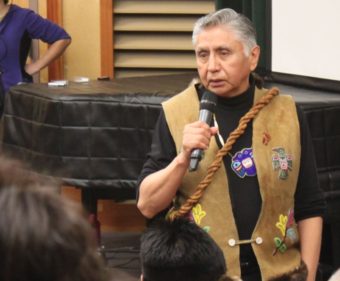
During one of the last songs, Mallott danced with the group wearing a custom Native “unity” vest that matches with Walker’s.
Part of the Tongass National Forest. (Photo Courtesy U.S. Department of Agriculture)
A long-awaited land selection agreement for Sealaska Corporation is among a package of public land bills that are now slated to move quickly through Congress. A deal to attach the package to the must-pass defense bill was announced late last night.
The bill would turn over about 70,000 acres of the Tongass National Forest to Sealaska, the regional Native corporation of Southeast Alaska, for logging and development.
Nationally, the bill moves 110,000 acres out of national control, enables a controversial copper mine in Arizona and expands a Bureau of Land Management program to streamline drilling permits. Outside of Alaska, it also establishes more than 200,000 acres of wilderness and designates new national parks.
Sen. Lisa Murkowski called it a balanced package that will increase economic opportunities in Western states. Leaders of both parties, in the House and Senate, have approved the deal. If it passes, it will be the most extensive public lands legislation to become law in at least five years.
The bill would sell an old DEW Line radar station to Olgoonik Corporation, the village corporation of Wainwright. The parcel is about 1,500 acres inside the National Petroleum Reserve-Alaska. The bill says the corporation must pay market value for the acreage. It also clears federal interests in three municipal lots in downtown Anchorage and, further north, turns over an Air Force tank farm to the city of Nome. In the defense portion of the bill, lawmakers affirm the process the Air Force used when it selected Eielson Air Force Base to house the first F-35A squadrons.
Goldbelt Inc. has named a veteran CIA and Department of Homeland Security officer as its next CEO.
Robert Irwin of Virginia has decades of experience in the federal government and officially begins work at the Juneau-based Native corporation Dec. 15.
Joe Kahklen, chairman of the Goldbelt Board of Directors, said Irwin was selected because of his “extensive knowledge” of federal contracting, especially with 8(a) contracts.
8(a) refers to a part of federal law that gives small, minority-owned and disadvantaged businesses assistance and special preferences for federal contracts. Subsidiaries are ineligible – unless the parent company is an Alaska Native corporation, Native Hawaiian organization, or an Indian tribe.
Goldbelt’s 2013 annual report shows contracted services generated nearly 94 percent of its revenue for the year, or about $138 million.
Outside of Alaska, the 8(a) preference for Alaska Native corporations has been controversial because it’s been exploited to secure hefty contracts without competitive bidding.
Goldbelt’s annual report says the company would aim to focus only on competitive 8(a) contracts to avoid the scrutiny and bad press. In 2013, it owned 14 subsidiaries engaged in 8(a) contracting, most based in Virginia.
Irwin is the author of a memoir published in 2010 about his decades of experience in the CIA and the Department of Homeland Security.
Many individuals and organizations in the Alaska Native community have called the readers depicting Native tragedies distorted, inaccurate and insensitive.
Earlier this week on KTOO’s A Juneau Afternoon, Miller said he’s read the four texts in question.
“I can certainly understand why a number of people who have those issues close to their heart and have experiences with boarding schools or relocation or not having sacred grounds honored feel very personal when they read stories like that and it makes a connection to them that feels wrong,” Miller said.
Miller said textbooks and curriculum materials are written for schools in California, Texas and New York, states with large student populations. He said they were not written for and don’t meet the needs of students in Alaska.
Prior to Juneau, Miller worked in large school districts in California and said it was challenging to teach the Civil War and slavery to a predominately black student body.
“You always have people who have different views, different slants, believe it should be taught in a different way. That’s what we do in public education. Not everybody wants their kid to learn everything in the same way, and so we do the best we can to hit the middle,” Miller said.
A school district committee formed to review the materials voted 7 to 2 last week to remove them from classrooms. Miller says he’s reviewing the recommendation carefully. In addition, he says the district is already talking to community partners about developing locally produced resources for the classroom.
For example, he says Juneau students can learn about the Native boarding school experience from local elders.
“So this has really opened up some opportunity for dialogue and instruction and place-based and culturally sensitive education that can really make Juneau, I think, a leader and a shining star as we start to move that direction,” Miller said.
He said the district would likely move toward customizing the curriculum to make it applicable to Juneau students.
The Juneau School District made copies of the controversial texts available for public review. (Photo by Lisa Phu/KTOO)
The Juneau School District will decide next week if four controversial texts will remain part of the elementary school curriculum.
Members and organizations of Juneau’s Alaska Native community raised concerns about texts depicting Alaska Native and Native American experiences, like boarding schools and the Trail of Tears. A cultural specialist calls the texts “inaccurate” and “distorted,” and a school district committee voted to remove the books from the classroom.
Fourth and fifth grade teacher Shgen George remembers unpacking books for the new language arts curriculum a week before school started.
“I came across one and I was like, ‘Oh my, that’s not very good.’ And came across another one and went, ‘Oh my gosh, this is getting worse.’ And by the time I got to the fourth book, I was just shaking,” George says.
One of the readers called “Continuing On” follows a Cherokee boy named John as he, his family and thousands of other Cherokee are forced to leave their homeland, a tragedy known as the Trail of Tears.
In the story, John’s father says, “The long miserable journey and the hard times will make us stronger in the end.”
Another tells the story of a Native American girl in a boarding school. From the late 1800s to the mid-1900s, the federal government split families and forced Native children into boarding schools to assimilate. The text describes some of the hardships, but glosses over the loss of cultural identity.
George says the texts are condescending and trivialize the true experiences of Native people.
“In our community, we deal with the effects of these every day now, still. With the boarding schools and trying to keep our language – those are directly related,” George says.
After George first drew attention to the texts in August, the school district’s Native Education Advisory Committee held public meetings filled with emotional testimony. The district also asked Paul Berg to assess the readings, which are part of McGraw-Hill’s Reading Wonders program. Berg is a former teacher and now works as a curriculum developer and cultural specialist at Goldbelt Heritage Foundation.
He says the author of “Continuing On” minimizes the emotional suffering of the boy who’s able to let go of his pain.
“The Trail of Tears was a death march. Twenty-five percent of the people who went on this march perished. This boy at the end of the march is a highly traumatized individual and the writer kind of ascribes to the school of pop psychology where you just get over it,” says Berg. “You don’t. It can take years to overcome and it has very severe effects.”
Berg reached out to the Cherokee Nation and representatives sent written comment listing inaccuracies in the text and called it “a poor choice for the classroom.”
Three of the four challenged readers are categorized as historical fiction, but Berg says they lean toward rewriting history.
“It’s called historical appropriation, when you take an historical event, important in the Native community and reinvent it, if you will,” Berg says.
Berg adds the community shouldn’t let national publishing companies like McGraw-Hill decide what children are reading.
“They are not the authority in reading. We are the professionals. We are the educators. We are the parents. We are the grandparents. We need to be the ones that make the actual decisions,” Berg says.
Beverly Russell and Freda Westman of the Alaska Native Sisterhood gave public testimony supporting Paul Berg’s recommendations at a recent school board meeting. (Photo by Lisa Phu/KTOO)
Berg’s report recommends discarding the publications and replacing them with locally developed materials from the Alaska Native perspective. The readers aren’t scheduled to be used until April.
A district committee that reviewed the challenged material voted 7-2 to remove the four readers from the classroom. Ted Wilson, the district’s director of teaching and learning, voted to keep the texts.
“I recognize that the books don’t do a great job of telling the story. I did not see them as being as damaging as what other perspectives see them as being,” Wilson says.
He says another committee has already met to find alternative literature.
“Given the nature of these texts and the concerns that have been raised, it would be in the best interest of everybody to have identified and present in the classroom other texts to be used either in place of these or in concert with these texts,” Wilson says.
School board member Lisa Worl says the readers may not be ideal, but at least there’s finally acknowledgement and discussion of these hard issues.
“Whereas when I was a child, nothing. This is a difficult conversation, however I’m happy that finally there’s something, even if it’s lacking, so now we can improve upon it,” Worl says.
The superintendent will make a final decision on the controversial readers in early December.
The Alaska Supreme Court listens to state attorney Mary Lundquist during the Supreme Court live event. (Photo by Leila Kheiry/KRBD)
Alaska’s Supreme Court was in Ketchikan this week – all five members. They were here for Supreme Court Live, during which the court hears oral arguments for a real case. But instead of a courtroom, it’s heard at a high school. Chief Justice Dana Fabe was joined on the Ketchikan High School auditorium stage by Justices Daniel Winfree, Craig Stowers, Peter Maassen and Joel Bolger.
They heard arguments from both sides in the State of Alaska versus Central Council of Tlingit and Haida, a case that will decide whether Alaska’s tribal courts have the right to determine child support.
In the audience, Kayhi’s approximately 800-seat auditorium was packed, mostly with students, although some members of the public attended the event, as well.
Here’s the opening of the event: “May it please the court, my name is Mary Lundquist and I represent the State of Alaska in this matter.”
Teachers sprinkled throughout the auditorium had to shake a few sleeping students, and shush some whispered gossip sessions. But overall, the kids did a pretty good job paying attention as attorneys for the state, the U.S. government and Central Council offered arguments on both sides of the matter.
OK, I’m going to try to simplify and summarize here, but keep in mind that this is a very complicated case and I’m just barely scratching the surface. Basically, the U.S. government gave money to Central Council to set up a tribal child support program. The tribe started issuing child support orders, and asked the state to enforce those orders. The state refused, arguing that the tribes don’t have jurisdiction over child support. The tribe sued the state in Superior Court and won, and now the state has appealed that decision.
Here’s state attorney Mary Lundquist again, arguing that tribes have limited jurisdiction: “They have some attributes of sovereignty over their land and their people, and in Indian Country, tribes have a heightened interest in self-government that might extend to both members and non-members. But the U.S. Supreme Court has stated in the absence of tribal ownership, it is virtually conclusive of the absence of tribal civil jurisdiction.”
That means Alaska doesn’t have much in the way of “Indian Country,” which is reservations such as those Down South. Metlakatla is the only reservation in the state.
Because of that, the state argues that the tribes in Alaska have less legal jurisdiction, especially over non-tribal-members, than a tribe in the Lower 48 has over people living within its borders.
The tribe disagrees, at least on the question of child support. Holly Handler of Alaska Legal Services, representing Tlingit and Haida, argues that tribes already are allowed to decide child custody for members.
“So if Central Council can decide where a child can live, who a child should live with, who a child can visit; you know that Central Council has the authority to terminate parental rights in children’s cases,” she said. “So the question here is whether Central Council’s authority also includes the ability of Central Council to determine what amount of support is appropriate for a child to receive to meet their basic daily needs.”
The U.S. government sent attorney Stacy Stoller to argue on the side of Tlingit and Haida.
“We sought to participate here because we’re greatly concerned that the state’s blanket refusal to enforce any and all of the tribe’s child support orders here interferes directly with the administration of the federal Child Support Enforcement Program,” she said. “The U.S. agrees with the tribe that tribes retain inherent tribal sovereignty to determine the appropriate support for tribal children.”
Attorneys on both sides were led through complicated discussions with the justices over subject matter jurisdiction versus personal jurisdiction. Basically, that’s the difference between an issue and an individual. The concern is whether a tribal court has the power to establish how much child support a non-Native parent must provide for a child who is a tribal member.
OK, so the case is interesting. But what’s fun is that the students were paying attention, and they had questions when it was all over. There were two question sessions, one with just the attorneys and another with the Alaska Supreme Court. Here’s one of the questions for the attorneys.
“Hi. I’m Cody. I have a question for (Lundquist). Why are you against this?”
Lundquist answered that “It’s not a question of whether the state is against a tribe or against tribal members. It goes to the essential question that was presented in this case. It’s a jurisdictional matter. And tribes are domestic dependent nations with limited sovereignty. And applying the tests set out by the U.S. Supreme Court, this was our analysis.”
When the Supreme Court returned for its question-and-answer session, a young woman asked Chief Justice Dana Fabe how her experience as a woman has affected her experience on the court. Fabe says everybody’s individual life experience is valuable.
“We try very hard to set aside our personal views about policy issues and decide the case only based on the facts and on the law, but my experiences as a woman are different in the sense that I’m a wife and I’m a mom, from my male colleagues,” she said.
Justice Craig Stowers broke in to point out that Fabe is the first female Alaska Supreme Court justice, and the first female chief justice of the state’s highest court.
Ketchikan’s Assistant District Attorney Ben Hofmeister is the one who encouraged the Alaska Supreme Court to consider Ketchikan for a Supreme Court Live event. After the two-plus hour program wrapped up, he said it went well and he’s pleased with the questions some of the students came up with. Hofmeister says Supreme Court Live is a great outreach effort.
“The chief justice said at the beginning that one of the big things they want is to inspire kids to do things like become lawyers. I don’t know if you have that here, but at the very least, you have kids getting interested in what the law is and how it impacts them,” he said. “I’m hoping maybe one or two.”
Supreme Court Live is a relatively new program, and this is the first time it’s come to Ketchikan. The state’s highest court has had similar events at high schools in Sitka and Barrow. The program began under former Chief Justice Walter Carpeneti, who retired a couple years ago.
You can watch this Supreme Court Live on 360 North.
Close
Update notification options
Subscribe to notifications
Subscribe
Get notifications about news related to the topics you care about. You can unsubscribe anytime.