Alaska Native Arts & Culture

Attorney: Yup’ik fishermen wrongfully convicted

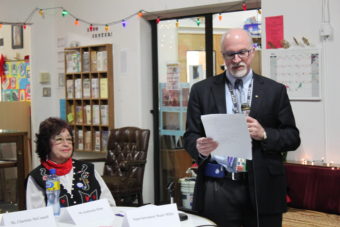
AFN President, Julie Kitka talks with reporters at the Bonney Courthouse.

Attorneys argued before the Alaska Court of Appeals in downtown Anchorage yesterday about whether Yup’ik fishermen, who fished for Chinook or king Salmon during a closure on the Kuskokwim River in 2012, were wrongfully convicted.

Attorney James Davis with The Northern Justice Project, an Anchorage-based private civil rights law firm represented the fishermen. He said that the state should have tried to accommodate the fishermen’s religious beliefs.

“The primary issue before this court is whether the state of Alaska had a duty under the free exercise clause to accommodate the Yupik fishers spiritual practices under the Frank versus state case and its progeny and whether the state did so. We submit that the state had a duty but failed to comply with the duty,” Davis says.

Due to a reduced run of king salmon the state closed the lower Kuskokwim River subsistence fishery in June 2012. Fishing for king salmon is a key part of Yup’ik spirituality. Dozens of people fished in defiance of the state closure. Many were given fines and some nets were confiscated. A few days later the state opened the area to fishing for other species of salmon, which allowed about 20,000 king salmon to be caught as bycatch.

The trial court agreed that king salmon fishing is integral to the Yup’ik religion but convicted the fishermen and decided that Alaska’s need to protect king salmon overrode the fishermen’s religious rights. Thirteen decided to pursue an appeal.

Attorney Laura Fox with the state attorney general’s office argued that issuing citations for fishing during an ‘emergency closure’ was needed to protect king salmon.

“The 2012 Kuskokwim King Salmon run was so weak and the numbers were so far from meeting the object that to say the state should have allowed more harvest is to completely disregard the public trust responsibility to manage that resource for sustained yield,” Fox says. “There was never any harvestable surplus of kings in 2012 and at the end of the day the state missed the escapement objective by 50-thousand fish.”

The ACLU, the Associate of Village Council Presidents and the Alaska Federation of Natives have filed amicus briefs in the case. Julie Kitka, President of the Alaska Federation of Natives attended the hearing. She says AFN supports the Yup’ik fishermen.

“Anybody in the Native community that knows traditional Yup’ik people know that their spirituality and their beliefs are a core part of who they are with everything that they do – how they treat their parents, how they treat their children, how they treat their neighbors, how they treat animals that give themselves up to them. You know we’re sad that this is in the court system but we hope the justices will give some consideration to them.”

A panel of three judges will weigh the arguments in the case of David Phillip versus the state of Alaska and issue a decision, likely sometime later this year or early next year.

Tlingit-Haida and State sign agreement to improve relationship

Central Council President Richard Peterson and Gov. Sean Parnell sign a Memorandum of Agreement on Monday at the Elizabeth Peratrovich Hall. (Photo by Lisa Phu/KTOO)

Central Council of the Tlingit and Haida Indian Tribes of Alaska and the State of Alaska signed a Memorandum of Agreement yesterday signifying a new level of communication and cooperation between the two entities, focusing on education, workforce training and jobs. The Governor’s office says it’s the first of its kind.

Central Council and the State already work together on a number of projects and initiatives, like the Village Public Safety Officer program, financial assistance and childcare.

But Randy Ruaro says there can be even more collaboration. He’s special counsel and policy director for Gov. Sean Parnell.

“We do a lot of the same things. We do workforce training, we do early education. But we weren’t talking to each other on a regular basis in some of them. And so I thought I’ll just meet with Richard and just talk about it and see if we can try to formalize our relationship a little bit and get both sides talking and communicating,” Ruaro says.

Richard Peterson was elected president of Central Council in April. He says it’s natural for the first people of Alaska to be working with the State of Alaska.

“We can utilize our programs with the state’s programs to deliver better services to our communities and our people,” Peterson says.

The MOA focuses on areas of common interest, like economic development, public safety and energy. It establishes a systematic review of issues and programs by both entities to identify opportunities to work together.

Peterson says it’s already been a historic year for Alaska Natives with the passage of two pieces of legislation recognizing indigenous languages as official state languages and making November 14 Dr. Walter Soboleff Day.

He says the bills are a good start in further broadening the relationship with the state.

“The next step now, I think, is to start making sure that legislation that represents our needs is being introduced. And so we need to start getting aggressive, and by aggressive, I don’t mean that in any negative way. Really, it just means that we need to be at the table and active participants in what happens around us,” Peterson says.

In light of the MOA, the State and Central Council have already started a new partnership working with Microsoft to bring educational opportunities and IT training to tribal members throughout Southeast and the state.

Peterson says in order to foster the new relationship, Central Council has created a government affairs liaison position. On the state side, Ruaro will be taking the lead.

At the MOA signing, Gov. Sean Parnell said the management of the VPSO program in Southeast is a good example of an existing relationship between the state and Central Council, something the MOA will only make stronger.

“We’ve worked to improve VPSO retention but frankly, that’s another area where I’m going to need additional work with Central Council on, and that’s an issue statewide,” Parnell said. “Tlingit-Haida has sought out federal funds for vehicles. You know, we’ve all kind of done our part to work to improve and enhance the VPSO coverage and the tools that they have.”

The agreement between the State of Alaska and Central Council is good for three years.

A partnership of language and love

Russian Orthodox funeral services for former Alaska poet laureate Richard Dauenhauer are taking place 10 a.m. on Thursday, August 28 at St. Paul’s Catholic Church in the Mendenhall Valley.

Dauenhauer, who died on Tuesday, was known for many things, including poetry, translation and teaching. He was also the husband of Tlingit scholar and Alaska writer laureate Nora Marks Dauenhauer. For more than 40 years, they had a partnership of marriage and scholarship.

Dick Dauenhauer was teaching folklore at Alaska Methodist University in the early 1970s when he met student Nora Marks.

Her friend Rosita Worl, now president of Sealaska Heritage Institute, was also a student.

“Her and Dick just hit it off. I think they had the same kind of sense of humor as I recall. And that was when their work started,” Worl says.

Dauenhauer and Marks married on November 28, 1973. She was 15 years older.

“They became quite a team. He had the technical knowledge of languages and stories and he was an educator, and she had all the traditional knowledge of Tlingit and it was a great combination,” Worl says.

Dick and Nora Dauenhauer at St. Nicholas Russian Orthodox Church on April 24, 2011. (Photo by Brian Wallace)

Born in Syracuse, New York in 1942, Dick Dauenhauer had been a linguist for most of his life. He earned degrees in Slavic Languages and German. He translated poetry from Russian, Classical Greek, Swedish and Finnish. In 1969, he moved to Alaska to teach at Alaska Methodist University, now known as Alaska Pacific University.

Dauenhauer and Marks spent a few years at the Alaska Native Language Center at the University of Alaska Fairbanks. In 1983, they moved to Juneau. Throughout the 1980s and 1990s, they worked at Sealaska Heritage Foundation in Juneau, now known as Sealaska Heritage Institute.

They co-authored Tlingit language books and developed teaching materials. With the publication of Beginning Tlingit, Worl credits the couple for popularizing the language’s written form.

“What he and Nora did was bring the orthography to everyday use. They made that available to the students of the language,” Worl says.

They collected hundreds of recordings documenting Tlingit history, culture and language. They co-edited the four-volume series, “Classics of Tlingit Oral Literature“, and received American Book Awards for two volumes.

Juneau playwright and screenwriter Dave Hunsaker based his play “Battles of Fire and Water” on the tri-lingual volume, “The Battles of Sitka, 1802 and 1804.”

“But really the book of ‘Tlingit Oratory’ was, to me, stunning. And by that time I had been adopted by the Tlingit. I had lived here in Juneau for 30 years and I felt like I knew a lot about the culture and when that book came out, I realized I didn’t know anything about the culture,” Hunsaker says.

At home a day after Dick Dauenhauer died, Juneau playwright Dave Hunsaker flips through his copy of "Anóoshi Lingít Aaní Ká/Russians in Tlingit America: The Battles of Sitka, 1802 and 1804." (Photo by Lisa Phu/KTOO)
At home a day after Dick Dauenhauer died, Juneau playwright Dave Hunsaker flips through his copy of “Anóoshi Lingít Aaní Ká/Russians in Tlingit America: The Battles of Sitka, 1802 and 1804.” (Photo by Lisa Phu/KTOO)

Hunsaker says through translated speeches of Tlingit elders, the Dauenhauers revealed the complex and poetic oral tradition of the Tlingit culture.

“They recognized that these are not charming campfire Indian lore stories; these were world literature. And they treated them as world literature. And the way they rendered them and the way that they’ve been published so we can all now read them forever, they, by God, are world literature,” Hunsaker says.

Between their joint books and separate volumes of creative writing, Dick and Nora Dauenhauer have produced an abundant body of work. But their partnership held much more.

“It’s one of the great love affairs of any life that I know anything about. They never got past the hand holding stage,” Hunsaker says.

Hunsaker has been friends with the Dauenhauers for about 40 years. Throughout that time, he says they always acted like newlyweds.

“In spite of age difference, in spite of their incredibly different backgrounds, I just saw them be always fascinated with each other,” Hunsaker says.

In 2005, Dick Dauenhauer was appointed President’s Professor of Alaska Native Languages and Culture at the University of Alaska Southeast. Chancellor John Pugh says the couple spearheaded the creation of the program.

“They just were really the heart and soul of the Alaska Native Language program,” Pugh says.

Pugh says up to that time, other UA faculty members had studied the language, but the Dauenhauers wanted to make sure it was spoken.

“That was the real change in terms of not being an academic language but trying to actually think about how we might have the speakers that we presently have and have them really be able to transfer the language to younger people who would carry the language forward and it could be a living language, continue as a living language,” Pugh says,

Assistant Professor Lance Twitchell now heads the Alaska Native Languages degree program at UAS. He says it’s been an honor to know and work with Dick and Nora, “and see how they operate just as poets and artists and linguists and anthropologists and just wonderful human beings. And I had the chance to tell both, ‘If I’m one-tenth of what you are, I’m pretty happy with the way my life went.'”

When Dick Dauenhauer passed away August 19 at the age of 72, he and Nora were nearing the end of a multi-decade project – a collection of Tlingit Raven stories.

Related story:
Richard Dauenhauer dies at 72

Indian Village totem poles come down

The two totem poles that stood for 36 years in Juneau’s old Indian Village have been hauled off.

A work crew with a 12-ton boom truck pulled the delicate poles and hauled them to a warehouse Tuesday. They had deteriorated badly over the years, but were taken away more or less intact.

Ricardo Worl is the president and CEO of The Tlingit-Haida Regional Housing Authority, which owns the Gajaa Hít building where the totem poles stood.

“There’s a lot of discussion as to what would be the best and most appropriate solution and what we’re going to do with them,” Worl said. “We even talked about letting them lie in state, here in the village.”

Fear of vandalism and concerns that pedestrians wouldn’t properly respect them have cooled that idea, Worl said.

“So for now, we’re going to bring them to the housing authority warehouse, let them dry out inside the warehouse, and then we’ll decide what we’re gonna do with it from there,” he said.

Brian Wallace was a teenager when he watched the late Edward Kunz Sr. carve the poles. Tuesday, Wallace happened to be passing by and stopped to watch.

“It’s mixed emotions, you know? Seeing something like this, and I don’t know how well it can be restored, or if it’s going back to the spirit of the forest,” Wallace said.

Worl said parts may be salvaged for indoor display.

Meanwhile, a pair of Haida carving brothers that Sealaska Heritage Institute commissioned have completed the new totem poles and nearly finished the new screen that will replace the warehoused ones.

Worl said the target date for raising the new poles is Sept. 29.

Richard Dauenhauer dies at 72

Richard Dauenhauer gave a lecture during Celebration 2014.  (Photo by Brian Wallace/Sealaska Heritage Institute)
Richard Dauenhauer gave a lecture during Celebration 2014.
(Photo by Brian Wallace/Sealaska Heritage Institute)

Tlingit expert, linguist and award winning writer Richard Dauenhauer passed away Tuesday morning at Bartlett Regional Hospital. He had been diagnosed with pancreatic cancer about a month ago. Dauenhauer was 72 years old.

He was married to Tlingit poet and scholar Nora Marks Dauenhauer. Together they authored many books, including the Classics of Tlingit Oral Literature series published by Sealaska Heritage Institute and University of Washington Press. They are two-time winners of the American Book Award.

He was poet laureate of Alaska in the 1980s and started teaching at the University of Alaska in 1984. In 2013, the University of Alaska Foundation honored him with the Edith R. Bullock Prize for Excellence for his contributions in preserving Alaska Native languages.

Assistant professor of Alaska Native Languages at UAS Lance Twitchell called Dauenhauer a “powerhouse” who merged the Tlingit world with the academic world.

“I remember telling him years ago and then I told him about a month ago that his work changed my life and put me on a path that I’m very thankful for and because of his work, I know what I’m supposed to be doing. And so, it’s amazing to have people like that close to you that can have such an impact on so many people in such a positive way,” Twitchell said.

Related story:
A partnership of language and love

Sealaska planning significant investments in Southeast

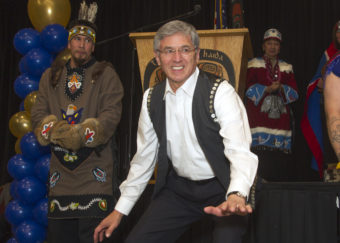
Anthony Mallott took over as CEO of Sealaska Corp. in June. (Photo by Casey Kelly/KTOO)

New Sealaska CEO Anthony Mallott says part of the Juneau-based regional Native corporation’s strategy for reversing recent losses will be to do business closer to home.

“Very likely within six months you’ll see significant investments by Sealaska in Southeast, or within industries that are heavily represented in Southeast Alaska,” Mallott told the Juneau Chamber of Commerce on Thursday.

He said Sealaska wants to provide economic opportunities and jobs for its nearly 22,000 shareholders. Most live in Southeast and the Pacific Northwest.

The corporation has sold some of its business interests in areas like Florida, Mexico and Alabama. Mallott says it now has a $100 million investment fund and a $65 million fund for acquisitions.

“So what we’ve done to transition is to load up effectively dry powder,” he said. “And bring on some people that know how to do mergers and acquisitions, and know what we want to look like as a corporation five, 10 years from now, and start making those acquisitions.”

While jobs for shareholders will be important, Mallott says the number one priority will be to invest in profitable enterprises. In 2013, Sealaska businesses lost about $57 million. That shrunk to $35 million due to revenue from investments and natural resource earnings shared by all Native corporations.

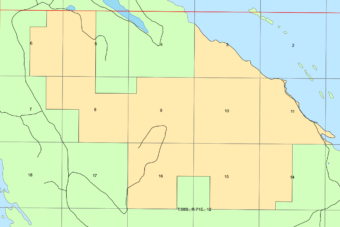
Mallott believes Congress is poised to pass legislation completing Sealaska’s land entitlement under the Alaska Native Claims Settlement Act. The long-awaited measure would transfer up to 80,000 acres of the Tongass National Forest to the corporation, providing a boon to Sealaska’s timber businesses.

“It’s been a long wait,” Mallott said. “We’re patient, we know that it’s owed to us and we’ll get there. But it is having some significant effects on our timber harvest and potentially the timber industry in Southeast.”

Mallott took over as CEO at Sealaska’s annual meeting in June. He’d previously served as treasurer and chief investment officer. He replaced longtime CEO Chris McNeil Jr., who retired. Mallott is the son of Democratic gubernatorial candidate and former Sealaska board member Byron Mallott.

Site notifications
Update notification options
Subscribe to notifications