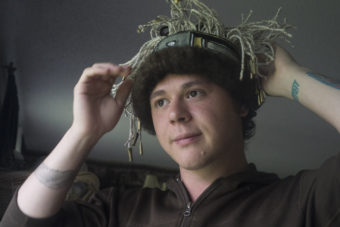
Wayne's Price's "Dancing Raven Hat" was awarded Best of Show and third place for formline art. (Photo by Lisa Phu/KTOO)
Della Cheney (right) looks at her "Leadership and Change" Ravenstail robe with a friend. (Photo by Lisa Phu/KTOO)
Lily Hope's "Little Watchman" placed third in the Northwest Coast Customary-Inspired Art category. (Photo by Lisa Phu/KTOO)
Teri Rofkar's "Caprini Tribal Regalia" Ravenstail robe placed first in the Northwest Coast Customary-Inspired Art category. (Photo by Lisa Phu/KTOO)
Pauline Duncan stands next to her Ravenstail Set, which placed first in the Northwest Coast Customary Art category. (Photo by Lisa Phu/KTOO)
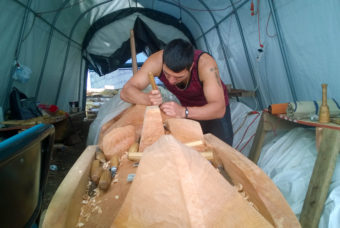
Wayne Price's paddles took first and second place in the new Formline Art category. (Photo by Lisa Phu/KTOO)
Della Cheney picks up her second place award in the Northwest Coast Customary-Inspired Art category from juror David R. Boxley during the Juried Art Show & Competition awards ceremony at the Juneau Arts & Culture Center. (Photo by Lisa Phu/KTOO)
Deborah Head-Aanutein's "Echoing Traditions" basket took third place in the Northwest Coast Customary Art category. (Photo by Lisa Phu/KTOO)
Price’s ‘Dancing Raven Hat’ is a painted hat made of red cedar and otter fur. The piece also took third place in the Formline Art category. Price’s other works – ‘Quantum Raven’ Paddle and ‘Mother Whale’ Paddle took first and second places in Formline, the show’s newest category.
Tsimshian carver and artist David R. Boxley was the show’s sole juror. He was responsible for selecting the 21 pieces featured in the show as well as the winners.
The Juried Art Show will be displayed at the Juneau Arts and Culture Center through June 30.
The Tlingit and Haida Dancers of Anchorage practice for Celebration. (Photo by Joaqlin Estus/KNBA)
Starting on Wednesday, Juneau will be overflowing with thousands of Tlingit, Haida, and Tsimshian people enjoying Celebration, a traditional dance and cultural event hosted by the Sealaska Heritage Institute every two years.
The Tlingit and Haida Dancers of Anchorage are getting ready to go to celebration. With tables and chairs pushed aside, a couple of dozen people are singing and dancing in a large room at the Alaska Native Medical Center. Almost half of them are under the age of ten. Between songs, the kids play. Two boys ask a young man to lift them up towards the ceiling, which he does a couple times each. A girl does cartwheels across the room. A six-year-old has her arms tightly wrapped around her friend as she carries her a few feet across the room.
During the songs, children might rest in their mother’s lap, watch from the sidelines, or join in the dancing. Austin Sumdum, a U.S. Marine on leave, says he started dancing at the same kind of free-flowing practice.
“Growing up, no one forced me to dance, so I was able to just go up on my own, cause I was just like, ‘oh, they’re doing that’ and I was just kind of jealous, cause like I was sitting down for a while. I think it wasn’t until I was four I actually got into it. I was like, ‘oh my Dad’s doing it; okay I’ll do it,’ ” he says.
The group meets once a week, and more often in the weeks leading up to Celebration, where there’ll be art shows, language classes and dancing. The schedule has dozens of dance groups on stage from 8:30 a.m. to 9 p.m., but performances often go later at night. Nae Brown, leader of the Tlingit and Haida Dancers of Anchorage, says Celebration is a liberating experience.
“Going to Celebration is a really empowering event because you get to be you for three whole days without any explanations, without having to like prove anything or say anything. You just are and that’s a really nice feeling,” she says.
No matter what else is happening in her life, Brown says she always has dance practice to look forward to, something she wants to pass on to her one-year-old daughter.
“Growing up in a dance group, I don’t know any other way of life. So to not have this, I don’t feel like I would have any kind of anchor to the life that I lead now. It’s really been my anchor throughout our childhood and I’m lucky that I’m able to pass that on to my daughter so she can grow up in the same way we did. It was a very rich lifestyle that we led,” she says.
The group holds raffles, bake sales and garage sales to raise travel money. Brown says they’ll be fundraising and practicing their dance moves right up to the day they leave. Celebration kicks off Wednesday evening and continues through Saturday in Juneau.
NCAI president Brian Cladoosby. (Photo by Lori Townsend, APRN – Anchorage)
At a wide ranging press conference during day three of the NCAI gathering in Anchorage yesterday, BIA Assistant Secretary for Indian Affairs Kevin Washburn said the concept of taking land into trust for Alaska tribes is a popular one.
“Even though we don’t have a rule in place that allows it, we have applications,” Washburn said.
NCAI President Brian Cladoosby, middle, BIA undersecretary for Indian Affairs Kevin Washburn, middle, and NCAI executive director Jacqueline Pata, left. (Photo by Lori Townsend, APRN – Anchorage)
A recent DC district court decision affirmed the Interior department’s authority to take Alaska tribal lands into trust if tribes request it and the Secretary of Interior approves the request. Washburn said although the decision is being appealed, the court was clear in the assertion. He said the issue is also supported by two other entities.
“One from the secretarial commission on trust reform, which was set up at the department of Interior and it’s a blue ribbon panel of outside independent experts, who said we think this would be a good idea,” Washburn said. ”We also heard from the Indian Law and Order Commission which set a whole chapter on Alaska because they were looking at issues for Indian Law and Order all over the country but the issues in Alaska are very serious and so they set aside chapter two.”
Trust status for Native lands would allow more tribal authority and jurisdiction over certain criminal behavior on those trust lands. The Indian Law and Order Commission sees it as a way to better address the high rates of domestic violence and sexual assault in Alaska Native communities.
Washburn said there have been applications from Interior and Southeast Alaska tribes.
Celebration begins this evening at 6 o’clock with the Grand Entrance procession to Centennial Hall. The four-day cultural event of Southeast Alaska Natives includes 50 dance groups. Among them is All Nations Children’s Dance Group of Juneau. The group formed in 1995 and has about 80 members. I attended a recent practice and learned that singing and dancing is a foundation for much more.
Vicki Soboleff talking to the group of parents and kids.
All Nations Children's Dance Group practice.
Barbara Dude (left) and Vicki Soboleff
All Nations Children's Dance Group practice.
Allison Ford (left) and Katherine Price at the front of the group.
It’s a Thursday evening and some 50 kids and teenagers dance their way through the Tlingit-Haida Community Center near Salmon Creek. Group founder and leader Vicki Soboleff walks up and down the line giving instructions. Soboleff says she and the group have come a long way since the first practice in 1995.
“There were 12 children here and there was a group of their parents and maybe grandparents and aunts and uncles. All those children were looking at me and I was terrified. We didn’t start off singing Tlingit songs. We actually started off singing ‘This Old Man.’ I was just trying to get them to sing and plus I was nervous.”
At this practice they sing numerous Alaska Native songs and Soboleff says they’re instruments for learning.
“Knowledge of your Native culture and involvement in Native song and dance and language really helps you with your sense of self and belonging. To your tribe, your clan. I believe it’s really important for Native children to know who they are, where they came from, what their tribal clan is.”
One of Soboleff’s early dancers is now a teacher. Barbara Dude joined the group when she was seven and now, at 26, she’s an assistant group leader. She helps 15-year-old Allison Ford with her Tlingit introduction—just like Soboleff helped her. Among other things, Dude says she gained language skills, self-esteem, and public speaking skills. But the most important lessons were about something more. She says the group’s goal to help engender identity worked.
“When I started the group when I was seven I didn’t know that I was Tlingit. The group has helped me gain a sense of pride in who I am and now I am able to share that with my children who have known they were Tlingit since they were born.”
Dude is excited for Celebration, especially the grand entrance.
“We all dance in together and ahead of us are dancers from another group, and behind us are dancers from another group and we’re dancing across stage and each person gets their chance to go across stage and dance their hardest. They feel it because everyone around them is feeling it with them.”
Dude tears up and apologizes for becoming emotional.
“How powerful it is to watch them be immersed in the culture and the language. It’s beautiful. It’s beautiful.”
The All Nations Children’s Dance Group is true to its name and is open to children of all races and ages until high school graduation. Then Soboleff and Dude hope they’ll join an adult group or stick around to help children learn language, song, dance, and especially, cultural identity and pride.
The Grand Entrance procession begins tonight at 6 p.m. at Centennial Hall. You can watch it on 360 North or 360North.org.
The National Congress of American Indians is holding their mid-year conference in Anchorage this week. Titled—Claiming our Rights and Strengthening our Governance, the conference started yesterday and runs through Wednesday.
U.S Department of Justice Assistant Attorney General Tony West. (Photo by Lori Townsend/APRN)
U.S Department of Justice Assistant Attorney General Tony West adhered to the theme as he said DOJ would work with tribes to enhance access to voting.
“And so the Attorney General announced today that we would engage in consultation with tribal leaders to come up with legislative proposals that would hopefully at the end of the day would result in polling places in local Native communities, on reservations, in Native villages as well as ensuring that election materials, ballot materials are being presented and offered in those Native languages,” West said.
State Division of Elections Director Gail Fenumiai says remote precincts have a polling place in the most populated part of the precinct and other areas are designated ‘permanent absentee voting areas’. Voters in these areas can apply to have an absentee ballot mailed to them.
West said there are no legislative efforts being crafted yet, because tribal governments need to weigh in on what an equitable plan would look like.
West made it clear that Justice Department officials strongly support tribal government sovereignty and will work to help clarify jurisdiction issues in Alaska, particularly as it relates to domestic violence and sexual assault.
“In US Attorneys’ office, we’re making sure there are funds and resources available to try to deal with sex trafficking, to try to deal with violence against women,” West said. “We strongly support the repeal of section 910 of Violence Against Women Act which took Alaska Native villages outside of this ability of tribes to exercise special criminal jurisdiction and pursue, in certain instances, domestic violence perpetrators.”
Speaking earlier to a large group at the Dena’ina Convention center, West said DOJ filed a “statement of interest” last week in case called Toyukuk vs. Treadwell. Plaintiff Mike Toyukuk of the village of Manokotak, is suing the state over a failure to provide oral language assistance for citizens who speak Yu’pik as their first language.
“Because, if remote geography, or the inability to speak English, do not free any of us from the obligations and responsibilities of citizenship, then they should not impede the exercise of rights to which we are all entitled,” West said.
The courtyard on the Egan Drive side of Centennial Hall serves as the mobilization area for North Pacific Erectors, the contractor replacing the roof on Juneau’s 31-year-old convention center. (Photo by Casey Kelly/KTOO)
North Pacific Erectors began mobilizing for the $1.4 million project about three weeks ago.
City and Borough of Juneau Project Manager Theresa Mores says the contractor plans to work around events at the hall, including this week’s Celebration festival, hosted by Sealaska Heritage Institute.
“They are going to stop construction during Celebration and then they’ll start demoing the roof immediately following Celebration,” Mores says. “That was one event that we knew about beforehand that we tried to schedule around.”
Mores expects the project to be complete by the end of August. Not only do crews want to avoid working around snow and Taku winds, but Mores says the outside temperature needs to be warm enough for adhesives to work on the roof membrane.
She says the roof will be replaced in sections.
“They’re going to start in the section that’s farthest away from their mobilization area, and go towards the mobilization area,” she says. “So they’ll demo, and then as they’re doing that their supplies will be coming into Juneau, and then they will start construction. Hopefully the timing will be just right, so they can start constructing the new roof immediately after they demo the old one.”
The mobilization area is the courtyard on the Egan Drive side of Centennial Hall. That’s typically where Sealaska Heritage does its Celebration group photo. It’s also a popular gathering spot for people attending events at the hall. SHI spokeswoman Kathy Dye says this year’s group photo will take place in the parking lot between Centennial Hall and the Juneau Arts and Culture Center on Saturday after the parade.
Mores says this is the first roof replacement in the 31-year history of Centennial Hall.
It’s past its useful life,” Mores says. “There’s stuff growing up there, and things are kind of disintegrating a little bit. It’s just time.”
Centennial Hall serves as a venue for events, concerts and meetings, as well as an emergency shelter for downtown Juneau.
The city’s legislative delegation secured funding for a new roof in the state capital budget three times, but Governors Sarah Palin and Sean Parnell vetoed the funds. Juneau voters in 2012 approved a bond measure to fund $3.2 million in maintenance and upgrades to the facility.
Close
Update notification options
Subscribe to notifications
Subscribe
Get notifications about news related to the topics you care about. You can unsubscribe anytime.