Alaska Native Arts & Culture

U.S. Patent Office Cancels Washington Redskins’ Trademark

Several of the Washington Redskins' trademark registrations have been cancelled, in a decision that is likely to be appealed. Nick Wass/AP
Several of the Washington Redskins’ trademark registrations have been cancelled, in a decision that is likely to be appealed. Nick Wass/AP

The U.S. Patent and Trademark Office has revoked the trademark of the NFL’s Washington Redskins, after ruling in a case brought by five Native Americans that the name disparages a minority. While the decision could have wide repercussions, it does not require the team to change its name.

In a statement about the decision, the patent office said the petitioners proved that “the term ‘Redskins’ was disparaging of Native Americans, when used in relation to professional football services, at the times the various registrations involved in the cancellation proceeding were issued.”

As a result, the agency said, “the federal registrations for the ‘Redskins’ trademarks involved in this proceeding must be cancelled.”

Explaining the decision’s immediate effects, the agency said its review board “determines only whether a mark can be registered with the federal government (and thus gain the additional legal benefits thereof), not whether it can be used.”

The trademarks in question date back to the 1960s and ’70s. The Washington, D.C., team lost a similar trademark case in the late 1990s, only to have its registration reinstated by a U.S. district court in 2003. It is almost certain the team will appeal the agency’s latest decision.

From The Washington Post:

“Federal trademark law does not permit registration of trademarks that ‘may disparage’ individuals or groups or ‘bring them into contempt or disrepute.’ The ruling pertains to six different trademarks associated with the team, each containing the word ‘Redskin.’ ”

The decision comes from the patent office’s Trademark Trial and Appeal Board, which said the trademark registrations will remain “on the federal register of marks” and wouldn’t be officially listed as canceled until “after any judicial review is completed.”

The football team has been under increasing pressure to change its name. You can follow our coverage here.

Copyright 2014 NPR. To see more, visit http://www.npr.org/.image
Read original article – Published June 18, 201410:43 AM ET
U.S. Patent Office Cancels Washington Redskins’ Trademark

Update: Racial outburst disrupts end of Celebration parade

Update June 18, 2014 at 12:45 pm

Police officers believe they have identified a person of interest in last Saturday’s racial incident that marred the end of the Celebration parade in downtown. He’s identified as between 5-foot-8 and 5-foot-10, 200 pounds, in his 30’s, looking ragged or disheveled, and with reddish hair and a pale complexion.

“We are not certain, but right now he is our best lead,” said Lt. Kris Sell of the Juneau Police Department.

Sell said there may have been other unusual or odd encounters since the man’s arrival in Juneau in April.

The man allegedly yelled racial slurs during Saturday’s parade, knocked over a woman, tried to spit on an American flag and grab it from a veteran, and then shoved another woman as he fled the scene. It’s believed that he was the same person that knocked over Main Street traffic barricades just before the flag incident.

Sell said if you see the man, don’t engage him.

“His behavior might be unsettling,” Sell said. “We ask that people not approach him, but to call us. He tends towards aggressive behavior. So, we wouldn’t want somebody to risk themselves by trying to talk to him and do their own investigation.”

Sell said that another man previously identified as the suspect is not the one responsible for the racial outburst. Pictures are being passed through Facebook and text messaging that apparently show the Juneau resident moments before the parade encounter. But Sell said they’ve already located and talked to that person.

“He’s telling the officer that interviewed him that he is feeling threatened,” Sell said. “We want to make people understand that he is not the suspect in this case. We don’t believe that he is the one that did this. We are looking at this other person of interest”

The widely circulated picture was taken the day before the incident on Friday. Sell said the Juneau man looks similar to their person of interest, but his alibi of working on Saturday during the parade checks out.

Original story June 16, 2014 at 9:36 pm

Juneau police are asking for help identifying a man in connection with a racist incident during Saturday morning’s Celebration parade through downtown.

Police say a white male confronted an Alaska Native veteran, who was part of a group of flag bearers that led the parade on Willoughby Avenue near Centennial Hall.

The unidentified man reportedly yelled racial slurs, tried to spit on the American flag, then grabbed it and tried to run off. Bystanders wrestled the flag away from the man before he fled toward Whittier Street, shoving people as he ran.

Juneau Police Lt. Kris Sell says a half-dozen people were involved in the incident that lasted only a few seconds.

“It was shocking for the people involved for somebody to just have this socially unacceptable outburst that became physical,” Sell said.  “I think most of us go through life not really expecting to see that. People don’t normally act that way within the view of the general public.”

No one was hurt during the incident.

Officers in a vehicle and on bicycles – including Lt. Sell — searched the area for the man.

Many people were taking pictures of the parade. Now police are asking the public if they have photos or video of the incident. Crime Line is offering a cash reward for  images or information that leads to the man’s identification.

The man was reported to be wearing a light toned multi-colored knit cap under the hood of a dark, possibly blue, jacket.

People with information should go to the Crime Line website, or call Juneau Police at 586-0600.

Weaving a journey of change

In early 2011, Della Cheney started weaving a Ravenstail robe for her daughter in honor of her doctoral degree. She had weaved about a quarter of it, when she began to feel not right.

“I knew something was wrong but I didn’t know, so I went to get my yearly test and they found something abnormal,” Cheney says.

She was diagnosed with endometrial cancer. She stopped weaving and had to have surgery and chemotherapy.

A year later, Cheney went back to the robe and started over. This meant undoing 14 inches of weaving, more than a year’s worth of work.

“You don’t want to have bad feelings in the robe. You don’t want to be weaving while you’re thinking bad things or in a bad place,” Cheney’s daughter, Gail Cheney, explains. “So can you tell yourself, ‘No, I want to start again’? That’s hard when you’ve gone down as far as she did when she took it back. In the midst of all her challenges, she held herself to a very high standard.”

Gail was in the process of getting her Ph.D. in leadership and change from Antioch University, a program focused on bringing about change in workplaces and communities.

She was also the Human Resources Director at Sealaska Corp., a position she still holds. Her dissertation explored the future of Native values at an Alaska Native corporation.

Gail says Sealaska has been working on integrating Native values at a corporate level for the past few years. She uses Haa Aaní, meaning ‘our land,’ as an example:

“We have a sense of what Haa Aaní means at a community level – subsistence, maintaining our resources,” Gail says. “What does that mean at a corporate level? Perhaps it means figuring out sustainable uses because we do need to use our land, but we need to use it in way that it’s there for future generations and for everyone’s use.”

Cheney’s challenge was how to show leadership and change in her weaving. She had to work with shapes like rectangles, triangles and squares, characteristic of Ravenstail weaving.

“So I chose to do the pattern called the flying geese pattern to show the change with the geese arriving in the spring and leaving in the fall and how the leadership changes when they’re flying in a flock. They take turns leading,” Cheney says.

The robe shows three rows of geese changing direction, flying right and left, then right again. The prominent colors are red and white.

“The red color shows the power of change and the white color shows the integrity that needs to be followed in order for change to happen,” Cheney says.

On the bottom of the robe is a black design that Cheney calls, “All of Our Ancestors.” It’s the foundation of the robe.

“That’s where our lives started, was from our ancestors,” she says.

The black also represents loss.

“We had four of our family members pass away with cancer in the time I started the robe to the end,” Cheney says.

For Cheney, no evidence of cancer remains. She says weaving is a form of art therapy and helped her through the process of being OK again.

“There’s all that healing that goes on because of that long repetitive movement that you have across the 60-inch robe, going over and under. Each row is a long ways across, maybe 45 minutes to get across. And what do you think about during that time besides the pattern? Really it’s a healing time,” Cheney says.

On the top of the robe, Cheney weaved the words Keex’ Kwáan in big, bold letters, which is Tlingit for their home village of Kake. This was Gail’s idea.

“She has grown up with this love from our family in Kake, so every time she wraps the robe around her she is getting a hug from her family,” Cheney says.

After seven years of studying, Gail received her Ph.D. this past February and had the graduation ceremony in Kake to thank the community. It took her mother three years to finish the robe. In the final year, she brought the loom wherever she went. She weaved in Juneau and Kake. She even brought it to Anchorage.

Gail says the robe represents journeys they both finished.

“When I look at this I think, ‘I’m done, I’m really done.’ I still have a lot of work to do, but the piece that’s kind of been nagging at me for seven years, the wait’s gone. It’s nice to see it finished. I think she feels the same, ‘Oh thank God, I’m done.'”

The robe will outlive both of them, Cheney says. In 500 years, the robe will continue to tell their woven stories of leadership and change.

Why Sealaska Heritage is important to Northwest Coast art

Juror David R. Boxley points out the beauty in Wayne Price's "Dancing Raven Hat," which Boxley awarded the competition's highest honor Best of Show. (Photo by Lisa Phu/KTOO)
Juror David R. Boxley points out the beauty in Wayne Price’s “Dancing Raven Hat,” which Boxley awarded the competition’s highest honor Best of Show. (Photo by Lisa Phu/KTOO)

Sealaska Heritage Institute’s biennial Juried Art Show and Competition is raising the bar for Native artists in Southeast Alaska. This year’s juror David Robert Boxley says the competition creates an environment for artists to constantly keep striving.

David Robert Boxley says it was agonizing to pick the 10 winners of the seventh Juried Art Show and Competition from the roughly 30 pieces submitted.

“The winners were chosen in a way that I hope will show what’s possible,” he says.

celebration_coverageBoxley is a Tsimshian artist from Metlakatla and the son of prominent carver David Boxley. His father just finished his 72nd totem pole.

David R. Boxley started carving when he was six, learning from his father.

He says Sealaska Heritage Institute’s competition pushes the standard of art being made in Southeast Alaska.

“Southeast Alaska is cut off from the rest of the coast and all the major galleries in Vancouver and Seattle and I don’t think as many artists are able to be exposed to what’s going on down there and Sealaska is trying to get rid of that gap,” Boxley says.

He says artists now are still trying to reach the level of work that was done in the past.

“There’s a whole period of time where our art – at the same time the culture – was outlawed, dropped in quality because the old masters weren’t able to pass things on,” Boxley says.

Striving to attain those standards and quality, he says, is part of what’s keeping Native culture alive and healthy in Southeast Alaska.

“The art isn’t safe necessarily. There are a lot of great artists but that doesn’t mean that if we don’t push the standard and maintain that, that it won’t slip away again,” Boxley says.

This is the first time Boxley has judged the Sealaska Heritage Juried Art Show. He says it’s stressful, but he knows being on the other end of the process is also angst ridden.

Artist Lily Hope can relate. Prior to the June 11 awards ceremony, Hope didn’t go to the show, which opened five days before.

“I was having all this anxiety and I was like, ‘I can’t go look. I can’t go look at everybody else’s because I don’t want to lose sleep over, like, who could be winning,'” Hope says. “And five or six days ago I woke up and I was like, ‘It’s cool. I got third place. I’m good.’ My dream said I won third place.”

Her dream was correct. Hope placed third in the Northwest Coast Customary-Inspired Art category for her child ensemble, Little Watchman.

“He’s kind of watching out for our kids, but also for the integrity of the art, how it develops over time and how we stay true to the spiritual life of our work,” Hope says.

During the awards ceremony, Sealaska Heritage Institute President Rosita Worl said art is a major part of Native culture because of its ties to spirituality.

“But we’ve also grown it into the Western culture where we can appreciate it also for its aesthetics. And this is where I think having our younger artists learn both aspects of it is so important to us,” Worl said.

The Juried Art Show and Competition was founded in 2002 to support the artists. This year’s awards total more than $8,000. Sealaska Heritage also offers art workshops throughout Southeast and its Celebration festival features a Native Artist Market.

“It is our goal to make Juneau and Southeast Alaska the Northwest Coast art capital,” Worl said.

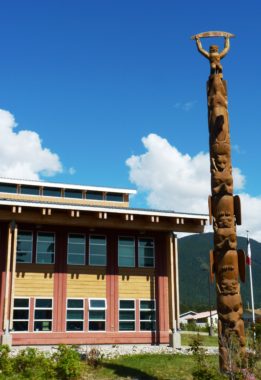
Sealaska Heritage broke ground on the Walter Soboleff Center last August. Part of the center’s purpose is to display Northwest Coast art and support artists through an artist-in-residence program, demonstration and research areas.

Worl says the Walter Soboleff Center will make Juneau the next hub of Northwest Coast art.

Related story:
Tlingit carver Wayne Price takes top honor at Celebration art show

Large crowd greets Celebration paddlers

celebration_coverageDozens of paddlers from Yakutat to Metlakatla and places in between landed their canoes on a Juneau beach on their way to the Southeast Native cultural festival Celebration 2014.

More than 500 people waded into the water or watched from the shore as the paddlers ended their journey Wednesday afternoon. Hundreds of others lined a nearby causeway or cheered from parks and bridges along the route.

We spoke with some of the paddlers and recorded some of the songs and filed this audio post card.

Celebration continues through Saturday night. You can watch many of the events on 360North TV or online at 360north.org.

2,000 dancers make a Grand Entrance to Celebration

More than 2,000 Southeast Alaska Natives danced their way to Juneau’s Centennial Hall Wednesday evening for Celebration 2014.

celebration_coverageThe biennial festival is the largest cultural event in the state. Organized by Sealaska Heritage Institute, it brings multiple generations of Tlingit, Haida and Tsimshian people together to celebrate their culture.

The Saanya Kwaan, Cape Fox dancers, were chosen to lead the processional of 50 dance groups in the Grand Entrance.

Harvey Shields is the leader of the Chief welcome dance.

“We are the Saanya Kwaan people and we originate about 50 miles south of Saxman,” he says.

Like other groups here, the Saanya Kwaan range in age from about 5 years old to elders.

“At two and three years old, they put regalia on them and then they start walking around and as they get older they find their place of where they need to be,” Shields says.

The Johnson O’Malley dance group from Wrangell is further down the street.

“I was still sewing on the ferry,” Sandra Churchill says, laughing. She made two button robes this year for Celebration.

“I know we know it’s every two years, and we still put it off ’til the last minute, but it’s worth it,” she says.

Celebration started in 1982 and Churchill has been to all 16 events. Her dance group has been practicing for months for this year’s festivities.

“It’s important for the young children,” she says, “to see the elders and how much they love it and instill that so they will carry it on for us.”

Patricia and Gary McGraw came from Florida for Celebration. She grew up in Juneau. (Photo by Rosemarie Alexander/KTOO)

The sidewalks were clogged with people snapping pictures and taking videos. Patricia McGraw and her husband Gary looked like they were on a safari. They had traveled from Pensacola, Florida to Juneau specifically for Celebration.

McGraw grew up in Juneau. She chokes up as she recalls that time.

“When I was young the Native traditions were totally disrespected. And you know kids knew. I was told not to play with the Native kids. But kids know what’s right, what’s wrong, and I’ve always felt quite strongly that they needed their traditions and we needed to honor their traditions,” she says.

And as a non-Native, Celebration is a homecoming McGraw embraced.

At age 75, Ken Grant says his dancing days are over. But he’s danced at many Celebrations with the Mount Fairweather group from Hoonah.

Grant works for the National Park Service and lives in Bartlett Cove, where he has a spectacular view of the Fairweather range on clear days.

His formal Tlingit name even comes from Mount Fairweather.

“It means being proud, and having pride in the mountain and all that it stands for; the songs, the regalia and the stories that come from it,” he says.

Much like Celebration, he says.

“Most of all I think it builds in pride, it builds in passion, which I think is really important. For anything to function properly you need to have that pride and passion,” he says. “And I think that Celebration is a good source for pride and passion.”

Celebration continues through Saturday with dance performances, Native Art, Native language sessions, lectures, a parade and the Grand Exit.

Site notifications
Update notification options
Subscribe to notifications