Sun shines through the canopy in the Tongass National Forest. (Photo by Brian Logan/U.S. Forest Service)
This is Lingít Word of the Week. Each week, we feature a Lingít word voiced by master speakers. Lingít has been spoken throughout present-day Southeast Alaska and parts of Canada for over 10,000 years.
Gunalchéesh to X̱’unei Lance Twitchell, Goldbelt Heritage Foundation and the University of Alaska Southeast for sharing the recorded audio for this series.
This week’s word is aasgutú, or forest. Listen to the audio below to learn how to say aasgutú.
The following transcript is meant to help illustrate the words and sentences.
Ḵaakal.áat Florence Marks Sheakley: Aasgutú.
That means forest.
Here are some sentences:
Ḵaakal.áat Florence Marks Sheakley: Ldakát át aasgutúdáx̱ yéi daatoné.
Dancers sing at a rededication ceremony of he Porcupine and Beaver Totem Pole at the Mendenhall Glacier Visitor Center on Saturday, Sept. 28, 2024. (Courtesy of Tlingit and Haida by Raeanne Holmes)
A totem pole was raised at the Mendenhall Glacier Visitor Center in Juneau over the weekend. Though it’s new to the building, the Porcupine and Beaver Kootéeyaa is almost 40 years old.
The totem pole was carved by late master Lingít carver Amos Wallace. For decades, it lived inside the U.S. Forest Service office in Juneau. But on Saturday it was rededicated to its new home inside the visitor center.
Amos’s son Brian Wallace was at the ceremony on Saturday. He said it means a lot to him to know that his father’s work will now live where thousands — perhaps millions — of visitors will see it.
“It was kind of a homecoming,” he said. “So now tens of thousands of people who visit the glacier center are gonna be able to visit it, and it’s not going to fade away — it’s going to have an indefinite lifetime.”
The pole was raised just before Monday’s Orange Shirt Day, an international day recognizing the effects of boarding schools on Indigenous communities. Amos was one of many Alaska Native children removed from their families and forcibly assimilated at government or church-run institutions. The practice lasted from the 1800s through the 1970s in the U.S. and Canada.
Wallace said the trauma from that experience deeply impacted his father, who found healing through his art. Wallace said he hopes it can do the same for the people who will look at the totem pole in the years to come.
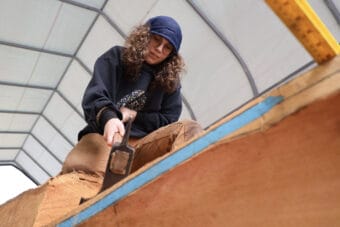
Amos Wallace carves his Porcupine and Beaver Totem Pole at Centennial Hall in 1985. (Coutesy of Brian Wallace)
“I have great pride that my dad did his part to keep the artwork going, even though it was oppressed,” he said. “It just shows the world that the Lingít, Haida, Tsimshian — they had a rich heritage, but they are still vibrant. We’re still here. Despite everything that happened, there’s still artwork here.”
The pole also signifies another step toward tribal sovereignty, according to the Central Council of the Tlingit and Haida Indian Tribes of Alaska. The tribe helped make the move possible and hosted the rededication ceremony.
A year ago, the tribe and the U.S. Forest Service signed a memorandum of agreement to co-manage the Mendenhall Glacier Recreation Area together in order to better educate visitors about the Indigenous history of the area.
The tribe hired 10 tribal members this summer to work as ambassadors at the visitor center, sharing their personal connections to Lingít culture and how Lingít people are connected to the land.
A Juneau Animal Rescue employee takes dogs out for a walk on Thursday, Jan. 18, 2024. (Clarise Larson/KTOO)
This is Lingít Word of the Week. Each week, we feature a Lingít word voiced by master speakers. Lingít has been spoken throughout present-day Southeast Alaska and parts of Canada for over 10,000 years.
Gunalchéesh to X̱’unei Lance Twitchell, Goldbelt Heritage Foundation and the University of Alaska Southeast for sharing the recorded audio for this series.
This week’s word is keitl, or dog. Listen to the audio below to learn how to say keitl.
The following transcript is meant to help illustrate the words and sentences.
Rear Adm. Mark Sucato issues a formal apology for the 1869 bombardment of Kake at the village’s community center on Saturday, Sept. 21, 2024. (Screenshot from Sealaska Heritage Institute livestream)
Over 150 years have passed since the U.S. Navy bombed Kake, a Tlingit village in Southeast Alaska. Navy representatives visited this weekend to formally apologize for the winter attack, which left many people to starve or die of exposure after the village was destroyed.
At Kake’s community center on Saturday, about a dozen elders walked or were wheeled to the front of the crowd, where they saluted the American flag as a Navy musician sang the Star-Spangled Banner. The men wore Tlingit button vests and blankets over their shoulders, and veterans’ caps on their heads denoting the military branch and foreign wars they served in — Korea, Vietnam, Iraq.
Joel Jackson is the president of Kake’s tribe, called the Organized Village of Kake. He said he couldn’t help but point out the irony.
“Our veterans have been in every major conflict,” Jackson said. “Even though they took our land, our men still went and fought for their country. I’m very proud of them for their service.”
To Jackson’s right, a totem pole, carved by local artist Rob Mills, stood behind the American flag. Half of the pole was blackened by fire, to represent the centuries of colonial violence endured by the Tlingit people.
Jackson said the Navy’s apology was a long time coming.
“I talked to a lawyer, and he said the military will never apologize or offer restitution for what they have done,” said Jackson. “I’m glad it’s happening in my lifetime.”
‘Wrongful military activity’
An unexploded shell from the 1869 bombardment of Kake. (Sealaska Heritage Institute)
The attack took place in January of 1869 — in the dead of winter.
The year before, American soldiers had attacked a Chilkat leader, Colchika, who left the fight with one of their rifles. Soon after, an army sentinel shot and killed two Kake Tlingit people who were trying to leave Sitka by canoe. The group’s lone survivor, a clan leader, asked the army garrison for compensation for their deaths. Gen. Jefferson C. Davis refused.
About a month later, in retribution, a party of Kake Tlingit people killed two white trappers on Admiralty Island. Jackson says they were acting in accordance with Tlingit law.
When Davis learned of those killings, he ordered the USS Saginaw to attack Kake. The warship’s crew found the village mostly empty, but they burned and bombed it to the ground — destroying homes, food caches, canoes, and totem poles.
The bombing left the people of Kake without food or shelter. Though historians haven’t determined the number of deaths, oral history records many — especially among elders and children.
In its apology, the Navy called the attack “wrongful military activity.” But Jackson calls it part of a series of acts of genocide.
“It basically is still in our DNA today,” said Jackson. “Because it wasn’t just a bombardment, it was the boarding schools and all the pandemics that we had back then. Trying to erase our people from this land.”
‘The beginning of a dialogue’
U.S. Senator Lisa Murkowski, who is an adopted member of the Tlingit Deisheetaan clan, spoke at the ceremony. She said she hopes the Navy’s apology will promote healing.
“At some moment, there has to be the time that the healing can begin, and that moment needs to be now,” she said. “It is my hope that we can move together forward with respect and understanding for each other’s cultures, for each other’s worldviews, and that with these words of apology, respect is finally afforded to the people of Kake.”
Rear Admiral Mark Sucato stepped up to the podium and said the Navy regrets how long it took to apologize.
“The Tlingit people of Kake did not deserve the destruction of their villages by U.S. Naval forces,” he said. “We are invested in supporting Kake’s healing. This is the beginning of a dialogue towards making amends.”
Jackson, the tribal president, didn’t accept the apology outright. Instead, he turned to the clan leaders at the gathering.
“You all heard the apology — What do you think?” Joel asked. “You don’t have to answer, but as the tribal president, I believe we should acknowledge the apology and move forward.”
Some clan leaders then shared stories from their ancestors who survived the attack. Others thanked the visitors for the apology, which the tribe ultimately accepted.
But the Navy’s work isn’t over. Now they’re speaking with Wrangell and Angoon’s tribes to apologize to clans that also suffered in the series of attacks. Those ceremonies will take place later this fall.
KTOO 360TV will air the U.S. Navy’s apology for the Kake bombardment on Sunday, Sept. 29 at 12:30 p.m.
Correction: A photo caption previously misidentified the year when the bombardment took place.
Joel Jackson, President of the Organized Village of Kake (OVK) holds up up a couple carved wooden paddles, which were among the objects a group of quakers returned to Kake in August. (Photo courtesy of Juulie Downs)
A group of quakers from Oregon visited Kake last month for the annual Dog Salmon Festival. The visit to the remote Southeast Alaska village was part of an ongoing effort to apologize for the religious group’s participation in the forced assimilation of the Tlingit people. They were there to return an assortment of cultural artifacts that had been taken out of Kake over a century ago.
Baby booties, wooden paddles, blankets, a small household totem — these are some of the cultural artifacts a group of quakers returned to Kake from Portland, Oregon this summer. But according to Juulie Downs, who was part of the group who went to Kake, some items were easier to transport than others.
“Oh, a set of canoe paddles — gorgeous, absolutely gorgeous! And really hard to get through TSA,” Downs said, laughing.
“I wanted to carry them on board, because I wanted to be careful,” said Downs. “But TSA said, ‘Oh, no, you’re going to have to go back and check them, because they could be used as a weapon. You know, you could whack somebody with them!’ [And so I said,] ‘Yeah, okay, whatever.’”
Many of them had been passed down through Downs’ family, through her great-grandmother, Bell Gardner, who taught at the quaker school in Kake around the turn of the century. It was a day school where the kids went home at night.
Downs said bringing those pieces back was just the right thing to do, as a step towards repairing the harm of the forced assimilation of Alaska Native people. But in letting go of the items that had been with her family for three generations, she also learned something about them.
“There was one thing I could never figure out,” said Downs. “I couldn’t see what it could possibly be for — it made absolutely no sense of any kind. It’s a pouch with a handle. I asked somebody, I said, ‘Do you know what this is?’ And she looked at it, and she picked it up and she handled it. She [said] it was a medicine bag. So it was important!”
Juulie Downs (center) returning objects to Kake residents at the Dog Salmon Festival in August. (Photo courtesy of Cathy Walling)
Joel Jackson is the president of Kake’s tribe, the Organized Village of Kake. He said the gesture meant a great deal to the community. But, that Kake is still recovering from colonization. He said many of the community’s elders, who went to the quaker day school, don’t like to talk about their experiences there.
“I don’t know if they’re embarrassed or [if] they just feel that it’s something they want to put behind them,” said Jackson. “But the main thing I expressed about that school was the forced assimilation of our people into the Western world. And that’s what lot of people across Alaska, in the United States, you know, they feel that, you know … They were forced into going to school and following the Western ways, and they were forbidden to speak their language. “
The return of the objects was preceded by a formal apology in January. S’eiltin Jamiann Hasselquist is an Indigenous activist from Angoon. She was there to witness the apology as a descendant of a person from Kake, and said it wasn’t just a blanket apology for operating the day school.
“They talk about the horrific abuse conditions, the taking of culture, the sexual abuse,” said Hasselquist. “They speak of the things that happened in their apology, which is exactly how an apology should be when coming to make apologies to Indigenous people. It shouldn’t be vague. Because we know what happens to us. And apologies without reparations are just words that fall to the ground.”
A pair of beaded baby booties a group of quakers returned to Kake in August, 2024. (Photo courtesy of Cathy Walling)
Downs said it was hard for her to confront that part of her family’s history. She remembers her great grandmother as a gentle, kind person, and doubts that she participated in the worst of the abuse. But, she said it was ultimately necessary to reconcile her views of the world with what Bell Gardner, who she calls “Nana,” participated in.
“It it just struck me … still not connecting it to Nana at that point,” Downs said. “But just realizing that we, as white people, have often not really understood other people’s religions.”
Then, one day, when she was putting on a scrimshaw pin that her great grandmother had brought down from Kake, she said it hit her “like a ton of bricks.”
“I was getting dressed, I thought, well, I’m going to wear that pin,” said Downs. “And then I went: ‘Ah!’”
Downs was getting ready for a meeting, where Hasselquist was speaking about the lasting harm missions and boarding schools had brought upon Indigenous people across North America.
“I got up and said that there was this pin that came down in my family, and [then I] gave it to this woman that had been speaking,” said Downs. “And I’m telling you, there wasn’t a dry eye in the whole room. Quakers have a kind of a concept that sometimes in a group there’s a heaviness of the Holy Spirit comes down and just enshrouds everybody, like in a cloud. It was like that.”
Cathy Walling is with another quaker group: the Alaska Friends Conference. She helped organize the reconciliation effort — including the return of the artifacts. She says she didn’t want the apology to be an empty, self-congratulatory gesture.
She said that’s why the group put up over $92,000 to cover the insurance costs for the village’s healing center, which is in the works. Walling says she hopes this act inspires other organizations with histories of colonization to take similar reparative steps.
“I’m hoping this story just helps to uplift the importance of apology,” said Walling, “for healing journeys, [and] for, you know, really — how we move forward in good ways together, towards greater healing that moves us towards transformation on our planet. Because, boy do we need it. Boy, do we need it.”
Jackson says the return of the artifacts represents a step towards healing intergenerational trauma brought about by colonization, and that the monetary contribution to his brainchild — the community’s cultural healing center — made the gesture even more meaningful.
“We’ve been talking about this intergenerational trauma for … how long now?” said Jackson. “And I think it’s time that we start healing our people. I’ve had the cultural healing center in mind for … I don’t know how long. Quite a while. It came to me after I lost two of my brothers to alcohol.”
As for Downs? She says that she’s only a little bit sad to part with some of the items, which made her feel connected to all the hands they had passed through — those of her mother and grandmothers. But she says she knows it was ultimately the right thing to do, and that she hopes she traded in the artifacts for lasting friendship with the people of Kake.
Visitors to the Father Andrew P. Kashevaroff State Library, Archives and Museum building are dwarfed by a life-sized eagle nesting tree on Thursday, May 26, 2016 in Juneau, Alaska. (Photo by Rashah McChesney/KTOO)
This is Lingít Word of the Week. Each week, we feature a Lingít word voiced by master speakers. Lingít has been spoken throughout present-day Southeast Alaska and parts of Canada for over 10,000 years.
Gunalchéesh to X̱’unei Lance Twitchell, Goldbelt Heritage Foundation and the University of Alaska Southeast for sharing the recorded audio for this series.
This week’s word is ch’áak’, or eagle. Listen to the audio below to learn how to say ch’áak’.
The following transcript is meant to help illustrate the words and sentences.