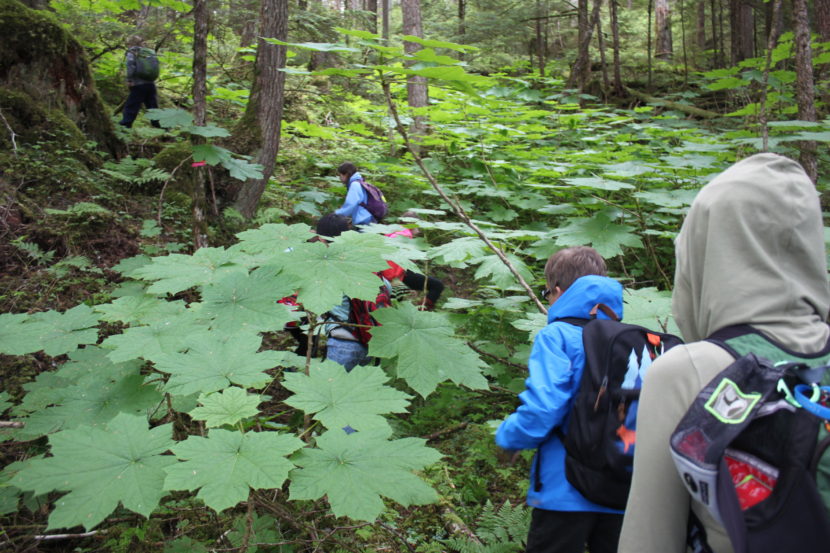
Kids hike by devil’s club on Juneau’s Auke Lake Trail. (Photo by Lisa Phu/KTOO)
This is Lingít Word of the Week. Each week, we feature a Lingít word voiced by master speakers. Lingít has been spoken throughout present-day Southeast Alaska and parts of Canada for over 10,000 years.
Gunalchéesh to X̱’unei Lance Twitchell, Goldbelt Heritage Foundation and the University of Alaska Southeast for sharing the recorded audio for this series.
This week’s word is s’áxt’, or devil’s club. Listen to the audio below to learn how to say s’áxt’.
The following transcript is meant to help illustrate the words and sentences.
Keihéenák’w John Martin: S’áxt’.
That means devil’s club.
Here are some sentences:
Keihéenák’w John Martin: Náakw yáx̱ x̱á atoolgein yá s’axt’.
Itʼs like medicine when we see devil’s club.
Keiyishí Bessie Cooley: Sʼáxtʼ, a daa yalikʼáts.
Devilʼs club bark has sharp things around it.
Kooshdáakʼu Bill Fawcett: Yak’éi áwé yéi aa ysaneiyí wé s’áxt’
Itʼs good the way you worked on some of the devil’s club.
Ḵaakal.áat Florence Marks Sheakley: Naakw yís yéi daadunéi yá sʼáxʼt.
People work on devilʼs club to make medicine.
Kaxwaan Éesh George Davis: Náakw sákw awliyéx̱ wé sʼáxtʼ
They made devil’s club into what will become medicine.
You can hear each installment of Lingít Word of the Week on the radio throughout the week.
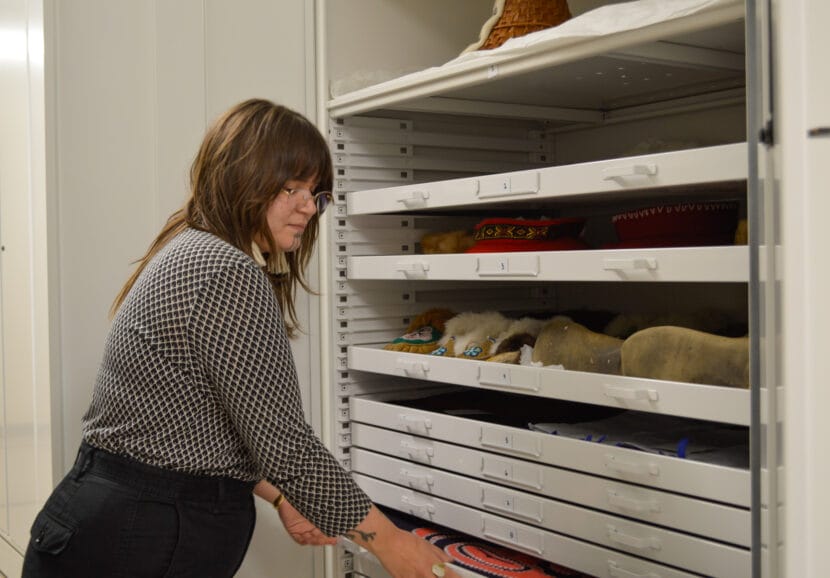
Marjorie Barker Edá Shawaat Tlakwadzee opens the drawers of the archives at Sealaska Heritage Institute. July 16, 2024. (Photo by Yvonne Krumrey/KTOO).
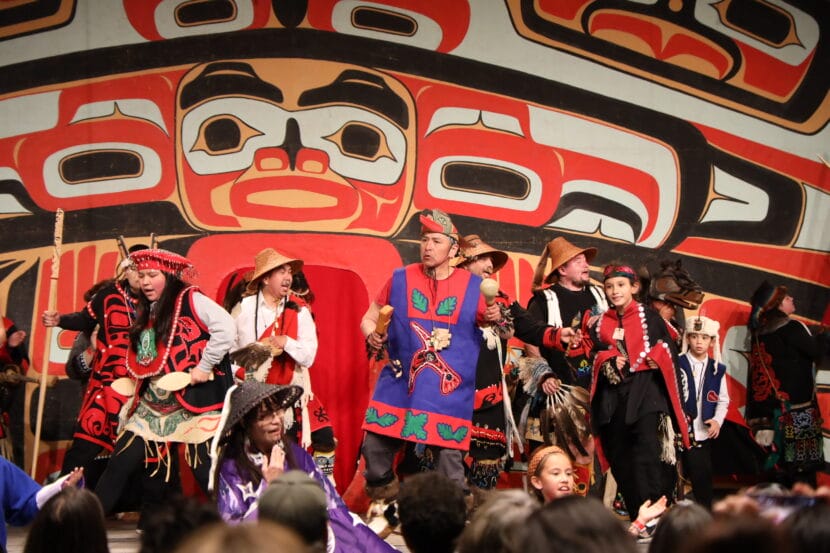
At the Grand Entrance to Celebration each June, dancers from around Southeast Alaska entered Centennial Hall, wearing button blankets with hand-beaded clan crests, hats woven from strips of cedar, and carved formline headpieces depicting clan emblems.
Celebration only lasts a few days, but in that time, over 5,000 Lingít, Haida and Tsimshian people bring cherished regalia, often handmade by loved ones or renowned artists, to Juneau.
After the drumbeats die down at the end of the week, many attendees start working on making or collecting regalia for next Celebration. But some of the items they bring get left behind. When that happens, it ends up in Sealaska Heritage Institute’s basement, where archivists have been carefully storing and cataloging the lost and found from Celebration over the years.
“There’s objects here, going back as far as, I think, 2006 and we want them to go home to their families,” said Emily Galgano, the archives and collections director at Sealaska Heritage Institute. Her team has been working to catalog the 150 or so lost items of Celebrations gone by.
Dancers fill the stage at Centennial Hall during a processional and grand entrance for Celebration in Juneau on Wednesday, June 5, 2024. (Clarise Larson/KTOO)
Sometimes, in the chaos of the dancing, singing, and story times, valuable things are dropped or left in a corner. In the days and months after the event, a few people reach out to claim their hats and robes.
“Then after a while, those requests start to trickle out, and people aren’t asking anymore, and that’s when it comes down to archives,” Galgano said. “And here we keep them in museum quality conditions. They’re in our vault where it’s temperature and humidity controlled, and we keep them in a sterile environment, and we just try to make sure we’re taking care of them.”
Marjorie Barker Edá Shawaat Tlakwadzee has been helping catalog the lost items. She’s a weaver, too, and she knows how much work goes into making some of these items.
“I’m sure a lot of these regalia was made by family members, you know, aunties or mothers or sisters,” she said. “Like, I mean, when I make regalia, I’m thinking of my nieces and nephews.”
Barker said she was shocked at first by how much stuff there was in the lost and found, but then she saw all the kids’ sized regalia. She thought of the way those nieces and nephews play around at gatherings and how they aren’t always the most aware of where their stuff is.
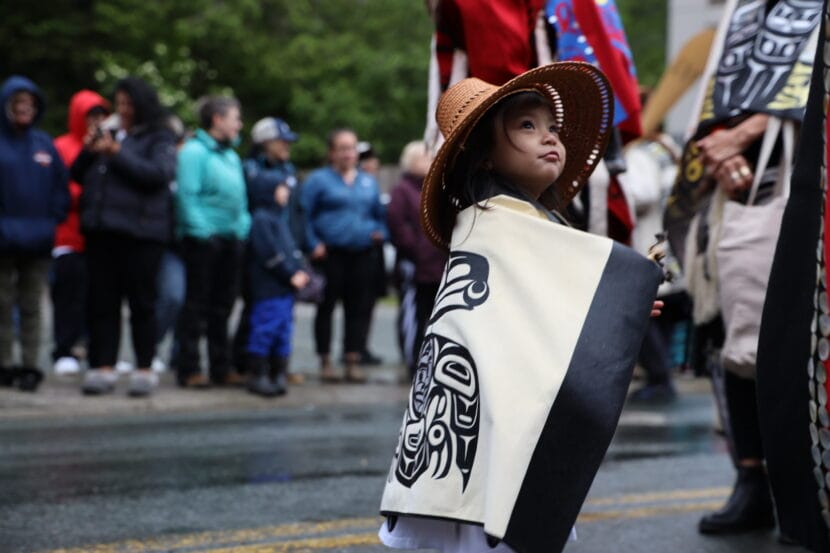
Shiloh Sanidad dances during a processional and grand entrance for Celebration in Juneau on Wednesday, June 5, 2024. (Clarise Larson/KTOO)
But the adult items make her think that the person it belongs to may be very worried about their regalia.
“I’d be devastated if I lost my robe,” she said. “So I just, it’s just kind of a weird feeling, just like, it’s like, you really want it to go back to who it belonged to.”
Galgano’s team will post a call out on social media to anyone who has lost a piece of regalia at Celebrations in the last 18 years. They ask for a description and photos of the item to prove ownership.
And if that item is in the basement, Galgano said, they’ll send it home, so that someone can dance in it again.
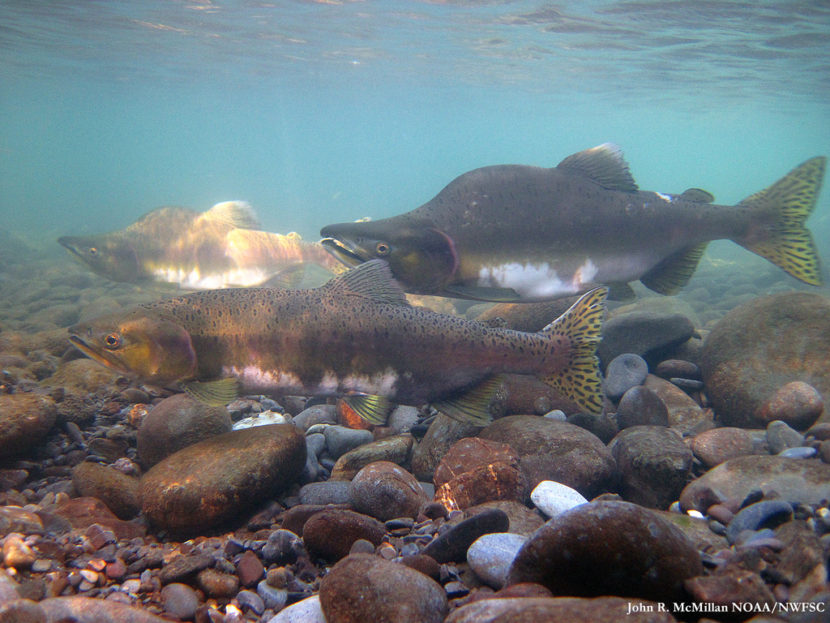
Fishing fleets caught 219 million pink salmon last year. (Photo courtesy NOAA fisheries)
This is Lingít Word of the Week. Each week, we feature a Lingít word voiced by master speakers. Lingít has been spoken throughout present-day Southeast Alaska and parts of Canada for over 10,000 years.
Gunalchéesh to X̱’unei Lance Twitchell, Goldbelt Heritage Foundation and the University of Alaska Southeast for sharing the recorded audio for this series.
This week’s word is cháas’, or pink salmon. Listen to the audio below to learn how to say cháas’.
The following transcript is meant to help illustrate the words and sentences.
Kooshdáakʼu Bill Fawcett: Cháas’.
That means pink salmon, or humpy.
Here are some sentences:
Kooshdáakʼu Bill Fawcett: Ḵúnáx̱ áwé yaawa.aa wé cháas’
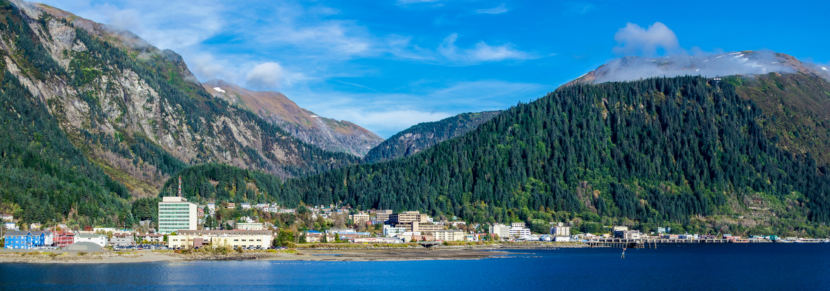
Juneau on a rare sunny day. (Photo by Heather Bryant/KTOO)
This is Lingít Word of the Week. Each week, we feature a Lingít word voiced by master speakers. Lingít has been spoken throughout present-day Southeast Alaska and parts of Canada for over 10,000 years.
Gunalchéesh to X̱’unei Lance Twitchell, Goldbelt Heritage Foundation and the University of Alaska Southeast for sharing the recorded audio for this series.
This week’s word is g̱agaan, or sun. Listen to the audio below to learn how to say g̱agaan.
The following transcript is meant to help illustrate the words and sentences.
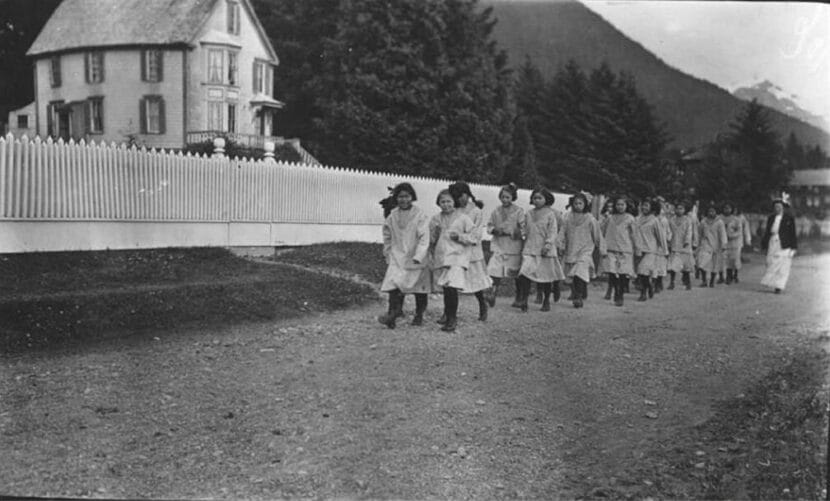
Children attend the Sheldon Jackson School in Sitka, in a photo dated between 1900 and 1930. (Library of Congress Prints and Photographs Division Washington, D.C.)
A new national report includes a series of recommendations from the U.S.’s top Indian Affairs official to promote healing from the forced assimilation of American Indian and Alaska Native children.
Twenty-two of the 417 federal Indian boarding schools that operated in the United States in the 1800s were in Alaska, according to an investigative report the U.S. Department of the Interior released on Tuesday.
Local research has found more evidence of boarding schools than the federal report did. Research from the Alaska Native Heritage Center shows there were more than 100 government-funded, church-run Alaska Native boarding schools in Alaska from the late 1800s through the 1960s.
The report documents the U.S. government’s role in operating the federal Indian boarding school system in which American Indian and Alaska Native children were removed from their families and forcibly assimilated from the 1800s through the 1960s.
Nearly 1,000 children died at such schools, the report said. Many living Alaskans have memories of abuse and cultural assimilation at such schools.
Assistant Interior Secretary Bryan Newland included several recommendations in the report, such as acknowledging, apologizing for and repudiating the forced assimilation policy. Other steps Newland recommended include: investing in culturally based community-driven healing efforts; building a national memorial to the board school experiences; returning the remains of children who died at the schools and never returned home; and returning the school sites to tribes at their request.
U.S. Sen. Lisa Murkowski, R-Alaska, is the vice chair of the Senate Committee on Indian Affairs and has led a bipartisan effort with U.S. Sen. Brian Schatz, D-Hawaii, to create a Native-led commission tasked with revealing the full scope of what took place at boarding schools. In a statement, she said she welcomed the report.
“These findings affirm my resolve to get the Truth and Healing Commission legislation signed into law,” Murkowski said in the statement. “The more we understand the truth about this era, the more we are able to help all those affected find healing.”
In a text, Murkowski said the report is more than just words, but the stories of real Alaskans.
“It was particularly impactful to read some of the specific Alaska anecdotes throughout the report, including excerpts from Alaskan survivors on the road to healing. Their stories bring life to the harsh realities that these children faced— being stripped from their traditional clothing, becoming violently ill from being fed spoiled food, and facing acts of sexual abuse and physical harm,” she wrote, in part.
It also has the overwhelming support of Alaska Legislators, who nearly unanimously OK’d a resolution backing it that was sponsored by Rep. CJ McCormick, D-Bethel. House Joint Resolution 17 supports the commission and acknowledges the trauma Indian boarding schools inflicted on Indigenous communities in Alaska and across the country.
McCormick, who is from Bethel, said reports such as this one hit close to home.
He said the report made him think of boarding schools like the Moravian Children’s Home near Bethel. “Thinking about it in the context of rural Alaska, knowing how remote some of these schools are, it’s just really scary and very just sad to know that there might be hundreds of other children … who are perhaps killed, and lay somewhere like in an unmarked place that no one will ever know about,” he said.
McCormick said he was struck by the amount of money that went into operating these schools — nearly $32 billion in today’s dollars. He said it is now up to lawmakers to think of ways to put equal measure into healing the harm.
“As time goes on and more comes to light, I’m finding out people I’ve known my whole life have experienced things that I never knew about them, or never knew they were subjected to,” he said.
“It’s really, really striking, I think, how many people that I know who have gone on to be community leaders or really anything for that matter, that they had to endure that.”
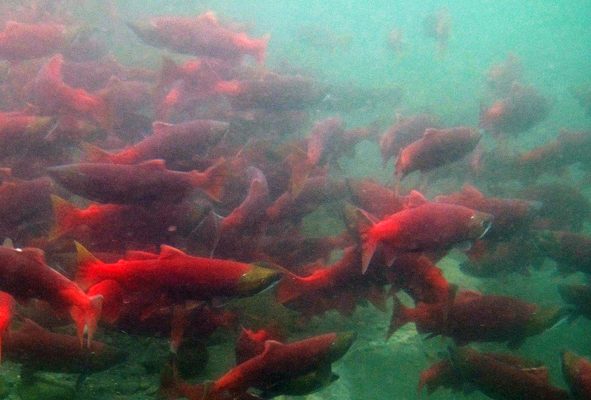
Habitat for sockeye salmon is vulnerable to climate change. (U.S. Fish and Wildlife Service)
This is Lingít Word of the Week. Each week, we feature a Lingít word voiced by master speakers. Lingít has been spoken throughout present-day Southeast Alaska and parts of Canada for over ten thousand years.
Gunalchéesh to X̱’unei Lance Twitchell, Goldbelt Heritage Foundation and the University of Alaska Southeast for sharing the recorded audio for this series.
This week’s word is g̱aat, or sockeye salmon. Listen to the audio below to learn how to say g̱aat.
The following transcript is meant to help illustrate the words and sentences.
Keihéenák’w John Martin: G̱aat.
That means sockeye salmon.
And here are some sentences:
Keihéenák’w John Martin: G̱aat at x̱’éeshi tlél wáa sá yak’éi.
Dried sockeye salmon is pretty good.
Keiyishí Bessie Cooley: G̱aat kei uwa.xʼák.
The sockeye swam up.
Ḵaakal.áat Florence Marks Sheakley: Ḵúnáx̱ ldakát át yís yakʼéi wé g̱aat.