Alaska Native Arts & Culture

U.S. Navy plans apologies to Southeast Alaska villages for century-old attacks

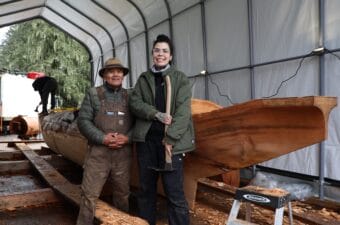
Angoon students prepare to paddle the unity canoe they built with master carver Wayne Price on June 19, 2023. It is the first canoe of its kind since the U.S. Navy bombardment of Angoon in 1882 that destroyed all the village’s canoes. The Navy plans to issue apologies to Kake and Angoon residents in the fall of 2024. (Photo by Claire Stremple/Alaska Beacon)

Two Tlingít villages in Southeast Alaska will receive apologies for wrongful military action from the U.S. Navy this fall.

The first of those apologies will take place in Kake this weekend, where U.S. Navy Rear Admiral Mark B. Sucato will acknowledge the harms of a bombardment in 1869. An apology in Angoon is scheduled for Oct. 26, the 142nd anniversary of the 1882 bombardment.

Navy ​​Environmental Public Affairs Specialist Julianne Leinenveber said it was determined that the military actions were wrongful because they resulted in loss of life, loss of resources, and inflicted multigenerational trauma on the affected communities.

“The pain and suffering inflicted upon the Tlingit people warrants this long overdue apology,” she wrote in an email.

Tlingit people have asked the U.S. government to apologize for decades. Leinenveber said the U.S. responded in the last few years with planning discussions at the highest levels of military leadership and the federal government about how to issue a substantive, meaningful apologies in a culturally appropriate manner. Lately, she wrote, military relationships with Alaska Native clans brought the matter to the attention of Navy leadership, who coordinated with the Office of the Secretary of Defense to formally apologize for the bombardments.

“The Navy will be issuing this apology because it is the right thing to do, regardless of how much time has passed since these tragic events transpired,” she wrote.

Joel Jackson, the president of the Organized Village of Kake, said the apologies are meaningful to the community even after a century.

“It’s a long time coming,” he said. “Hopefully, through this apology, we can start healing from the wrongs that were committed against us.”

Jackson said he is particularly concerned with the effects of intergenerational trauma, which he said he sees in his community today. The Navy apology will specifically acknowledge the U.S. government’s responsibility for that trauma.

Jackson said the military history of the event is not an accurate accounting of what happened. Many accounts refer to the bombardments as the Kake Wars.

“We never did go to war with them,” he said. “They attacked our communities.”

Military action in Kake

There are different accounts of the military events in Kake in 1869. Some refer to the events as a bombardment, while others refer to them as the Kake Wars.

What goes without much dispute is that a U.S. Navy vessel, the USS Saginaw, totally destroyed three village sites and two forts in the area of Kake in the winter. Soldiers then burned the villages and destroyed food and canoes. By all accounts, the destruction led to “many deaths.”

Descriptions of the events that precipitated the bombardment differ. An account from William S Dodge, one of two mayors of Sitka under the provisional government, printed in the Annual Report of the Department of the Interior, recounts that two Alaska Native men were killed by a sentry in Sitka when they were unaware there was an order not to leave the village there. Afterward, men from Kake killed two colonizers in retaliation, which caused the war, Dodge wrote.

A forthcoming book from Zachary R. Jones, Ph.D., is similar to this account, with the detail that a Kake clan leader asked for trade blankets and goods as compensation for the deaths in accordance with Tlingit law, but the general refused, which is why a “party of Kake Tlingits” killed two trappers on Admiralty Island in retribution. The information was released in advance of the book’s publication in a news release from the Sealaska Heritage Institute.

New relationships

Angoon School Principal Emma Demmert was invited by the U.S. Navy to take part in planning meetings early this summer for its October apology. She said she is hopeful for the future after working with Navy officials and seeing their openness and willingness to embrace Angoon’s cultural traditions.

“This is a really good step to healing for our community, and it’s really been enlightening to be a part of the team and meeting with the Navy on this whole topic,” she said.

Demmert said the apology is a shift in relations with the U.S. government and she credits the Biden administration, in part, for that change. She also pointed to the work Angoon students did to build a dugout canoe and shine light on the history of the bombardment as a reason for renewed attention to the issue.

In Kake, Joel Jackson said he was also looking to the future and to right relations with the U.S. military.

“Giving an apology is by no means the end of it. Definitely we’ll be looking for them helping us even more,” he said. Jackson pointed to Kake’s high unemployment rate.

“Helping to set up infrastructure, you know, to get in some totem poles, stuff like that. Hopefully a museum to commemorate what happened.”

Correction: One of the references to the year of the bombardment of Kake was incorrect in the original version of this article. 

Lingít Word of the Week: Yéil — Raven

Ravens sit near the seawalk in downtown Juneau on Tuesday, April 9, 2024. (Katie Anastas/KTOO)

This is Lingít Word of the Week. Each week, we feature a Lingít word voiced by master speakers. Lingít has been spoken throughout present-day Southeast Alaska and parts of Canada for over 10,000 years.

Gunalchéesh to X̱’unei Lance Twitchell, Goldbelt Heritage Foundation and the University of Alaska Southeast for sharing the recorded audio for this series.

This week’s word is yéil, or raven. Listen to the audio below to learn how to say yéil.

The following transcript is meant to help illustrate the words and sentences. 

Kooshdáakʼu Bill Fawcett: yéil. 

That means raven.

Here are some sentences:

Kooshdáakʼu Bill Fawcett: Yéil neechx̱ yaa nagút.

Raven is walking along the beach.

Keiyishí Bessie Cooley: Yéil yóode saduwa.áx̱ch.

A ravenʼs call is heard way over there.

Ḵaakal.áat Florence Marks Sheakley: Neechx̱ yaa nagút yéil.

Raven is walking on the beach. 

Keihéenák’w John Martin: Yéil yádi x̱at sitee.

I am a raven child.

You can hear each installment of Lingít Word of the Week on the radio throughout the week. 

Find biographies for the master speakers included in this lesson here.

Learn more about why we use Lingít instead of Tlingit here.

Lingít Word of the Week: Héen — Water

Cars cross the Juneau-Douglas bridge on Saturday, March 23, 2024. (Clarise Larson/KTOO)

This is Lingít Word of the Week. Each week, we feature a Lingít word voiced by master speakers. Lingít has been spoken throughout present-day Southeast Alaska and parts of Canada for over 10,000 years.

Gunalchéesh to X̱’unei Lance Twitchell, Goldbelt Heritage Foundation and the University of Alaska Southeast for sharing the recorded audio for this series.

This week’s word is héen, or water. Listen to the audio below to learn how to say héen.

The following transcript is meant to help illustrate the words and sentences.

Kaxwaan Éesh George Davis: Héen.

That means water.

Here are some sentences:

Kaxwaan Éesh George Davis: Héen ax̱ x̱’éix̱ natí

Get me a drink of water.

Keihéenák’w John Martin: Héen tuwáadáx̱ áyá haa lix̱éitl.

We are blessed by the water.

Keiyishí Bessie Cooley: Yées héen yaa anayáan, wé ḵáa.

The man is packing fresh water.

Kooshdáakʼu Bill Fawcett: Ax̱ x̱ʼeit aa sa.ín wé héen.

Bring me some water to drink.

Ḵaakal.áat Florence Marks Sheakley: Wé héen nadaa.

The water is flowing.

You can hear each installment of Lingít Word of the Week on the radio throughout the week.

Find biographies for the master speakers included in this lesson here.

Learn more about why we use Lingít instead of Tlingit here.

Bill adding more Indigenous languages to Alaska’s official list becomes law

Rep. Andi Story, D-Juneau, speaks during a House Education Committee meeting on May 3, 2024. (Eric Stone/Alaska Public Media)

A bill adding more Indigenous languages to Alaska’s official list became law on Friday without the governor’s signature. 

Its passage means Alaska now officially recognizes 23 Alaska Native languages. The new additions to the list are Cup’ig, Middle Tanana, Lower Tanana and Wetał. Middle and Lower Tanana were previously classified as just one language.

Juneau Rep. Andi Story sponsored the bill. She’s a Democrat running uncontested for reelection this year.

Story said it’s a significant win for all residents in the state. 

“I just think it enriches all of us, Native and non-native, to know about our language and culture and embrace it,” she said. 

The law expands and renames a council that advocates for the survival and revitalization of Indigenous languages in the state. Previously called the Alaska Native Language Preservation and Advisory Council, it’s now called the Council for Alaska Native Language. 

The majority of the state’s Indigenous languages are critically endangered. And, in a report released this spring, the council stated that Alaska Native languages are at a “crucial juncture.”

X̱ʼunei Lance Twitchell chairs the council and teaches Alaska Native languages at the University of Alaska Southeast in Juneau. He strongly advocated in favor of the bill during legislative testimony earlier this year.

“Every single Alaska Native language is sacred and irreplaceable,” he said during his testimony. “It contains concepts that cannot be translated, it contains things that cannot be replaced, and that give a sense of fulfillment and wholeness and health to Alaska Natives and to non-natives in Alaska.”

Two seats will be added to the council and it will be moved from the Department of Commerce to the Department of Education and Early Development to better reflect the council’s focus on education. 

Lingít Word of the Week: Kichx̱.anagaat — Rainbow

Rainbow near the Wrangell Narrows. (Photo by Angela Denning/CoastAlaska)

This is Lingít Word of the Week. Each week, we feature a Lingít word voiced by master speakers. Lingít has been spoken throughout present-day Southeast Alaska and parts of Canada for over 10,000 years.

Gunalchéesh to X̱’unei Lance Twitchell, Goldbelt Heritage Foundation and the University of Alaska Southeast for sharing the recorded audio for this series.

This week’s word is kichx̱.anagaat, or rainbow. Listen to the audio below to learn how to say kichx̱.anagaat.

The following transcript is meant to help illustrate the words and sentences. 

Ḵaakal.áat Florence Marks Sheakley: Kichx̱.anagaat. 

That means rainbow.

And here is a sentence:

Ḵaakal.áat Florence Marks Sheakley: Séew daak wustáanidáx̱ áyá kichx̱.anag̱aat yéi tusatínch

It is from the rain that we always see rainbows.

You can hear each installment of Lingít Word of the Week on the radio throughout the week. 

Find biographies for the master speakers included in this lesson here.

Learn more about why we use Lingít instead of Tlingit here.


Lingít Word of the Week: Téel’ — chum or dog salmon

Two chum salmon show the distinctive stripes that emerge after they enter freshwater to spawn. Chum salmon are important to the diets of Indigenous residents of Western Alaska. (Photo provided by NOAA)

This is Lingít Word of the Week. Each week, we feature a Lingít word voiced by master speakers. Lingít has been spoken throughout present-day Southeast Alaska and parts of Canada for over 10,000 years.

Gunalchéesh to X̱’unei Lance Twitchell, Goldbelt Heritage Foundation and the University of Alaska Southeast for sharing the recorded audio for this series.

This week’s word is téel’, or chum or dog salmon. Listen to the audio below to learn how to say téel’.

The following transcript is meant to help illustrate the words and sentences. 

Keiyishí Bessie Coolie: Téel’. 

That means chum or dog salmon.

Here are some sentences:

Keiyishí Bessie Cooley: Téelʼ tsú, Deisleent dax̱ uxʼaakch, yéis yít.

Dog Salmon, too, they swim to Teslin in the fall.

Kooshdáakʼu Bill Fawcett: Ḵúnáx̱ yak’éi áwé wé téel’ útlx̱i

Dog salmon is really good boiled fish. 

Ḵaakal.áat Florence Marks Sheakley: Aangoon yá Lʼeeneidí has du ádix̱ sitee yá téelʼ.

In Angoon the dog salmon belongs to the Lʼeeneidí.

Kaxwaan Éesh George Davis: Téelʼ yeisxʼ áwé has yax̱ ya.aa, hóochʼi aayí 

Dog salmon, in the fall, they complete their migration. They are the last one. 


You can hear each installment of Lingít Word of the Week on the radio throughout the week. 

Find biographies for the master speakers included in this lesson here.

Learn more about why we use Lingít instead of Tlingit here.

Site notifications
Update notification options
Subscribe to notifications