Alaska Native Arts & Culture

The language speakers behind KTOO’s Lingít Word of the Week

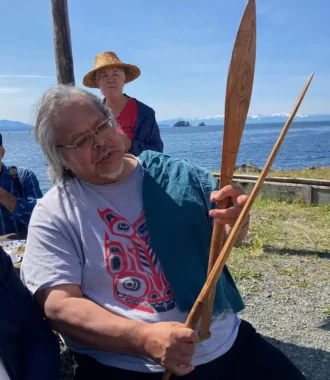
KTOO’s Lingít Word of the Week series owes a debt of gratitude to X̱ʼunei Lance Twitchell, professor of Alaska Native Languages at the University of Alaska Southeast, and to the elders and language scholars who recorded the words and sentences used.

Here is more information about the people involved:

Keiyishí Bessie Cooley

Keiyishí Bessie Coolie is Kooḵhíttaan and a child of a Yanyeidí man. She’s from Deisleen (Teslin) and grew up spending time in Teslin, and around Teslin lake. She earned a Master’s degree in Indigenous languages and linguistics from Simon Fraser University. She’s currently translating projects for the Children of the Taku Society. 

Kooshdáakʼu Bill Fawcett

Kooshdáakʼu Bill Fawcett was Lukaax̱.ádi and the child of a Southern Tutchone man who passed away before Bill was born. His mother later married Tseexwáa Bill Fawcett, who helped raise Bill. He lived on Áakʼw Ḵwáan Aaní and enjoyed working with advanced language learners, helping them answer difficult questions about the language.

Ḵaakal.áat Florence Marks Sheakley

Ḵaakal.áat Florence Marks Sheakley is Lukaax̱.ádi and the child of a Chookaneidí man. She grew up on Mark’s trail in a family that used Lingít as the primary language and were involved in documenting, teaching and publishing in Lingít. She has taught the language at all levels, and has served as the teacher of teachers in the Juneau area for decades now. 

Kaxwaan Éesh George Davis

Kaxwaan Éesh George Davis was Tʼaḵdeintaan and the child of a Tsaagweidí man. He grew up in Ḵéex̱ʼ (Kake) and learned to speak well because he would always bring traditional foods to the elders there. As someone who fished a lot and spent time on the land, he knew lots of Lingít place names all over the area, and he learned many stories and advanced ways of speaking.

Keihéenák’w John Martin

Keihéenák’w John Martin was T’aḵdeintaan and a child of a Kaagwaantaan man. He is from the Xunaa Ḵaawu, the people of Hoonah, and was a contributing elder and speaker at many language immersion gatherings in Glacier Bay, Yakutat and Juneau. He attended boarding school in Shg̱agwei (Skagway) and attended Gonzaga University.

Juneau man’s 70-year-old photos could help preserve cultural knowledge for King Island Inupiat community

Paul Tiulana, a King Island man, in the early 1950s. (Photo by Juan Muñoz Sr.)

Yaayuk Bernadette Alvanna-Stimpfle was born to a King Island family in 1955. She wasn’t raised on the Bering Sea island, but her family kept it as close as they could in her upbringing.

“My generation were the first ones to be raised away from the island, but we were still raised on the east end of Nome,” she said. “They still spoke to us in the language.”

In 1959, the Bureau of Indian Affairs closed the school on King Island and made the children move to Nome. By 1970, all King Island people were living in Nome year-round. 

But before all of that, one visitor to the island, a Juneau man, took hundreds of photos of the people and their way of life. A few of those photos appeared in National Geographic in 1954. Then in 2005, more were published in a book. 

Yaayuk says King Island elders would use those photos to teach her about her community.

Raphael and Paul Sebwanna, Patrick Asuna, and Michael Salamana in the early 1950s off King Island. (Photo by Juan Muñoz)

“They would tell me who the names of the people were on that island,” she said. “They would explain things to me. They would use the pictures.”

A Juneau couple on King Island

Late last month in the Rie Muñoz Gallery in Juneau, Juan Muñoz Jr. pointed to a photo high on the wall.

“This is one of my favorite photos — here is an enormous ice cave that they had on King Island,” he said. 

 A man in a fur parka appears small in the bottom center of the photo, framed by towering walls of ice.

“They’d get seal and walrus, and then they would keep all their meat in different sections, and different families would have their stash of meat and blubber rooms,” Juan Jr. said. “If one family didn’t have very much, of course they’d share it.” 

Juan is the son of Rie Muñoz, an artist who painted watercolors of life across Alaska for over 60 years. Soon after Rie first came to Juneau in the early 1950s, she took a job as a Bureau of Indian Affairs teacher on King Island.

Her husband, Juan Muñoz Sr., came with her. And he brought a camera — a Hasselblad.

King Island residents in the early 1950s. (Photo taken by Juan Muñoz Sr.)

“He took hundreds of these marvelous photos of everyday life on King Island,” Juan Jr. said.

Not long after the Muñozes returned to Juneau, the BIA closed the school.

“Then several years later, the whole village moved to Nome,” Juan Jr. said. “And so they got to see the last bit of this culture and record it — culture that had been in existence for tens of thousands of years.”

Rie Muñoz signaling a plane onto Ukivok’s runway on King Island in the early 1950s. (Photo by Juan Muñoz Sr.)

‘A living time capsule’

Juan Jr. had thought that all of his father’s King Island photos were in that 1954 issue of National Geographic. 

“But when my dad passed away in 2005, I went to clean out his locker, and I found this suitcase full of hundreds of negatives,” he said. 

Rie and Juan Jr. then made a book called King Island Journal, which included more of the photographs along with letters the couple had sent to their families while they were living there. 

Juan Jr. has since digitized all the photos with the help of Jerrick Hope-Lang, his longtime friend and a cultural preservationist. 

“It’s a living time capsule. And these people are still around, you know. There’s people that are connected to these that are still present with us,” Hope-Lang said.

Rie Muñoz on King Island in the 1950s. (Photo by Juan Muñoz Sr.)

This year, they donated the prints, negatives and digital copies to the Katirvik Cultural Center in Nome. Juan Jr. says his mother, who died in 2015, would be glad these memories of her time on the island can be returned to the descendants of the people who lived there.

“It was just a wonderful experience for my mom,” Muñoz said about the year his parents lived on King Island. “And she said she was ready to go back there again the following year.”

Hope-Lang says he thinks the photos are an opportunity to look back at what happened to King Island and the people who were made to leave. 

Yaayuk is an Inupiaq language scholar now. She says some of the images show traditions that aren’t widely practiced anymore — like making rope out of rawhide, or sewing sealskin pants — and those photographs could be especially valuable. 

She also hopes the photos may help King Island elders remember some parts of their language that havenʼt been in use since her people were forced to move to Nome, because some words only pertained to the island. 

“Our language is based on the environment,” she said. “So of course, some of the words weren’t used on the mainland like they were on King Island, where it was steep.”

A Chilkat robe returns to Southeast Alaska, but SHI needs help identifying it

Sealaska Heritage Institute Director of Archives and Collections Emily Galgano shows the back of a Chilkat robe on loan from the Rahr-West Museum in Wisconsin. June 20, 2024. (Yvonne Krumrey/KTOO)

In the basement of the Walter Soboleff building on a recent afternoon, Emily Galgano opened a huge white cabinet. She pulled out a long drawer with a Chilkat robe laying inside. The robe’s colors are faded. 

“So it could be very old, or it could be less old. I’m assuming at least 100, 150 years old,” she said. “But it’s hard to say exactly.”

In May, a Wisconsin museum sent a Chilkat robe that it’s had for the last 80 years to Sealaska Heritage Institute in Juneau to identify which clan it belongs to and, hopefully, give it back to them. 

Galgano is Sealaska Hertiage Institute’s archives and collections director. She said the robe is a diving whale design. Some of the black coloring has faded to purple and rust. Other spots are still rich and dark, which could indicate a different batch of dye. 

With gloves on, Galgano flipped a corner of the robe to reveal colors much closer to how they might have looked when the robe was new: dark blacks and bright yellows. 

Earlier this month, the robe was on display during Celebration. Galgano had hoped that people might see it and know something about its origins. 

“We’re always working with the community to try and crowdsource that sort of information,” she said. “This is the first time I’ve done something with an object like this, that’s of this scale — but we have done similar, smaller projects.”

The robe is on loan from the Rahr-West Museum in Manitowoc, Wisconsin. Greg Vadney, the museum’s executive director, said they don’t have anything else like it — he believes it came to the museum in the 1940s from someone who served in the U.S. Coast Guard in Alaska.

“We have nothing else that we know that even comes from the Pacific Northwest, let alone Alaskan tribal culture,” Vadney said. “So we were excited to be able to return it to its home. And we’re also very excited that hopefully, while it’s at Sealaska Heritage, some of the gaps in the history that we don’t know about — some of that detail can get filled in in this partnership.”

He said the idea to reach out to SHI came from Manitowoc artist Skip Wallen, who designed the whale sculpture in Juneau’s Overstreet Park.

A Chilkat robe on loan from the Rahr-West Museum in Wisconsin. Sealaska Heritage Institute is looking for any information that could help identify it. June 20, 2024. (Photo by Yvonne Krumrey/KTOO)

Vadney said Rahr-West is eager to return the robe to its original owners. 

“Certainly as a museum, oftentimes we kind of, unfortunately, look at the things as things, and forget about the material culture of it and the human element,” he said. “And in this case, the spiritual element that is inherent to it.”

The robe is on loan to SHI for the next year, but it could stay in Juneau long term while the organizations decide next steps. 

“Our thought process is, this is a step towards repatriation,” Vadney said. 

Galgano said SHI’s next step will be gathering expert weavers to study the robe. 

“If it belongs to a clan, and it’s something like at.oo — where it’s a clan-owned object — then we also have a process where clans can long-term loan items here, where we’ll still care for it. It’ll still be in our climate-controlled vault and taken care of here, but it won’t belong to the museum, and they can then check it out for ceremonies, things like ku.eek,” she said.

Galgano said she wants anyone who thinks they may have information about the robe to make an appointment to come see it by emailing her at emily.pastore@sealaska.com. 

New cultural ambassadors deepen tourists’ experience of Juneau’s Mendenhall Glacier

Jinkasee.ee Rose Willard explains a náxw, or halibut hook to visitors. She is one of 10 cultural ambassadors at the Mendenhall Glacier Visitor Center on June 13, 2024. (Photo by Yvonne Krumrey/KTOO)

When tourists come to Juneau, the Mendenhall Glacier is usually near the top of their sightseeing list. It gets hundreds of thousands of visitors each summer.

And now, those visitors will have the chance to learn more about Indigenous connections to the glacier through cultural ambassadors.  

For the first time this year, tribal members were hired as ambassadors to share their own experiences and culture with visitors. 

Jinkasee.ee Rose Willard sat at a table inside the Mendenhall Glacier Visitor Center Thursday, while tourists milled around her. They peered at the spread in front of her: books about Lingít culture, small button blankets and pieces of beadwork, and a piece of wood the size of her hand carved in the style of a kootéeyaa, or totem pole. 

A young girl visiting the glacier with her family pointed to a deerskin drum.

“What’s this?” she asked. 

“This is a drum. We call it a gaaw. Can you say gaaw?” Willard said.

Willard handed her the drum, and she beat it a few times before saying it was cool.

Willard is one of 10 cultural ambassadors from the Central Council of the Tlingit and Haida Indian Tribes of Alaska that will spend their summer teaching visitors about Lingít culture — and about how Lingít people are connected to the glacier. It’s part of the new co-management strategy between the U.S. Forest Service and the tribe.

“That’s the first question people ask: Are you Lingít? Are you of this area? Are you a local? People want to know: are you a representation?” she said. “So I think it’s really important for them to know that they are speaking to a person who is from this area.” 

The rest of the year, Willard is a Lingít language teacher at Sítʼ Eetí Shaanáx̱ Glacier Valley Elementary School. So she likes to share pieces of language with visitors, like teaching them to say gaaw for a drum, or náxw for a halibut hook. 

She said when she first introduces herself, people are sometimes confused about why she’s there, and what the connection between Lingít culture and the glacier is

“But a lot of times people don’t know that our history — our Lingít people are here because of the glaciers, and our histories are all tied to the mini-glacier period. So when they receded, our people were able to travel over and under the glaciers to reside on these coastal areas,” Willard said. “Then they’re like, ‘Oh, wow.’ Then they make a connection between Lingít people and this amazing glacier.”

And, she said, it still feels like these interactions are authentic, not superficial or theatrical glimpses into her heritage. 

“I love that we are not selling the culture out here. We are simply sharing the culture about this amazing place,” Willard said. 

Jinkasee.ee Rose Willard is one of 10 cultural ambassadors at the Mendenhall Glacier Visitor Center. June 13, 2024. Photo by Yvonne Krumrey/KTOO.

Sarah Strand has been working for the Forest Service for three years now, and she said Lingít representation at the glacier used to be mostly limited to the short film shown to visitors.

“I think that’s very important to not only talk about the importance of our environment around here,” Strand said. “But the importance of the culture around it as well.”

Cultural Ambassador Supervisor Aankadax̱steen Jeremy Timothy said the Forest Service staff who they work with daily have made it easy for the ambassadors to experiment with the new program. 

He said this first summer is only the beginning. They hope to fill more of the space in the visitor center with even more cultural items and information.

“We’re looking at pop-up artists, maybe having a Chilkat robe, maybe tunics, hats. We’re looking at a kootéeyaa that’s coming back, that used to be out here,” Timothy said. “So we’re looking at possibly doing a ceremony for that, just kind of bringing more of our traditions to light here, and letting the visitors engage with us.”

But for now, Willard and the cultural ambassadors are set up and eager for your questions. 

Chemists, curators and Chilkat weavers present findings on historic dye techniques

A detail of Lily Hope’s first full size Chilkat Robe. (Photo by Annie Bartholomew/KTOO)

The Chilkat robes in the Alaska State Museum collections feature formline faces woven with yarn. The historic ceremonial garments combines once-vibrant yellows that have softened with age with warm black-browns and striking blues and greens.

Museum conservator Ellen Carrlee and her collaborators wanted to figure out where those classic pigments came from. The color curiosity evolved into Chilkat Dye Working Group, a collaboration between staff from museums in Washington, Oregon and Juneau, chemists from Portland State University and Alaska Native weavers from across the region that set out to study historic and modern dye techniques. Carrlee presented their research results during 2024’s Celebration. 

With only three colors to identify, how hard could it be?

“Much harder than we anticipated,” Carrlee said. 

They spent five years and $1 million in funding from the Andrew W. Mellon Foundation to examine samples from historic Chilkat robes and concoct new dye formulas from scratch.

Dye-making experiments over the years have revealed an abundance of yellow.

“You might think that if you took say, like a Lupin, or an iris, and you’re like ‘Wow, I’m gonna get a purple dye. And you grind up, you put in a dye bath, you get yellow,'” Carrlee said. “Even out of weeds, out of plants are all over the place, getting yellow dyes is pretty easy.”

That’s because dye-making is not about the color of your material. It’s about the chemicals inside it. And a chemical compound called a flavonoid, present in many plants, makes yellow pigment. 

The blonde inner bark of the Western hemlock is packed with a chemical called tannins, which produces a deep, reddish brown dye when applied to yarn. Dip that dyed yarn in a solution of copper or iron and it transforms into a rich black. 

Chemists were able to find these chemicals on even the oldest Chilkat robes in the collection of the Alaska State Museum and the Sheldon Jackson Museum, which means a lot of the yarn was colored with natural dyes.

The chemical analysis on the historic robes also matched up with oral histories passed down from generations of Chilkat weavers. Traces of wolf moss were found in the yellow dye. The bright green lichen, which does not grow in the Tongass, was traded from drier regions, and it’s still used as a natural dye today. It’s well-liked because it is easy to dry and store and it acts as a natural pesticide. On robes dating back to the late 19th and early 20th century, moths that ate away at some sections of the robe tended to leave wolf-moss dyed portions in tact. 

Lily Hope dyes with Deb O’Gara (left) and Kay Field Parker (right) during a collaboration at the Alaska State Museum. (Photo courtesy of the Alaska State Museum)

Though plenty of natural dye is present in the historic weavings, most of the blue dye was synthetic. Modern weavers can extract shades of blue and green pigment from processing copper. 

“But the yarns that were visually minty green on our historic samples did not have copper in them, even though visually the color looks the same,” Carrlee said. “So it’s still a mystery.”

Blue has always been considered one of the hardest dye colors to make, but today’s weavers are exploring the possibility of making blue from chocolate lilies or a local mushroom called the bleeding tooth fungus, even as the formal dye research is wrapping up. 

Renowned Juneau weaver Lily Hope says this kind of experimentation, which blends science and art, has been one of the most inspiring things to come out of the research collaboration.

“Just because the results have been released into the world doesn’t mean the research ends,” Hope said. There’s always more to discover, and more to collaborate on. And, yeah, I hope it inspires more opportunities for collaborations like this.”

The blues were not the only synthetic dyes in the historic weavings. Many garments wove natural-dyed yarns and synthetic-dyed yarns together. Chemical analysis reveals that synthetic blues were sometimes overdyed with natural yellows to create unique blue-greens. And black borders were often woven with natural dyes, while the intricate formline centers were created with synthetic dyes.

The invention of many synthetic dyes in the late 1800s and early 1900s, when many of the museum’s weavings were created. 

“So this means that synthetic dyes were incorporated into Chilkat weaving all along, at least for the weavings in the Alaska State Museum and the Sheldon Jackson Museum,” Carrlee said. 

Today, store-bought materials and synthetic dyes are readily available. But Hope says making and using natural dye is a part of the artistry that goes into weaving. 

“I always ask my students, what is the story that you are telling with your art? What is the story of the work when it’s done, where you can say I gathered these handfuls of mountain goat, or I traded for this yellow cedar bark,” Hope said.  “When we use the historic materials and the historic ethnographic dyes, what is the story we’re telling with a piece of work made that way?”

The more weavers know about dye techniques past and present, the more stories they can tell. 

New film documents local play reimagining Macbeth through Lingít lens

Jake Waid as Macbeth and Richard Atoruk as Soldier in Perseverance Theatre’s “Macbeth.” (Photo by Katherine Fogden/Smithsonian National Museum of the American Indian)

Last Thursday’s show at Juneau’s Goldtown Nickelodeon began with a blood-splattered formline title card on the screen. It read: “Macbeth through Alaskan eyes.” 

Beating drums marked the entrance of the three witches. They danced and slinked across the screen wearing masks that showed the barred teeth of a shape-shifting otter from Lingít folklore. 

As flashing stage lights evoked the stormy night that sets the play’s murderous plot in motion, actress Lily Hope delivered the familiar first line — when shall we three meet again? 

“Xeitl tóox’, séew kaa ch’u k’eeljáa gé,” Hope said — in thunder, lightning, or in rain? 

That line opens every performance of Macbeth. But the translation, and the elements of Lingít culture throughout, put a twist on Shakespeare’s tragedy. 

The production first ran at Juneau’s Perseverance Theater in the early 2000s. It even had a 2007 run at the Smithsonian Museum of the American Indian in Washington, D.C. 

“I remember going in the subways in D.C. speaking our lines together, in packed subways,” said Juneau actor Jake Waid, who played Macbeth. “And it was just like — to be in the nation’s capital, speaking our lines around the city — it was just a powerful experience to just feel like we were claiming the play.”

Recordings of the play were originally captured during those performances, but for years the footage was stored away in the Sealaska Heritage Institute archives. Now, it’s finally been adapted for the big screen as a film presented for 2024’s Celebration.

Actor Jake Waid during Macbeth’s coronation in a performance at the National Museum of the American Indian in 2007. (Photo courtesy of the Sealaska Heritage Institute archives)

Director Anita Maynard-Losh came up with the idea for the play after spending more than a decade living in Hoonah. She’s not Alaska Native herself, but the Shakespeare expert said she saw similarities between Lingít culture and the Scottish values portrayed in the play.

“The Scots and the Lingít were extremely feared for their fierceness and their warfare” Maynard-Losh said. “And they had a deep connection with the supernatural. And they had a cultural value of putting the good of the group ahead of any one individual.”

Maynard-Losh says valuing community is a virtue that prevails in Macbeth, and one that’s infused into the Lingít translation, which was originally done by the late elder Johnny Marks Kooteix’téek. While most of the characters deliver their lines in Lingít, some of the play, including most of the soliloquies and clandestine meetings between Macbeth and his sinister wife Lady Macbeth, are in English.

“We decided that we were going to lean into the metaphor by having the people who were adhering to that cultural value speak in Lingít,” she said. “And when the people were not adhering to that value, and going for personal ambition, they spoke in English.”

But delivering the rest of the lines in Lingít was a challenge. Though all of the actors are Alaska Native, and many are Lingít, none were fluent speakers. 

Waid said watching his performance brought back memories of rehearsing the difficult stanzas over and over with his castmates.

“It feels like a miracle that we got up on stage and we got the words out,” he said.

The play also incorporates cultural elements beyond language. The costumes and set feature formline designs. When Macbeth is crowned king, he dons a Ravenstail robe and a headdress adorned with ermine skins. When Banquo’s ghost haunts his killer Macbeth, he wears a raven costume. 

And when the righteous Macduff finally vanquishes Macbeth, they face off with shields that are drums and swords that are drum sticks, punctuating each blow. 

But in a lot of other ways, it’s just like any other Macbeth production, right down to superstition. Macbeth, in the world of theater, is often considered a cursed play. Hope recalls how, when they were putting the original production together, stage lights that fell from the ceiling and stage pieces that broke constantly felt like bad luck. 

“I think it was four-fold with the Lingít language being 10,000 years old, where we were like ‘Oh, let’s pull out some really dark energy in here,’” Hope said.

For Waid, all the Lingít elements enhance the play for new audiences and actors without changing Macbeth’s core meaning. 

“It’s one of the great plays in the English language. This is part of our history too, as English speakers, and also as people who want to dig deeper into our own culture and find meaning,” Waid said. “We’re not relegated to just what people might think of as Lingít things.”

Sealaska Heritage Institute staff said they’re hoping to screen the film again later this summer.

Disclaimer: KTOO 360TV was contracted to produce television and online video coverage of Celebration. 

Site notifications
Update notification options
Subscribe to notifications