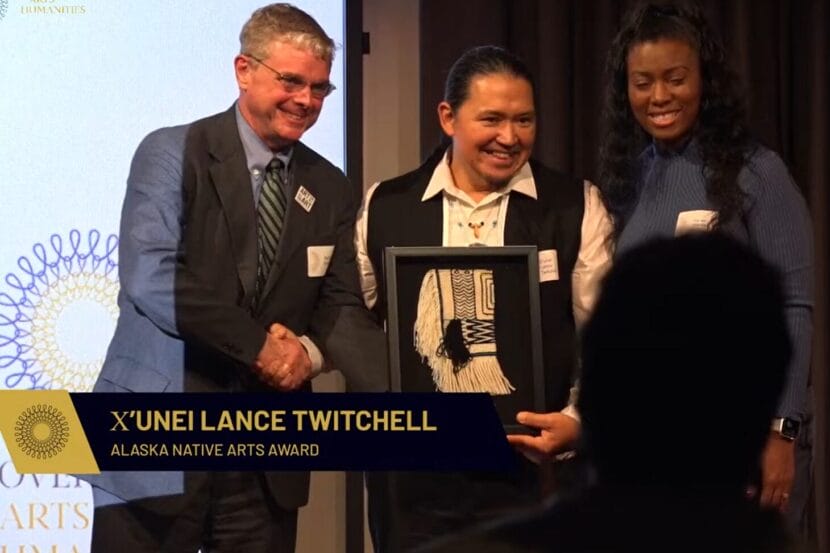
X̱ʼunei Lance Twitchell (center) receives the Alaska Native Arts Award from Benjamin Brown (left) and Renee Wardlaw (right) during the Governor’s Arts and Humanities Awards on Oct. 29, 2024. (Screenshot from YouTube)
Two Juneau residents were honored Tuesday night at the Alaska Governor’s Arts and Humanities Awards in Anchorage.
X̱ʼunei Lance Twitchell, a professor of Alaska Native Languages at the University of Alaska Southeast, received the Alaska Native Arts Award. The distinction recognizes his commitment to preserving Indigenous languages.
Twitchell is vice-chair of the Alaska Native Language Preservation & Advisory Council and has spent years recording, documenting and teaching Lingít.
He opened his remarks in Lingít before switching to English, saying he was hopeful about the future of Indigenous languages, despite the threats they face today.
“My challenge to every one of you is to say seven generations from now, will those little grandchildren of ours know your name based on what you did to avoid an unnecessary genocide of Indigenous peoples,” Twitchell told the audience. “I think they will know your name. I think they will say ‘this was a moment when things shifted in a positive direction for us. They did this for us.’ Because Alaska Native languages don’t just benefit Alaska Native peoples. They allow us all to survive.”
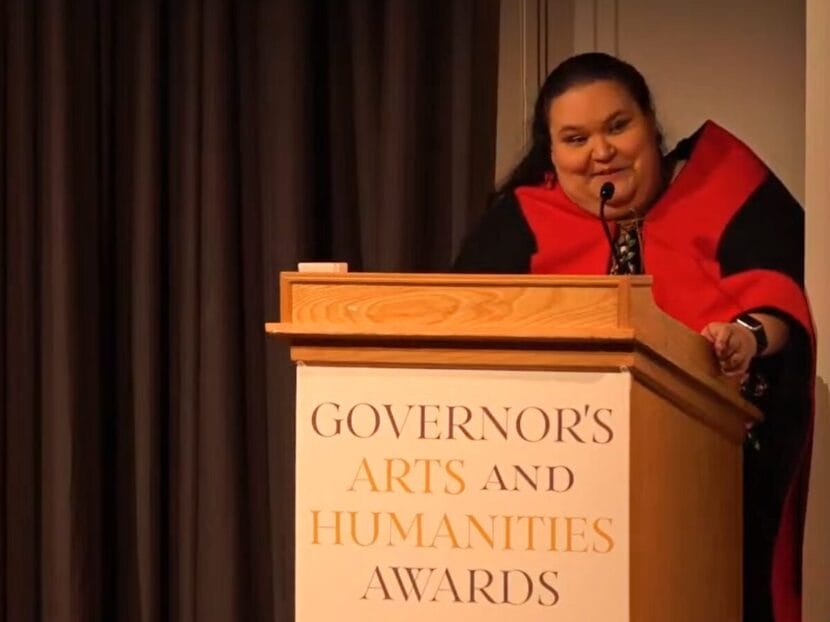
Also being honored Tuesday was the new state writer laureate Vera Starbard, a Lingít playwright, magazine editor and TV writer based in Juneau. She will serve two years in the role, traveling around the state to promote the literary arts.
State Writer Laureate Vera Starbard speaks during the Governor’s Arts and Humanities Awards in Anchorage on Oct. 29, 2024. (Screenshot from YouTube)
Accepting her award, Starbard said she was honored to be recognized for sharing the everyday stories of Alaskans.
“I see much of my job now as translator, and taking this state, and this land and these people that I love so much, and figuring out how to turn that into bite-sized pieces for an outside world that can learn from us,” she said. “Your stories are not only valid, they are needed.”
Another Juneau resident created the awards for the ceremony. Master Chilkat weaver Lily Hope wove a Ravenstail dancing blanket that was divided up among the awardees, symbolizing reciprocity and interwoven identities.
“When a Chilkat dancing blanket is cut up and given away to dignitaries, this communicates the valuable relationship acknowledged by the receivers, who treasure their small part of the whole in a cultural cycle of reciprocity,” Hope said in a video shared on Instagram.
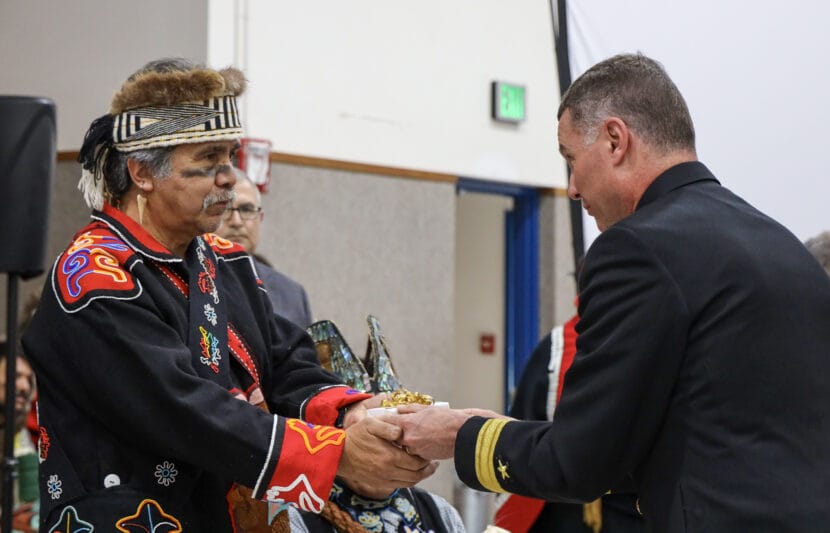
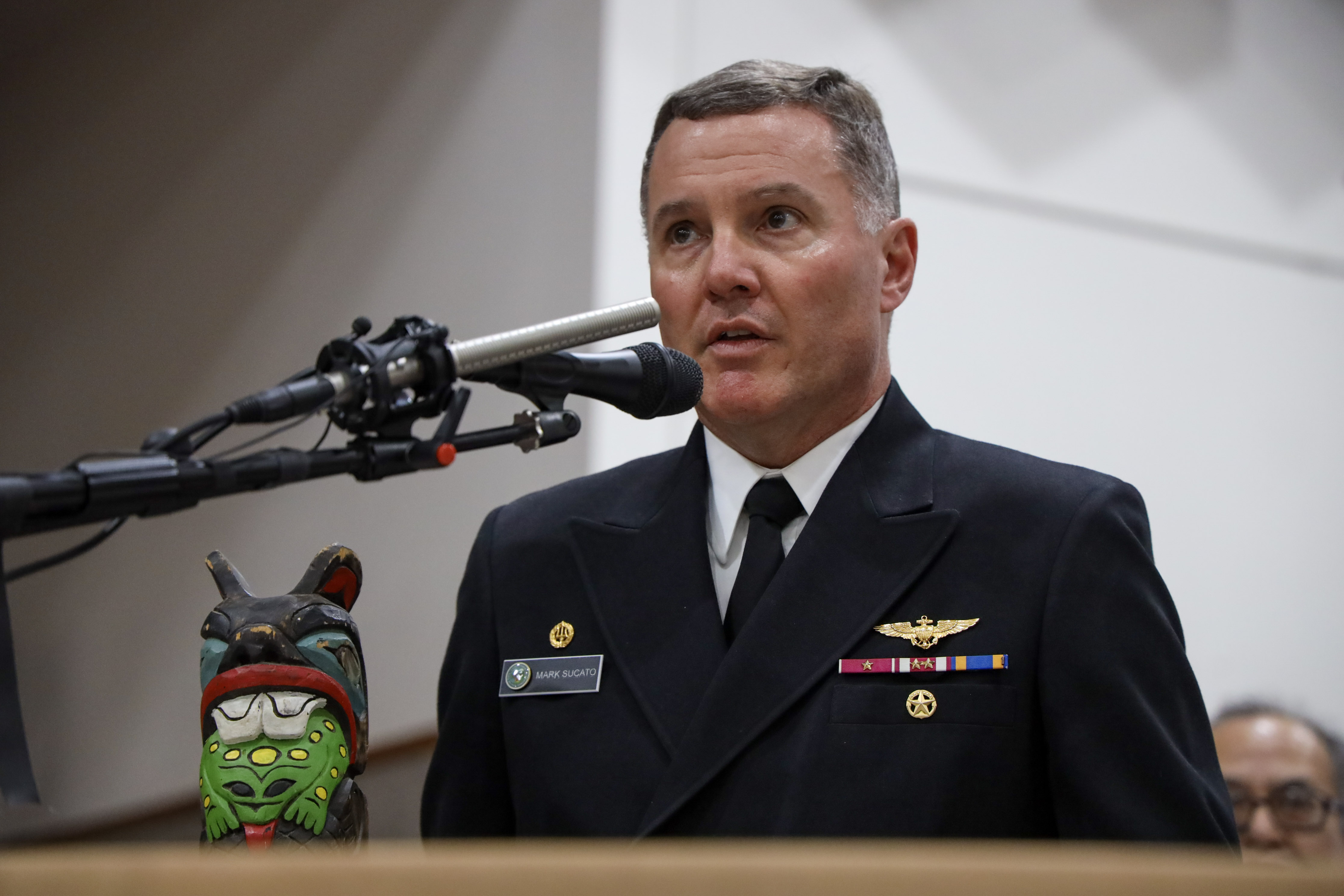
Rear Adm. Mark Sucato offers a gift to Joe Zuboff in Angoon on Saturday, Oct. 26, 2024. (Clarise Larson/KTOO)
142 years ago, Angoon went up in flames.
On Oct. 26, 1882, the U.S. Navy bombarded the Lingít village on Admiralty Island, destroying clan houses, food caches, 40 canoes, and leaving the community for dead.
But the community of Angoon didn’t die. And, for decades, they’ve been asking for an apology from the federal government.
On Saturday, close to a century-and-a-half after the horrific shelling, that apology finally came.
Listen:
X’ash Kugé ka Yaanasax Barbara Cadiente-Nelson’s grandmother survived the bombardment as a young woman.
“Can you imagine my grandmother, at 26, having to scramble and run with her family?” she said Saturday at the apology ceremony in Angoon. “And the fear, the real fear.”
According to written accounts of villagers who survived the bombardment, it all started because a Lingít shaman for the community was killed in a whaling accident.
U.S. government documents at the time claimed other Lingít villagers took two of the white whaling crew as prisoners, and demanded compensation of 200 blankets from the whaling company. Lingít accounts deny that prisoners were taken.
Then the Navy got involved. They said the village wasn’t owed anything, and in fact would be fined 400 blankets for taking prisoners.
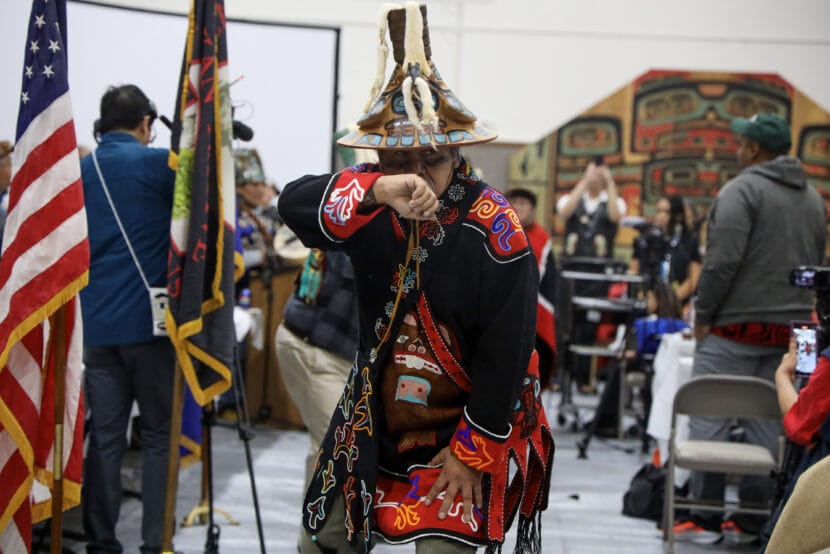
Joe Zuboff dances during the official Navy apology for the 1882 bombardment of Angoon. Saturday, Oct. 26, 2024. (Clarise Larson/KTOO)
“They scrambled to come up with blankets at the onset of winter. What were they going to do without blankets themselves?” Cadiente-Nelson said.
They only delivered about 80. As a result, the Navy attacked. Six children were killed in the shelling and an unknown number of others died in the following months from exposure and starvation.
Since the 1980s, representatives from Angoon have been asking for an apology. In June, the Navy announced they would issue one. They planned it with Angoon elders for the anniversary of the attack on Saturday.
The destruction of Angoon led Cadiente-Nelsonʼs grandmother to move to Juneau, about 50 miles away. Her kids were later sent to boarding school, where they weren’t allowed to speak Lingít.
Cadiente-Nelson said Angoon holds an annual memorial for the children killed during the bombardment. And every year, leaders ask those in attendance if anyone from the Navy is there to make an apology.
“And there was no reply. Today, it appears there will be a reply,” she said.
Though it’s a long time coming, Cadiente-Nelson said many in the community have mixed emotions about the apology.
“How do you restore a human being, how do you restore a family?” she said. “How do you restore a community who have been the target of annihilation?”
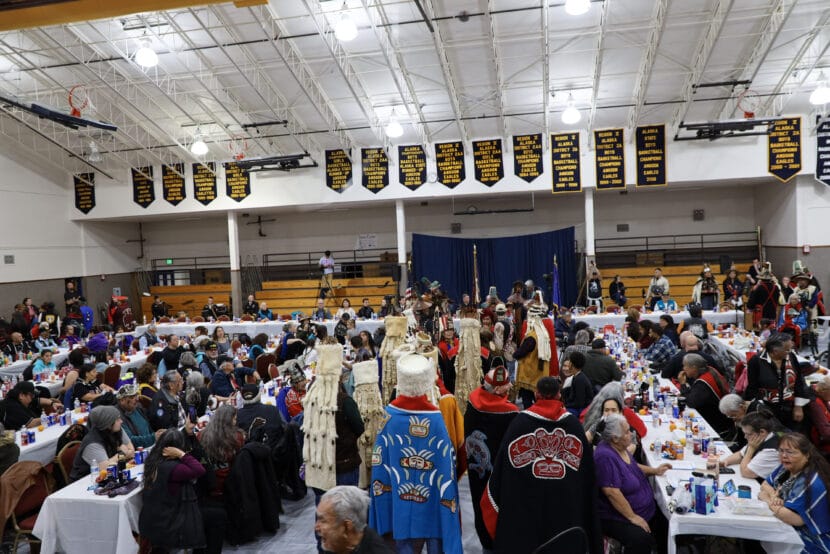
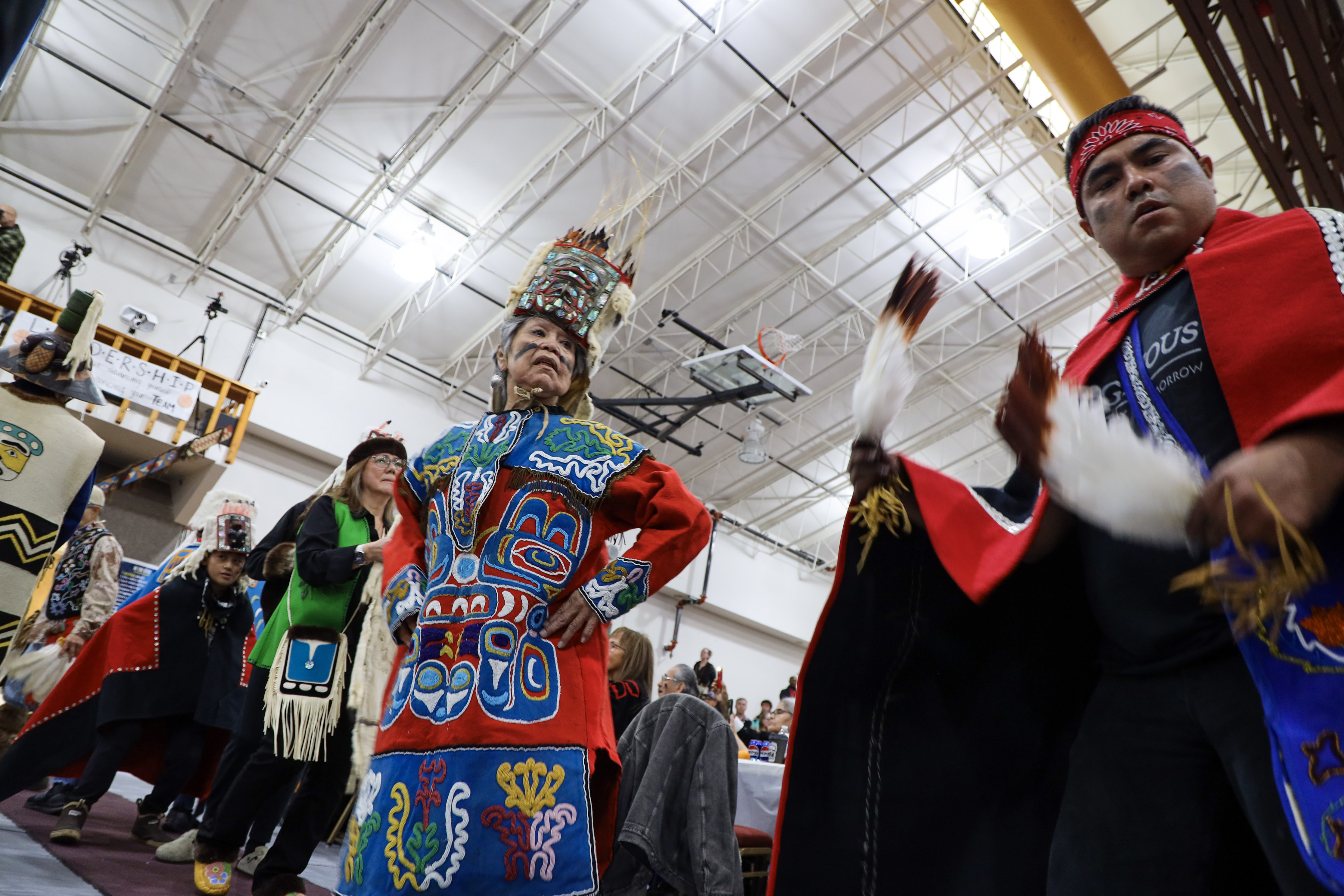
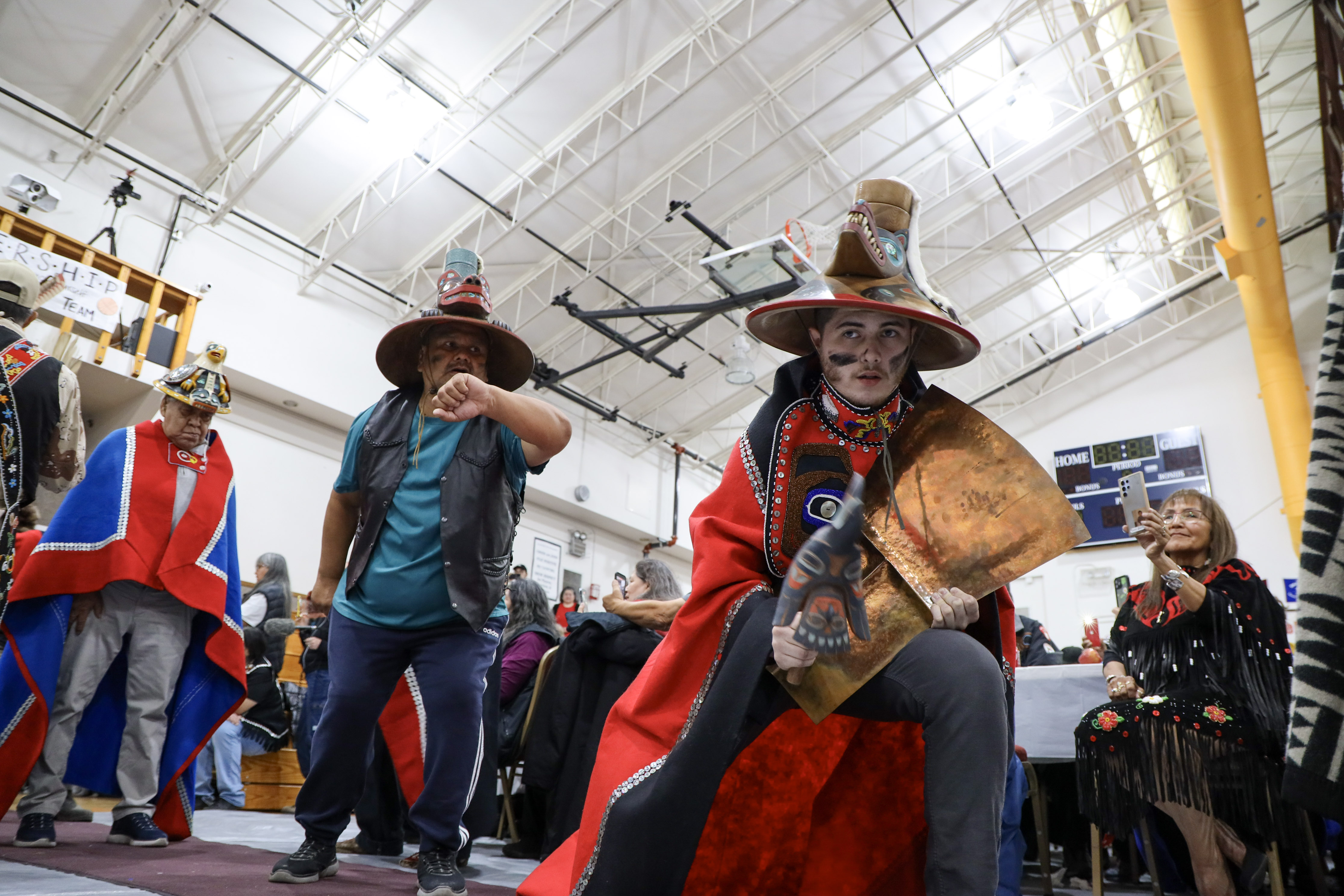
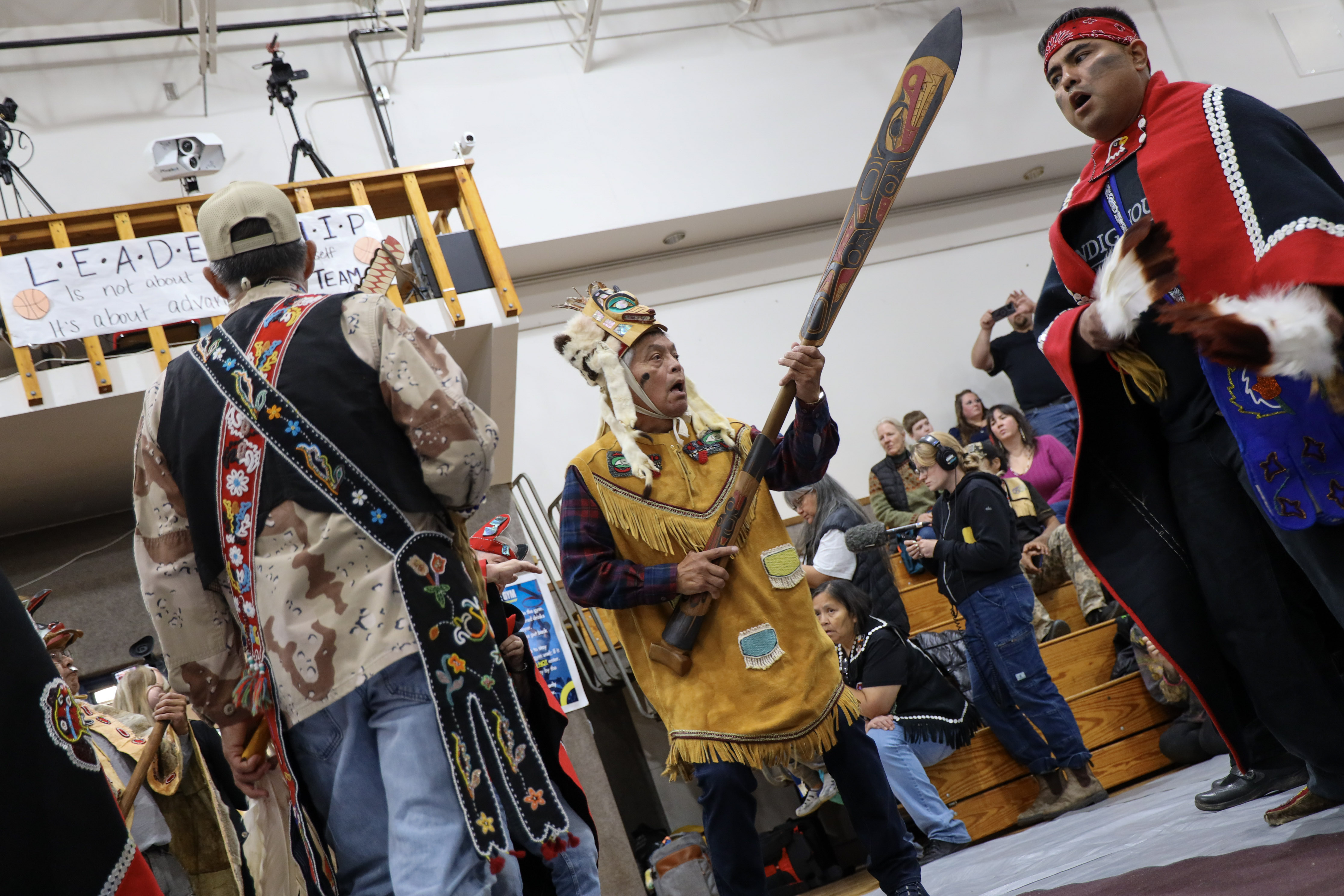
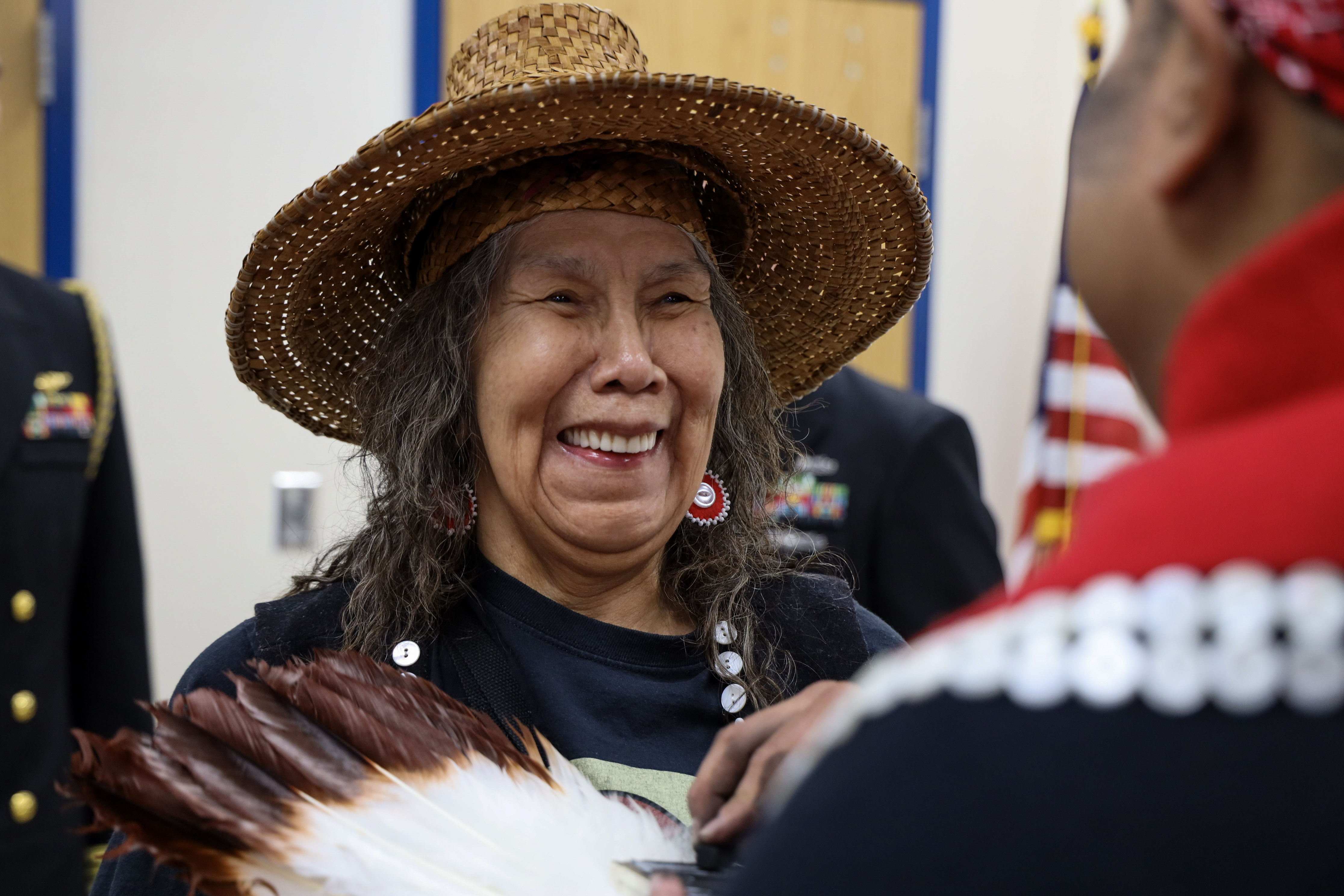
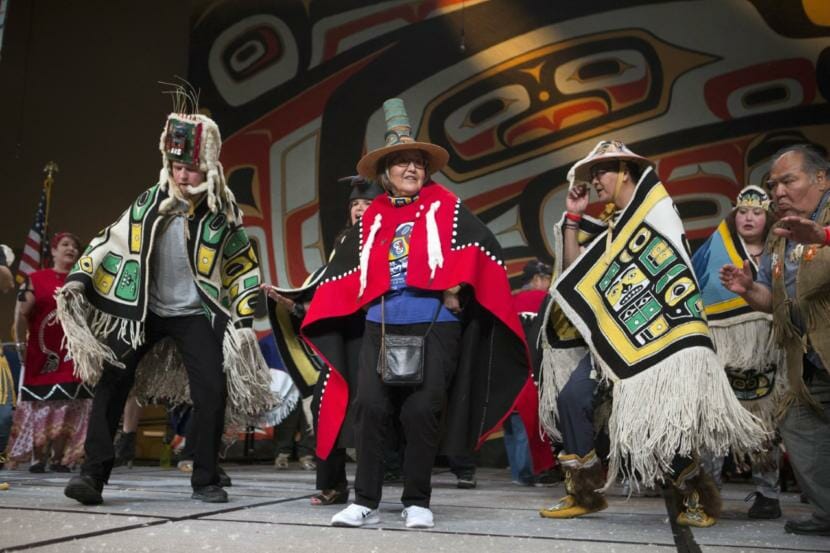
On Saturday, Lingít people from all over Southeast Alaska and beyond gathered in the Angoon High School gym to receive the apology. They danced in wearing regalia – button blankets, carved formline hats featuring bears, frogs, wolves and killer whales, with mother-of-pearl eyes and ermine pelt adornments.
Dancers enter during the official Navy apology for the 1882 bombardment of Angoon. Saturday, Oct. 26, 2024. (Clarise Larson/KTOO)
U.S. Navy Rear Admiral Mark Sucato presented the apology to hundreds in the room and the thousands watching on a livestream.
“The United States Navy … apologizes on behalf of the United States Navy to all the Lingít peoples of Angoon for the pain, suffering and generational trauma inflicted by the bombardment of their village, acknowledges that the Lingít people of Angoon did not deserve nor provoke the bombardment and subsequent destruction of their village by US Naval forces,” he read.
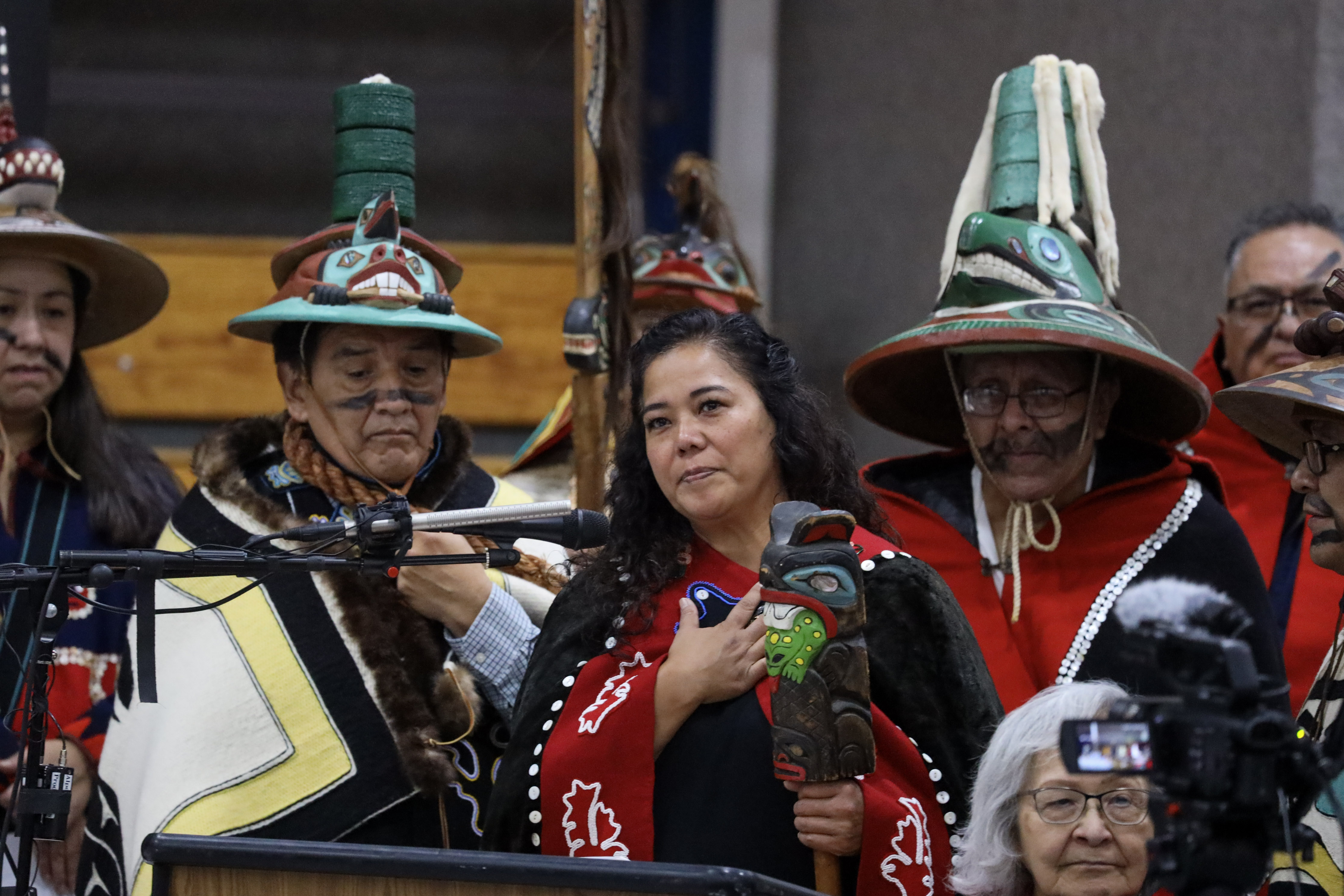
The gym filled with applause. One by one, starting with Deisheetaan leader Dan Johnson, Jr., clan elders responded to Admiral Sucato’s apology.
“None of us in this room will ever forget. We will take it to our graves, we will teach it to our children,” Johnson said. “For our house, we accept the apology that you’ve provided.”
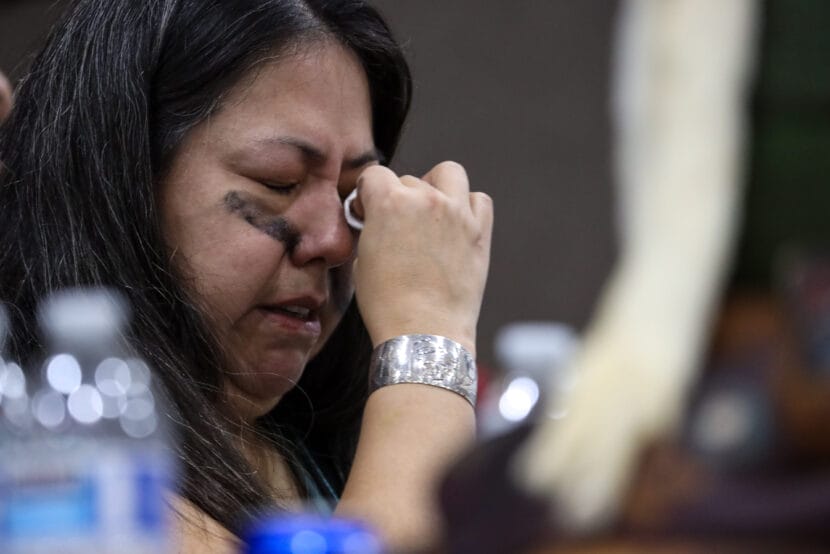
Shgendootan George grew up with this story. She taught in Angoon for years and would teach her students about the shelling and burning of their village.
Shgendootan George cries during the official Navy apology for the 1882 bombardment of Angoon. Saturday, Oct. 26, 2024. (Clarise Larson/KTOO)
Apologies like this — that take ownership of colonial violence without justifications — confirm the true history of this story. And George said she was excited to teach this part of the history now, too.
“It doesn’t matter how many times I talk about it and how many times I talk with students about what happens like every time I tear up, like the emotions never go away and that feeling of injustice and disrespect, it’s gonna be amazing to be able to say the right thing happened, finally,” she said.
The celebration lasted into the early morning hours on Sunday.
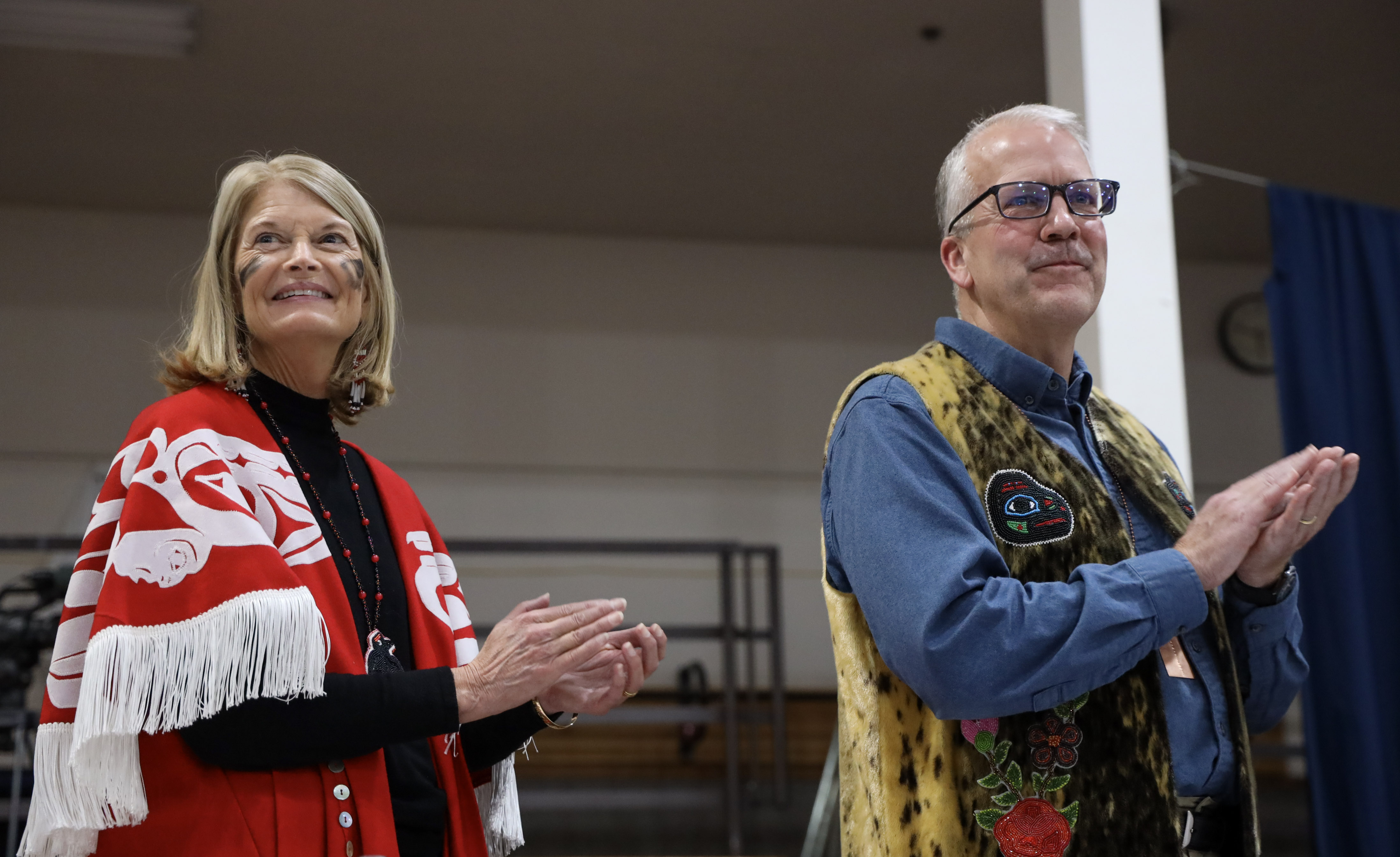
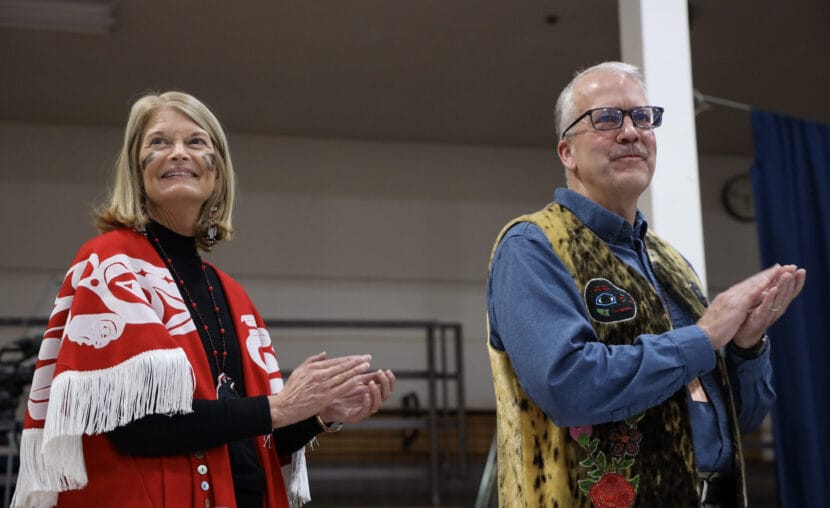
U.S. Sen. Lisa Murkowski and Sen. Dan Sullivan clap during a speech in Angoon on Saturday, Oct. 26, 2024. (Clarise Larson/KTOO)
Angoon School Principal Emma Demmert gives a speech during the official Navy apology for the 1882 bombardment of Angoon. Saturday, Oct. 26, 2024. (Clarise Larson/KTOO)
Dancers enter during the official Navy apology for the 1882 bombardment of Angoon. Saturday, Oct. 26, 2024. (Clarise Larson/KTOO)
Dancers enter during the official Navy apology for the 1882 bombardment of Angoon. Saturday, Oct. 26, 2024. (Clarise Larson/KTOO)
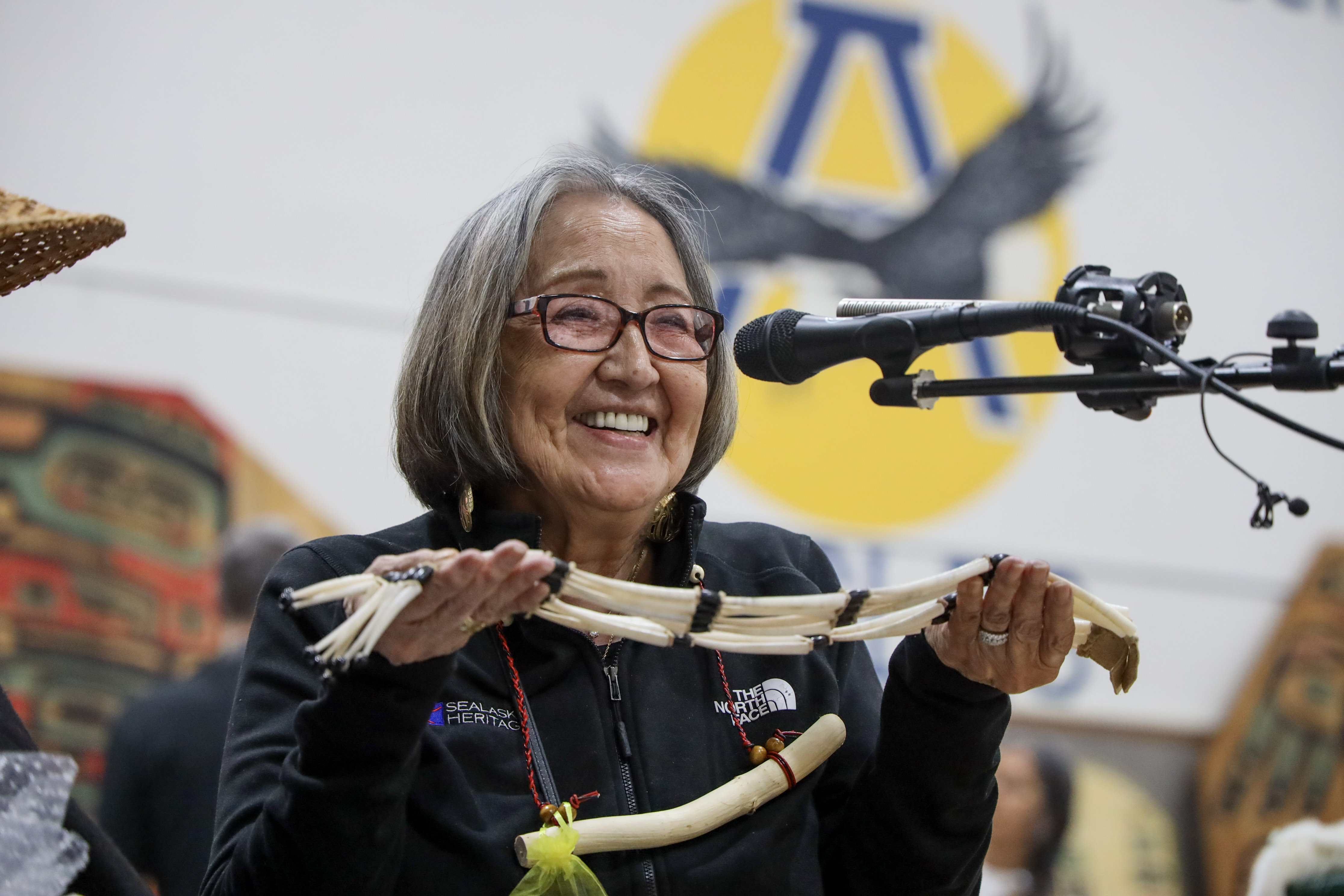
Sealaska Heritage Institute President Kaaháni Rosita Worl gives a speech during the official Navy apology for the 1882 bombardment of Angoon. Saturday, Oct. 26, 2024. (Clarise Larson/KTOO)
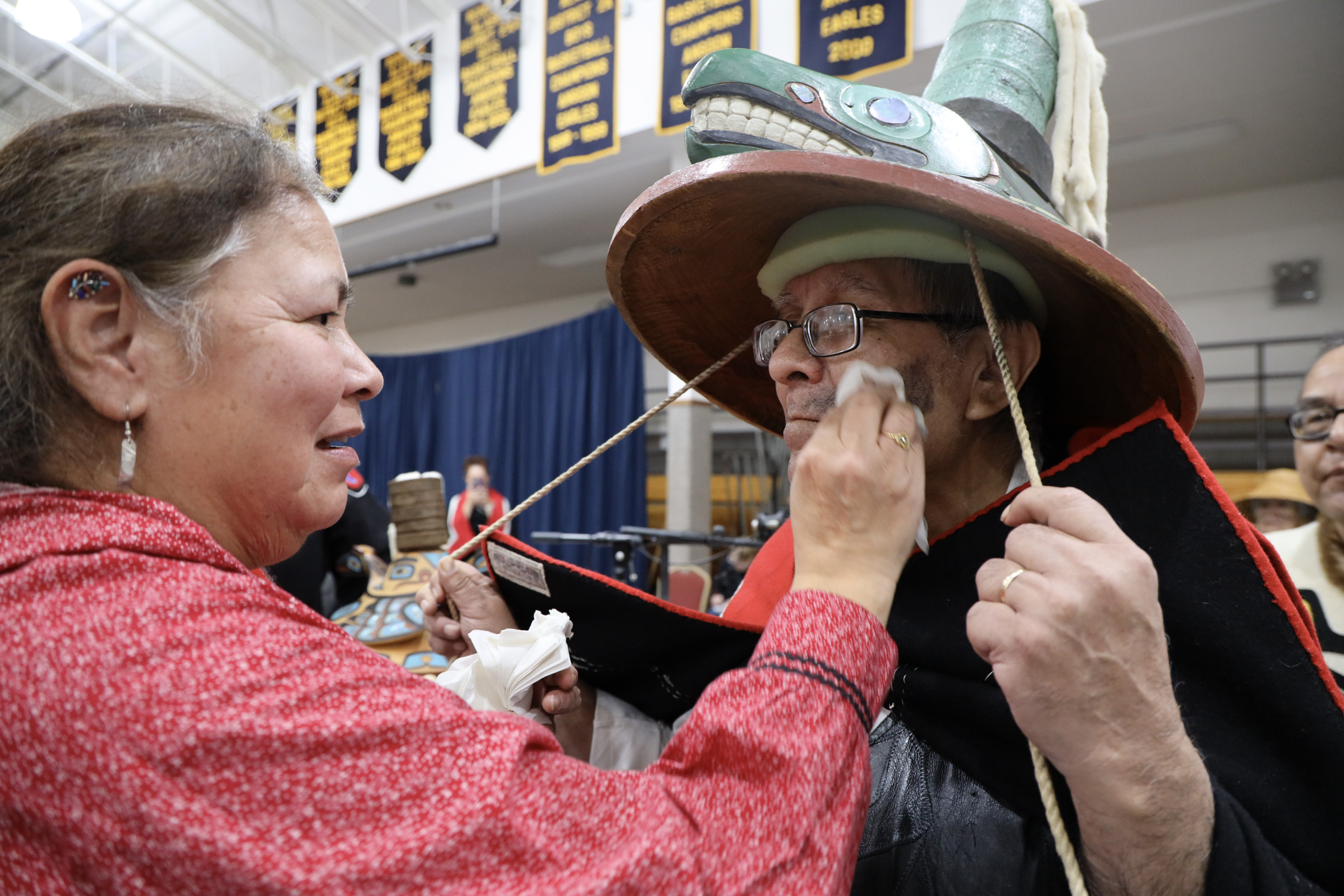
Alan Zuboff gets paint wiped from his face. The paint signifies sorrow, and was wiped off after the apology was given on Saturday, Oct. 26, 2024. (Photo by Clarise Larson/KTOO)
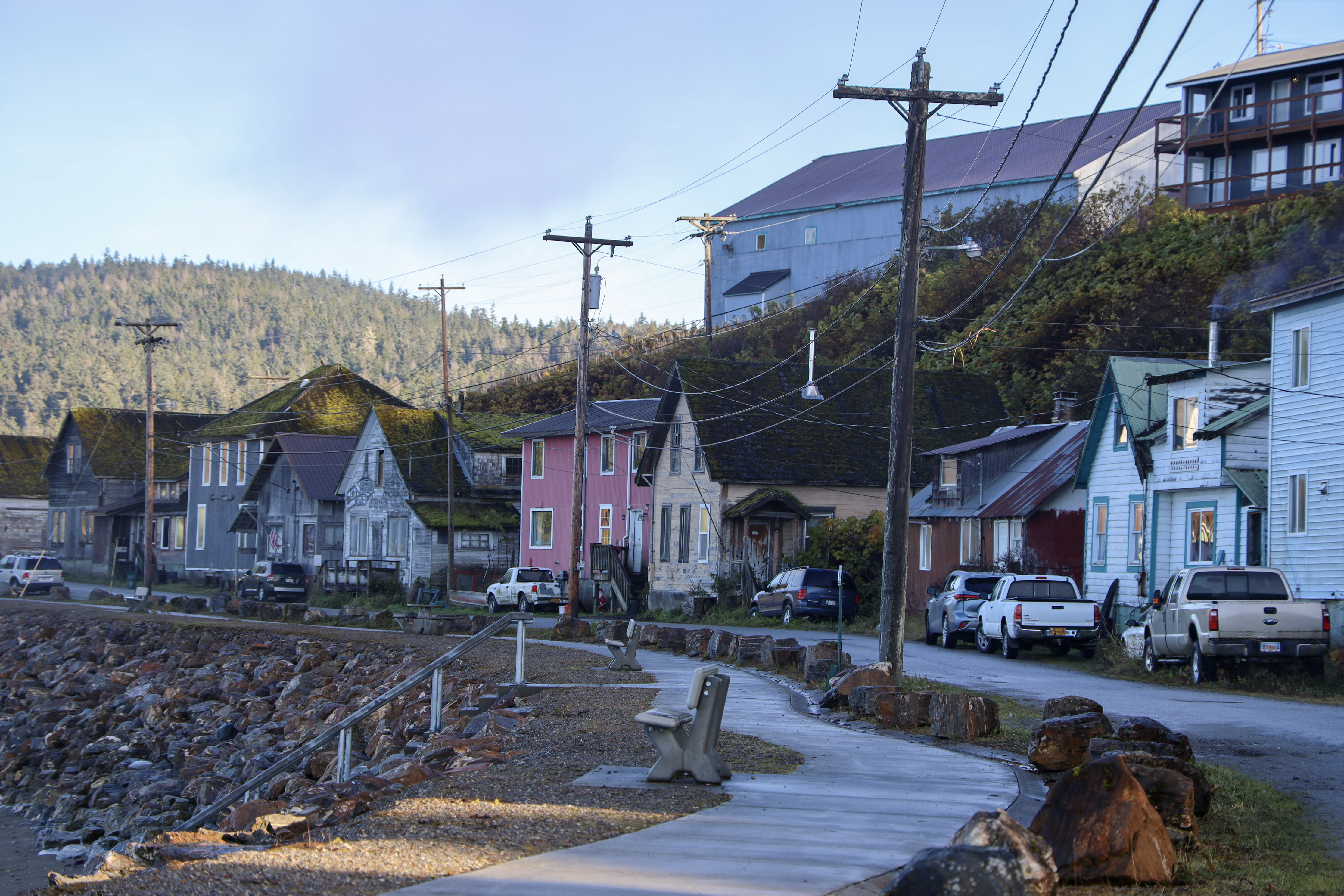
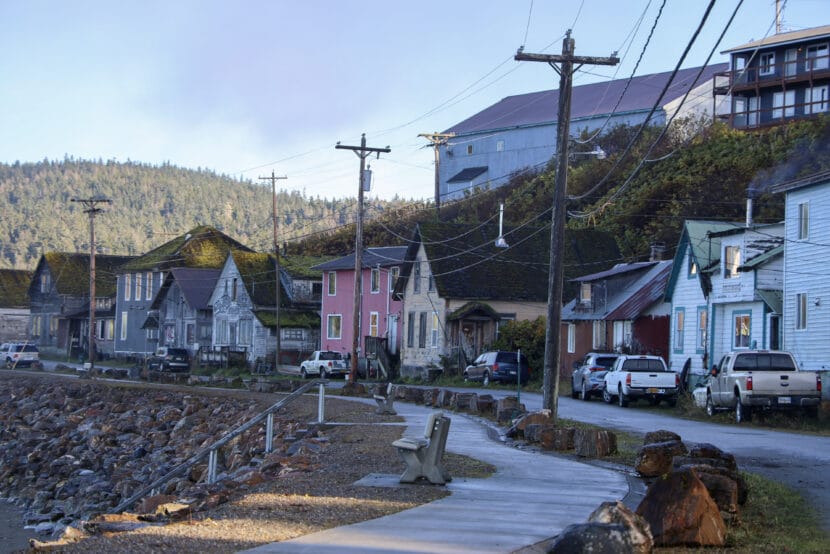
Angoon on Sunday, Oct. 27, 2024. (Clarise Larson/KTOO)
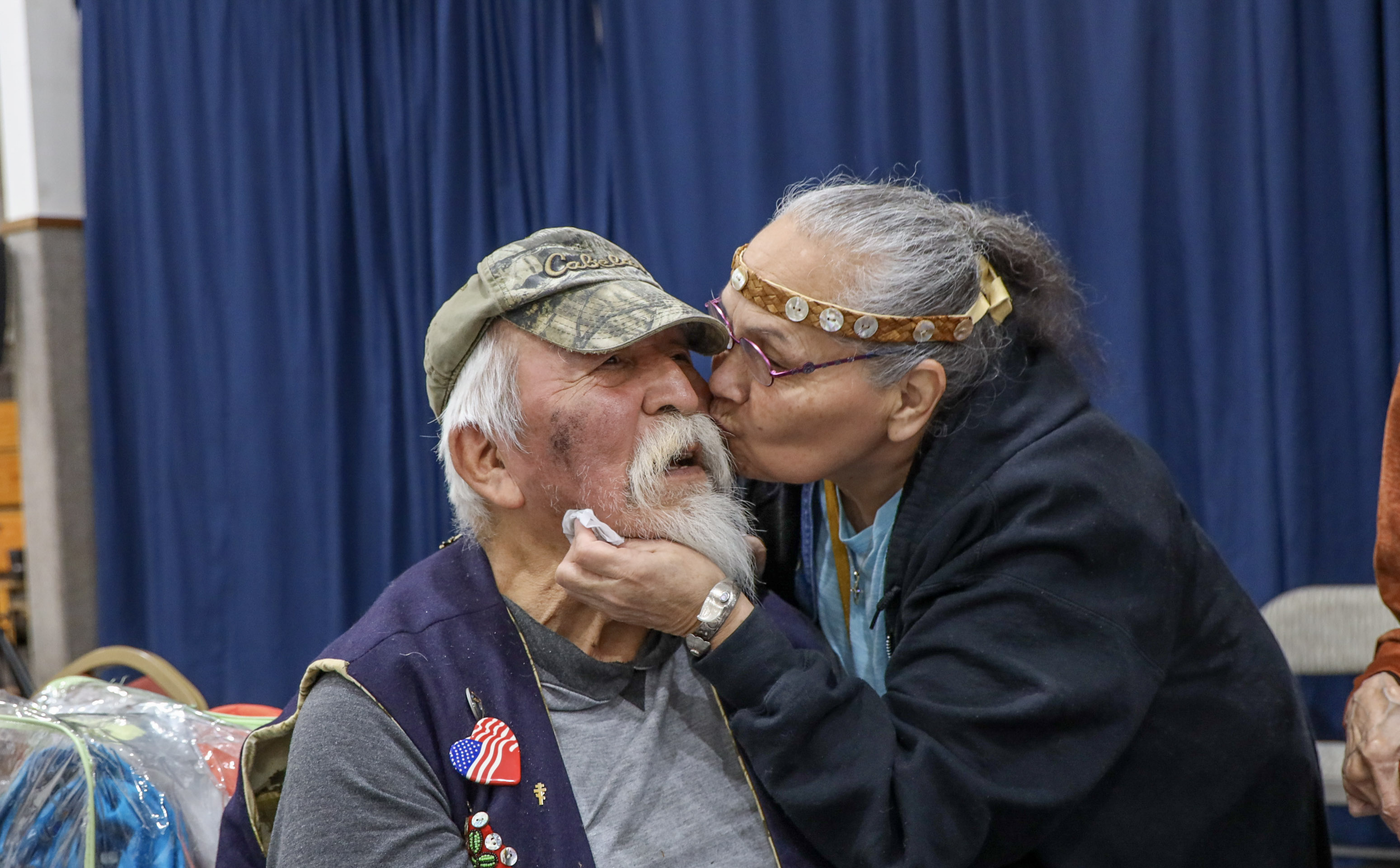
Daphne Demmert kisses her husband, Leonard Demmert, while wiping off paint from his face. The paint signifies sorrow, and was wiped off after the apology was given on Saturday, Oct. 26, 2024. (Photo by Clarise Larson/KTOO)
Dancers enter during the official Navy apology for the 1882 bombardment of Angoon. Saturday, Oct. 26, 2024. (Clarise Larson/KTOO)
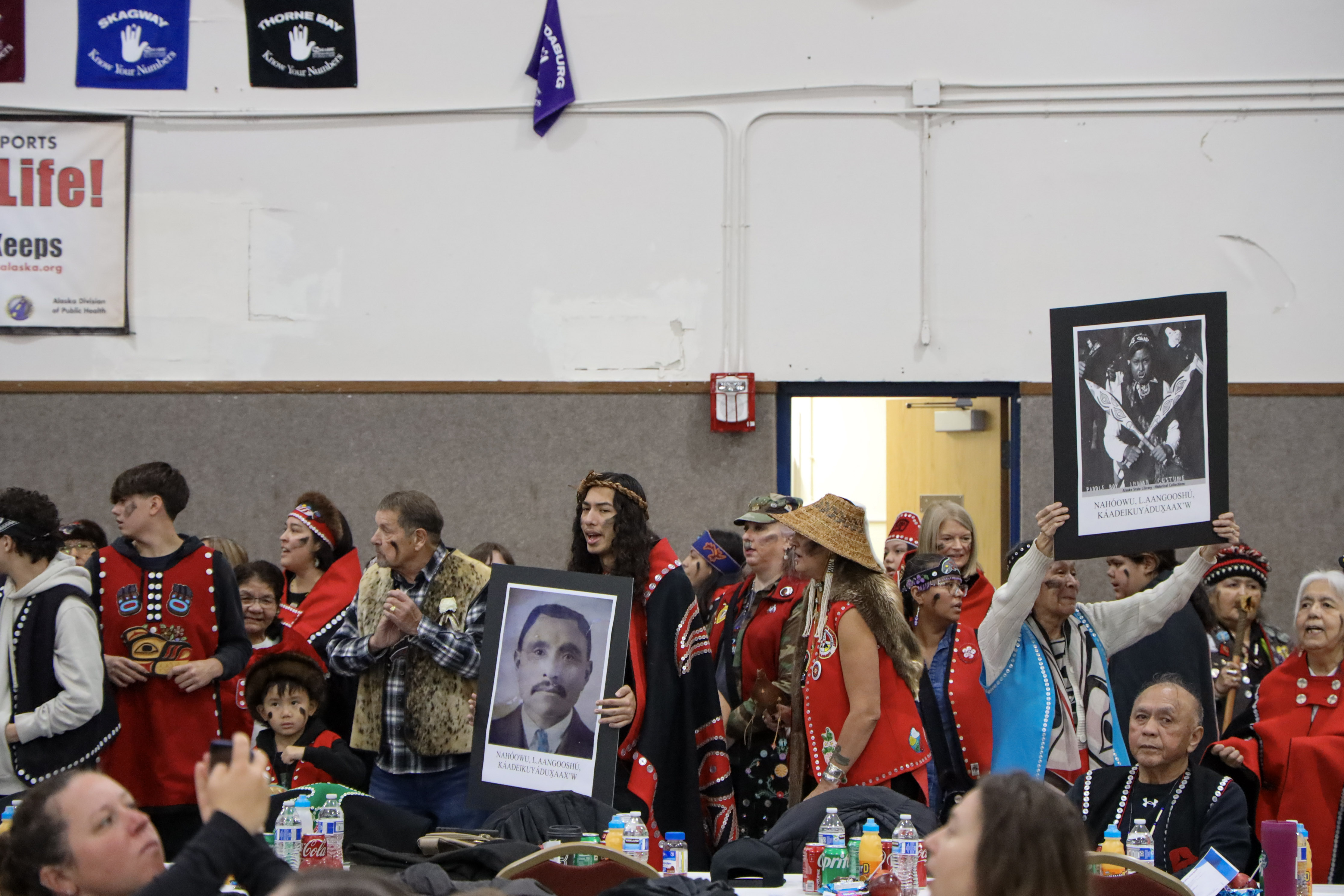
Dancers hold signs with photos of survivors of the 1882 bombardment of Angoon on Saturday, Oct. 26, 2024. (Clarise Larson/KTOO)
Rear Adm. Mark Sucato, commander of Navy Region Northwest, offers an apology for the 1882 bombardment of Angoon. Saturday, Oct. 26, 2024. (Clarise Larson/KTOO)
Genevieve Guanzon smiles while paint is applied to her face. The paint signifies sorrow, and was wiped off after the apology was given on Saturday, Oct. 26, 2024. (Photo by Clarise Larson/KTOO)
Watch Sealaska Heritage Institute’s recording of the event here:
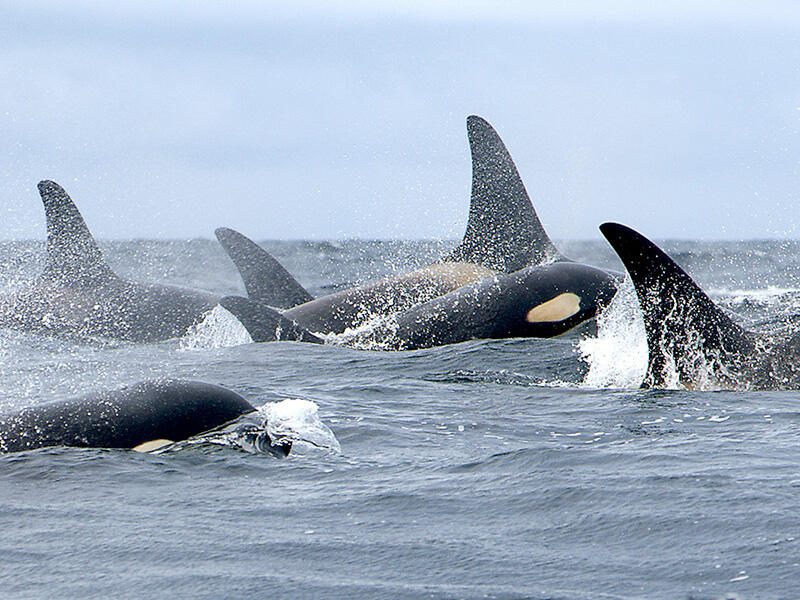
The population of endangered southern resident killer whales has dwindled to 76 individuals. (Holly Fearnbach/NOAA)
This is Lingít Word of the Week. Each week, we feature a Lingít word voiced by master speakers. Lingít has been spoken throughout present-day Southeast Alaska and parts of Canada for over 10,000 years.
Gunalchéesh to X̱’unei Lance Twitchell, Goldbelt Heritage Foundation and the University of Alaska Southeast for sharing the recorded audio for this series.
This week’s word is kéet, or killer whale. Listen to the audio below to learn how to say kéet.
The following transcript is meant to help illustrate the words and sentences.
Keihéenák’w John Martin:kéet.
That means killer whale.
Here are some sentences.
Keihéenák’w John Martin: Haa saani has áyá kéet ḵwáan.
Our paternal uncles are killer whale people.
Keiyishí Bessie Cooley: Naanya.aayí has du at.óowu áwé wé kéet
The killer whale is the at.óow of the Naanya.aayí
Ḵaakal.áat Florence Marks Sheakley: At.óowx̱ sitee yá kéet.
The killer whale is at.óow.
Kaxwaan Éesh George Davis: Kéet haa yinaadé yaa yanagwéin
Killer whales were traveling toward us.
You can hear each installment of Lingít Word of the Week on the radio throughout the week.
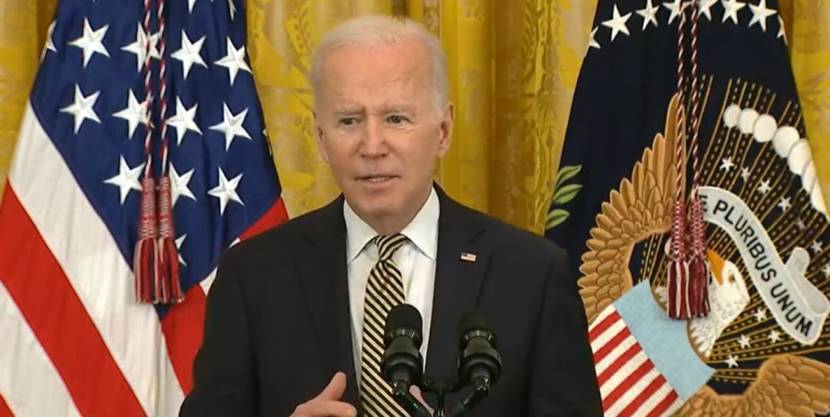
President Joe Biden delivers remarks on Wednesday, March 16, 2022, on the reauthorization of the Violence Against Women Act. (Image from C-SPAN)
President Biden is expected to issue a formal apology for the federal government’s Native American boarding schools during a visit to Arizona on Friday, according to the governor of a Native American tribe.
Gila River Indian Community Gov. Stephen Roe Lewis told NPR that the formal apology is coming as part of Biden’s first official visit to an Indigenous community as president.
Biden’s message would be the first public apology from a sitting U.S. president in response to a federal policy that wreaked havoc on tribal communities.
Biden is expected to visit Gila Crossing Community School to issue his formal apology, Lewis said. The apology was confirmed by a person familiar with the White House’s thinking who wasn’t authorized to speak publicly about the announcement yet.
Also traveling with the president is Interior Secretary Deb Haaland, who has also visited the tribe as a part of her “Road to Healing” tour aimed at giving survivors “the opportunity to share with the federal government their experiences in federal Indian boarding schools for the first time.”
The Interior Department earlier this year released a report that confirmed at least 973 American Indian, Alaska Native and Native Hawaiian children died while attending boarding schools in the system.
“This is going to really start the healing and the reconciliation and the redeeming of this sad part of history, not only for the boarding school survivors. A significant, very important part of this apology is admitting that this happened,” Lewis said in an interview ahead of the trip, where he is expected to travel with Biden on Air Force One.
Lewis said the visit comes full circle after Vice President Harris also paid a visit to the community earlier this month.
“There’s going to be a sense of redemption, of confirmation, of what these boarding school survivors have been through,” he said.
Between 1819 and 1969, the federal government operated more than 400 boarding schools across the country and provided support for more than 1,000 others, according to the Interior department’s investigation. The goal was complete cultural assimilation.
Rodney Butler, the chairman of the Mashantucket Pequot Tribal Nation, Mark Macarro, president of the National Congress of American Indians and chairman of the Pechanga Band of Luiseño Indians, and Whitney Gravelle, chairwoman of the Bay Mills Indian Community, are also expected to fly with Biden to Arizona for the visit.
“It’s almost like we’re bringing him — we literally are bringing President Biden, flying with him, bringing him to Indian Country, bringing him to my community,” Lewis said. “This is the last leg of this journey to healing as part of President Biden’s administration.”
The landmark visit by the president, which comes less than two weeks before Election Day, fulfills a promise Biden made to tribal leaders two years ago.
“I’ve spent a lot of time in Indian Country as a senator and vice president. But I can say here today I intend to make official presidential visits to Indian Country to make it official,” Biden said during the 2022 tribal summit at the White House.
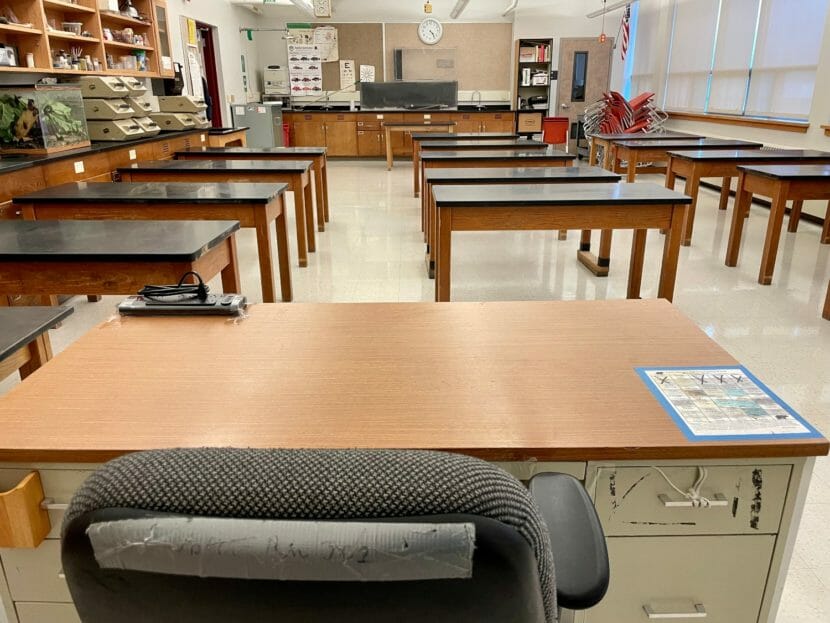
An empty classroom at Juneau-Douglas High School: Yadaa.at Kalé in Juneau on July 20, 2022. (Photo by Lisa Phu/Alaska Beacon)
Twenty-three Alaska Native languages have been recognized alongside English as official Alaska state languages for a decade, but until this month there was no measure by which its schools could gauge reading competency in them.
A group of Alaska Native educators developed reading standards for Alaska Native languages and presented them to the Alaska Board of Education and Early Development on Oct. 9. It is now up to the board and Gov. Mike Dunleavy to decide whether or not to implement the new standards, which would allow Alaska Native languages to satisfy the state’s reading requirements.
The change would be a step towards parity for Alaska Native languages with the English language in the state’s education system.
Sealaska Heritage Institute, the nonprofit arm of the Alaska Native corporation Sealaska, contracted with TIDES Education Associates to develop the standards for the state.
Nancy Douglas, an educator and curriculum specialist with TIDES, said the standards honor Alaska Native ways of knowing within the state’s school system.
“The goal was to make sure the standards honored our worldview, and that it’s holding up the knowledge students come to school with and learn through,” she said.
To this end, the reading standards emphasize cultural literacy and place-based knowledge through metrics that reflect how Alaska Native knowledge has been transmitted through oral narrative. Students will be asked to demonstrate the skills of listening, thinking, speaking and understanding in addition to reading text if the standards are adopted.
The standards are a metric by which to gauge literacy in nearly two dozen distinct languages.
Jamie Shanley, an early childhood educator and assistant director of education at SHI, said the reading standards are meaningful in an historical context because of the state’s recent history of forced assimilation in educational settings.
“Schools have worked to strip Indigenous people of their cultures and languages, and so we have to use schools to be able to support bringing that back to children and families,” she said.
Sealaska Heritage Institute’s education director, Kristy Ford, said the standards are unique, and they broaden the lens of what can be described as reading. She said the scarcity of expertise means the state should prioritize supporting those educators and their materials.
“In Alaska, these languages are spoken on this land, in those particular communities, and no place else in the world,” she said. “There’s a handful of people that have the skills and the abilities to develop instructional materials to teach the language.”
Shgen George, one of that handful of people as a Lingít educator and curriculum specialist with TIDES Education Associates, said developing the standards was a challenge because it involved translating an Alaska Native worldview in which teaching is very integrated into one where reading is its own discrete skill.
“Asking us to kind of take everything apart and parcel it out and just pull out reading…I felt like it was counterintuitive to our worldview,” she said.
“I think it’s just another example of Indigenous genius, adapting and survival, really, to hold our children up.”
Rosita Worl, president of Sealaska Heritage Institute, center, dancing with her fellow Thunderbird dancers. (Photo courtesy of Brian Wallace)
A longstanding Indigenous leader from Juneau was honored at the White House on Monday, along with other Americans who have impacted the nation’s culture for the better.
Sealaska Heritage Institute President Kaaháni Rosita Worl was one of 10 Americans to receive the 2023 National Humanities Medal from President Joe Biden Monday afternoon.
Other honorees included the late chef and author Anthony Bourdain and literacy advocate and actor LeVar Burton.
“Each of you has helped us venture out to see our world with clarity, empathy and courage. Thank you and congratulations,” First Lady Jill Biden said, opening the ceremony.
Worl – who is Lingít – wore a yellow Chilkat robe to the ceremony. She stood out in a sea of blue, black and gray suits.
Worl is 87 years old and has led SHI’s mission to bolster Southeast Alaska Native languages and arts for nearly 30 years.
She served as the chair of the Native American Graves Protection and Repatriation Act National Review Committee in the early 2000s and advised revisions to the Alaska Native Claims Settlement Act in the 1980s.
She has advocated for Alaska Native issues at the statewide and national levels.
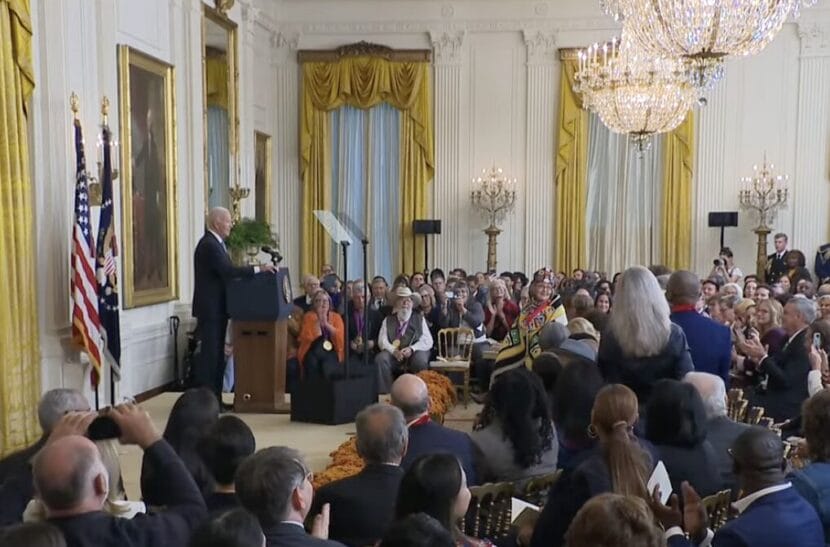
A still from the 2023 National Humanities Medal awards ceremony where SHI President Kaaháni Rosita Worl was recognized on Oct. 21, 2024. (Image courtesy of the White House)
National Endowment for the Humanities Chair Shelly C. Lowe, a member of the Navajo Nation, introduced President Biden and pointed to the Indigenous representation in the room and in the Biden administration.
“It is now my distinct honor to introduce a man who ensured that when I came into my position, there were others who looked like me, other Native voices, other Native individuals who were leading us and who are making the administration do what we needed to do,” Lowe said.
Worl was one of four Indigenous awardees recognized for their achievements during the ceremony. The others included “Braiding Sweetgrass” author Robin Wall Kimmerer, poet Joy Harjo and educator Robert Martin.
President Biden said during the ceremony that all of today’s recipients helped bring America into a better future.
“You have broken barriers. You blazed new trails, you redefined culture,” Biden said. “You’re the truth tellers, the bridge builders, the change seekers, and above all you’re the masters of your craft who have made us a better America for all you’ve done.”
Worl is one of 207 Americans that have received the medal. In a statement, she credited her mother, Bessie Quinto, for inspiring her life’s work.
“She devoted her whole life as a union organizer to secure economic equity for our people, among many other things,” Worl said in the release.
Close
Update notification options
Subscribe to notifications
Subscribe
Get notifications about news related to the topics you care about. You can unsubscribe anytime.