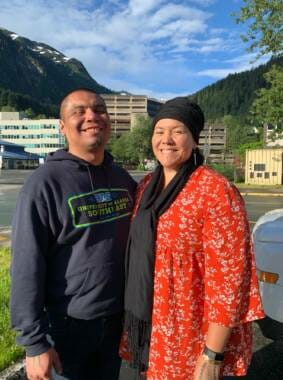
Dak júus Rob Yates teaches X̱aad Kíl, the language of the Haida people. Courtesy of Dak júus Rob Yates
This is Tongass Voices, a series from KTOO sharing weekly perspectives from the homelands of the Áak’w Kwáan and beyond.
Dak júus Rob Yates teaches the language of the Haida people, X̱aad Kíl.
According to the most recent statewide report, there is only one person alive who has spoken X̱aad Kíl since birth. There are two other highly proficient speakers. Yates says he isn’t one of them yet, but he’s still working to breathe life into the language.
Yates has moved several times to do this work. Now, he lives in Craig and has been concurrently learning and teaching the language for nearly a decade.
Listen:
This transcript has been lightly edited for clarity.
Dak júus Rob Yates: I think it’s a really rewarding journey. I think it’s a healing journey. For me. It never gets boring, because there’s so much to learn. So I get excited each time I find out something new. It’s kind of like Christmas, getting something new.
Rob Yates hín uu díi kya’áang. My name is Rob Yates. Dak júus hín uu X̱aad Kíl díi kya’áang. My Haida name is Dak júus. It literally means small shrimp.
I think in 2014 when I got the dictionary of Alaskan Haida and then the Alaskan Haida phrase book came out. And then some of us started teaching ourselves. Then in 2016 I started UAS college courses.
I became homeless for a short time. Along came this Our Language Pathways Program by [Sealaska Heritage Institute] where they wanted Lingit Haidas and Tsimshian to learn their languages and become teachers. One of my distant relatives in Juneau, I reached out to her, and she’s like, “This program is, it’s like it’s tailor made for you.” So I took it serious, and that summer, I started building up curriculum. The requirement was that you had to live in Juneau on the [University of Alaska Southeast] campus.
I remember it was a Friday, and I was supposed to have gone to a meeting in the evening to discuss who was gonna teach X̱aad Kíl at UAS as a fill in, and I forgot, and I lay down and took a nap, and then I woke up to all these texts messages that I was the new teacher.
And the class was three hours long, so it was quite the challenge, and I was a full time student as well. I am back at UAS teaching Beginning Haida, Intermediate Haida and Advanced Haida curriculum development.
Here again, I find myself transitioning from teacher to student. No, I don’t get the college credit of the Intermediate Haida class that I was taking because I’m now the teacher, and so I don’t get those credits at all. But one of my colleagues said, “You’re going to be so busy teaching that you may not ever get a bachelor’s degree.” It rings more true now, two and a half years later.
The phrase is X̱íinaag ‘láa uu íijang, “life is good,” but it also goes deeper than that, like “life is precious.” “Live your life to the fullest,” type of thing. Whenever I say that phrase, it’s like I could feel the positivity and that they are not empty words, that the words ring true.
You can sign up for Yates’ ongoing December X̱aad Kíl class here.
A seagull, or kéidladi, in Glacier Bay National Park in July 2023. (Photo by Clarise Larson/KTOO)
This is Lingít Word of the Week. Each week, we feature a Lingít word voiced by master speakers. Lingít has been spoken throughout present-day Southeast Alaska and parts of Canada for over 10,000 years.
Gunalchéesh to X̱’unei Lance Twitchell, Goldbelt Heritage Foundation and the University of Alaska Southeast for sharing the recorded audio for this series.
This week’s word is kéidladi, or seagull. Listen to the audio below to learn how to say kéidladi.
The following transcript is meant to help illustrate the words and sentences.
The moon shines through clouds to illuminate trees on Mt. Roberts in Juneau on Nov. 14, 2024. (Photo by Eric Stone)
This is Lingít Word of the Week. Each week, we feature a Lingít word voiced by master speakers. Lingít has been spoken throughout present-day Southeast Alaska and parts of Canada for over 10,000 years.
Gunalchéesh to X̱’unei Lance Twitchell, Goldbelt Heritage Foundation and the University of Alaska Southeast for sharing the recorded audio for this series.
This week’s word is dís, which means moon or month. Listen to the audio below to learn how to say dís.
The following transcript is meant to help illustrate the words and sentences.
Keihéenák’w John Martin: dís.
That means moon, or month.
Here are some sentences:
Keihéenák’w John Martin: Dís haa tuwáa kalitéesʼshan.
Moria Johnson-Sidney uses an adze to carve out the inside of a dugout canoe — or yaakw — on Nov. 6, 2024. (Photo by Yvonne Krumrey/KTOO).
This is Tongass Voices, a series from KTOO sharing weekly perspectives from the homelands of the Áak’w Kwáan and beyond.
Earlier this month, we heard from Master Carver Wayne Price and his apprentice Skaydu.û Jules, who are working on a dugout canoe, or yaakw, in Juneau for Goldbelt Heritage Foundation.
Today, we hear from another apprentice: Moria Johnson-Sidney shares how carving has added stability to her life during a tumultuous time.
This transcript has been lightly edited for clarity.
Moria Johnson-Sidney: My name is Moria Johnson-Sidney. I’m a volunteer apprentice carver. This is my first time working on a dugout. My father’s clan is Kaagwaantaan. My family’s from Yakutat and like Klukwan area, my Lingít nickname is G̱ooch Yádi.
This project, and in general, it came into my life at a very delicate time, I guess. So it’s been kind of a stabilizer for me. I’ve lost a lot of family this year. You know, lost a lot to alcoholism, different types of addictions. I’ve had a lot of issues on my own.
And so this carving project, it’s really put things into perspective, I guess. And it’s definitely, like, kind of helped me put myself back together, I guess. But, it’s been really, really special to me.
You know, there’s like — not to get cheesy, I guess. But, you know, some people they start going to church, or like they find God, or they make art, or they make stories. Some people make boats. I guess, just different things to kind of patch up their, you know, smaller parts of their damaged selves.
But I’m from Yakutat. My family is from Yakutat. And they have, they have cultural things here and there. They’re in a celebration. They have the Lingít language in the schools, but they don’t have boats.
So I want to bring dugouts back home. And I definitely have a lot of family that could benefit from it: cousins who are younger than I am, who struggle with alcohol. It starts when you’re like 11, 12, 13. But, yeah, carving kind of found me. I mean, well, Goldbelt kind of kept me in the carving realm ever since I was 15.
Basically, you know, I kind of veer off and get distracted by different things that aren’t really as important, and they always kind of finally bring me back.
Fr. Michael Nicholai pauses to offer the shovel to another clergyman while uncovering the grave of Matushka Olga during the process of her exhumation in Kwethluk on Nov. 16, 2024. (Courtesy Katie Baldwin Basile)
Puffs of feathery snow drifted among the crowd gathered at the cemetery of the St. Nicholas Orthodox Church in Kwethluk on a bitter cold Saturday, Nov. 16. Clergy, Kwethluk residents, and people from as far away as Eastern Europe stood packed between the tight rows of graves, while dogs weaved through the crowd. The people sang a final blessing to St. Olga of Alaska before the task at hand began.
“We’re going to begin now the process of uncovering the relic of a saint,” said Bishop Alexei, the head of the Russian Orthodox Diocese of Sitka and Alaska, wearing a heavy fur-lined robe and holding a golden crozier topped with two serpents.
Bishop Alexei traveled to Kwethluk alongside clergy from across the state. With the blessing of Orthodox faithful from the region, the church is completing the next step in making Olinka “Arrsamquq” Michael, or Matushka Olga, the first female Orthodox saint in North America, and the first-ever Yup’ik saint.
“All of us, I think, must ask in our heart that holy Matushka Olga will help us, will bless us to do this thing which is not done anywhere,” Alexei said.
Fr. Nicholai Larson (third from left) advises his fellow clergymen to dig safely so no one is hurt during the process of uncovering Matushka Olga in Kwethluk on Nov. 16, 2024. (Courtesy Katie Baldwin Basile)
Half a dozen priests huddled under a tarped enclosure and drove steel bars into the frozen tundra where St. Olga was laid to rest 45 years ago. The ground quickly began to crack and peel away to reveal soft, sandy soil that the mid-November frost hadn’t yet touched.
For the entire, hours-long exhumation process, clergy took turns continuously chanting from the Gospels, the biblical account of the life and teachings of Jesus. Others kept a constant supply of incense and charcoal burning, which wafted through the crowd and over the growing hole.
Orthodox disciples from up and down the Kuskokwim and as far away as Slovakia watch as the remains of Olinka Arrsamquq Michael, known as Matushka Olga, are unearthed over several hours in Kwethluk on Nov. 16, 2024. (Courtesy Katie Baldwin Basile)
St. Olga’s granddaughter, Margaret Michael, stood placidly as the pile of dirt grew next to the grave. She said it’s an honor to see her grandmother made a saint, and to hear faraway accounts of her healing powers after her death. But Michael said, for her, St. Olga simply represents the strength and compassion of Yup’ik culture.
“For the most part, Yup’ik people are like how she was. So I thought of her, like, as a normal human being until those people started dreaming about her,” Michael said.
At the graveside, dirt from the grave was carefully packed into Ziploc bags, which were distributed through the crowd and tucked into backpacks and coats. The holy soil will be used as a tool for healing among the people that fill the cemetery and their congregations back home.
It’s been more than 50 years since a saint’s remains were exhumed in Alaska, but soil from St. Herman’s resting place on Spruce Island near Kodiak is still used in the same healing way today.
Dirt from Matushka Olga’s grave, a holy relic to Orthodox disciples that will be used for healing and ceremonial purposes, is carefully packed and distributed throughout the crowd during her exhumation in Kwethluk on Nov. 16, 2024. (Courtesy Katie Baldwin Basile)
At one end of the growing pile, Zoya Ayapan gathered up soil. She said she became sick as a newborn in Kwethluk, and that when she suddenly got well her parents named her after Matushka Olga.
“One of my names is Arrsamquq. I was born like a month before she passed away,” Ayapan said.
Ayapan said that the recognition of St. Olga is a blessing for Kwethluk.
“The stories that I’ve heard of Matushka Olga, she goes to anybody, and I think the healing is for everybody that needs healing,” Ayapan said. “I was talking to Fr. Vasily (Fisher) before all this, and I said, ‘I think Kwethluk is going to be on the map for a good thing this time, you know.’”
Up from the grave
After more than four hours of digging down into the tundra, the splintered wood cover overlaying St. Olga’s metal casket came up from the grave.
The priests fastened ropes to the corners of the casket, just as they were fastened on Nov. 8, 1979, when Matushka Olga was lowered into the ground.
The ropes stretched tight and held fast to the casket as it rose from the grave. Laypeople, priests, and pilgrims who persevered through the bitter cold suddenly began to sing a prayer for mercy in the ancient Church Slavonic language used throughout the Orthodox world.
A crowd of roughly 100 people follow Orthodox clergy as they carry the unearthed remains of Matushka Olga into St. Nicholas Orthodox Church in Kwethluk on Nov. 16, 2024. (Courtesy Katie Baldwin Basile)
There was some anxiety in the air. Despite detailed plans for the first exhumation by the church in Alaska in more than 50 years, it wasn’t clear what the condition of the grave would be, or whether the casket might fall to pieces under its own weight.
But under the bishop’s direction, a dozen priests found a way to carry the casket through the decaying headstones and along the snowy lane leading the short distance to the new church as the crowd followed behind, transfixed.
The priests worked as a team to make a final push up the stairs. As St. Olga’s relics disappeared inside, the church bell triumphantly rang out to announce her arrival.
The crowd was too large to fit inside the St. Nicholas Orthodox Church, and it spilled down the stairs and onto the boardwalk below. Inside, the bishop and priests transferred St. Olga’s relics to a new wood coffin crafted by monastic nuns from California.
When the nave of the church finally opened – more than five hours after the ceremony began – there was no speech or grand exaltation. The mood was solemn. Tears flowed across some of the faces in the crowd.
Matushka Olga’s body is laid to rest in a wooden coffin made by monastic nuns in California and adorned with her image, salmonberries and the words “God is wonderful in his saints” in Kwethluk on Nov. 16, 2024. (Courtesy Katie Baldwin Basile)
The new resting place was adorned with an icon of St. Olga, surrounded by salmonberries. Matushka Olga’s relatives were first in line to kneel and kiss the coffin. The blessings they received from their family member turned saint will soon be shared with pilgrims from across the world.
In June 2025, Bishop Alexei and leaders throughout the Orthodox Church in America will be back in Kwethluk for the final step in making her sainthood official, a process known as glorification.
“This is to allow the larger church to also show their love for blessed Matushka Olga. But the primary service is really for the Yup’ik people who have been so extremely gracious, so very giving,” Alexei said. “Our entire time here, they have literally given everything they have, precisely the way Matushka Olga had taught them.”
The glorification will be unprecedented. But the same can be said for everything that has happened over the past year to the woman and wife of a priest from Kwethluk known as a mother, a midwife, a healer, and now a saint.
Matushka Olga’s relics will remain on display in the nave of the Kwethluk church as the community prepares for the final step in her canonization.
Dall sheep in Denali National Park. (Photo by blmiers2/Flickr Creative Commons)
This is Lingít Word of the Week. Each week, we feature a Lingít word voiced by master speakers. Lingít has been spoken throughout present-day Southeast Alaska and parts of Canada for over 10,000 years.
Gunalchéesh to X̱’unei Lance Twitchell, Goldbelt Heritage Foundation and the University of Alaska Southeast for sharing the recorded audio for this series.
This week’s word is tawéi, or mountain sheep. Listen to the audio below to learn how to say tawéi.
The following transcript is meant to help illustrate the words and sentences.
Kooshdáakʼu Bill Fawcett: tawéi.
That means mountain sheep.
Here is a sentence:
Kooshdáakʼu Bill Fawcett: Ax̱ tuwáa sigóo tawéi.
I want a mountain sheep.
You can hear each installment of Lingít Word of the Week on the radio throughout the week.
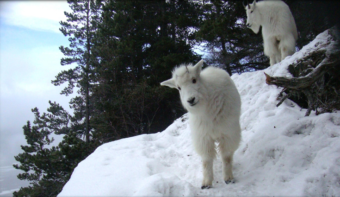
Editor’s note: While there are only mountain goats in Southeast Alaska, mountain sheep live in interior regions of Canada and Alaska. The word for mountain goat will be featured in a subsequent Word of the Week.