A wolf on Pleasant Island near Gustavus, Alaska peers at the camera. (Photo by Bjorn Dihle)
This is Lingít Word of the Week. Each week, we feature a Lingít word voiced by master speakers. Lingít has been spoken throughout present-day Southeast Alaska and parts of Canada for over 10,000 years.
Gunalchéesh to X̱’unei Lance Twitchell, Goldbelt Heritage Foundation and the University of Alaska Southeast for sharing the recorded audio for this series.
This week’s word is g̱ooch, or wolf. Listen to the audio below to learn how to say g̱ooch.
The following transcript is meant to help illustrate the words and sentences.
Kaxwaan Éesh George Davis: G̱ooch.
That means wolf.
Here are some sentences:
Kaxwaan Éesh George Davis: G̱ooch kei akaawag̱áx.
The wolf is howling.
Keihéenák’w John Martin: Kaagwaantaan, g̱ooch áwé has du yahaayí átx̱ alyiex̱.
The Kaagwaantaan use the image of the wolves.
Keiyishí Bessie Cooley: G̱ooch ax̱ éesh du kʼoodásʼi kaadé wuduwaḵáa.
A wolf was sewn on my fatherʼs shirt.
Ḵaakal.áat Florence Marks Sheakley: Kaagwaantaan Yanyeidí has du at.óowu áyá g̱ooch.
The wolf is the at.óow of the Kaagwaantaan and the Yanyeidí.
Waves from a winter storm near Kodiak on Dec. 26, 2022. (Brian Venua/KMXT)
This is Lingít Word of the Week. Each week, we feature a Lingít word voiced by master speakers. Lingít has been spoken throughout present-day Southeast Alaska and parts of Canada for over 10,000 years.
Gunalchéesh to X̱’unei Lance Twitchell, Goldbelt Heritage Foundation and the University of Alaska Southeast for sharing the recorded audio for this series.
This week’s word is ayawditee, which means ‘it’s stormy.’ Listen to the audio below to learn how to say ayawditee.
The following transcript is meant to help illustrate the words and sentences.
Ḵaakal.áat Florence Marks Sheakley: Ayawditee.
That means “it’s stormy.”
Here are some sentences:
Ḵaakal.áat Florence Marks Sheakley: Ḵúnáx̱ ayawditee yáa yagiyee.
It is very stormy today.
Keihéenák’w John Martin: Táakwxʼ tlákw haa káa ayawditee táakwt ḵuwuhaayí.
In the winter, it is always stormy on us when winter comes.
Major General Hilbert apologizes to Wrangell Cooperative Association on Jan. 11, 2025 for bombarding Ḵaachx̱aana.áakʼw 155 years ago. (Colette Czarnecki/KSTK)
A large group of people greeted each other with morning chatter at the end of a Wrangell peninsula on Saturday, where the Taalkweidí clan once resided.
They were there to witness the U.S. Army apologize to the Wrangell Cooperative Association for bombarding the Tlingit village of Ḵaachx̱aana.áakʼw in 1869. The tribe lost at least five people, a totem pole and multiple houses. And for the past 155 years, the tribe has been waiting for this apology.
This was one of several different stops on Saturday’s walk to where Tlingit clans once lived. The last was where a Tlingit man, Shx’atoo, was hanged at Fort Wrangel. Before he turned himself in to stop the bombardment, he stopped at each clan’s location to say goodbye. The group retraced his last steps on this walk.
After visitingTaalkweidí and honoring the clan through a small ceremony, footsteps and chatter took over the walk towards the second stop, where the Teeyhíttaan clan lived.
“When he stopped here, he talked to the clan leader, whose name I now bear, Gashx,” Teeyhíttaan clan leader Aak’wtaatseen Mike Hoyt said. “He brought his hat out and he brought out other at.óow to stand before. That’s how I’m feeling today, that we would bring these things out for him if he were here, and that his spirit is here.”
At.óow are significant tribal artifacts.
Continuing the walk
Fifteen-year-old Vincent Cordova from Ketchikan was holding a peace pipe on the walk. It’s one of the recently repatriated at.óow. It features the Gunakadeit, a sea monster in Tlingit culture.
“I got told to hold the pipe because I am the clan leader’s oldest nephew,” Cordova said. “I’m proud of this and I’m happy to hold such an artifact.”
Gaalgé Kevin Calahan lights Naanyaa.aayí pipe that Vincent Cordova and Major General Hilbert hold on Jan. 11, 2025 in front of Shakes Island. (Colette Czarnecki/KSTK)
After a few more stops, the group ended up in front of Shakes Island, where the Naanyaa.aayí clan lived. Clan leader Gaalgé Kevin Calahan said there were six houses on Shakes Island.
“I have my nephew, Vince. This is a Naanyaa.aayí pipe that belonged to Chief shakes,” Calahan said. “We bring it out when we do our smoke ceremonies. I thought it would be appropriate if the General will hold it, we won’t smoke out of it, but I’ll light it.”
“The body remembers the wrongs that were done to my ancestors.”
The group visited Kiks.ádi territory and then headed towards Fort Wrangel, which is now the post office. Wrangellite Heidi Armstrong said her parents lived for this day.
“As a native child, I’m half native,” she said. “You know the wrongs that were done weren’t necessarily done to me, but the body remembers the wrongs that were done to my ancestors.”
She said there’s a picture from the 1940s in the Wrangell Museum that shows a similar walk along Front Street after they raised Chief Shakes house.
“It’s a historic walk,” Armstrong said. “I’ve always looked at that and thought, man, I wish I was part of that. Sorry. I’m getting choked up. I never dreamt that I’d be part of such a huge, I don’t know, maybe huge is the wrong word, but such a meaningful time.”
When the group reached the last stop, at the old Fort Wrangel, clan leader Hoyt said this is where the altercation happened. Where the U.S. Army launched bombs into the village. Where Shx’atoo turned himself in. Where he was hanged.
“I want you to imagine thinking back to where we started,” Hoyt said. “If you look that direction, you can see the trees. You can see the point. I want you to imagine paddling across and turning himself in over here.”
Hoyt said before Shx’atoo walked to the gallows to face his fate, he sang a song. He played the only recording, sung by William Tannery in the 1950s. Tannery was the primary storyteller who was key to passing the bombardment story to future generations.
It sounded lonely, just his voice.
Arthur Larsen (forefront) sings with others on walk honoring Tlingit clans of Ḵaachx̱aana.áakʼw on Jan. 11, 2025. (Colette Czarnecki/KSTK)Tlingit tribal members gather to remember Shx’atoo before bombardment apology began on Jan. 11, 2025. (Colette Czarnecki/KSTK)
“This does not look like a conquered people to me.”
The group then walked to the Nolan Center, Wrangell’s civic center.Inside, there was a significant amount of historical at.óow in the front of the large room.
“It’s often said that we are a conquered people. This does not look like a conquered people to me,” Hoyt said. “This looks like a statement of who we are, a statement that goes back hundreds of years, thousands of years, and a statement that will continue to go forward accordingly.”
U.S. Army Major General Joseph Hilbert waited at the door to request permission to be on the tribe’s territory.
“Good afternoon. I’m Major General Joe Hilbert from the Commanding General 11th Airborne Division in the United States Army Alaska,” he said. “I live and work on the land of the Tlingit people. I request permission to enter the land the Shtaxʼhéen Ḵwáan.”
After accepting the request, the tribe sang a welcome song with a drum beat that filled the room.
Major General Hilbert of the U.S. Army requests permission to enter on tribal territory on Jan. 11, 2025. Wrangell Cooperative Association’s Tribal Administrator Esther Aaltséen Reese stands to the left. (Courtesy of James Edward Mills)
All of the clan leaders spoke in response to the Major General’s request, including Gaalgé Kevin Calahan with the Naanyaa.aayí clan.
“There really wasn’t a handbook out on how this happens,” Calahan said. “We’ve done plenty of Koo.éex’, plenty of feasts, we’re preparing to raise poles. This was a new thing. This is a great thing, but it was still brand new in new territory.”
He said the songs that they sing mean something big is happening.
“Some of the most beautiful songs are cry songs”
The tribe then sang a cry song, with a slow drum beat in the background.
“Some of the most beautiful songs are cry songs, but they’re songs you don’t hear because they’re so heavy,” Calahan said. “They serve a purpose.”
Some keynote speakers took turns speaking about how this event was historical, including U.S. Senator Lisa Murkowski.
“In order for us to move forward, the wrongs have to be addressed,” she said. “They have to be acknowledged, and we need that apology for us to move forward and to heal.”
She said the solemnity that the military presents is not casual and she hopes it’s recognized. She also honored the veterans in attendance.
“I’m grateful to those who have served,” Murkowski said. “Our treasured veterans, you have not always been treated with the dignity and the respect that should be afforded you.”
U.S. Alaska Senator Lisa Murkowski speaks during bombardment apology by the U.S. Army on why it’s necessary and long past due on Jan. 11, 2025. (Courtesy of James Edward Mills)
Later in the day, Major General Joseph Hilbert officially apologized to the clans. He assured everyone that the apology was written by human beings with hearts, even though it might sound formal.
“It is incredibly a heartfelt apology on behalf of the Department of the Army to acknowledge the 1869 bombardment of the Tlingit village of Ḵaachx̱aana.áakʼw by the United States Army,” he said. “And to offer an apology to the Tlingit people on behalf of the United States Army.”
He acknowledged that the U.S. Army’s bombardment on Ḵaachx̱aana.áakʼw resulted in death, suffering and generational trauma on the Tlingit people.
“I hope that today represents not an end, but a beginning,” Hilbert said. “A beginning of healing and a relationship between us going forward.”
Not every clan accepted the apology. The Taalk̲weidí, Khaach.ádi, Kayaashkeiditaan and Sik’nax̲.ádi accepted.
Three clans did not accept the apology
Aak’wtaatseen Mike Hoyt, with the Teeyhíttaan, did not. He said making peace is about rebuilding and restoring a relationship.
“I have heard your apology and I show as much respect as I can,” he said. “I really appreciate the words that you said in there that this is not the end, but a beginning, and to that extent, we can’t fully accept the apology so much as we see this as the beginning.”
Gaalgé Kevin Calahan who leads the Naanyaa.aayí clan said talking to others has deepened his understanding of the bombardment.
“I know it’s easy to sit back and think, ‘well, that happened so long ago, it didn’t affect you,’” he said. “I was like, ‘well, we’ve been asking about it every year since then.’ It affects us. It’s never left. You think about it every December.
Major General Hilbert said there needs to be continued communication to further establish the relationship between the Army and the Tlingit clans.
“I think where I was very much encouraged was it was an acknowledgement, and not a rejection, and a demonstration of a relationship going forward,” he said.
The other clans that did not accept the U.S. Army’s apology were the Kiks’adi and Naanyaa.aayí. In total, four clans accepted and three did not.
The Mendenhall Glacier Visitor Center on Oct. 19, 2024. (Photo by Clarise Larson/KTOO)
The U.S. Forest Service plans to raise five new totem poles – called kootéeyaa in Lingít – at the Mendenhall Glacier.
At an open house on Wednesday, it was clear that the kootéeyaa are meant to honor and acknowledge the original people of the land. But some of those original people say they should be included in creating the plan.
Listen:
The discussion got heated as soon as leaders from the Central Council of the Tlingit and Haida Indian Tribes of Alaska and the Forest Service unveiled the plan. They came with slideshows and maps, but soon the conversation among the two dozen attendees turned to how the kootéeyaa would represent the people and history of this place.
The proposal brought up conversations about stewardship, clan representation and belonging. Several tribal members said they’re upset about the lack of consultation in this process.
Seikoonie Fran Houston was one of them. She’s the spokesperson for the Áak’w Ḵwáan – the Lingít people who originally lived in what’s now called Auke Bay.
“Sometimes I feel like I’m being stomped on,” she said. “We’re being stomped on.”
Houston asked where the plan for this project came from, and why her clan, the L’eeneidí, wasn’t consulted sooner.
Neilg̱áa Koogéi Taija Revels is the executive director of Goldbelt Heritage Foundation. She stood to defend the project, but also to acknowledge that this project has departed from the Lingít way of raising kootéeyaa.
“I know this isn’t the way that we do things,” she said. “That we’re forced into a Western process where we have to get permission first before we can start talking to the clans about designs, how we’re going to do this properly.”
But Revels said this is also a chance to “correct the lie” that natural spaces like the glacier are inherently devoid of Indigenous people.
“We were the natural landscape. We were the last frontier,” she said. “This gives us an opportunity, when visitors come to see the gorgeous lands that we are either guests on or stewards of, to see that Lingít people have always been in these places.”
Michael Downs, the district ranger for the U.S. Forest Service, was quick to say the plan isn’t even close to final.
“No big decisions have been made,” he said. “There’s plenty of time for these great discussions. I want you to all understand that.”
To address some of the frustration shared by tribal members, Downs said the Forest Service plans to have many meetings in the future about the kootéeyaa.
“This is not like something’s going to happen tomorrow,” he said. “I mean, I’m just being honest there. They’re probably going to be about $250,000 a piece, and we don’t have no money right now.”
This co-management relationship between the tribe and the Forest Service is only a couple of years old.
Lee Miller is Áak’w Ḵwáan, and he worked as a cultural ambassador at the glacier last year. That’s a new role: tribal members educate tourists on Lingít culture and its connections to the landscape.
“Last year we saw fantastic changes and more to come,” Miller said. “This is our opportunity, folks. Put aside the bickering. Make this ours. Own it. It’s been a long time coming.”
Miller said an opportunity for more Lingít representation at the glacier wasn’t imaginable a few years ago.
“What was out there? The glacier, the waterfall, the wildlife, and it’s still there. But we’re there,” he said. “We are finally there.”
Sa.áax’w Margaret Katzeek, who is Jilkaat Ḵwáan, came to the meeting with several of her nieces and nephews. She grew up here, and plans to raise her family here.
“I just think that it would be really important for them to be able to see something like this, wherever they are,” she said. “And know that they are part of this land as well, and that they belong here and that they are important and cared about and respected.”
She said kootéeyaa at the glacier would show future generations their reflections in the landscape.
Northern fur seals at a haul-out on St. Paul Island in October, 2024. (Theo Greenly/KUHB)
Everyone around St. Paul knows Zinaida Melovidov as Grandma Zee. She grew up working in the community’s blubbering shop, back when the local economy revolved around the commercial fur seal harvest. Even then, she said, people worried about what would happen if the island’s seals, birds and other marine life disappeared.
“My mom and dad used to talk about this years ago,” she said. “I didn’t understand. Now I know. No more seals, no more food, no more birds.”
St. Paul Island, in the Bering Sea, is home to vast marine ecosystems that have supported the Unangax̂ community for generations. But the island’s most iconic species — the northern fur seal — has been in steep decline for decades.
“They’re all declining,” Melovidov said. “I remember rookeries used to be millions, thousands in every rookery around the island — all full of seals. Now it’s empty.”
With approximately 400 year-round residents, St. Paul bills itself as “the largest Aleut village.” (Theo Greenly/KUHB)
About half of the world’s northern fur seals breed in the Pribilofs. The population fell sharply when Russian fur traders set up an outpost in the Pribilofs in the late 1700s. And numbers kept falling in the twentieth century — the Pribilof Island population dropped by about 50% between the 1950s and 1998, prompting the National Oceanic and Atmospheric Administration to classify them as “depleted” under the Marine Mammal Protection Act.
But a recent push to protect St. Paul’s sea life met with strong resistance, especially from fishing interests. Now, St. Paul’s tribal government is moving forward with a new plan — one that prioritizes local and traditional knowledge in managing the island’s rich marine resources.
A push for a national marine sanctuary
St. Paul Island is 30 miles from the Eastern Bering Sea shelf. The surrounding waters are among the most productive marine environments globally, supporting dense populations of pollock, crab, and other marine species. In 2022, the community’s tribal government — the Aleut Community of St. Paul Island — announced plans to seek a federal designation as a national marine sanctuary to protect those resources. It would have been the first marine sanctuary in Alaska, giving the tribal government a seat at the table with state and federal resource managers.
A blue Arctic fox on the rocks above a St. Paul beach in November, 2024. (Theo Greenly/KUHB)
But the proposal faced significant pushback, prompting the tribe to change its approach. Commercial fishing groups were among the most vocal critics. Regional communities like Unalaska, whose economies rely heavily on fishing, also opposed the sanctuary. Even within St. Paul, some residents worried that the federal designation could jeopardize local fishing practices.
“People think, ‘Oh, federal and state governments would have the power, and they can regulate my fishing,’” said Destiny Bristol Kushin, who works with the tribe’s conservation office. “It’s more of, I call it a fear — a fear because fishing is a big part of our history, and you don’t really want to lose that.”
Tribal leaders repeatedly stated that the sanctuary would not curtail commercial fishing. Under the National Marine Sanctuary Act, fisheries management councils still would have had final authority over fishing regulations. But the assurances weren’t enough to calm critics.
Tribal Council President John Wayne Melovidov said the tribe ultimately decided in October to pause efforts to pursue the federal designation.
“We didn’t want to move forward with something that would be so controversial and potentially tear people apart instead of bring them together,” he said.
The proposed sanctuary will remain on NOAA’s nomination list, though tribal leaders said it is unlikely to go through without community support. NOAA expects to make a final decision within the next five years.
A new approach
Last fall, the tribe began holding listening events to hear from residents about how to protect the island’s ecosystems from threats such as climate change and overfishing. The eventual goal behind that work is designating the waters around St. Paul Island as an Indigenous marine stewardship area.
Kushin said the designation would allow the community to take control of its waters.
“It essentially gives the power to the people in the community,” she said. “And it gives us the opportunity to incorporate traditional knowledge into the decision making within this protected area.”
The tribal government says the stewardship area designation would give it greater authority to protect the region’s vast ecosystems and resources, including rich fishing grounds and habitat for the federally protected northern fur seal. (Theo Greenly/KUHB)
Indigenous marine stewardship areas are less common than government-declared protection areas, but their numbers are growing, following a global trend. California tribes created the first one in the U.S. in 2023. The designation lacks the legal framework and enforcement power of a national marine sanctuary, but it does emphasize local leadership while bringing in less federal and state oversight.
Tribal leaders have not firmed up details like what the boundaries and regulations would be. Melovidov said the tribe is still working with community members to develop a cohesive plan. And he said local participation will be key to its success.
“Nobody else is going to come in and save the day,” he said. “So, we feel the need to take it upon ourselves to do something about the downturn of the ecosystem in our backyard.”
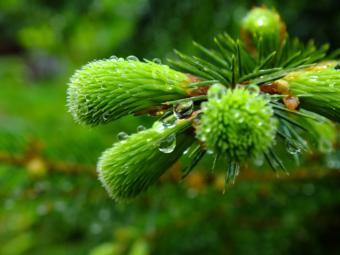
Hemlock trees (Photo courtesy of Elizabeth Graham/National Forest Service)
This is Lingít Word of the Week. Each week, we feature a Lingít word voiced by master speakers. Lingít has been spoken throughout present-day Southeast Alaska and parts of Canada for over 10,000 years.
Gunalchéesh to X̱’unei Lance Twitchell, Goldbelt Heritage Foundation and the University of Alaska Southeast for sharing the recorded audio for this series.
This week’s word is yán, or hemlock. Listen to the audio below to learn how to say yán.
The following transcript is meant to help illustrate the words and sentences.