City and Borough of Juneau public works employee Randal Jim replaces the “Seward St.” sign with one the reads “Heritage Way” on Nov. 1, 2023. (Photo by Yvonne Krumrey/KTOO)
Standing on a ladder, Vicki Soboleff painted a red streak across a street sign reading “Seward Street.” A City and Borough of Juneau public works employee climbed up next, and under the pressure of dozens watching, swapped the painted sign for one that says “Heritage Way.”
On Wednesday, one of downtown Juneau’s central streets was renamed. Sealaska Heritage Institute President Kaaháni Rosita Worl proposed the change in April.
“Today, we celebrate the removal of this stain in our history,” Worl said at the renaming ceremony. “And we celebrate reclaiming our history with a new street name, Heritage Way.”
Heritage Way runs between Front Street and Marine Way, and until this week, it was called South Seward Street. City Hall, SHI’s Walter Soboleff building and the recently-bought SHI building between the two are the only addresses that will be changed.
“If we need to continue to buy our way into this historic mining district just to do small things like this, we’ll continue doing that,” said Sealaska Board Director Joe Nelson.
Deputy Mayor Michelle Hale spoke on behalf of the city.
“I am so pleased to right perhaps one small wrong and rename this part of the street as Heritage Way,” Hale said.
She said she’s seen the impact Sealaska Heritage Institute has had on revitalizing Southeast Alaska Native culture.
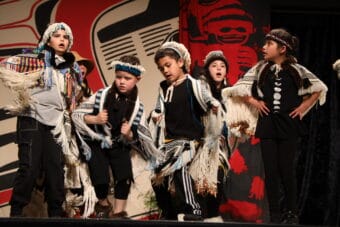
Yées Ḵu.oo Dance Group performs at the Heritage Way renaming ceremony at the Sealaska Heritage Institute arts campus on Nov. 1, 2023. (Photo by Yvonne Krumrey/KTOO)
The Juneau Assembly unanimously agreed to support the change in May. Worl thanked the city for its support.
“We would not have been able to accomplish the many things that we have done, like our arts campus, like the Walter Soboleff building, like the Totem Pole Trail, without the support of the city,” Worl said.
Seward Street’s namesake, William Seward, was the secretary of state when the U.S. bought unceded Alaska Native land from Russia. Worl said Seward referred to Indigenous people as “uncivilized” and “savages.”
“In sharp contrast to his view of Alaska, as a land of great beauty and riches, he saw Alaska Natives not as owners of the land, but as laborers who would support the colonization of Alaska,” Worl said. “We’ve come a long way in now, where the public joins with us in celebrating our culture.”
The ceremony also served as a dedication for a bronze mask made by Metlakatla artist John Hudson. The “Capturer of Souls” mask now sits in a corner of the Sealaska arts campus, facing the middle of the plaza.
Hudson said the mask is named for shamans who would bring souls back to those who had lost them.
“I believe, metaphorically, it really represents what Sealaska is also doing here with this magnificent building,” he said. “The street name change and all the totem poles are all getting a little piece of our soul returned to us.”
Hudson said he’s proud to have a carved piece near one his father made inside the Sealaska building.
The cover art for “Kuhaantí.” (Image courtesy of Goldbelt Heritage Foundation)
“Kuhaantí” means “orphan” in Lingít. Itʼs now the title of a childrenʼs book written entirely in the language with no English translations — the first of its kind in decades. The book will launch on Friday at 5 p.m., with a reading at Juneau’s Elizabeth Peratrovich Hall.
University of Alaska Southeast language professor X̱ʼunei Lance Twitchell, who collaborated with master Lingít speakers to write the book, says the lack of English translation serves two purposes.
“Very few people can speak our language, so it’s one of many different tools to help people learn,” he said. It’s also a way “to privilege our language, and to elevate it to this place to say, ‘Our literature can stand on its own.'”
Central Council of Tlingit and Haida Indian Tribes of Alaska and Goldbelt Heritage Institute are hosting the book launch. Twitchell will read the story aloud, and the illustrators G̱at X̱wéech Nick Alan Foote and Jaax̱snée Kelsey Mata Foote will sign copies for attendees. Little ones and parents are encouraged to wear regalia.
“Kuhaantí” tells the story of a young orphaned girl named Saháan who is taken in by a powerful family and learns about the value of respect.
In 2016, Twitchell began writing down that and eight other stories with master Lingít speakers Kaxwaan Éesh George Davis and Shaksháani Marge Dutson. Both have since died. Twitchell said he wanted the final product to honor their legacies “as incredible speakers and teachers of our language.”
He anticipates the lack of an English translation of “Kuhaantí” could bring up complicated feelings for some readers.
“Some of those are going to be based in concepts of racial superiority and linguistic superiority, but others are going to be nested in just longing for being able to speak,” Twitchell said.
He hopes that for those who feel left out, the book could inspire them to start learning Lingít.
“We have become dependent on the English language,” Twitchell said. “‘We’ being the entire region — everybody who lives on Lingít Aaní.”
And so, he says, the goal is to give everyone on Lingít land a free copy of “Kuhaantí.” For now, Tlingit and Haida and Goldbelt are giving free copies to all tribal citizens who sign up.
The eight other Lingít-only children’s stories are still being made.
George J. Bennett Sr. poses with his bentwood cedar boxes during the 2023 AFN arts market in Anchorage. (Photo by Matt Faubion/AKPM)
Hundreds crowded the main exhibition hall at the Dena’ina Center in downtown Anchorage Thursday for the first day of the Alaska Federation of Natives arts market.
Each year, Indigenous artisans converge for three days during the convention to sell carvings, kuspuks, fur-lined hats and all manner of jewelry. Festival organizers said this year’s market was bigger than ever.
This year’s convention featured more than 200 artists from around Alaska and the Lower 48. Sitting in the middle of it all was George J. Bennett Sr., a Lingít artist from Sitka. His bentwood boxes, decorated in formline designs, were already halfway sold out by the end of the morning.
“I had about six, eight people converge on my table before I was even ready to price them,” Bennett said. “They wanted boxes … so about eight or nine boxes went out within a half hour after I got here!”
Bennett has been making boxes for 25 years. This is his fifth market. His wife is from the Interior, so they enjoy catching up with all of the friends they run into.
“This is kind of like the melting pot,” he said. “It’s like you’re sat on a corner and you’re watching all your friends go by and as you see them and you wave.”
Jack Bonney from Visit Anchorage worked as a volunteer at this year’s convention. He said every region of the state is represented.
“It’s a microcosm of all of Alaska in Anchorage, in one or two rooms for a couple of days,” he said.
Bonney said the market draws thousands of people to AFN every year. Upstairs, prominent leaders speak and important discussions about Alaska Native issues take place. But the market can be an entry point for the general public.
“The Arts Market is one of the big draws for folks who may not otherwise know what AFN is about, or it might be their first visit that leads to a broader conversation about what AFN does in the community,” he said.
Earrings made by Vina Brown, owner of Copper Canoe Woman, sit on display during the 2023 Alaska Federation of Natives arts market in Anchorage. (Photo by Matt Faubion/Alaska Public Media)
Trinity Villalobos came to the convention from Fairbanks for work. But like everyone else who attends AFN, she and friend Tiara Davis took some time to browse for things that wouldn’t break the bank.
“I was looking for something cool, something unique, something that I can afford,” Villalobos said.
She was eying some Halloween-themed bracelets — while Davis had her eye on a hummingbird hair clip.
“We realized that like the beadwork, it takes a lot of time and so you want to be able to pay people what they are worth or what they’re quoting,” Davis said. “But, you know, the price just might not be what your pockets can handle.”
Vina Brown, owner of Copper Canoe Woman, sells her jewelry during the 2023 Alaska Federation of Natives arts market in Anchorage. (Photo by Matt Faubion/Alaska Public Media)
For the first time, this year’s market spilled over into an additional room upstairs. Vina Brown set up her table there. She’s Haíłzaqv and Nuučaan̓uɫ, originally from British Columbia. She traveled from Lummi, Washington to the market for the first time. She’s been to the Santa Fe Indian Market and others.
“I really didn’t know what to expect. But it’s quite impressive so far. I mean, there’s so many people,” she said.
Her business is called Copper Canoe Woman, based on her Indigenous name ƛ̓áqvas gḷ́w̓aqs, and features traditional designs like formline with a high-fashion flare.
“Just like our rights aren’t frozen in time, our art isn’t frozen in time. So we’re allowed to adapt and pivot and elevate that,” Brown said.
Many artists sell out before the final day, and Brown said she was manifesting that as well — to help offset her travel costs.
Back in the main hall, Bennett said that whether he sold all his boxes or not, seeing people enjoy his work was enough.
“It’s a good way to connect and share each other’s culture through this kind of work,” he said. “So it’s beautiful.”
Correction: Jack Bonney from Visit Anchorage was a volunteer at this year’s convention and does not represent AFN.
Students from the Tlingit Culture, Language and Literacy program sing and dance at Elizabeth Peratrovich Hall on Oct. 9, 2023. The event, held on Indigenous Peoples’ Day, was part of a series of ceremonies acknowledging the closure of the Memorial Presbyterian Church, which for decades served a primarily Alaska Native congregation in Juneau. (Katie Anastas/KTOO)
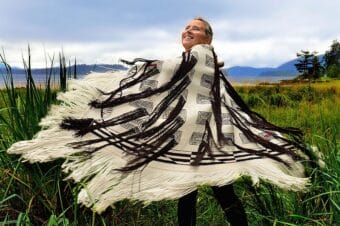
Dozens of kids streamed into Elizabeth Peratrovich Hall on Indigenous Peoples Day, singing in Lingít. Most wore red and black regalia dotted with mother of pearl buttons. One wore a fringed Chilkat robe with yellow, black and blue formline designs.
“Because of the advocacy of our ancestors, of our elders, of our leaders and of our people, these things are becoming more common, finally,” said La quen náay Liz Medicine Crow, president and CEO of First Alaskans Institute.
The performance opened the final ceremony in a weekend of events meant to acknowledge the 1962 closure of Memorial Presbyterian Church, which for decades served a primarily Alaska Native congregation in Juneau and became a vital part of Juneau’s Alaska Native community.
Last summer, national, regional and local Presbyterian Church leaders committed to paying nearly $1 million in reparations. This weekend, they began to fulfill that commitment by donating nearly $105,000 to Sealaska Heritage Institute and the Central Council of the Tlingit and Haida Indian Tribes of Alaska.
A thriving church closed
On Sunday, church leaders delivered a long-awaited apology at Ḵunéix̱ Hídi Northern Light United Church, just a few blocks away from where Memorial Presbyterian Church once stood.
Rev. Walter Soboleff was the church’s pastor. Beginning in 1940, he led a mostly Alaska Native congregation, preaching in both Lingít and English. But in 1962, citing a new policy to end segregated churches, the Presbyterian church closed Soboleff’s church and loaned money to a non-Native congregation to build a new one.
Rev. Bronwen Boswell leads the U.S. denomination of the Presbyterian Church. On Sunday, she said the racist closure had followed “decades of Memorial Presbyterian Church’s thriving ministry and Dr. Soboleff’s unmatched record of transformative service.”
“The Presbyterian Church USA apologizes for the act of spiritual abuse committed by the Presbyterian Church’s decision of closure, which was sadly aligned with nationwide racism toward Alaska Natives, Indigenous nations, Native Americans and other people of color,” Boswell said.
Students from the Tlingit Culture, Language and Literacy program sing and dance at Elizabeth Peratrovich Hall on Oct. 9, 2023. The event, held on Indigenous Peoples’ Day, was part of a series of ceremonies acknowledging the closure of the Memorial Presbyterian Church, which for decades served a primarily Alaska Native congregation in Juneau. (Katie Anastas/KTOO)
House of healing
Sunday’s apology came after years of advocacy. In the 1990s, a group of Alaska Native church members started discussing Memorial Presbyterian Church’s closure and possible reparations.
In 2021, the church’s Native Ministries Committee wrote an overture outlining the actions and monetary contributions that could make up an apology for the closure.
Some have already happened. For example, the church has been renamed Ḵunéix̱ Hídi Northern Light United Church. Ḵunéix̱ Hídi means “people’s house of healing” in Lingít. They’ve also committed to funding scholarship programs, incorporating Lingít language into church services, and adding Alaska Native art and architecture to the building.
Freda Westman, a member of the Native Ministries Committee, said those efforts will offer the next generation a chance to celebrate their culture within the church.
“What I’m excited about is bringing in younger people and children with the language, with the cultural practices and seeing how those can be woven together,” she said in an interview.
Tlingit and Haida President Chalyee Éesh Richard Peterson accepts a donation from Ḵunéix̱ Hídi Northern Light United Church council member Jim Alter on Oct. 9, 2023. (Katie Anastas/KTOO)
‘This is the beginning’
At Monday’s event, national church leaders gave $100,000 to Sealaska Heritage Institute to support language revitalization efforts. Church council member Jim Alter also presented Tlingit and Haida President Chalyee Éesh Richard Peterson with a check for more than $4,400 for the Tribe’s cultural programs.
Future reparations payments will fund cultural opportunities for Alaska Native youth, support Tlingit and Haida’s reentry programs for people returning from incarceration, and pay for educational materials about the closure at Ḵunéix̱ Hídi Northern Light United Church.
In an interview, Peterson said it’s important to acknowledge the role churches have played in colonization and language loss throughout Alaska.
“This is the United States Presbytery taking accountability for one instance,” he said. “I hope that the churches really do step up and take their role in the healing, as they took their role in the damage.”
Medicine Crow said this weekend’s events offer a framework for “other entities and institutions who were complicit in the efforts to eradicate the Native people of this place.”
“What happens here is going to shape, impact and give more foundation to all the other apologies that are due,” she said. “This is the beginning. We are setting a table together.”
A new sign outside the Juneau Fire Hall on Glacier Avenue commemorates Rev. Walter Soboleff’s leadership of Memorial Presbyterian Church before its closure. (Katie Anastas/KTOO)
This weekend’s events also included the unveiling of a sign at the site of Soboleff’s church, now occupied by the Juneau Fire Hall. It describes the church’s closure and the Presbyterian Church’s commitment to reparations.
The sign also says Ḵunéix̱ Hídi Northern Light United Church “hopes to create a more fitting memorial at this place” in the future.
Visitors take images of Mendenhall Glacier near Juneau in summer 2022 from inside the Mendenhall Glacier Visitor Center. (Photo by Ned Rozell.)
The Central Council of the Tlingit and Haida Indian Tribes of Alaska and the U.S. Forest Service will collaborate on managing the Mendenhall Glacier Recreation Area going forward, with plans to better educate visitors on Alaska Native culture.
Tlingit and Haida President Richard Chalyee Éesh Peterson said the Tribe is excited to share more cultural history with the nearly one million tourists who pass through the Mendenhall Glacier Visitor Center each year.
“The people who go there want to learn about the glacier. They also want to learn about the people,” Peterson said. “And if you know anything about Lingít culture, we have songs, stories, history about migrating over, under and through the glaciers.”
The Forest Service and Tlingit & Haida signed a memorandum of understanding last week, which outlines a mutual commitment to collaborating on resource management and planning in the recreation area.
“We are overdue for having better representation of the Alaskan Native perspective,” Hood said. “It’s part of upholding our nation to nation relationship with these sovereign Tribal nations.”
At the glacier, the first priority will be including more Lingít culture, history and language in the recreation area’s programming. That will likely include updating signs and displays on trails and in the visitor center. But according to Hood, the memorandum of understanding could also pave the way for collaboration on trail maintenance, watershed restoration and caring for the fish and wildlife in the area.
In the short term, the agreement calls for the Forest Service to hire Tribal citizens to work as educators and guides.
“Who better to tell our stories than us?” Peterson said. “Aak’w Kwáan people talking about Aak’w Kwáan, you know?”
Two kootéeyaa on Juneau’s waterfront on Oct. 4, 2023. (Photo by Yvonne Krumrey/KTOO)
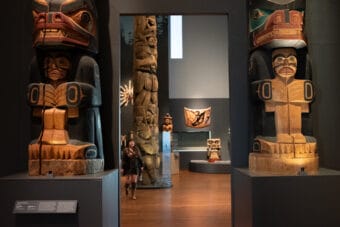
On a quiet October day, with no cruise ships in port, Noah Boos stood looking at a sign right next to a kootéeyaa, or totem pole, on Juneau’s waterfront. The sign breaks down what each of the carved figures are — a bear with curved teeth and large formline eyes, an eagle with a face painted in red on its back, a killer whale with a fish in its mouth — and at the top, a Kaagwaantaan clan member.
“I love these signs,” he said. “(They) tell you a little bit about what the totems are all about.”
Boos said he’s been to Juneau before, but not since the kootéeyaa sprang up. He said he likes that cruise ship passengers can learn so much after getting off their boats.
“First thing you’d see pretty much would be the totems and the signs,” he said.
Noah Boos looking at new signage for kootéeyaa on Juneau’s waterfront. October 4, 2023. Photo by Yvonne Krumrey/KTOO
The organization put up storyboards last week to educate visitors and protect the poles from mistreatment.
“These are objects that are sacred for Lingít people,” said SHI’s Ricardo Worl. “And we hope that the storyboards will help people learn more about our history and how sacred these kootéeyaa are for us.”
Each storyboard has a diagram of the pole, with a breakdown of what each symbol is and the story the kootéeyaa tells. It also lists the artist, their clan and clan stories.
Early in the cruise season, pictures surfaced of tourists putting children in the large, brass hands of the Shangukeidí Kootéeyaa. Community members were frustrated with these and other examples of people mistreating and touching the poles.
Worl said SHI discussed erecting barriers to stop it, but decided not to.
“We thought about that, putting verbiage on the storyboards: ‘Please don’t touch, these are sacred objects.’ But the more we thought about it, the more we believe that everyone in this community has a responsibility to educate our visitors,” he said.
Worl said mistreatment of the kootéeyaa likely stems from a lack of understanding about what they mean to Alaska Native people. He said he wants non-Native residents and those in the tourism industry to speak up when people act inappropriately with the kootéeyaa.
“For our visitors, this is an excellent opportunity to learn that this is more than art,” he said.
The 12 poles are part of the Kootéeyaa Deiyí, or Totem Pole Trail. Eventually, SHI plans to install 30 poles total along the docks, many representing clans.
The kootéeyaa will give Indigenous people keys to understanding their identities and their ancestors, he said.
“They tell our history. They tell clan stories. They make connections from our ancestors to our current generations,” Worl said. “Our grandchildren will now be able to come and view the Kootéeyaa and confirm their identity to their ancestors and to their crests.”
Worl said SHI has the funding to commission one more kootéeyaa and is seeking funding for 17 more.
Close
Update notification options
Subscribe to notifications
Subscribe
Get notifications about news related to the topics you care about. You can unsubscribe anytime.