Alaska Native Arts & Culture

Mud pies and ‘Molly of Denali’ could strengthen STEM education in rural Alaska

A GoPro camera captures a child’s point of view as they make mud pies in Hoonah. Videos like this will help researchers and educators to design new environmental science programming in rural Alaska Native elementary schools. (Screenshot courtesy of Carie Green)


Making mud pies may not seem scientific. But in a sodden school yard in Hoonah, kids discern between different materials and tools for building by gathering the best sticks, rocks or pinecones. Or they modify those materials by wetting down dirt to make more mud for sculpting. 

Education researchers Angela Lunda and Carie Green call that “mud science.” And they say that kind of experimentation in the natural world can help young children develop an interest in environmental science.

For Alaska Native children, activities in the natural world are also an important foundation for cultural identity.  

“The children are already stewards of the environment, right? They already see themselves that way,” said Lunda, who is Lingít and teaches at the University of Alaska Southeast. “And that really is what defines us as Indigenous people.”

Lunda and Green’s research — known as the Molly Community Science Project — focuses on strengthening STEM programming in rural Alaska schools. 

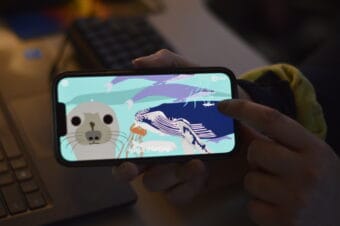
The project’s namesake comes from the popular PBS Kids program “Molly of Denali”, an educational animated series which features an Alaska Native main character. The goal is to build on the show’s success by developing “Molly of Denali”-themed multimedia resources with Indigenous students in mind. It’s a collaboration funded by the National Science Foundation. 

Lunda says Alaska Native communities inherently possess a depth of environmental knowledge and skills. But Alaska Native students are underrepresented in  science, technology, engineering and math fields, and traditional programs don’t make space for Indigenous identity. 

“So it’s really important for us to be aware of that and to be actively working to try to change,” Lunda said. “That happens when we build on their world, their worldview. What they see, what they do.”

Their research design takes that literally, by outfitting Alaska Native elementary school children with GoPro cameras, which they wear as they play and explore outside. 

Green — a professor of early childhood education at South Dakota State University —  developed the research method during her previous work studying children’s relationships with the environment. She said kids will often forget that they’re wearing the cameras. 

“And so they’ll tell you how they’re feeling, they’ll sing songs, they’ll narrate what they’re doing,” Green said. “All that sort of self-talk is really insightful.” 

In one video, a child compares different crab shells on the beach, to figure out which ones are occupied and which ones are left over from molting. In another, a child tells her friends how to safely handle S’áxt, or Devil’s Club. And in yet another, a child goes fishing with their mother, and the clip captures them cheering as they reel in their catch. 

“Yes! See? This is how you fish, because I caught something,” the child says. “Now put it in the water so it lives to get bigger.” 

A child practices catch and release while fishing in Hoonah (Screenshot courtesy of Carie Green)

By examining those videos, Lunda and Green can identify activities that foster the empathy, knowledge and confidence kids need to act responsibly towards the environment. The research also incorporates interviews with elders, families and educators in Bethel, Hoonah and Northway, a village in the Interior. 

Amelia Wilson is the project’s community liaison in Hoonah. She said much of the existing STEM programming for Alaska Native students targets older students.  

But she hopes that the Molly project’s focus on elementary children will help to nurture cultural identity early on, to teach Alaska Native students that their Indigenous perspectives can make them stronger scientists. 

“Respect for our environment, you know, that’s a cultural value that has always been,” Wilson said. “So how powerful would it be to have these children be those scientists that are making policies, making the decisions for our environment.”

She said Alaska Native representation in STEM is especially important as rural Alaska Native communities, including Hoonah, work to adapt to climate change. 

For now, the researcher team is still working to analyze the videos and interviews. But they’ll begin to design and test “Molly of Denali’s” science programming in partner elementary schools over the next year.

2023 Rasmuson Distinguished Artist awardee plans to weave biggest Chilkat blanket ever

This undated photo shows Anna Brown Ehlers. right, and her daughter wearing Chilkat blankets she'd woven. (Photo courtesy of Hulleah Tsinhnahjinnie/National Endowment for the Arts)
This undated photo shows Anna Brown Ehlers, right, and her daughter wearing Chilkat blankets she wove. (Photo courtesy of Hulleah Tsinhnahjinnie/National Endowment for the Arts)

Chilkat weaver Sainteen Anna Brown Ehlers has been named the 2023 Rasmuson Distinguished Artist.

The Juneau artist says she plans to use the $50,000 award to weave the biggest Chilkat blanket ever. 

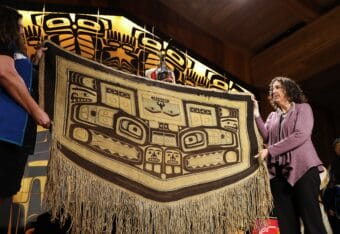
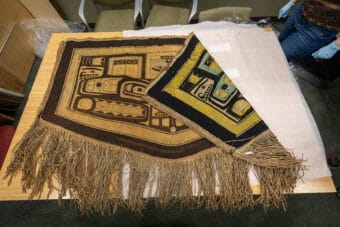
“Everything I’ve done is the largest ever done,” she said. “The killer whale blanket I have down at the Alaska State Museum and Archives now is eight feet wide and seven feet high. It took me a year to split the yellow cedar bark and spin the wool for that.”

That killer whale blanket took 8,000 hours to weave, she said. That’s the equivalent of about 11 months of nonstop work. She says she hopes to weave a blanket twice that size.

Ehlers had already been recognized by the National Endowment for the Arts. But she said that awards from Alaskans mean more to her.

“Being recognized nationally is nice,” Ehlers said, “But being recognized by the people of the state, it’s more fulfilling to me.”

Ehlers has woven several dozen blankets over the last 40 years, and she’s taught hundreds of students. She says she learned from two weavers, Dorica Jackson and Jennie Thlunaut. Thlunaut was 92 at the time.

“I watched her weaving when I was a little girl,” Ehlers said. “And since I was four years old, I knew that this is what I wanted to do with my life.” 

Her father told her that she would have to earn mentorship from Thlunaut, though. Ehlers says she brought wool that sheʼd spun to Klukwan to show her, and then Thlunaut began teaching her how to weave in her style. Ehlers finished a child-sized blanket under her guidance.

“I went back up there and showed her, and she said ‘Youʼre just like me, youʼre just like me!’ She was just so happy,” Ehlers said.

For potential young weavers, Ehlers says they shouldn’t let the enormity of the tradition hold them back.

“Follow your heart,” she said. “Don’t let anybody diminish your dreams. Start small. You know, everything starts small.”

Ehlers said she couldnʼt do her work without her familyʼs help. Her husband renovated their house to build her a studio, and her daughters spin wool for her.

Rasmuson also awarded Juneau residents Lyndsey Brollini and Mistee St. Clair $10,000 each for a basketry and multimedia project and a poetry collection, respectively.


This story was updated to include that Mistee St. Clair also received a project award. 

Áakʼw Rock Indigenous music festival starts Thursday in Juneau

Qacung Stephen Blanchett performs with Pamyua during a closed filming of their set for Rock Aak’w on Friday, Nov. 5, 2021, in Juneau, Alaska. Juneau’s first Indigenous music festival is streaming online Nov. 5-6. (Photo by Tripp Crouse/KNBA)

An event billed as the only Indigenous music festival in the country begins Thursday in Juneau.

Áak’w Rock kicks off Thursday afternoon at Elizabeth Peratrovich Hall. It’s the first time the festival has been held in person since it began virtually in 2021. Organizers held a side stage fundraiser last year.

Indigenous performers from across Alaska, the U.S. and the world will play over the course of three days.

Organizers visited Juneau Afternoon on Tuesday to talk about the lineup and the buzz the festival is creating in the music world. Qacung Blanchett says their team has received invitations from people in other countries who want to hold similar events.

“They’re looking at us, what we’re doing, because it’s like ‘Oh wow, this festival’s happening.’ And it’s something that’s unprecedented right now,” Blanchett said.

He’s also a member of Inuit-soul band Pamyua, and has performed all over the world.

“Thirty years of me being in this scene, in this music business, there’s been nothing like this – ever,” he said.

Áakʼw Rock began virtually in 2021. Headliners this year include Snotty Nose Rez Kids, Halluci Nation and Ya Tseen. Local acts like Air Jazz and Daniel Firmin will also perform.

Tickets are still available for all three days or for individual day passes. Performances take place at Centennial Hall and Elizabeth Peratrovich Hall. Nightly open jams will take place at the Juneau Arts and Culture Center from 7 to 9 p.m.

Organizers say they want youth to be involved in the festival too. A free youth jam at Elizabeth Peratrovich Hall on Wednesday from 6 to 9 p.m. is open to youth between 13 and 20-years-old. Adults with tickets to the festival can also bring one child age nine or younger with them.

Editors note: KTOO is contracted to produce parts of the festival.

Four years into the Yukon salmon collapse, an Interior Alaska village wonders if it will ever fish again

An aerial view of Fort Yukon Alaska on Tuesday evening, August 29, 2023. (Matt Faubion/Alaska Public Media)

Without salmon, Gwichyaa Zhee is missing its heart.

“It’s just no good,” said Linda Englishoe, sitting on the sofa in her house not far from the Yukon River. Englishoe is an elder who has lived in the village for her entire life.

There are signs of fall in Englishoe’s house — a pan of apples and cinnamon on the stove, a tray of lowbush cranberries waiting to be processed. Fall usually also means the arrival of chum salmon on their journey upriver, but this year, the run is a fraction of the size it once was.

Without fish, Englishoe said, nothing in the village is the way it’s supposed to be. The smokehouses, normally full of salmon drying for the winter, are empty. Even the smell of town is different.

“It used to smell so good, smelling those fish,” Englishoe said. “Ooh, I used to just sit outside, smelling.”

A picture of the town Fort Yukon.
The town of Fort Yukon on Thursday, August 31, 2023. (Matt Faubion/Alaska Public Media)

Gwichyaa Zhee is the Gwich’in name for Fort Yukon. The village sits on the upper Yukon River 150 miles northeast of Fairbanks. It’s home to less than 500 mostly Gwich’in Athabascan people, many of whom are related and have deep ties to other communities all along the river and into Canada. Small homes, many with large moose antlers mounted above the door and snow machines or four-wheelers in the yard, sit on a sprawling grid of dirt roads and flat tundra. People here are used to sharing food with one another.

Life in Gwichyaa Zhee revolves around the Yukon River, which is wide and braided where it passes by town. Its silty waters barely make a sound winding through scalloped islands and sandbars. This river used to be full of fish and busy with families traveling back and forth from fish camp, Englishoe said.

“Everyone would visit each other along the river,” She remembered.

Now, the riverfront is quiet, except for a few hunters heading out to try for moose.

A boat next to a river with a sunset.
The Yukon river on Tuesday, August 29, 2023. (Matt Faubion/Alaska Public Media)

Englishoe is one of the 15,000 people living along the Yukon River who are feeling the effects of the salmon collapse, from the Bering Sea to the river’s headwaters in Canada.

The river’s once-strong king salmon run has been on a long, slow decline since the 1990s. Chum salmon runs have also been unpredictable. But in the last four years, both species’ runs abruptly crashed.

Researchers are still unsure exactly what is driving the collapse. Scientists say climate change probably plays a big role, raising the temperature of river water and potentially affecting the availability of prey species at sea. Many people along the river also blame bycatch from the Bering Sea trawler fleet and commercial salmon fishing along the Aleutian chain.

This year, the king salmon run was less than a fifth of its normal size. This summer, for the fourth year in a row, fisheries managers closed almost all king and chum fishing along the Yukon River in Alaska to try to ensure as many fish as possible make it to their spawning grounds.

That means, in Gwichyaa Zhee, there’s no salmon to eat, and no salmon to put away for the winter.

A man in a plaid jacket stands in the road.
Michael Peter outside his home in Fort Yukon morning. September 1, 2023. (Matt Faubion/Alaska Public Media)

Michael Peter worries about young people — his kids — losing a part of their identity.

Peter is second chief of Gwichyaa Zhee. He grew up learning to cut fish from his grandmother. Summers at fish camp connected him to his community, the river and his family from a young age. But now, he said, instead of spending the summer working together on the river, people are at home.

“A lot of our young people are kind of lost, because of not having our traditional foods and showing them our traditional values, and teaching them, going to fish camp,” Peter said.

For him, fish camp served as a “spiritual awakening,” Peter said. He worries younger generations are missing out on their opportunity to carry on the tradition.

The salmon collapse has also made daily life harder. Without fish, people have to rethink what they eat. Many families are hunting more, Peter said, but fueling up a boat to hunt for moose or shoot geese can cost $9 per gallon. Grocery shopping at the local AC store costs three times what it would in Anchorage.

Year-round work is limited in Gwichyaa Zhee, and Peter said, without fish it’s hard to make ends meet.

“A lot of people are migrating to the city,” he said.

For people in Gwichyaa Zhee, the salmon collapse is just one of a cascade of outside threats.

Recent floods destroyed fish camps up and down the river. Floods like that could become more common, as climate change drives more unpredictable spring river breakups and extreme weather. Peter also worries that oil development like the Willow project and proposed mining in the Brooks Range will threaten caribou herds his community relies on for subsistence. These projects do have support from some communities and Alaska Native leaders, even as Peter and others see them as threats.

“It seems like we’re being attacked all at one time, without any consideration for our future — our kids, our land, our animals, our air, our water, our climate,” Peter said. “The earth can only sustain so much.”

Peter and other residents want Alaska Native people to have more control over how the river and other resources are managed. Currently the U.S. Fish and Wildlife Service and Alaska Department of Fish & Game set limits on subsistence fishing when the runs don’t meet the escapement goals and quotas set out in a decades-old treaty with Canada.

Peter represents the Yukon Flats in the Yukon River Intertribal Fish Commission executive council which develops recommendations for fishery management. He and other Yukon residents are pushing to establish tribal co-management rights for Yukon River salmon. They’re looking at the Kuskokwim River where 33 federally-recognized tribes work in partnership with state and federal agencies to make management decisions, as a model.

“We shouldn’t have to struggle to survive, but we’re survivors, and we’re resilient,” Peter said. “We’ve been here, we’re not going nowhere, and this has always been our home. And who are the better managers of the land than the people themselves?”

Presbyterian Church leaders visit Juneau to plan apology for 1962 church closure

Tlingit and Haida President Chalyee Éesh Richard Peterson, Sealaska Heritage Institute President Kaaháni Rosita Worl, Lingít language professor X̱’unei Lance Twitchell and La Quen Náay Liz Medicine Crow on a panel about historic trauma on August 30, 2023. (Photo by Yvonne Krumrey/KTOO)

Southeast Alaska Native communities have worked for decades to undo the harms of colonialism. But Lingít language professor X̱’unei Lance Twitchell says that for too long, the organizations that caused that harm were conspicuously absent. 

“L’eiwtu Éesh Herman Davis once stood up at a gathering and said ‘Why is it just us? Where are the people who did this to us?’” he said. 

Now, some of those people are trying to join the effort. Presbyterian Church leaders came to Juneau this week to learn how exactly they ought to make an apology. The visit is part of a plan to formally apologize to the Lingít community for the 1962 closure of Memorial Presbyterian Church, which destroyed an important center for the Lingít community in downtown Juneau. 

Twitchell sat on a panel Wednesday at the Walter Soboleff building with Tlingit and Haida President Chalyee Éesh Richard Peterson and Sealaska Heritage Institute President Kaaháni Rosita Worl. La Quen Náay Liz Medicine Crow moderated as they spoke to church leaders about the harm religious organizations have done to Lingít communities through language suppression and violence at boarding schools. 

“Until about a few weeks ago, I’ve never stood up and talked about my trauma,” Peterson said. “Couldn’t do it. Now I feel like I have to as a leader, so people can understand and know what we all go through.”

Worl said that when she was putting together her presentation, she had flashbacks to when she was taken to boarding school as a child.

“I had been kidnapped from my home with my grandparents and brought to a Presbyterian mission, Haines House,” she said. “I am a strong woman, but last night, I will tell you I saw myself, I felt myself as a 6 year old that cried in my bed wondering, ‘Why was I taken from my family?'”

Twitchell said he can teach Lingít today because of the elders who held on to the language through all the violence at boarding schools.

“One time I was driving [Lingít elder Marge Dutson] home and she said ‘They tried everything, they tried to beat it out of me, they tried to scare it out of me, they tried to shame it out of me, but I held on to my language,’” he said. 

Jermaine Ross-Allam is the director of the Church’s new Center for Repair of Historical Harms. His job is to travel to places where the Presbyterian Church has created trauma and caused conflict, like Liberia. 

“The Center for Repair can’t tell Lingít people ‘This is what your reparation looks like,’” he said.

Ross-Allam said he noticed a lot of joy in the work that leaders like Twitchell have done to restore language and community, and that’s why he wants the Presbyterian Church to do this apology right. 

“For me, reparation is ultimately about reclaiming the material resources necessary to have more of that kind of joy,” Ross-Allam said.

Presbyterian Church USA has committed $1 million in reparations. They’re installing a memorial at the site of the former church on Oct. 7, and church leaders will read an apology Oct. 8.

Alaska Native youth to carve 2 dugout canoes with federal education funding boost

People paddling with Goldbelt Heritage Foundation, the first recipient of the Native Hawaiian and Alaska Native Culture and Arts Development grant program. Photo courtesy of Goldbelt Heritage Foundation.

Federal money for arts, culture and educational programs will fund the creation of two dugout canoes in Southeast Alaska.

Goldbelt Heritage Foundation, the nonprofit arm of Goldbelt, Inc., will teach Alaska Native youth how to carve canoes with nearly a quarter million dollars in grant funding from the National Park Service. The goal is to teach Lingít culture while applying the principles of science, technology, engineering and math education to canoe making.

The National Park Service awarded the grant of $243,457 to Goldbelt Heritage Foundation on Aug. 15, 2023.

Desiree Jackson, Goldbelt Heritage Foundation executive director, said the 4-year grant will be the start of a continuing education program that will uphold canoe stories behind the traditional use of the canoe.

“We want to grow this momentum around youth paddling and utilization of the yaak’w (canoe) because this is another sport and activity youth should be engaged with,” she said.

Goldbelt Heritage Foundation will create courses around the building of dugout canoes.

“There is so much undocumented curriculum around navigation,” she said. “How did we use the stars? How did we use waypoints?

The program is called “Daak Yaylatsaak,” which means “push the boat out” in the Lingít language. Jackson said the goal is for the program to be run through classrooms in Southeast Alaska during school, which she said is important for Alaska students as part of place-based education.

The group aims to host a regional youth canoe gathering within the next few years.

The money is part of the first round of awards for the Native Hawaiian and Alaska Native Culture and Arts Development grant program. The National Park Service administers the grant on behalf of the Secretary of Interior, Deb Haaland, using funds appropriated by Congress.

National Park Service Director Director Chuck Sams said the project will provide educational programming while it continues traditional practices for youth in Southeast Alaska.

“The National Park Service is committed to supporting Native Hawaiian and Alaska Native culture and art programs, including traditional and contemporary expressions of language, history, visual and performing arts, and crafts,” said Sams.

The National Park Service awards the grants for scholarly study and instruction of contemporary arts and culture, to establish educational programs that lead to degrees in Alaska Native and Native Hawaiian art and culture programs or to develop arts in the community. Private, nonprofit groups that primarily serve Native Hawaiian or Alaska Native communities and are recognized by the governor of Hawaii or Alaska are eligible.

Site notifications
Update notification options
Subscribe to notifications