The Hōkūle’a in Ward Cove (Courtesy Jared Boekenhauer)
The traditional voyaging canoe Hōkūle’a captured statewide attention as it stopped in several Southeast Alaska ports.
The regional tour kicked off the Moananuiākea journey, which is all about Indigenous knowledge and love for the ocean.
The Alaska leg of the global journey ended after visits to Metlakatla and Prince of Wales Island earlier this month.
The Hōkūle’a was towed most of the way from Metlakatla to Hydaburg, since the water was so calm. Lohiao Paoa said that’s pretty rare. The canoe’s crew usually relies on twin sails.
“We got to sail more than halfway across the Dixon Entrance,” he said.
Paoa is a crew member on the Polynesian Voyaging Society’s traditional twin-hulled canoe. He said in Metlakatla, there was a lot of drumming and celebration.
“They had really nice songs and dances and all the kids from one-year-olds were playing the drums and dancing together with elders,” he said.
And on Prince of Wales Island, the crew visited Hydaburg, Kasaan, Craig and Klawock. They were welcomed and received tours in each community. A send-off was held in Hydaburg. Hydaburg has a special connection to the Polynesian Voyaging Society – a different voyaging canoe was built with logs harvested from a bay just six miles away from the town.
“Every community was really nice and treated us with respect and gave a history of their community, as well as a lot of gifts, which is amazing,” he said.
While finishing the Alaska journey, Paoa noticed how similar Alaska’s Indigenous communities are to Hawaii’s islands.
“It’s crazy to see how connected all these tribes are,” he said. “And I think it’s very similar to Hawaii’s islands and how the people are related back home.”
Now, the canoe crew has moved on to Canada. After stopping in Haida Gwaii, the Hōkūle’a is expected to head toward Prince Rupert, British Columbia at the end of the week.
ngoon students paddle their dugout, war-style canoe into Chatham Strait from Front Street. June 19, 2023. (Photo by Claire Stremple/Alaska Beacon)
Angoon students led a procession of regalia-clad residents down the village’s Front Street on Monday. Elders and family members looked on as they sang and drummed Lingít songs in the afternoon sun, then joined in dances — the killer whale song, the dog salmon song and the Haida “tired paddler” song. Children spun on playground equipment above the sparkling water of Chatham Strait, and visitors recorded videos on their phones.
It was a celebration of enduring culture — the students were preparing to name and launch a dugout canoe they’d created with master carver Wayne Price. When a canoe, called a yaakw in Lingít, first enters the water and takes its name, it becomes at.óow, a sacred object. The students’ canoe is the first of its kind to be built and launched in Angoon since the U.S. Navy shelled the village and destroyed its war canoes and winter stores in 1882. The U.S. Navy has never formally apologized.
Jeannette Kookesh helps her nephew, Triston Rose-Shaquanie, with his regalia. Angoon students named and launched a dugout canoe on June 19, 2023. (Photo by Claire Stremple/Alaska Beacon)
Kyle Johnson Jr., an Angoon High School student, led the songs and dancing with Cheyenne Kookesh and Gabbi George-Frank, who drummed. Johnson Jr. addressed the crowd: “In the words of my grandfather: Your presence here means everything,” he said, invoking the words of Albert Kookesh, an Alaska Federation of Natives leader and former state senator who died in 2021.
Cedar to at.óow
The canoe started as a red cedar log in the Angoon High School parking lot. It got there because Jonathan Wunrow, then the interim president of Kootznoowoo Inc., Angoon’s village corporation, heard from shareholders that a canoe would be good for the community.
Peter and Mary Jane Duncan, as well as Donald Frank, told Wunrow that they’d like to work with Wayne Price. Wunrow and Kootznoowoo Inc. raised roughly $165,000 for the project, from Sealaska Corporation, the Crossett Fund, Central Council of Tlingit and Haida Indian Association, Sealaska Heritage Institute, the Rasmuson Foundation, Hecla Greens Creek Mine, and the Juneau Community Foundation.
Students helped Price every day, Wunrow said. It took a little over a year to complete the project. After the ceremonial steaming — where participants fast and place hot rocks in the canoe to open the wood — Kootznoowoo, Inc. dedicated and gave the canoe to the school and Angoon students.
“This is about the kids, it’s about the community, it’s about healing. It’s about resilience,” he said. He then quoted Daniel Johnson Jr., the acting leader of the Basket Bay House: “As Dan Johnson said, ‘We’re still here.’ You know, the community, the people of Angoon are still here.”
Master Carver Wayne price (left) works on the canoe in the Angoon High School parking lot. (Photo by Jonathan Wunrow)
The effect on the community was palpable on Monday. Mayor Albert Kookesh III – son of the late AFN leader and state senator – and teacher Chenara Johnson rallied the students and the crowd for the event.
“We’re still here”
Residents and guests filled Front Street, including the crew of the Polynesian voyaging canoe Hōkūle‘a, who were in Angoon before a four-year trans-Pacific voyage.
Community members Frances and Jesse Daniels waited with Floyd Jim and their children and grandchildren at a table on Front Street to watch the procession and dances.
“I’m proud of the kids, of what they accomplished and carrying our songs and traditions,” said Jim. As he watched the kids dance by the 40-foot canoe, the memory of the bombardment was on his mind.
“We do things like this because in the ’80s my dad and mom went to D.C. to ask for an apology,” he said. “But it never came.”
The bombardment isn’t part of the school’s curriculum — “yet,” said Emma Demmert, the principal. She just finished her first year in the role and back in her hometown.
“But it is: I mean, everybody knows about it,” she said. “The kids know about it. They have that history.”
It’s a violent chapter in the history of American colonialism and repression of the Lingít language and culture, and it’s one that Angoon residents are still reckoning with.
Angoon dancers and community members process down Front Street before they name and launch a dugout canoe they built with master carver Wayne Price. June 19, 2023. (Photo by Claire Stremple/Alaska Beacon)
Peter Frank was in the crowd at the naming ceremony. He grew up in Angoon and said when he was a child, the Lingít culture wasn’t something that could be proudly expressed on Front Street.
“They told us to go hide away,” he said. Culture was something that happened “when no white eyes were watching.” He said that began to shift as he became an adult, after boarding school at Mt. Edgumbe High School in Sitka. Now language and culture are openly celebrated.
Launch
The students called three adults to come help with the naming ceremony.
Frank Jack III, a board member of Kootznoowoo Inc., wore a wolf hat, and his voice was thick with emotion when he addressed the students and the crowd.
“This is something we have never seen in our lifetimes. It’s a great honor to be here,” he said. “When the songs were being sung, I had a moment where I was tearing up because I’m so proud. Proud of them for what they’re doing.”
A few spontaneous calls of “Gunalchéesh” came from the crowd — “thank you,” in Lingít.
He and Daniel Johnson Jr. explained the naming ceremony and invoked the history of violence and survival that deepened the canoe’s significance.
“Your grandfathers stand here today to say that with the name that you chose, we stand confident in knowing that you’re ready to move forward,” Johnson said.
He wore a Chilkat robe with a beaver design that was woven in the 1920s. Johnson’s uncles named him in Lingít after the prow piece of the sole remaining canoe after the Angoon bombardment, carved in the form of a beaver.
“Our way of life, our culture, will continue to live if you continue to hang on to what’s in your heart that called you to be a part of the carving of this canoe,” he told the students. “And we hope that you continue with that long into your life, so that our way of life, our culture, continues to thrive.”
Then he repeated the name the students chose for the canoe three times: Ch’a Tléix Tí, Ch’a Tléix Tí, Ch’a Tléix Tí.
Unity
Chenara Johnson is the students’ Lingít language teacher, but she’s been a mentor to many of them since she ran their early childhood education program, Head Start. She oversaw the canoe project and helped the students pick a name for it.
“The students chose unity because they’ve seen how split our community can be,” she explained to the crowd on Monday. “The hope is that we named the canoe unity, Ch’a Tléix Tí, and our community will eventually come together and be one and work together and be where we want to be.”
It took about a dozen people to carry the canoe into Chatham Strait, including some of the Hōkūle‘a crew. But most of them were students, who wore American-flag-printed life vests and carried hand-carved wooden paddles.
As parents, guests and community members looked on from the beach, they pushed off. The canoe wobbled slightly, then steadied, and the students began to paddle towards the white-capped mountains of Baranof Island. Gabbi George-Frank, of the Aangoon Yatx’i dance group, stood at the prow of the boat with her drum.
Angoon students prepare to paddle the unity canoe they built with master carver Wayne Price. Crew from the Polynesian voyaging canoe Hōkūle‘a help steady the canoe while their teacher, Chenara Johnson, looks on. June 19, 2023. (Photo by Claire Stremple/Alaska Beacon)
Johnson was emotional when she remembered the launch later.
“As soon as I saw the canoe tilt back and forth really quickly and then just stop, I knew that they were there,” she said. “And I knew that they were OK. And I knew that they were going to take off.”
She was talking about their transition into adults, she said, but also into something more — a foundation for the Lingít community and culture in Angoon.
“They’re ready to help teach what they know to the next generation,” she said.
“That was always important, is to make sure these kids knew who they were, where they were from. And just know, and feel accepted. And now they are. And now they do. And now they’re ready to make sure the next generation is going to be OK.”
Artwork for sale at the Sealaska Heritage Institute shop on Friday, June 16, 2023, bears a label declaring it compliant with the Indian Arts and Crafts Act. The federal government has filed several recent cases in Alaska for violations of the act. (Photo by James Brooks/Alaska Beacon)
A Ketchikan man agreed to plead guilty this month to federal charges in conjunction with a long-running scheme to sell fake Alaska Native souvenirs manufactured in the Philippines.
Travis Lee Macaset’s plea deal follows several other guilty pleas this summer that stem from a scheme to sell mislabeled products from two businesses in Ketchikan.
“It occurs more often than we would like,” said Jack Schmidt, the assistant U.S. Attorney who prosecuted the cases.
With tourism rebounding from the COVID-19 pandemic, so is the market for souvenirs. In the shops along the Southeast Alaska waterfront, authentic Alaska-made items sell for many times the cost of mass-manufactured ones created overseas, and the threat of fake products appears to be growing.
“The temptation is always there,” Schmidt said.
In the United States, souvenirs sold as authentic products of tribes or tribal members and identified as coming from American Indian and Alaska Native people are specifically protected under the federal Indian Arts and Crafts Act.
That law makes it illegal to market and sell artwork falsely labeled as created by an Alaska Native artist or a Native tribe. The act is enforced by the federal Indian Arts and Crafts Board, which collects complaints and investigates violations.
Breaking that law might seem like a minor crime, said attorney Jacob Adams, but the long-term consequences are large.
“Allowing non-genuine products like that to be out there in the market, and essentially take over a lot of areas, it makes the environment that much more difficult for Indigenous craftspeople to live off of their culture, and that causes many follow-on effects,” Adams said.
“If people are unable to make use of their culture, to live off their culture … then it disincentivizes upcoming generations to pick up those crafts,” he said.
Three years ago, Adams represented Sealaska Heritage Institute, a Southeast Alaska Native cultural group, and several other plaintiffs in a lawsuit against Neiman Marcus, the luxury retailer. At the time, Neiman Marcus was selling a “Ravenstail” coat that the plaintiffs said was the copyrighted work of a Native weaver.
The parties later settled the suit with an undisclosed agreement.
Statistics for the scale of the problem are hard to come by, Adams and others said.
In 2011, the federal Government Accountability Office concluded that it was impossible to gauge the size of the illegal market with available data but noted that of 649 complaints filed with the Indian Arts and Crafts Board between 2006 and 2010, almost a quarter involved apparent violations of federal law.
Anecdotally, officials and artists pointed to the number of prosecutions and actions against the sellers of fake products as a demonstration of both the problem and actions being taken to combat it via the Indian Arts and Crafts Act.
“To a great extent, for the most part, we’re seeing more of its use both in the private and the criminal side in recent years, in the past decade or so,” Adams said, referring to the law.
This spring, the U.S. Attorney’s office in Seattle prosecuted a man who sold fake American Indian and Alaska Native artwork at Pike’s Place Market.
Two years ago, the attorney’s office in Alaska prosecuted the former owner of the Arctic Treasures gift shop in Anchorage. Seven years ago, four shops were charged by federal prosecutors.
Fines for violations of the Indian Arts and Crafts Act are common, but jail time remains rare, Tribal Business News reported in 2021.
The arts board operates a special investigations unit, Schmidt said, with one investigator based out of Juneau and another out of Anchorage.
“There’s a lot of potential for fraud out there,” Schmidt said.
The state of Alaska also investigates complaints via its consumer protection unit and in 2022 filed a civil lawsuit against the owners of an Anchorage business, accusing them of shipping Alaska-bought bones and antlers to the Philippines before turning them into knives and other products there.
At the start of this year’s tourist season, the Department of Law sent a warning letter to 44 tourism businesses, warning them not to remove foreign country markings from souvenirs.
“In the past, CPU has received information indicating that some businesses serving the tourist market may be removing foreign country of origin markings from products, which confuses or misleads consumers into believing that the products were made in Alaska,” the letter said in part.
Patty Sullivan, an attorney and spokesperson for the department, said that the letters weren’t intended to target particular businesses and aren’t a sign that the state believes those businesses are doing something wrong.
“These are stores that we believe serve the tourist market. There have been allegations that this conduct is happening in stores that serve the tourist market. We may send a second round of letters to additional shops in the future,” she said.
Adams said the issue is worth continued attention.
“Many people would think this discussion is trivial, but it’s actually essential to the identity of Indigenous groups,” Adams said.
“If we are going to support not only the Indigenous people but also celebrate the idea of diversity, we have to protect and secure these types of valuable pieces of identity,” he said.
Shop at stores with good reputations, those linked to tribes or tribal groups, and ask for a written guarantee or written verification that what you’re buying has been made by an Alaska Native artist.
If possible, get a receipt that includes all the information about the maker, the maker’s village or tribe, and where they’re from.
Look for a certification tag. The board and the Alaska State Council on the Arts’ “Silver Hand” program each offer a certification process that includes a label.
Go beyond “Made in Alaska.” Something can carry a “Made in Alaska” logo but be made by a non-Native. Instead, look for labels and explanations that something was made by a member of a particular tribe.
Price, materials and appearance are all clues. Authentic items will cost much more than mass-produced ones. If something is advertised as hand-carved but is right next to identical pieces, be skeptical. Something advertised as soapstone might actually be made of resin — real stone is cool to the touch, plastic is warm, and stone is heavier.
Members of the Hōkūle‘a crew look on from shore during the welcome ceremony at Auke Rec on June 10, 2023. (Photo by Yvonne Krumrey/KTOO)
Juneau residents have one more opportunity to hear from the crew of Hōkūle‘a before it sets off on its four-year journey throughout the Pacific Ocean.
After arriving in Juneau last weekend to a traditional Aak’w Kwáan welcome, the Hōkūle‘a has been anchored at Statter Harbor in Auke Bay awaiting the global launch of the Moananuiākea voyage.
The wind-powered canoe will visit 36 countries during its 40,000-nautical-mile journey through the Pacific as the crew practices traditional voyaging and navigation and learns about sustainability from other Indigenous communities.
Thursday’s event was moved indoors due to the weather forecast. It will take place at the UAS Recreation Center from 1 p.m. to 4 p.m. and feature traditional Alaska Native and Native Hawaiian ceremonies to bless the canoe and crew on their journey.
The public is welcome to attend the event, which will also air live on KTOO 360TV starting at 1 p.m.
Hōkūle‘a will visit other Southeast communities on its way south. Its progress can be followed on the canoe’s website and on social media.
Disclosure: KTOO was contracted by Sealaska to produced video coverage of the Hōkūle‘a arrival on Saturday and Thursday’s launch ceremony. This has no impact on news coverage of the event.
South Seward Street runs between the Sealaska Heritage Institute building, Heritage Square and the Sealaska Corporation headquarters. (Katie Anastas/KTOO)
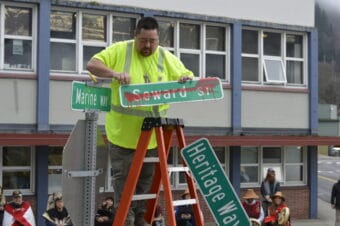
Part of a street in downtown Juneau will have a new name this fall. At a meeting Tuesday night, the city’s planning commission approved a request to change South Seward Street to Heritage Way.
The nonprofit Sealaska Heritage Institute made the request. SHI President Rosita Worl announced the proposal in April at a ceremony celebrating Kootéeyaa Deiyí, the totem pole trail installed along Juneau’s waterfront this spring.
“I think naming it Heritage Way really celebrates the heritage of Alaska’s first people,” Worl said at Tuesday’s meeting.
South Seward Street runs from Front Street to Marine Way, between the Sealaska Heritage Institute building, Heritage Square and the Sealaska Corporation headquarters.
“I would like to thank the city administration for all the support we’ve had as Sealaska Heritage Institute,” Worl said. “I think we’ve become a model for many communities in terms of the partnership between citizens, organizations and the city.”
Juneau’s City Hall is also on that street. The name change won’t go into effect until Nov. 1 so that it won’t interfere with voter information materials for the October election.
“We have to put out voter information as far as where to mail back ballots and also where voting locations are, which is City Hall,” said Jill Maclean, director of Juneau’s community development department.
The Sealaska Heritage Institute proposed renaming the part of South Seward Street that runs through its campus, between Front Street and Marine Way. (Katie Anastas/KTOO)
The city’s planning commission approves name change requests. The Juneau Assembly agreed to support the change last month. The city is the only other property owner on South Seward Street. Seward Street begins at the crosswalk between Heritage Coffee’s downtown cafe and Juneau Drug Co.
The planning commission unanimously approved the street name change.
“We’re headed in the right direction,” said Mandy Cole, who chairs the commission. “It’s a good day for Juneau.”
William Seward was the secretary of state in 1867 when the U.S. bought unceded Alaska Native land from Russia. In 2020, hundreds of people signed a petition to remove a statue of Seward near the Alaska State Capitol, saying the purchase of Alaska reflected U.S. imperialism.
Correction: A previous version of this story attributed the final quote to CDD Director Jill Maclean. It has been updated to attribute it to planning commission chair Mandy Cole.
Weaver and textile artist Lily Hope shows a group of students how to forage for horsetails near the Alaska State Museum in Juneau. They boiled the plants to make a natural dye. June 10, 2023. (Photo by Claire Stremple/Alaska Beacon)
Six pots full of natural dye bubbled on the back patio at the Alaska State Museum in Juneau — deep red beet, yellow wolf lichen, grassy horsetail, golden turmeric, brown coffee, and blue-violet cabbage. About two dozen kids from the community labeled small skeins of merino wool with their names and used sticks to dip them in the steaming dye baths.
Lily Hope, a Tlingit weaver and fiber artist, led Saturday’s workshop. She moved quickly through the students and dye stations, adjusting a burner here, complimenting a technique there. The workshop is one of the community learning events the Alaska State Library hosts to serve the state’s cultural and natural heritage.
Lily Hope adjusts the heat under a pot of natural dye at the Alaska State Museum in Juneau. June 10, 2023. (Photo by Claire Stremple/Alaska Beacon)
“I think that art is the core of who we are as human beings. Teaching children to have fun with art, keeping that enthusiasm and wonder, keeping that wonder going is key for me,” she said. “I’m also constantly looking for someone to step into my shoes.”
She said she keeps an eye out for anyone who really connects with the workshop, or has extra questions and interest.
Art, science, and culture
“We’re going to go on an adventure in a minute,” Hope told the workshop. “Then we’re going to talk about this red cabbage. It’s sensitive to pH changes, to changes in acid and base.”
Hope led the kids on a foraging walk to pick horsetails, fern-like plants that are native to the region, and begin boiling them for another dye color. Back at the museum, Ellen Carrlee, a conservator there and a natural dye researcher, showed the kids how to break the bushy green stalks into smaller pieces for better color extraction when they’re boiled.
While half the class followed Carrlee into the museum to take a look at different dye specimens and create an experiment to test how quickly different natural dyes fade with sunlight, Hope got back to the pot of cabbage.
She explained how the cabbage dye changes color if an acid or a base is added to it.
Skeins of wool yarn soak in natural dye baths made from red cabbage leaves. (Photo by Claire Stremple/Alaska Beacon)
“It’s a pH indicator,” one boy volunteered.
“Exactly!” she said.
The students divided the deep blue cabbage dye into three transparent buckets. They added vinegar to one, and it turned pink before their eyes. When they added baking soda to another, it turned green. Hope supplied a few more skeins of wool yarn, so they could dye them with the new colors.
While the students’ yarn soaked in the dye baths, Hope gave a mini weaving lesson. She taught them how to make tassels like those on Tlingit dancing robes, which have been woven and worn in the region for hundreds of years.
“I have to pass it on”
Hope is a weaver in the Tlingit styles of Ravenstail and Chilkat weaving, which she learned from her mother. She is one of only a few designers of dancing blankets. It was after her mother died that she fully accepted weaving and the passing of that knowledge as her life’s work.
“I love kids, and I love the sharing of knowledge — whoever the person is that wants to suck some of that up,” she said, as kids filed out of the patio dangling their tassels.
“We’re weaving history so that in 100 years, there’s a record that there were some humans here and we made some beautiful things,” she said. “It was left in my care. And I have to pass it on.”
The mood of the day was light, but in it was the thread of a bigger responsibility: that those who take on art leave something bigger than themselves behind.