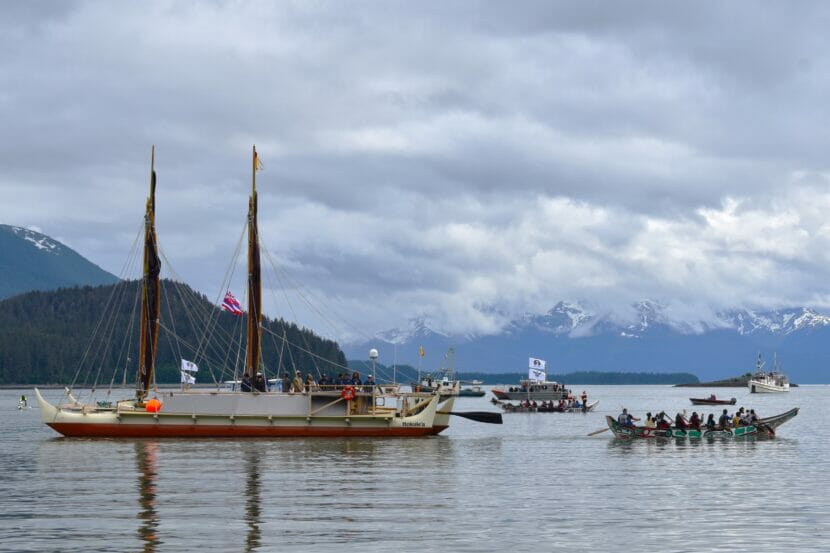
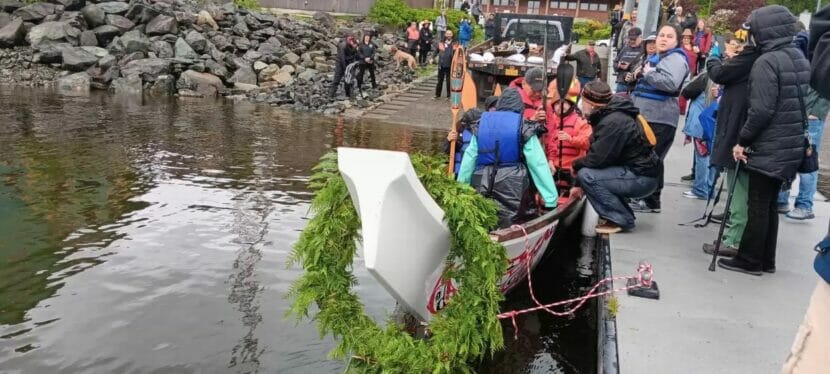
Yaakws greeting the Hōkūle‘a and its crew at Auke Bay. June 10, 2023. (Photo by Yvonne Krumrey/KTOO)
A thousand people gathered at Auke Bay in Juneau on Saturday to welcome the Hōkūle‘a and her crew to Juneau. Now, the crew is preparing to embark on a four-year journey around the world.
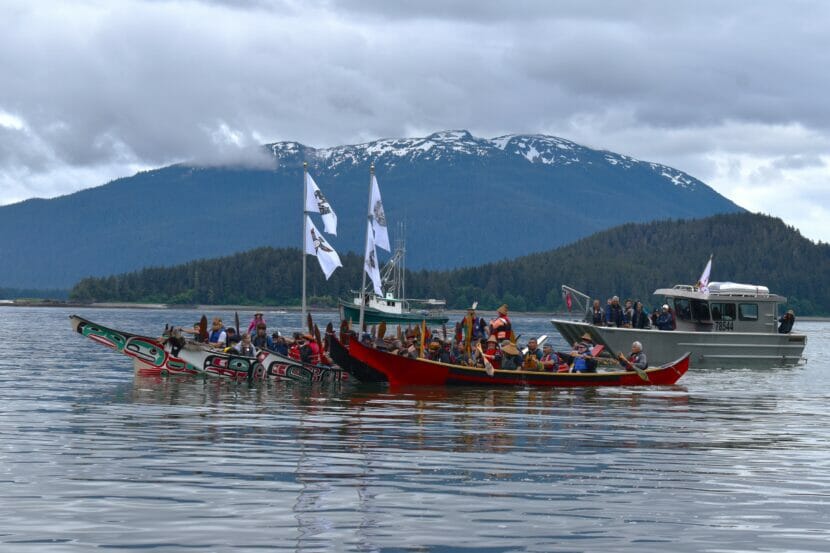
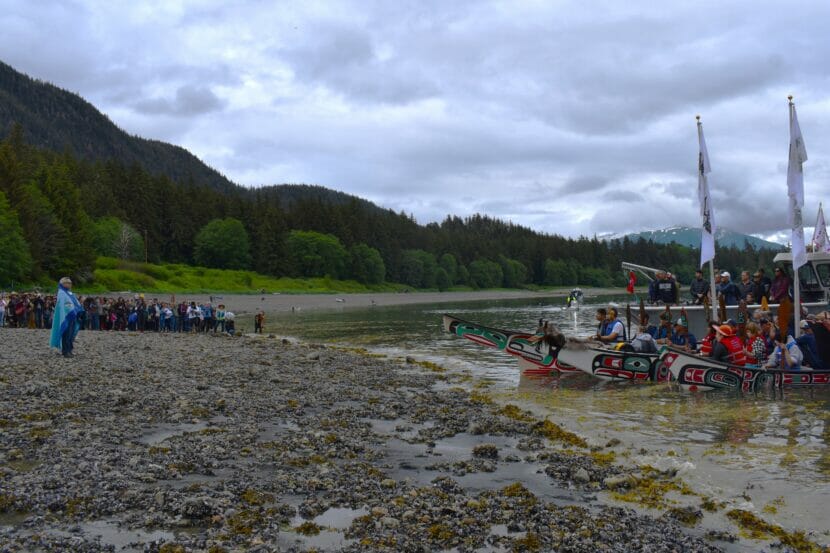
People on the shore heard Pu Kani — the sounding of the conch — as the twin-hulled, wind-powered voyaging canoe approached. Formline-painted yaakws brought the crew to shore as dancers performed in cedar hats and Chilkat robes.
Áakʼw Ḵwáan leaders welcomed the canoe to their homelands. Elder Fran Houston said the four-year journey will be special — and good for the communities it touches.
“It means a whole lot, a whole lot to everybody,” she said. “The connection is powerful. Everything right now is powerful. And I’m just real happy and just tickled pink.”
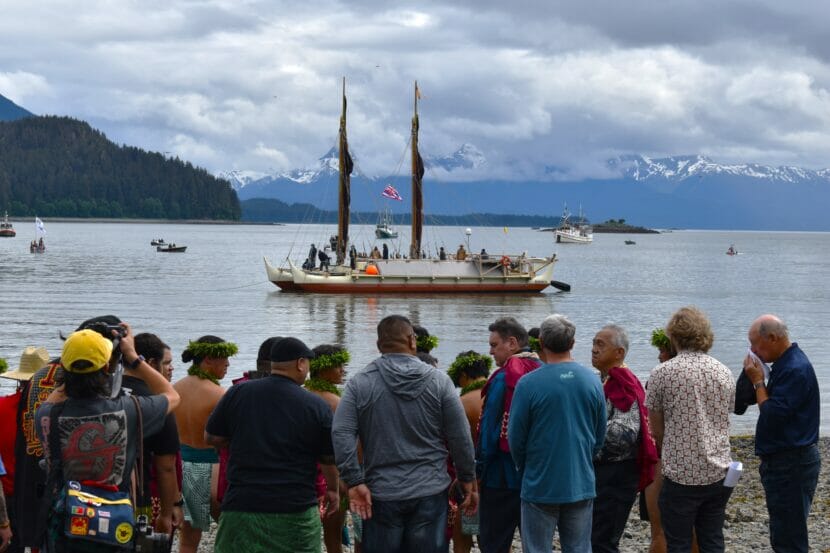
The crew of the Hōkūle‘a and their Southeast navigators lined the beach, facing the Lingít elders who came to greet them. Houston led a song she learned from her grandmother to the visitors.
“It’s with love,” she said. “And I love singing it and I’m surprised that I sang both verses twice.”
Members of the Hōkūle‘a crew look on from shore during the welcome ceremony at Auke Rec on June 10, 2023. (Photo by Yvonne Krumrey/KTOO)
The crew — some dressed in t-shirts and hats, others in leis and malo — returned the welcome with their own songs and chants.
The Hōkūle‘a was returning from a voyage to Yakutat and other Southeast communities. On Thursday, the crew will begin a more than 40,000-mile journey — called Moananuiākea — with a goal of learning about land stewardship and unity from Indigenous communities around the world.
The voyaging canoe first sailed in 1975, when members of the Polynesian Voyaging Society started relearning traditional navigation methods from masters who have since passed. This will be its fifteenth voyage.
Central Council of Tlingit and Haida Indian Tribes of Alaska President Chalyee Éesh Richard Peterson said these relationships are very important to Alaska Native people as well.
“It’s really us kind of reigniting old ties, building on old relationships that have gone back since time immemorial. Our people have circumnavigated the Pacific and the world, not just the Hawaiians, but Lingíts and Haidas as well,” he said. “And so we have these intergenerational relationships.”
Yaakws greet the Hōkūle‘a and its crew at Auke Bay on June 10, 2023. (Photo by Yvonne Krumrey/KTOO)
Chris Blake is a part of the crew that traveled to Yakutat. Back home in O’ahu, he teaches traditional, non-instrument navigation and wayfinding.
“It was beautiful. It’s a 30-hour journey, being in the inland areas,” he said. “And then, when we got out to the ocean, it’s definitely a lot colder than we were used to. But the amount of things that we’re seeing and the unfamiliarity with it — a lot of elders and people who are much more familiar with the area were there to guide us.”
Blake said he was energized by the navigation and voyaging skills shared by Indigenous Hawaiians and Southeast Alaska Natives.
“It was great to see the abilities that we have, and how they parallel a lot of the experts who are familiar with these areas,” he said. “A lot of our similarities are able to help us and to drive us into the things that we have to do.”
K’ aatl’ soon gaet James Jack. Sr., from the Wooshkeetaan clan and Eagle Shark House of Hoonah welcomes members of the Hōkūle‘a crew on June 10, 2023. (Photo by Yvonne Krumrey/KTOO)
Blake hopes to be chosen to continue to participate in the Moananuiākea voyage as it circles the earth.
The Hōkūle‘a will set off on its voyage around the world Thursday afternoon, and all are welcome to send them off. In the meantime, crewmembers will give tours of the voyaging canoe at Statter Harbor.
Thompson says the canoe gets stronger when people touch it.
The crew is giving tours of the Hōkūle‘a Monday afternoon until 4 p.m. The voyage sets off Thursday afternoon from Auke Bay and will air live on KTOO 360TV starting at 2 p.m.
Anyone is welcome to attend the send off from 2 p.m. to 6 p.m. Information about how to attend Thursday’s event can be found on Sealaska’s website.
Disclosure: KTOO was contracted by Sealaska to produced video coverage of the Hōkūle‘a arrival on Saturday and Thursday’s departure. This has no impact on news coverage of the event.
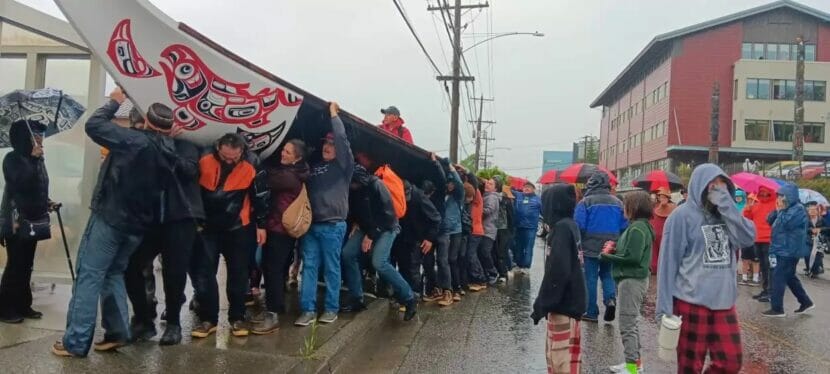
People work together to carry the canoe from Ketchikan Indian Community’s Tongass Ave. building to the Bar Harbor boat launch on Friday. (Raegan Miller/KRBD)
Pouring rain didn’t stop a special ceremony honoring a one-of-a-kind canoe last week. Tribal members and Ketchikan residents gathered to awaken and launch a canoe designed by a late master carver and artist who called Ketchikan one of his homes.
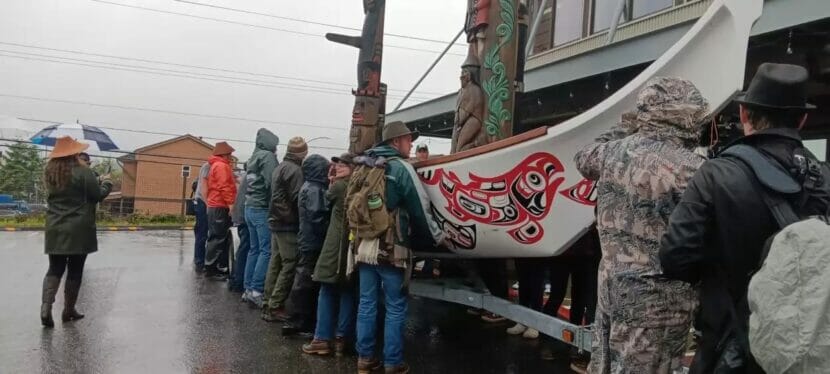
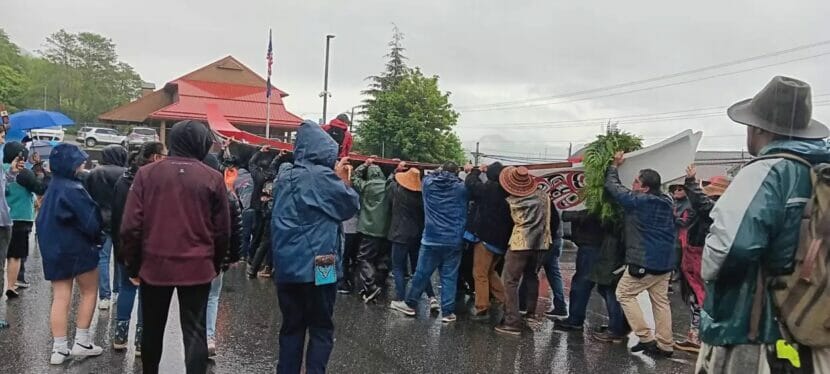
Dozens of people shouted in the Haida language as they heaved together, carrying the canoe to the Bar Harbor boat launch from Ketchikan Indian Community’s Tongass Avenue building. The canoe has a fiberglass hull with wood underneath, and is painted red, white, and black.A design of running salmon swirls around the canoe.
When someone grew tired, another stepped in. It’s a show of teamwork, and of strength.
People listen to instructions as they prepare to lift the canoe, named X’oots kuye’ik. (Raegan Miller/KRBD)
Earlier in the afternoon, a big crowd of tribal members and Ketchikan residents had gathered for an awakening ceremony. The canoe was designed by the late Marvin Oliver, Quinault and Isleta-Pueblo. Oliver owned Alaska Eagle Arts in downtown Ketchikan, but also had art installations around the world, in Canada, Japan and Italy. He was a professor and a curator at the University of Washington and the Burke Museum, respectively, and had won the Charles E. Odegaard Award from the University of Washington for his work in diversity.
Several speakers shared their thoughts during the awakening part of the ceremony, before the launching. They included Ketchikan Indian Community staff and tribal members, and Oliver’s family.
His wife, Brigette Ellis, stood in front of her husband’s creation alongside her family. She talked about respecting the canoe’s place in Indigenous culture.
“First thing I want to share with you is you never say the ‘B-word,’” Ellis said. “Okay? It’s spelled B-O-A-T. But we don’t say the ‘b-word.’ In traditional canoe culture, the canoe is always a canoe and never the ‘b-word’.’ It is said if a paddler speaks of the vessel as a ‘b-word,’ that paddler will be thrown into the water. You learn really fast to call it a canoe at all times.”
People start carrying the canoe, named X’oots kuye’ik, down the hill to the boat launch. (Raegan Miller/KRBD)
She said that Oliver felt connected to canoes because of his Salish heritage and his father’s role in the Paddle to Seattle.
“The canoe revitalization will empower the youth. That’s what he and I had in mind to carry these important traditions forward,” Ellis explained. “It’s the canoe that fosters a healthy sense of identity among young Indigenous people. Those youth that struggle emotionally come together and say, ‘canoe culture is a life changing event.’”
Oliver died in 2019. But the year before, the tribe’s council bought the canoe.
SaanuGa Gianna Willard was a big advocate for buying the canoe, according to a KIC statement. A former tribe president, Willard has taken 14 canoe journeys around Alaska, Canada and Washington.
“When she was KIC President, she made it her biggest goal to secure a canoe for the tribe, and purchased this beautiful fiberglass canoe designed by Marvin Oliver while he was still alive,” the statement from KIC reads.
People watch as the X’oots kuye’ik canoe is carried into the water near Bar Harbor boat launch. (Raegan Miller/KRBD)
Tribe leaders say that the canoe — and canoe journeys — advance’s the tribe’s strategic plan – which focuses on uniting the community and spreading culture.
Norman Skan is the Ketchikan Indian Community President.
“We already have our dance, we have our arts, we have our subsistence food,” he said. “And this is just another component of the wholeness that we are slowly becoming.”
The canoe also received its name.
Brothers Richard and Willie Jackson named the canoe X’oots kuye’ik, or Brown Bear Spirit. Willie Jackson explained their choice.
“He is your protector on the water,” he said. “He is your protector on this canoe.”
He led the crowd through a chant of the canoe’s name.
Those who will be paddling the canoe step in. Cedar boughs still decorate the canoe. (Raegan Miller/KRBD)
Before the canoe is carried into the water, there was drumming, singing, and an acknowledgement of the Indigenous people who have lived on the land since time immemorial. Adults lifted up children and help them drape cedar boughs on the canoe.
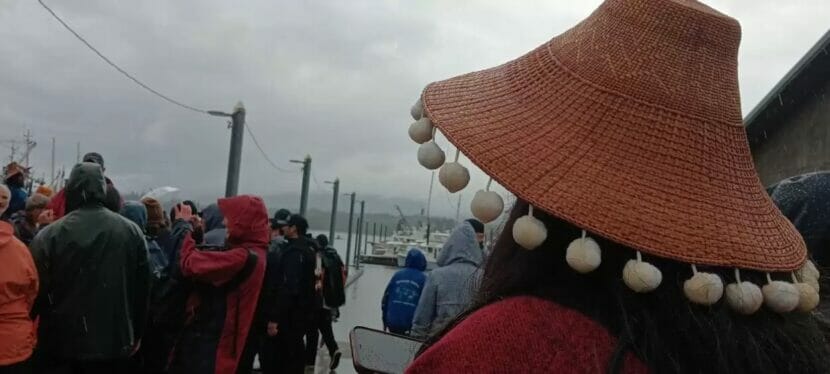
After the canoe was floating, the mood was joyous. There was dancing and singing. Some wore cedar hats and drummed, and others danced in their soggy jeans and sneakers.
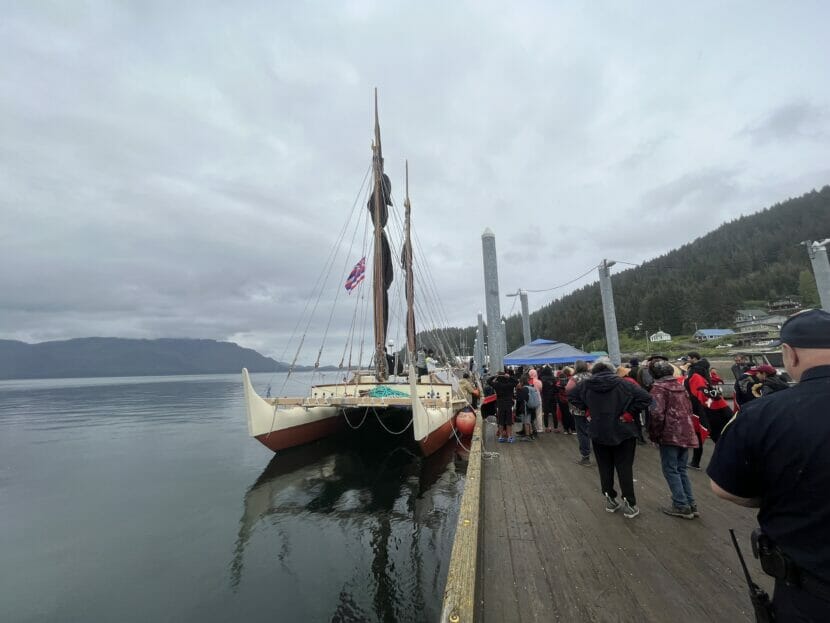
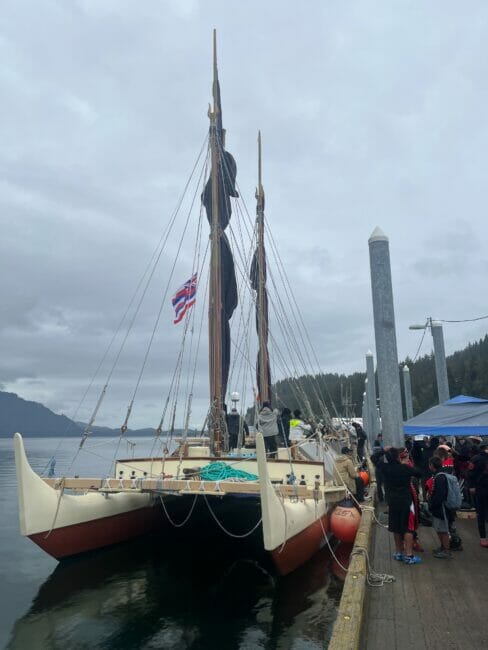
The Hōkūle‘a docked in Hoonah on June 1, 2023. (Photo courtesy of Carter Johnson)
A four-year voyage across the world starts in Juneau this month.
The Polynesian Voyaging Society will take the Hōkūle‘a — a twin-hulled, wind-powered canoe that was carved 50 years ago and has embarked on 14 voyages since — over 40,000 miles around the globe.
The journey is called Moananuiākea, and the crew’s goal is to learn about land stewardship and unity from Indigenous communities throughout the Pacific Ocean.
KTOOʼs Yvonne Krumrey spoke with Nainoa Thompson, president of the Polynesian Voyaging Society. He first came to Alaska looking for logs suitable for a voyaging canoe after a painful search in Hawaii came up empty.
Nainoa Thompson: We searched for nine-and-a-half months. And let’s see, we found trees big enough for the size that we needed to build the hulls of this canoe from our forests, but none of them are healthy enough. So what we found in our forests was a really sad story, that we can’t build a single canoe today. That 90% of our koa forests — the koa is the traditional preferred wood, hardwood, in Hawaii’s forest — 90% has been cut down and much of it’s been replaced by cattle.
Nine-and-a-half months, we couldn’t find these trees — we couldn’t find it. And it was like the first voyage that we took that we didn’t find our destination. And it was very painful to us.
Captain Vancouver, when he visited the Hawaiian Islands, wrote in his logbook that he measured a canoe that was 108 feet long on the island of Kauai, and it is twice the length of our canoe Hōkūle‘a. And it was made out of, in his writing, made out of the finest pine. Pine is not native to the Hawaiian Islands.
And so when he asked the chief where the trees come from, he said they came from the gift of the gods. They were driftwood logs. And we suspect these trees would have to be, because it was pine, from the Pacific Northwest. And then how I got involved was a single phone call from one of our elders who had a great friendship with one of the Lingít elders in Southeast Alaska. His name is Judson Brown.
And he just said, “Okay, we will get you two trees to build your canoe to carry your culture, but you need to talk to this man, to Byron Mallott, who is the CEO of Sealaska.” And on that phone call, I wasn’t there. But I was told that Byron basically said, “Okay, we’ll give you the trees,” but he had three conditions.
And one was, you know, don’t ever ask us how much it costs, then it’s not a gift. And he said, “Don’t ever bring these trees back. Once we give it to you, you are responsible for those trees.” And his third comment was that “We’re not giving you trees and just wood. We’re giving our children … Our relationship over 12,000 years in Alaska is about making sure that things in the forest and the oceans are family, so we take care of them.”
That was a profoundly important statement as to why we’re there now. It’s about celebration of family.
Ernie Hillman took a tape measure out and measured the tree and said, “Look, this tree, we found it for us your specifications, this is what you wanted.” And he was stern with me and strict and I really appreciated that.
And then he says, “Shall we cut it down?” And I told him “no.” And so he got more quiet. I did too. I flew back home to the board of directors in Honolulu. And this is the difference. Yeah, the board of directors get their monthly pamphlets, and all they see is a project and wood.
But what I saw was the difference between what’s wild and what’s full of life, and what’s still free and powerful of the Alaskan forest compared to the depression of ours. And I just couldn’t cut the trees down.
The ability to take the trees required the Alaskans and Hawaiians and people in Hawaii come together, and they start replanting our forest. So the Alaskans came to Hawaii, and for one weekend, we planted 80,000 koa trees, fenced it off to keep the pigs and the cattle out. And in that forest, it’s just a promise, right? We made a promise.
Yvonne Krumrey: One question I had that stood out to me from things I’ve read so far about the trip up to Yakutat is that that was the first time they welcomed a yaakw, or canoe, in 100 years. And I think this voyage sits at this really interesting moment in Southeast Alaska where Lingít people are starting to have these experiences and moments that they’re building and working towards that they haven’t had in 100 years.
So can I ask, why start from Juneau? Why go up to Yakutat before this journey?
Nainoa Thompson: We view — and Alaskans view — that the ocean is what connects us, and that we’re all Pacific Ocean’s people. And we are family of the ocean, and that we are family with each other.
I want to come to Alaska, I want to capture their stories, I want them to tell us about their genealogy of 12,000 years, and how they figured out all the things that we can’t in the modern day, like sustainability, and balance and so forth. How did they do that? Because the evidence is that their country, Alaska, is in relative terms compared to a place like Hawaii, extraordinarily healthy.
I look in Alaska, all I see is life, where I don’t in Hawaii anymore. So in our opinion, Alaska is an extraordinary school.
Yvonne Krumrey: What’s unique about the Hōkūle‘a?
The Hōkūle‘a docked in Hoonah on June 1, 2023. (Photo courtesy of Carter Johnson)
Nainoa Thompson: She doesn’t have any motors, that’s for sure. But she would be the first canoe that was constructed — best guess, there are no blueprints left anymore. Enormous amount of research back in the early 70s to come up with a design of what the voyaging canoes might have been like.
She is powered by the wind solely. We have no engines. But what’s most unique about this canoe, it carries the students of the earth. And what it does, it allows us to go into nature, and try to find our way by just being a part of nature.
They found a man by the name of — his name is Piailug, but the nickname is Mau. He came to Hawaii, agreed to sail in Hōkūle‘a with a crew heʼs never met, and go on a voyage six times longer than any voyage heʼs ever taken. On a canoe that’s eight times bigger, and it would cross the equator, he’d see southern stars that he’s never seen before. And he’s going to find that island by using nature. And he did 31 days later, from leaving Maui on May 1, 1976, 31 days later they arrived in Tahiti, a miracle. But why is Hōkūle‘a so, so unique because it carried the master Mau, found Tahiti and changed the Pacific world. Navigation, voyaging is taught all over the Pacific now because of that man.
I mean, Yvonne, we didn’t know anything. We didn’t know how to sit, we didnʼt know how to stand, we didn’t know how to look, we didn’t know how to sleep, you know. We didn’t know anything, nothing. And so all we did for 25 years is watch him and talk to him and be with him.
He told me, he laughed at me and goes, “You know, I want to take you back to my islands (the Carolines in Micronesia), and half the people are gonna like you and half the people are not gonna like you because I give you the navigation.” But what he was saying was, “I give you the navigation and you have responsibility to this navigation.” And that responsibility — ultimately very simple — is to teach. Because we have learned over time, that the way you stop extinction is to make your students better than you. Thatʼs how you stop it.
Yvonne Krumrey: Can I just ask — are you nervous at all?
Nainoa Thompson: I’m always scared. I’m not a courageous person. And the triggers to get me to commit to something of this kind of risk … The big question always, always, “Is your purpose and your intent greater than the risk you’re putting people in?”
There’s two key pieces: training, and then the other is having the intelligence about nature in a changing, hot world, on a hot earth.
But here’s where I get scared. Because these young people I talked about, if I asked them, “Hey, you want to go, you want to sail from the Cook Islands in New Zealand through into Intertropical convergence zone?” They’re gonna say yes, because they believe in two things: One is that they’re going to be part of something much greater than themselves; and two, it’s safe, because leadership would never ask them to go if it wasn’t safe. That’s why I’m scared. I’m scared, because they would go, they would blindly, blindly go.
So we’re gonna watch it and — and make the right decisions.
Thompson says there will be chances to tour the Hōkūle‘a while it’s in town. He says the canoe gets stronger when more and more people put their hands on it.
The Hōkūle‘a returns to Juneau on Saturday, June 10 at Auke Rec and sets off on its voyage on Thursday, June 15. The arrival will air live on KTOO 360TV starting at 3 p.m. Information about how to attend Saturday’s event and the global launch on Thursday can be found on Sealaska’s website.
Correction: This story has been updated to reflect that the Hōkūle‘a is twin-hulled, not double-hulled.
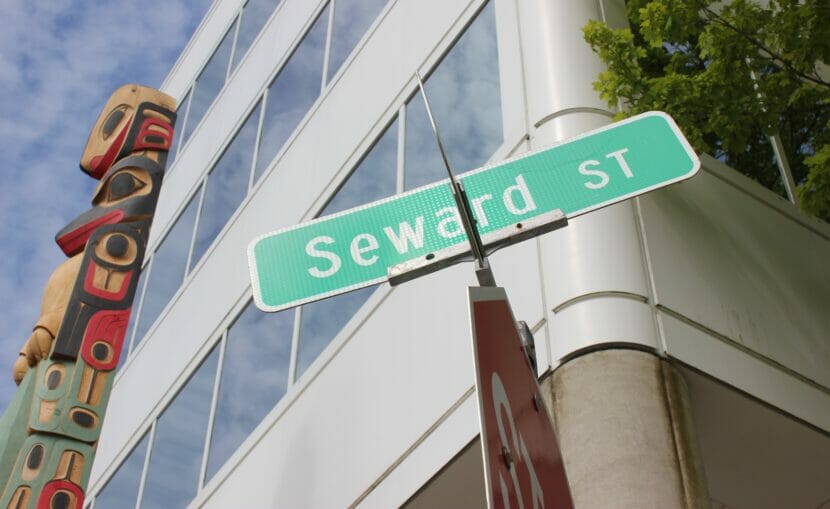
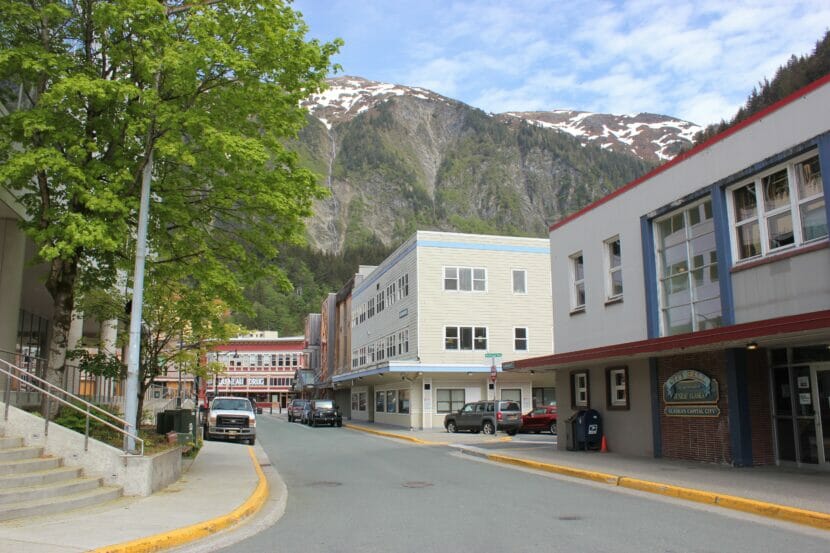
The Sealaska Heritage Institute has proposed renaming the part of South Seward Street that runs through its campus, between Front Street and Marine Way. (Katie Anastas/KTOO)
The Sealaska Heritage Institute has proposed renaming the part of South Seward Street that runs through its campus.
President Rosita Worl announced the proposal in April at a ceremony celebrating the installation of Kootéeyaa Deiyí, the totem pole trail along Juneau’s waterfront.
“The city recommends that we have a community meeting to discuss the proposed change,” Worl said to the crowd. “I would say that our citizens here today constitute a community meeting.”
Worl handed Deputy Mayor Maria Gladziszewski an application to rename the part of the street between Front Street and Marine Way to Heritage Way.
The Sealaska Heritage Institute has proposed renaming the part of South Seward Street that runs through its campus, between Front Street and Marine Way. (Katie Anastas/KTOO)
According to city code, applications to change street names go through the city planning commission. The process includes a public hearing. If the commission approves the name change, SHI will be responsible for replacing the street signs.
A change in street name also requires approval from the majority of property owners there. On that part of Seward Street, the only other property owner is the city.
At a Juneau Assembly committee meeting Monday, Assembly member Wade Bryson said he wanted to know how much it would cost to change City Hall’s address on official documents.
“There is a cost to this,” he said. “I’m interested in what SHI is trying to do, but at the same time, if it costs us a million dollars to properly re-address all city functions, we have to have a real conversation about that.”
City Manager Rorie Watt said the cost would be minimal.
“It’s not like we have reams and reams of pre-printed paper that we’re putting in typewriters,” he said. “There will be a transition – as people order new business cards and things, we can update it – but I don’t see a reason we need to throw out perfectly good stationery.”
Assembly members agreed to support renaming South Seward Street between Front Street and Marine Way. The proposal now goes to the Planning Commission.
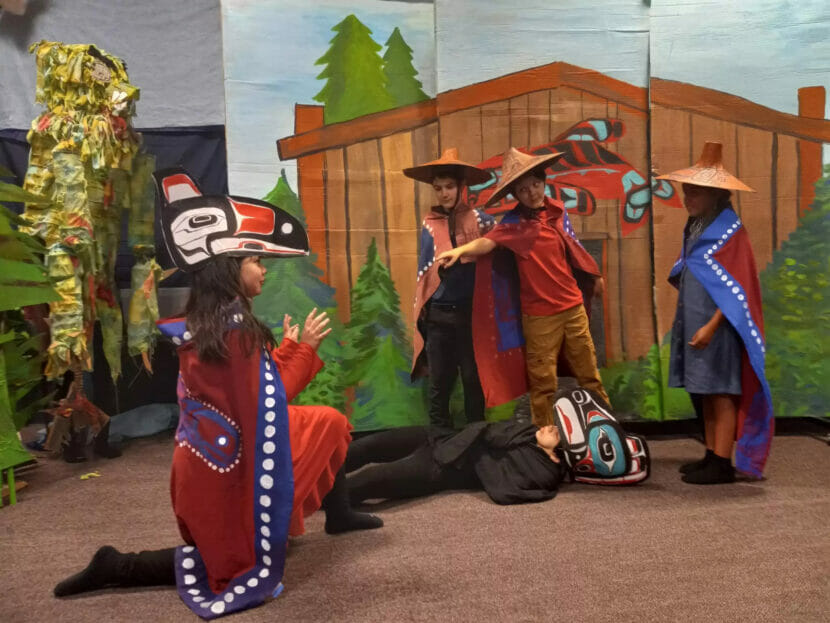
From left to right, Madison Ryan, Chance Side, Isaak Simerly, Mallory Willard Flanery and Olivia Heisler Hinahon act out a scene in “How Devil’s Club Came to Be.” (KRBD photo/Raegan Miller)
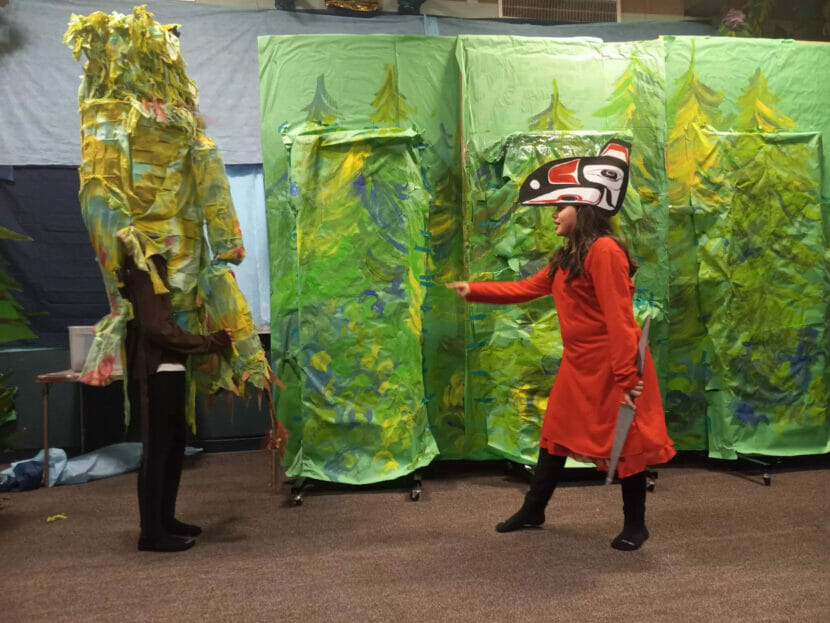
Two Indigenous stories came to life on stage at Ketchikan Charter School. Students turned “Killer Whale Eyes” and “How Devil’s Club Came to Be” into short plays featuring handmade props and formline the students learned from an artist-in-residence.
Paddling a cardboard canoe, the student actors are exploring the ocean. They’re looking for their classmate, the one who turned into a killer whale. Pods of hand painted cardboard orcas bob and weave in an ocean of royal blue cloth shaken by the students.
In another play, a student fights a monster who is stealing their tribe’s shaman. The heroine visits the Thunderbird people. She defeats the giant.
Then the metaphorical curtain came down, and they were all kids again, acting out traditional Indigenous stories as plays. The stories, written in those forms by Sondra Segundo and Miranda Rose Kaagweil Worl, are part of Sealaska Heritage Institute’s Baby Raven Reads program.
Halli Kenoyer is an art teacher at Charter School. Her class designed the props, and drama students in Erin Henderson’s class wrote the scripts. She applauds the students’ work.
“I mean, look at their formline,” Kenoyer commented.
Student Amelia Loeffler helped make a lot of the props — she proudly states she learned how to use an Exacto knife. Loeffler says her favorite of the two plays is “How Devil’s Club Came to Be.” That story follows Raven’s niece as she battles a giant who had been taking the village shaman. She discovers devil’s club and its medicinal properties along the way.
Sophia Weston and Madison Ryan act out a scene in “How Devil’s Club Came to Be.” (Raegan Miller/KRBD).
“It’s sort of fun to see how different cultures are,” she said.
Riley Presnell also helped bring the scenes to life.
“I think I really like painting,” he said. “I really like painting the canoe. I really liked painting the blanket.”
Kai Clevenger, a Lingit student, is the daughter of Kevin Clevenger, the school’s artist-in-residence. She helped create the formline that appears on the props. The seventh-grader says it’s important to her to see her culture taught and celebrated in school.
“I like how my culture is communicating with other, like, stuff now,” Clevenger explained. “And l like how my culture is like out there now.”
Student Ryan Boling also worked backstage. He says the fact that they’re traditional stories is what makes it special.
“I feel like Native stories need to get out there more than they are,” Boling said.
Bringing the stories to the stage was a community effort, Kenoyer says, with help from Ketchikan’s tribe staff. That included Irene Dundas, Ketchikan Indian Community’s cultural resources coordinator.
Fourth- and fifth-graders were able to pitch in, too. Kenoyer says the school’s artist-in-residence had taught the younger kids about formline design, which came in handy.
“And when we ran out of time to work on our props, fifth grade and fourth grade did our designs on the paddles, they worked on the button blankets,” she said. “They worked on the designs for all of the hats. And it was all on account of working with Kevin Clevenger that they knew how to do this. They were really excited to participate.”
That was one of the most satisfying parts of the production process, Kenoyer says.
“It was really cool to see that just that ripple effect of a really great program come into play in our little theater project,” she added.
The students performed their plays for classmates and community members, including the staff of Ketchikan’s local theater. They received a rowdy chorus of applause.
Jade T. Wren, Service High School graduate, walks on stage to recieve her high school diploma on May 18, 2023. (Mizelle Mayo/Alaska Public Media)
Anchorage School District students no longer have to wear a typical cap and gown to their high school graduation. Now, they can wear any form of cultural regalia.
Jade Wren was among the students who graduated this week and took advantage of the updated policy. She’s Inupiaq and spent time growing up in Kotzebue and Dillingham. She walked across the stage at the Alaska Airlines Center Thursday wearing a Kuspuk, instead of the common graduation gown.
In the days leading up to her graduation, she said she felt proud that she could show her Inupiaq heritage during the ceremony.
“I will be going in a lot more confident and a lot more happy than just, ‘Oh, it’s graduation day, I’m going to grab my diploma and leave,’” she said. “It’s going to be a lot more, and also the stuff that I wear will be more memorable.”
Wren also wore sealskin slippers. Her graduation cap had sealskin and jade fastened to the top. And it was bordered with green and yellow beadwork — Service High School’s colors. Wren said Indigenous women in her life gifted her many of the items she wore.
“Just showing off who I am and my culture and also the people that again have helped me get to where I am,” she said.
Wren is one of about 8,000 Alaska Native students in the district.
Paul McDonogh, supervisor of the district’s Indigenous education program, said the Native Advisory Committee suggested the updates to the regalia policy, which allow students to ditch the traditional cap and gown. Also, they no longer need to get their regalia approved by staff. It’s the third time the district has revised the policy in five years.
“Our intention is to really allow traditional ceremonial expressions that groups of people have always done to celebrate rites of passage and to bring them here,” he said.
The district’s policy update also follows a parallel, statewide push to allow regalia at public ceremonies. The Alaska Legislature passed a bill in 2019 mandating that state agencies, universities and schools allow tribal regalia or objects of cultural significance at public events, including graduation ceremonies.
McDonogh said, as a result of the district policy, he has noticed students from different cultures taking an interest in learning more about their heritage and connecting with their elders and family members. He said the decision to drop the permission form for cultural regalia stemmed from a desire to build trust with students and families.
“There’s a spiritual impact of this that I think is really awesome,” he said.
Close
Update notification options
Subscribe to notifications
Subscribe
Get notifications about news related to the topics you care about. You can unsubscribe anytime.