Alaska Native Arts & Culture

Students in UAS Northwest Coast Arts program will showcase their work on Friday

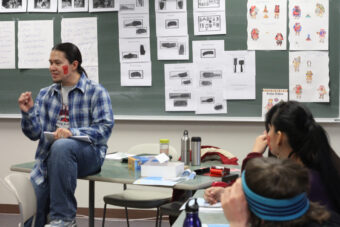
Lukwil Gatgyeda T’aamtsooyax James Williams shows the work he’s completed in Wayne Price’s beginning carving class on April 18, 2023. (Photo by Yvonne Krumrey/KTOO)

The University of Alaska Southeast will showcase student work made in the school’s Northwest Coast Art program this Friday.

Earlier in the week, students were making paddles in a basement workshop on campus. Lukwil Gatgyeda T’aamtsooyax James Williams was working away at one for master carver Wayne Price’s class.

“I can’t quite get it to look the way I want it. So I’ve been fiddling around with it. And different designs,” he said.

Several of Price’s beginning carving students were working intently, hunched over their paddles with chisels or paint brushes. No one was chatting.  

Price says they’re almost ready to show their work.

“Everybody’s counting how many days to go and how much work they got to get done,” Price said over the sound of carving. 

Guná Megan Jensen’s project is already finished. She’s an instructor in the Arts department but took Price’s class because she admires his work.

“Because he’s a boss. He’s the best,” she said.

Guná Megan Jensen paints a paddle that Wayne Price carved on April 18, 2023. (Photo by Yvonne Krumrey)

Price said the students have been putting in a lot of hours out of class, too. And he says the weekend show offers a good chance for them to learn how to present their work

“Based on my own personal experiences, doing art shows, they’re tough,” Price said. “Some people are really, really good at it. But it didn’t happen right away, for me. It was a slow climb to the top.”

Price’s advanced class will bring their work too, including masks and clan hats. 

The gallery is open to the public from 4 to 8 p.m. on Friday in Egan 225 in same building as the UAS campus library. 

A dozen new totem poles will be dedicated in Juneau on Saturday

A totem pole carved by Gyibaawm Laxha David Robert Boxley is raised at Overstreet Park for SHI’s Totem Pole Trail on April 16, 2023. (Photo by Bostin Christopher/KTOO)

Sealaska Heritage Institute has begun raising poles for its Kootéeyaa Deiyí, or Totem Pole Trail.

When it’s finished, 30 poles will line Juneau’s waterfront. On Saturday, the first 12 poles will be dedicated by representatives of the clans and tribes depicted on them. 

One of those poles, carved by Gyibaawm Laxha David Robert Boxley, represents the Tsimshian people. He watched on SHI’s Facebook stream as it was raised Sunday at Overstreet Park. 

“It went up a little earlier than it was going to. I’m flying up there tonight,” Boxley said. “There’s a couple of pieces I have yet to glue on.”

He said he doesn’t envy the organizers, who are rushing to get all the poles up by Saturday. 

Boxley has been carving since he was 6 years old, and he’s carved nearly 30 poles in his life. Some are in places like Disney World and Washington D.C., but many are in his hometown of Metlakatla.

A totem pole carved by Gyibaawm Laxha David Robert Boxley is raised at Overstreet Park for SHI’s Totem Pole Trail on April 16, 2023. (Photo by Bostin Christopher/KTOO)

Boxley said carving a pole that represents all Tsimshian people was no simple task.

“They’re in order top to bottom of — the Killer Whale clan was first and then the Ravens and the Eagles and the Wolves,” he said. “So in the origin of our people, that’s it, it was a way to tell Tsimshian history and make sure everybody was represented.”

Boxley said he’s grateful to be a part of the project, with so many carvers he respects and admires. 

“Through everything we’ve been through, the artists made this comeback, along with our culture and the strength of the civilization of Northwest Coast Native peoples,” he said. “And I think it’s beautiful to be part of.”

The dedication will be held at 11 a.m. on Saturday at SHI’s Heritage Plaza in downtown Juneau. 

This story has been updated with the Lingít name of the trail.

High fashion at high latitudes: Event showcases Indigenous design

Models at Thursday’s Far North Fashion Show wear traditional parkas designed by Mary Ann Lomack, at right. From left are Karen Lomack, wearing a creation of model Mary Ann Lomack; and four others wearing creations of designer Merna Wharton. Those model are Helen Lorrie Wharton, who is carrying Tiara Konig; Lanakila Wharton; and Maisha Ivanoff. At far right is the designer, Merna Wharton. (Photo by Yereth Rosen/Alaska Beacon)

The fourth annual Far North Fashion Show held last Thursday drew a packed crowd to the Anchorage Museum of History and Art.

The event showcases Indigenous designs that are traditional, contemporary and a blend of the two. It has become a highlight of the three-day Arctic Encounter Symposium, a conference that this year drew nearly 1,000 participants from more than two dozen countries. Among the participants were ambassadors from Arctic and non-Arctic nations, prominent Arctic scientists and members of Congress.

Models dressed in traditional and modern designs strut the catwalk in front of photo-snapping spectators at the fourth annual Far North Fashion Show held at the Anchorage Museum of History and Art on Thursday. The fashion show is part of the Arctic Encounter Symposium, an international conference held last week in Anchorage. (Photo by Yereth Rosen/Alaska Beacon)

The Far North Fashion Show provided a break from the policy discussions.

Models strutting the catwalk at this year’s event wore parkas, dresses and other items designed by Corrine DannerAlannah Jones, Diana Martin, Cara Qaulluq McDonnell, Merna Lomack Wharton and Jackie Qataliña Schaeffer.

Members of the Tanam Anĝii Collective, an Unangax̂ dance group, strike poses after performing at the Far North Fashion Show, held Thursday at the Anchorage Museum of History and Art. (Photo by Yereth Rosen/Alaska Beacon)
Violet Seinsmeyer models a contemporary dress at the Far North Fashion Show held Thursday at the Anchorage Museum of History and Art. The dress was designed by Jackie Qataliña Schaeffer. (Photo by Yereth Rosen/Alaska Beacon)

The designers are experienced. Some have their own clothing businesses. Wharton is a celebrated Yup’ik skin-sewer and Schaeffer, who is Inupiat and is director of climate initiatives at the Alaska Native Tribal Health Consortium, holds a fashion degree from the American College in London.

The show closed with a performance by the Tanam Anĝii Collective, an Unangax̂ group.

This story originally appeared in the Alaska Beacon and is republished here with permission.

Correction: Designer Cara Qaulluq McDonnell’s name was misspelled in an earlier version of this article.

Gold Medal basketball tournament returns to Juneau after pandemic hiatus

U.S. Rep. Mary Peltola put up the ceremonial jump ball for Kake’s Rich Austin (15) and Hoonah’s Albert Hinchman (22) during their Masters Bracket game in the Juneau Lions Club 74th Annual Gold Medal Basketball Tournament, Sunday, March 19, at the Juneau-Douglas High School: Yadaa.at Kalé gymnasium. (Klas Stolpe/For the Juneau Empire)

The Gold Medal Basketball Tournament was a familiar favorite for Southeast Alaska athletes for decades, until the COVID-19 pandemic hit the pause button. Last week, players took to the court at Juneau-Douglas High School: Yadaa.at Kalé for the first time in four years. 

Reporter Klas Stolpe covered part of the tournament for the Juneau Empire. He spoke with KTOO’s Chloe Pleznac about some of the highlights and history of this beloved event.

This interview has been edited for length and clarity.

Chloe Pleznac: Thank you so much for joining me today to talk about the Gold Medal basketball tournament last week. I wanted to start off just by asking how many teams participated in the tournament and where were they from?

Klas Stolpe: Well, they have four brackets and there’s a B bracket, a C bracket, Masters bracket and women’s bracket. And so you have eight teams in the B bracket, eight teams in the C bracket and six teams apiece in the Masters and women’s bracket. And they come from all over Southeast. You got Angoon, Haines, Hoonah, Hydaburg, Juneau, Kake, Metlakatla and Yakutat and Hydaburg. Usually don’t get a Juneau team in, usually if someone drops out at the last minute. And in this instance, I think Wrangell backed out of their entries, just couldn’t find enough players. 

Chloe Pleznac: So how did it go over the week who came out on top?

Klas Stolpe: Well, in the B bracket, which is kind of the more elite players. The entry from Juneau won this this bracket, then they defeated perennial power Hydaburg, and it was awesome, awesome tournament games in the beat all year long, all tournament long, I should say. And Juneau won 86 to 62 in the championship game. The C bracket which is 32 years and older, again, the FilCom Juneau team defeated Klukwanw 79 to 49. And the Masters bracket which is 42 years and older, Hoonah defeated the Juneau team 64 to 43. And in the women’s bracket, Prince of Wales defeated Yakutat 79 to 38. And of course, there’s interesting stories in every bracket, which makes the tournament a lot of fun if you’re a media person. 

Cassie Williams is congratulated by her mother Ann after winning the Women’s Bracket championship and Most Valuable Player honors, Saturday, March 25, during the Gold Medal Basketball Tournament at Juneau-Douglas High School: Yadaa.at Kalé. (Klas Stolpe/For the Juneau Empire)

Chloe Pleznac: Well, that’s awesome. Was there any cultural significance that you noticed while covering this event?

Klas Stolpe: It’s funny because in Southeast Alaska, culturally, basketball has always and probably will always be just huge. I myself, you know, grew up in Petersburg, Alaska, before the internet age and before cell phones, and I still have lifelong friends that I’ve met across Southeast through basketball. Its course is really big in rural Alaska and the small communities and larger ones. They always share common courts when they play. Originally this tournament started in 1947. A Boy Scout executive for Southeast Alaska, his name was Dell Hanks, he had traveled all around Southeast on his missions, and he noticed how big basketball was. And he was talking to the Juneau Lions Club and they got this idea to start this tournament. So that said, it slowly gathered, it steamrolled over the years into this major tournament. And while it originally started with community pride, and gathering and seeing opponents and old friends again and again, and establishing and strengthening relationships. You usually at these tournaments, will have a couple of special activities during the week there. You know, there’ll be a Native dance group, a local cheerleading group. There’s usually a welcoming blanket dance where the names of every tribe are pronounced out and people in the stands will come down and of course, we always have frybread that’s passed out and the lobby is filled with vendors and the stands with fans and, of course, there’s some thick skinned referees. So yeah, it becomes a huge fun event.

Chloe Pleznac: Was there anything that surprised you covering this?

Klas Stolpe: Cassie Williams, she was the MVP of the women’s bracket. And she remembered when I interviewed her, she remembered traveling to the tournament as a kid and watching her mom and play and win a women’s championship. And now it’s 20 years later, and two of her mom’s teammates were on this year’s team. And her mom was in the stands watching Cassie win a championship so that was cool. Wow. And and then, in Juneau, do you notice FilCom a guy named Alex Heumann dreamed of winning a gold medal championship with his youth and high school teammate Larry Cooper. Plus he was playing for a family member who had passed and so they won a championship together. And Metlakatla’s Willie Hayward, who is just an icon in Southeast basketball, he was playing with his son. And Hydaburg’s Matt Carle – who was another icon and now he’s, he’s moved to Juneau – he was playing with his son Jaren on the Hydaburg team. You get all these little. I mean, it’s just families gathering, and very good competition. Hydaburg, Vinnie Edenshaw, I mean, he’s the smallest player on the court. But he was the tournaments, leading scorer. And there’s a great game well, Hydaburg defeated Angoon in a double elimination game was double overtime. And Hydaburg trailed by two points with .03 seconds remaining in the game, and the aforementioned Edenshaw on the line. So everyone thinks he’s going to tie this game up. But he misses the first free throw, so he had to miss the second, and the ball bounced back out and was tipped in the air by his teammate, George Peratrovich. And it tied the game and ascended into the second overtime and Hydaburg advanced. So that was pretty cool.

Chloe Pleznac: Wow, that is pretty cool. Thank you for telling that story. And thank you so much for taking the time to speak with me. I really appreciate it.

After a decade away, dancers from St. Mary’s return to Cama-i

Moses Paukan Sr.’s wife receives a plaque in his honor from Cama-i Dance Festival organizer Linda Curda. (Katie Basile)

It’s the opening night of the annual Cama-i dance festival in Bethel, and most of the members of one of the featured dance groups aren’t here yet.

Inside the Bethel Regional High School green room, where dancers wearing qaspeqs and fur-lined headdresses gather to prepare for their performances, St. Mary’s dance group leader George Beans is trying to buy more time.

“The plane just got to St. Mary’s,” he tells festival organizer Linda Curda. Weather delayed the afternoon flight, which was scheduled to bring about half of the dancers from the Yukon River community.

Glancing at the printed schedule, Curda does some mental math. St. Mary’s was meant to be on stage already, but she moved up the Marshall dancers. Maybe she can move another?

“Ok, so guess what? I’m going to go talk to these guys and see if we can get them to move up,” Curda tells Beans.

St.Mary’s dancers perform at the 2023 Cama-i Dance Festival. (Katie Basile)

Travel hiccups are just another part of life on the Yukon-Kuskokwim Delta, and the St. Mary’s Dancers are used to delays at this point. Cama-i announcers said that they’re one of the oldest dance groups in the region, but it’s been over a decade since they’ve danced at the annual event.

This year’s event is the first full-scale festival since 2019, and it’s dedicated to Moses Paukan Sr., who helped start the St. Mary’s dance group about 50 years ago. He was also a former state representative and longtime school board member in St. Mary’s.

Paukan died in 2017 and was meant to be recognized at the 2020 festival, but it was canceled due to the COVID-19 pandemic. His wife, Martha, and some of his children traveled to Bethel to receive the dedication.

“We’ve been put off for five years, so now it’s got to be the real deal now,” Beans said.

Luckily, Cama-i’s organizers are no strangers to improvising. After rearranging the dancer schedule and inviting a few unplanned speakers to the stage, they’ve just about exhausted all their options when Curda takes the mic.

“Guess what? St. Mary’s is here!” she tells the packed auditorium. Applause erupts as dancers and drummers pour onto the stage. Without pausing, they take their places and the yuraq begins.

One of the songs they perform was written by Paukan Sr.: “Ataki Tang Wiinga.” He wrote many songs for children and encouraged the youth in his community to continue dancing. Today, the dance group he founded 50 years ago has more than 20 members, from youth up to Elders, including his wife and some of his children and grandchildren.

St.Mary’s dancers perform at the 2023 Cama-i Dance Festival. (Katie Basile)

Isabella Peterson is 16. This was her first Cama-i. She wasn’t on the plane that was delayed, but her grandmother was. Despite all the stress earlier in the day, she said that it was all worth it to step out on the stage in Bethel.

“It feels pretty amazing to dance in front of many other people and to see other dance groups dance and perform,” Peterson said.

Pausing from her dancing, Martha Paukan accepted a plaque for her husband and led the room in the Lord’s Prayer by way of thanks. The audience, young and old, joined in.

“Your legacy, Moses, your spirit lives on in the dances of St. Mary’s,” Curda said during the dedication.

Artists worry that proposed changes to Southeast Alaska sea otter hunting rules could threaten traditional craft

Artist Christy Ruby sits for a picture with her colored sea otter in her studio on March 2. (Eric Stone/KRBD)

Christy Ruby stood by a table piled with blue, red and purple sea otter pelts in her Ketchikan studio. These are her bestselling colored sea otter. Since 2017, she’s used the dyed fur in her traditional handicrafts. She sells her creations online and at local craft events.

“I use them sparingly because it costs twice or three times as much to have them dyed that color,” she said.

She says the rich colors are what make her creations unique. She’s grateful for her ability to hunt the animals, but worries that efforts to reform sea otter management could jeopardize her business and traditional craft.

Sea otters are a keystone species, protecting vital kelp beds, but they also prey on crab and clams that make up lucrative fisheries. They’re protected by federal law, and only certain Alaska Native people can hunt them.

Southeast’s otters were driven to near-extinction by the fur trade in the early 20th century, but their numbers have grown considerably since they were reintroduced in the 1960s. And as the population has grown, so have calls to loosen the strict federal rules protecting them. And that has some artists and hunters concerned.

To be clear, scientists aren’t sure that otters are overpopulated in Southeast Alaska. There are now more than 25,000 spread throughout the panhandle, and one 2019 study estimated that the region’s ecosystems could support three times as many. But that hasn’t stopped efforts to reduce their numbers.

Ketchikan’s Borough Assembly recently took the topic to lawmakers in Washington, D.C., asking for control of the federally managed species to be turned over to the state, or for current regulations to change. Petersburg’s assembly called for higher harvests in 2018. And the late congressman Don Young attempted to make it easier to sell intact hides.

Proponents say increasing sea otter hunting would help bolster lucrative shellfish fisheries.

But Ruby says those changes won’t fix the problem — at least, not without putting her traditional work at risk. She says state control of otter hunting could result in more red tape, preventing her from creating her work.

She says she’s been frustrated for years by how the Marine Mammal Protection Act — the law informing how sea otters are managed — is written. She and nearly two dozen other otter hunters met with federal officials in the early 2010s to clarify ambiguities in the federal law, and Ruby says she’s concerned that the state management could put up new roadblocks.

“The state will get funding, and they’ll have areas where they’ll close off to even Natives won’t be able to hunt that area because they say there’s a lack of otters there. Which, you know, you cannot track an otter — they move all the time,” Ruby said.

She’s also worried about allowing non-Native hunters to kill sea otters. That’s against the law under the 1972 Marine Mammal Protection Act. If rules are relaxed, Ruby said she thinks hunters will flood the market with hides and lower the value of the traditional work she creates.

“They’ll turn them into coats, and all this stuff that they want to do, and our crafts will be gone,” she said. “Because we don’t have the ability to pay that much money for what the hunters will get for that hide.”

She’s also worried about backlash: If sea otter pelts become a widely traded commercial commodity, she said she’s concerned that could spark calls for hunting to be banned outright.

Will Ware, a Lingít artist who lives in Petersburg, also opposes opening sea otter hunts to non-Native people. He says there are simpler solutions, starting with the Marine Mammal Protection Act itself.

The law currently requires hunters to be at least one-fourth coastal Alaska Native by blood quantum. He says he’d like to allow any enrolled tribal member to hunt. For example, in Ketchikan, that would allow anyone enrolled with Ketchikan Indian Community to hunt sea otters.

“I think you would see a lot more otters being harvested each year,” Ware said. “That would be low hanging fruit that would immediately make a difference.”

Ware also thinks that the rules should change to allow the exportation of tanned hides and handicrafts to Canada. Neither is currently allowed under federal law. He said Lingít and Haida people have been sending goods through that route for years.

“If we had our congressional delegation start working with our counterparts in Canada, which were traditional trade routes of our Lingít and our Haida people,” that would be ideal, Ware said.

Jeremiah James, an artist based in Yakutat, also has an issue with marketing laws. Some of his pieces have sold for around $1,000, but he can’t reach a wider market.

“And it’s one thing to sell it in the country to each other,” James said. “But we’re just passing money back and forth, and that’s not how you create wealth.”

He also agrees that non-Native people shouldn’t be allowed to kill sea otters. He said laxer rules could allow businesses to squeeze out Alaska Native artists.

“When people talk about opening it up to more people, all I see is another thing that’s being taken away from my people,” he said.

But Ware, the Petersburg artist, said he sympathizes with crabbers and dive fishermen who say that higher otter populations are weighing on fisheries. He emphasized that he doesn’t want to pit fishermen and Native hunters and artists against each other.

“We sense the frustration,” he said. “Alaska Natives utilize the shrimp and crab as part of our subsistence foods, and our traditional and customary foods for millennia. We don’t want to see the crab or shrimp disappearing any more than anyone else.”

Back in her brightly lit studio, surrounded by fur-draped mannequins and old sewing machines, Ruby, the Ketchikan artist, said she agrees. She thinks the answer lies in more aggressive support for Native hunters, and maybe even more communication with crabbers and fishermen about where they’re seeing the sea otters move.

“It’s a no-brainer when it comes to actually making something happen,” she said. “But we just don’t get the full cooperation from everybody.”

The bottom line, she explained, is that policymakers concerned about the impacts of otter populations should focus their efforts on increasing the capacity of existing hunters and craftspeople. She suggested a Southeast Alaska tannery, for instance, would allow her to process more hides and cut down on considerable shipping costs.

“There’s no tannery — quality tannery — here,” she said. “We have a few tanneries, but they don’t put out the quality that people really want to use.”

She said hunters, crabbers and dive fishermen have the same goal — and they should work together.

Site notifications
Update notification options
Subscribe to notifications