Alaska Native Arts & Culture

A Lingít culture and language program for Juneau students is expanding to middle school

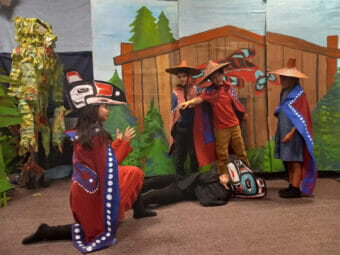
Juneau students in the Tlingit Culture, Language and Literacy program perform before the ribbon cutting of the Father Andrew P. Kashevaroff Library, Archives and Museum Building on June 6, 2016.
Juneau students in the Tlingit Culture, Language and Literacy program perform before the ribbon cutting of the Father Andrew P. Kashevaroff Library, Archives and Museum on June 6, 2016. (Photo by Matt Miller/KTOO)

A program at Juneau’s Harborview Elementary has been integrating Lingít language and culture into classroom teaching for decades. Now it’s expanding to middle school, with plans to teach other subjects in Lingít as well.

Molly Box is the interim principal for the Tlingit Culture Language and Literacy program. She said parents were excited to hear their children could stay in the program longer. 

“Families who have fourth graders or fifth graders were like ‘Oh my gosh, this kid can’t think of better news,’” she said.

Box said the program has brought cultural heritage to Lingít students through singing and dancing, and it’s helped students learn about their clans and family histories and celebrate Lingít values at school.

The program has three classrooms at Harborview. Each has a teacher, a Lingít language teacher, and an elder helping out. Box said the program has about a dozen students in each grade. 

With funding from the Sealaska Heritage Institute, the program will add a fourth classroom in the fall, for sixth and seventh graders. The grant will pay for two new classroom teachers and one Lingít teacher.

They also plan to add eighth grade students in 2024.  

Box said that in time, the program will teach other school subjects in Lingít as well.

University of Alaska Southeast Lingít language Professor X̱’unei Lance Twitchell said dual-language programs have proven effective with other Indigenous languages. 

“Once they started using the language as a medium of education and said, ‘We’re not teaching the language anymore, we’re teaching through the language,’ then that really shifted things in terms of adult fluency levels, and especially children,” he said. 

Jamie Shanley, SHI’s program manager for the language program, said the funding includes training for teachers to help make that possible. 

“The grant is also providing some resources for the teachers to strengthen their language acquisition, such as immersion retreats where they go and spend several days together in a place and only speak and live in the language,” Shanley said. 

Twitchell said one barrier to dual-language programs is the fear that students won’t be prepared for standardized testing. But those measurements don’t serve language revitalization efforts, he said, and national standardized tests don’t factor Indigenous language learning into their equations.

“If our language is not part of the standard, then we need to reject the standard and say, ‘Okay, well, that might be something that you’re measuring for someone else,” he said. “But don’t use that tool of measurement for children who are invested in and families who are invested in making sure our language is still around.’”

Box said there will be an assessment planned for the program, but it will focus on the students’ language proficiency and how well the program is investing in the Lingít language. She said it’s vital that the program do two things: develop fluency and prepare students academically for the next step.

“We really want to make sure that we lay the groundwork for a really rigorous program, that not only do they get the benefit of staying within TCLL and having the cultural relevance in their education in the Lingít language, and we still prepare them for high school,” Box said. 

Box said the program will eventually include programs for families so kids can engage with Lingít at home, too.

Registration for TCLL opens March 1. 

‘Noah Loves Kristy’ brings Toksook Bay laughter to TikTok

Kristy and Noah Lincoln at a beach campfire. (Courtesy Kristy and Noah Lincoln)

Toksook Bay, on Nelson Island in Western Alaska, is home to Yupik language, hunting, boating — and social media sensation “Noah Loves Kristy”, a couple married for almost 20 years.

Noah and Kristy Lincoln have six kids, plus a brand-new granddaughter. In their spare time, they reenact scenes from movies and TV shows with a twist of Alaska Native humor.

So far, they have over 40,000 followers on Facebook and 20,000 on TikTok. And it all began while they were out hunting for geese.

“We had our son take the camera and start recording,” Noah said. “It was all natural.”

Once the video rolled, Noah asked Kristy to do different bird calls. First, she made raven and goose calls. Then there was a request to mimic a mating swan.

“Be a sexy swan,” said Noah to Kristy in the video. Kristy broke out in laughter, as she made lots of silly sounds.


They posted the video to their Facebook page, where it was shared and reshared hundreds of times. It was then that Noah and Kristy knew they were on to something big.

“I thought, ‘Man, we can get so many people to laugh,’” Noah said. “Just me and my wife make the videos.”

Since the release of the popular show “Reservation Dogs” on Hulu, Indigenous humor has been trending on social media. But Native humor is a little different, and often draws upon subsistence hunting.

“Sixteen years I’ve been married. And my wife said she don’t love me anymore,” Noah pouts in one video. The door opens, and Kristy shouts back, “All I said is, ‘you’re not getting a new gun!’”

The videos have even popularized Kristy’s catchphrase “Gee, whiz,” delivered with a touch of sarcasm, which their social media followers tend to mimic in response to things Noah complains about in their videos.

Kristy enjoys acting in the videos with her husband but said it’s Noah who comes up with the ideas.

“It just comes out of the blue,” Kristy said, giggling.

But life wasn’t always full of laughter for Noah.

“I was heavily into alcohol, and I couldn’t keep a job,” Noah said.

After realizing what his addiction was doing to his family, Noah swore off alcohol for good. When asked if he is still sober, Noah is always happy to respond.

“I am so happy to say, ‘Yes,’” he said.

It also makes Noah happy that their videos bring joy to people, especially those who have their own struggles.

@noahloveskristy

Never again, hurricane force winds ALASKAN STORM

♬ original sound – Noah loves Kristy

“There’s this lady who lost her daughter. She was grieving for so long, she couldn’t be happy because she lost her daughter, and she came across our videos,” he said. “She started looking through the videos and she found herself laughing and laughing, like she forgot that she was grieving.”

Noah said he’s glad their videos give her hope and healing.

“And that really has opened my eyes and my heart,” he said, getting a little choked-up as he spoke. “Social media is really strong. And I believe laughter is medicine.”

Anthony Lekanof from St. George Island is a “Noah Loves Kristy” fan. He said the couple has paved the way for other Indigenous storytellers.

“If you look among the Indigenous creators and comedians, we don’t have a whole lot,” said Lekanof, who believes Noah and Kristy are an inspiration to up-and-coming artists, whether they pursue comedy or acting. “It really enriches the Indigenous spirit that we have within Alaska, based on how relatable Noah and Kristy are.”

Lekanof said some of the videos bring back memories of his own upbringing on the Pribilof Islands.

Noah and Kristy also make it a point to sprinkle in messages of inspiration and hope — showing that at the end of the day, family and faith are everything.

As Noah talked about the spiritual side of producing “Noah Loves Kristy,” he spoke first in Yugtun, the Yup’ik language, then translated what he said.

“I thank God for everything,” said Noah in English. “Everything happens for a reason for his purpose, thank you Lord.”

With all of the fame and notoriety that comes with their popular skits, Noah and Kristy Lincoln are proud to say they remain humble and happy in Toksook Bay, surrounded by their family and the wilderness.

Chilkat weavers who learned online during the pandemic see their robes come to life

Sakoon Donedin Jackson showing her robe to language nest students. Chilkat robe weaving on Jan. 30, 2023 in preparation for First Dance & upcoming art show. Jan. 30, 2023. (Photo by Tasha Elizarde/KTOO)

There are about a dozen Chilkat weavers in Juneau this week. They’re meeting at a makeshift workshop set up at Generations Southeast Community Learning Center and weaving five or more hours a day, trying to finish up intricate, child-sized robes that will be worn by local children while they dance a ceremonial dance. 

The weavers are apprentices of Lily Hope. During the pandemic, she offered classes virtually, so students outside of Southeast Alaska could learn from her. 

Now, they’re getting together in person to level up and finish their projects. The children’s robes are detailed and time consuming, but less so than the two or more years it takes to make an adult-sized robe. 

Lily Hope and weaving mentor Ricky Tagaban working on a robe. Jan. 30, 2023. (Photo by Tasha Elizarde/KTOO)

Growing the number of Chilkat weavers is important to Hope. 

“Over the last 120 years, fewer than a dozen Chilkat blanket makers or robe weavers existed at any given point. We are changing that story this week,” she said on Juneau Afternoon last week.

Sakoon Donedin Jackson is here from Alberta, Canada. Through Hope’s virtual teaching, she spun her yarn for the robe, hung it on the loom and began weaving. But on a road trip last summer, she got in an accident and the blanket — as well as everything in her camper van — burned in the wreck.

“The only reason I was able to participate at all is because [a community member] gifted me her auntie’s yarns, who had passed,” Jackson said. “So all of the yarns in this blanket, except for the mask color and the yellow, are ancestral aunties’ that had been donated to me from this group to make this happen. So it is absolutely a project of love and support of this entire community.”

Jackson walked away from the wreck with a severe concussion but was able to restart the robe, and thinks she’ll finish in time for Wednesday’s dance.

“It’s not like joining a crochet group, right? It’s a lot more,” Jackson said. “There’s culture and there’s the spiritual aspect of it. I think it’s what changes it from art to a living being.” 

The design is from Hope’s late mother Clarissa Rizal. It was the last child-sized robe she designed. It doesn’t have clan affiliations, Jackson said. She said they wanted to use a design that was “open source,” so that children with any clan affiliation could dance in them. 

Weaving on Jan. 30, 2023 in preparation for First Dance & upcoming art show. (Photo by Tasha Elizarde/KTOO)

Gunaa Shaa Karen Taug started weaving in 1984, but she put it on hold after having five children. She started learning again from Rizal over a decade ago. The child robe she’s working on in Juneau is her first big weaving piece, she said.

“When you get stuck, like on a circle, there’s so many people to ask,” Taug said. “Plus Lily does the videos, but still, it’s nice to interact with all the ladies. Because you learn little tricks of the trade like this thing here, that’s a magnet,” she said, pointing to a magnet holding her needle to the loom.

Ksm L’x Sg̱a̱a Ruth Hallows shows children her Chilkat robe. Jan. 30, 2023. (Photo by Tasha Elizarde/KTOO).

She plans to have her grandson dance in the robe, which shows the face of a fisherman and his two grandchildren in profile, turned towards him in the center, Taug said.

“My goal really is to let the world know that we’re still making sure Chilkat robes are still weaving our history. We’re still telling our stories. We’re still here, alive, and well,” Hope said.

The First Dance, where a dance group made of children will wear these robes for the first time, is Wednesday. It will be live-streamed on Sealaska Heritage Institute’s YouTube page. On Friday, the robes will be displayed at the Juneau Douglas City Museum.

Writer Ernestine Shaankaláx̱t’ Hayes awarded $50,000 from United States Artists fellowship

Ernestine Hayes is seen in Juneau, Alaska, this winter. (Photo by Pat Race)
Ernestine Hayes is seen in Juneau, Alaska, this winter. (Photo courtesy of Pat Race)

In 2018, Ernestine Shaankaláx̱t’ Hayes’s house caught fire. Her writing was on hold while she spent countless hours negotiating with contractors and insurance. She lived in hotels and apartments, using her life savings to fix the house.

The $50,000 United States Artists fellowship she was awarded last week will allow her to recover from her loss and get back to writing.

I was here and there throughout and didn’t have any time to set up a computer and have a writing space at all,” Hayes said. “But I was writing on my iPad and writing notes to myself and doing a lot of texting to myself when things would occur.”

Now, the house is nearly finished, and she’s rebuilding her life. 

“This fellowship allows me to catch up with what I owe the IRS on all this, all these expenses for rehabbing the house and has allowed me to be able to afford to rent my own little apartment,” Hayes said. “I’m in a better place now. And it’s going to allow me to devote more of my time and attention and energy on writing and to my next book.”

This is exactly the sort of thing the fellowship was made for. It’s awarded to artists in many fields, from architecture to theater to writing, at any stage of their careers. 

Getting fellowships and awards like this has given Hayes more than funding, she said. It has made her feel valued.

“When I received the Rasmuson distinguished artist (award), I realized that I was part of a community, which is something that I never fully felt throughout my life,” Hayes said. “And it made me feel valued.” 

Her next book, she said, is about what she calls the “spoken forest.”

“This thought came to me that there are beings in the spoken forest that are relatives and they are holding for us everything that we think that we have lost,” Hayes said. “People we don’t find, people who are missing, people who run away from boarding schools and are never found. And maybe even everyone who walks into the forest, I think they are all still there. And I believe that when it’s time and we enter the forest, they will be there to greet us.”

She kept track of these ideas through the chaos of losing her home. Now, with this award, she’s closer to putting them to paper. 

There’s another USPS stamp coming out featuring Lingít formline art

Juneau artist Crystal Worl says the Postal Service’s art director was most drawn to her salmon designs — and she was fine with that.

“I’m always down to do a salmon,” she said. “I’m from the Lukaax̱.ádi clan, the salmon Sockeye clan and I never get bored of drawing it in a different way.”

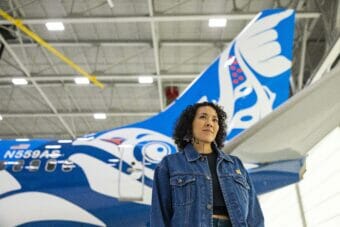
Worl and her brother Rico put Lingít formline art on a lot of things: playing cards, clothes, umbrellas, walls — the Juneau International Airport. And postal stamps. In 2021, Rico Worl was the first Lingít artist to be featured on a stamp. Now it’s Crystal’s turn.

Crystal Worl’s design for new USPS stamps. (Courtesy of Crystal Worl)

She says her brother’s experience showed her the power of having Lingít art on a stamp. 

“He kept receiving fan mail with the stamps on it,” Worl said. “Like, postcards from all over using his stamp and just saying thank you.”

She had to work in several art forms to arrive at the design: five different formline sketches of salmon, then a digital piece with different color options. Finally, they sent her a skateboard, where she painted the salmon design.

Worl said it was cool that they wanted the physical object painted.

“They could use that digital design to superimpose over the artwork,” she said. “But they wanted an original.”

The Postal Service then photographed the skateboard being held up by a model, and that picture will go on the stamps. It will be part of a four-stamp set showing skateboards with traditional Columbian and Diné design themes. 

Worl has tackled big projects before, like her Native American Heritage Month design for Google, or her massive mural in downtown Anchorage. But she said this is the first time she’s worked with an organization that had little knowledge of formline art.  

“I definitely had a challenging moment, trying to fulfill USPS expectations of what they wanted of my art and my style,” she said. “I just had to backtrack and like, elaborate and explain the ABCs of formline design.”

Worl’s stamp comes out in March, and she said she’s hoping to sell them at her and her brother’s store. She says she can’t wait to see them in person.

“It’s always like a really satisfying thing when you spend all this time designing something,” Worl said. “And it’s finally finished and you get to hold it in your hand.”

Master carver Wayne Price is back at UAS teaching carving and formline

Wayne Price works on a 12 foot tall totem pole in his Haines studio. (Photo by Emily Files/KHNS)

Lingít Master Carver Wayne Price is returning to the University of Alaska Southeast as part of its Northwest Coast Arts program. 

“The attention being paid to all branches of Northwest Coast Native art. I really feel the support out here at UAS,” Price said.

He will be teaching carving courses and formline design classes.

Both art forms have beginning, intermediate and advanced curriculums, but some of the classes are combined. Price says the formline class is intensive. 

“In my formline class, they were sweating,” Price said. “It seems they were trying so hard.”

Price said he only found out last week that he would be teaching this term, but he thinks his classes will fill up fast. Students in the beginning carving class will be making paddles, while intermediate and advanced students can choose their projects. 

“So they have the benefit of an artist who’s got 50 years of Northwest coast art under my belt. And I bring that all here to the University of Alaska, at Áak’w,” Price said. 

Price has taught at UAS before. Since then, he has carved dugout canoes — or yaakw — with high schoolers across Southeast Alaska and most recently unveiled a healing totem at Twin Lakes in Juneau, which was built in remembrance of missing and murdered Indigenous women. 

Price lives in Haines with his wife, but he moved to Juneau for the semester. He said he doesn’t yet know if he’ll teach in the fall.

“I’m just taking it one semester at a time,” he said. “And let’s see how it goes.”

A UAS spokesperson said that anyone interested in taking one of Priceʼs classes can call the registrar’s office to ask if there is space.

Site notifications
Update notification options
Subscribe to notifications