Alaska Native Arts & Culture

Ketchikan’s own Tallie Medel describes ‘surreal’ Oscar night after co-starring in best picture winner

Medel’s character, Becky, talks to Gong Gong, her girlfriend’s grandfather, played by James Hong, in a still from the movie.

Some Alaskans recognized a familiar face on stage at the 95th annual Academy Awards on Sunday night. An actor born and raised in Ketchikan was celebrating their movie’s big win.

Tallie Medel co-starred in “Everything Everywhere All at Once,” which took home a total of seven Oscars, including best picture. KRBD caught up with the actor.

Even before Oscar night, “Everything Everywhere All at Once” had already won a bevy of awards — like an outstanding cast award from the Screen Actors Guild, two Golden Globes and a Writers Guild of America award. According to IGN, even before the Oscars, it had already claimed the title of most-awarded movie ever.

So, co-star Tallie Medel was hopeful the streak would continue on Oscar night.

The movie had already racked up six awards by the time Harrison Ford came out on stage to present the award for best picture. After all, co-star Ke Huy Quan, who some might remember as Data from “The Goonies,” had acted alongside Ford in an Indiana Jones movie decades ago. Medel took it as a sign.

“We, at that point, had already won so many awards — besides the Oscars, too,” Medel said. “So leading up to the best picture announcement, it seemed clear that we were poised to win.”

And they did. “Everything Everywhere All at Once,” an A24 film that premiered at the South by Southwest Film Festival last year, won best picture. It beat out competition like “Top Gun: Maverick,” “Avatar: the Way of the Water,” and “Elvis.” In total, the movie earned seven Oscars.

Lead actress Michelle Yeoh became the first Asian person to win an Oscar for best actress. The film also collected awards for best supporting actress (Jamie Lee Curtis), best supporting actor (Ke Huy Quan), best director (Daniel Scheinert and Daniel Kwan), best editing, and best original screenplay. It is the second-most decorated film to come out of an Academy Awards, after “Moonlight.”

Medel said it was overwhelming to look out from the stage as the producer, Jonathan Wang, accepted the best picture Oscar.

“I didn’t look at the audience much because I think I might have, you know, collapsed from seeing … the faces of artists that I’ve always looked up to and admired,“ Medel said.

But Medel — who played the part of Becky, girlfriend to the character Joy Wang (Stephanie Hsu) — said the win just “felt right.”

Medel’s character struggles to be accepted by her girlfriend’s parents, who immigrated from China, and her traditional grandfather who Joy’s parents don’t want to know they’re dating. It’s one of the struggles that contributes to Joy’s character being taken over by a force from another universe and kind of going off the deep end and creating an everything bagel that could wreak havoc.

The movie is a fast-paced sci-fi that follows Joy’s mother as she jumps through bizarre and absurd universes, trying to reconcile the things that could have been if her life had been different. In some worlds, she’s a martial arts pro, in others, a movie star. In some, she divorces her husband or never moves to America.

Medel explained it like this:

“I think a message that we can roll in for this time that’s from the film is nothing matters,” Medel explained. “But that also means that we can do anything we want. You know, it’s ours to create and to heal. And collaborating with other people, catching the words that you’re experiencing, you know, floating over your head, being able to grab them and write them down. Anything that you feel compelled to create, just make it and the judgments not going to serve you.”

Between Oscar night and the various after-parties, Medel says it’s been a whirlwind.

They mingled with stars like Brendan Fraser (Oscar winner of best actor for “The Whale”), Alison Brie (“Community,” “GLOW”), Jenny Slate, Paul Mescal (Oscar presenter, (“Aftersun”), Paul Dano, Kyle MacLachlan, Sally Field, (“80 for Brady,” “Steel Magnolias”), Michelle Williams, and others.

“It’s been absolutely surreal,” they said. “I’m so happy for everybody. And I’m so honored.”

Medel plans to stay in Los Angeles for the next month before jumping into more projects. Medel also teaches “clowning” theater classes and is the founding member of the three-person dance group “Cocoon Central Dance Team.” They are working on a screenplay about Ketchikan, which still holds a special place in their heart.

“I just am really grateful to everybody in Ketchikan for being so supportive and so kind,” Medel said.

Medel remembers taking classes at the Ketchikan Theatre Ballet and performing with First City Players. Medel said they owe a lot to this town of nearly 14,000.

“And Alaska has just so many amazing artists,” they said. “Aren’t we so lucky?”

They hope to visit again soon — they were in town last summer, teaching classes with First City Players.

Elizabeth Nelson, First City Players’ executive director, hopes to see Medel again soon.

“I think really what I would say about Tallie is she is one of the kindest, most open people I know,” Nelson said. “And how she is able to just take what is such a gorgeous sense of play, and performance and make other people feel that they can do exactly what she does. But there’s just such an open kindness about her, I am thrilled for her.”

And it’s safe to say that Medel is thrilled, too.

Lingít culture bearers plan Indigenous performing arts workshop in Juneau

A man in a button blanket and raven mask looks into light at Centennial Hall. Gene Tagaban dances with Khu.éex' at Centennial Hall on Monday, January 28, 2019. Tagaban played flute and sang as part of the performance. (Photo by Annie Bartholomew/KTOO)
Juneau storyteller Gene Tagaban dances with Khu.éex’ at Centennial Hall on Monday, January 28, 2019. Tagaban played flute and sang as part of the performance. (Photo by Annie Bartholomew/KTOO)

A new Sealaska Heritage Institute program beginning in March hopes to help train more Indigenous actors and performing artists in the Lingít language.

Ed Littlefield is a teacher in the Naakahidi Academy and sat down with KTOO’s Chloe Pleznac to talk about what participants can expect, and his hopes for the program. 

This interview has been edited for length and clarity.

Chloe Pleznac: Hello, Ed! Gunalchéesh for joining me today to talk about the new Naakahidi Academy program that will be kicking off in March. First off, why don’t you just tell me about the name? What does it mean and how does it illustrate your hopes as an instructor for this program?

Ed Littlefield: Gunalchéesh! Thanks for allowing me to be here … This academy is to help prepare future performing arts people, and Indigenous people, in the different ways of the performing arts. So we’re inviting I think there are 20 seats, 20 spots available. And we are trying to fill those spots up with performing artists that are currently already performing and doing performing arts. And we’re going to be doing some dancing, some movement, movement and dancing, some singing some language work. Great teachers and cultural leaders Lance Twitchell, Xeetli.éesh Lyle James, myself, Vera Starbard and it’s gonna be great. We’re trying to work on you know, how, what is, what are the old ways of telling stories? And how can we take that into the future for many years to come? And different ways of doing that?

Chloe Pleznac: What can potential participants expect from the program overall?

Ed Littlefield: Well, the first meeting that we’re going to have will be it just sounds like a lot, but it’s actually three hours from 9 a.m. to 12 on March 11 and 12. So two different days. And, yeah, we’re going to start with some language work with X̱ʼunei, trying to figure out how to, you know, pronounce some words that we have, you know, just to get language work in there. It’s always great to have some work with language. And then the second hour roughly is movement and dance, and so we’re going to Xeetli.éesh and Dax̱kil.átch Kolene James, are going to, hopefully, help us with some contemporary movements, like how to tell stories with our bodies. So it’s not necessarily just dancing, like we do in our ceremonies. But it’s more for the fact of moving with intention. So how does, how does this movement share our stories? And then, the last hour or so is with me doing some vocal technique, you know, how to sing loud and proud without losing your voice. So I’ve written a couple Lingít vocal warmups, which could be cool, you know, working on the Lingít vowels they have, there’s lots of different, you know, saying in lots of choirs growing up, and there’s lots of vowels, a, e, i, o, u. But there, there’s not really some Lingít vowels … And then also tying that in with the language that we do with X̱ʼunei. So making sure that when we sing, we’re also doing the language. And so yeah, really cool just a mix of everything. And we’ve got two days with that on March 11 and 12.

Chloe Pleznac: Is this program exclusively for those with acting or performing experience already under their belts? Who should apply?

Ed Littlefield: Well, no, not necessarily. I think if you have an interest in getting out there and doing some performing arts, there’s no, that I know of, I don’t think there is a, you know, like a prerequisite or anything, we’re trying to get people in the seats. And I think people that have an interest in performing arts should definitely put their name in the hat there because we only have limited space and for 20 people, so and it’s open now the signup process is open now.

But no, I think anyone with a want to learn language, movement and singing. I mean, that’s who we’re looking for, you know, and in addition to like, the warm-ups and how to sing, and maybe we’ll do some new songs that I built that I’ll share with the participants. But we’re also going to work on, this is the different part, maybe how to sing in harmony, which is cool. So you don’t have to, you know, you know, there’s definitely melody line. But for some people that are willing to take a chance we’re going to start introducing some harmony and how that works in Lingít music because that’s, I know, there was a talk about Yakutat harmonies a month or two ago at Sealaska Heritage and, you know, they definitely had harmony, you know, a long time ago. And so we’re trying to utilize that knowledge and yeah, see where we can go with it for the future. 

Chloe Pleznac: So currently, this program is only being offered in the Lingít language. Is this something you’d like to expand to other Alaska Native languages?

Ed Littlefield: Yeah, I mean … I think this program if we get the right instructors we need, you know, I don’t speak Sm’algya̱x or Xaat Kíl. So yeah if we get the instructors we can definitely do a very similar thing with each language and it is primarily Lingít right now at this point but you know, sky’s the limit.

Chloe Pleznac: Awesome. Well, thank you so much for taking the time to talk with me today. 

Ed Littlefield: Gunalchéesh!

This post has been updated with the correct spelling of Sm’algya̱x. 

Sealaska Heritage Institute has a new building dedicated to Indigenous approaches to teaching science

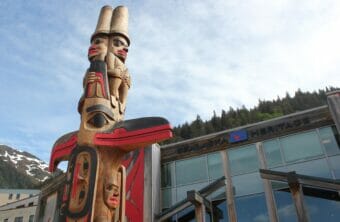
The totem pole at Sealaska Heritage Institute’s art campus shown in front of the Walter Sobeleff building in Juneau on June 1, 2022. The building to the right will become a new learning space for SHI. (Photo by Paige Sparks / KTOO)

Last week, Sealaska Heritage Institute announced the purchase of a building next door to its Walter Soboleff building. 

The organization said it plans to create a multi-subject learning environment for its STEAM program, which encourages Alaska Native youth to engage with science, math, technology, art and engineering while incorporating traditional knowledge. 

“We’re hoping that our programming can bridge some of the standing gaps of where Indigenous science has been left out in those subjects, and build some interest and pathways for our Alaska Native youth,” said Becca Soza, SHI’s STEAM manager.

Soza said this new building makes room for more hands-on learning in a central place.

“It’s going to be a really innovative space where people can come and learn together,” she said.

Plans for the building include a digital recording studio, a kitchen where students can learn about traditional food and nutrition, and even potentially a virtual reality system for trying out different learning environments, according to Soza. 

With all this new equipment, she said students can dig deeper into their culture.  

“So the design of the space and the programs that we implement there will be rooted in our core values, and in that the Indigenous ways of knowing,” she said. 

Teachers from across Southeast Alaska will be able to work with Indigenous instructors to make lesson plans in the new building. Soza said SHI wants to be a regional meeting point for STEAM education for all teachers who serve Southeast Alaska Native students. 

“We’ve been working to support teachers actively for years,” she said. “But we’ve been in our cubicles and behind our computers.”

The organization said in a press release that the building, which currently houses Capitol Copy and some city offices, is 14,000 square feet, and that the organization plans to design the exterior of the building to match the rest of SHI’s campus.  

That construction isn’t coming soon, the release said. SHI needs to raise the money first.

Juneau athletes represent at first Arctic Winter Games since 2018

Juneau-based members of Team Alaska who competed in the 2023 Arctic Winter Games include Lyric Ashenfelter, Ezra Ellisoff, Matthew Quinto and Kyle Worl, pictured in the KTOO studio on Wednesday, Feb. 15, 2023. (Photo by Chloe Pleznac/KTOO)

The Arctic Winter Games were held earlier this month in Northern Alberta for the first time since 2018. Team Alaska placed second overall in terms of both wins and gold medals, or “ulus.”

Four Alaska athletes traveled from Juneau and sat down with KTOO’s Chloe Pleznac upon their return to discuss their experience competing in the 2023 games.

This interview has been edited for length and clarity.

Chloe Pleznac: Joining me today to talk about team Alaska’s recent involvement — and victories — at the Arctic Winter Games are Matthew Quinto, Ezra Ellisoff, Kyle Worl and Lyric Ashenfelter. So, Kyle, I’m going to start with you. You scored gold for Team Alaska in the Airplane Open Male. I was really impressed to learn exactly what the airplane event is because it’s even more incredible that you did it for that long. So, could you explain to me how you compete in the airplane event?

Kyle Worl: The Airplane is one of 10 games in the Arctic sports division. It’s a traditional Inuit game. You start by laying on the floor in an iron cross position, your arms are out, your legs are straight. And you’re lifted up by the wrists and your ankles and you’re lifted about a couple of feet off the ground, and you have to hold that iron cross position as long as possible.

Chloe Pleznac: Wow. And you held it for, was it a minute and three seconds?

Kyle Worl: Yep. A minute and three seconds. Matthew here was the one counting it off for me.

Chloe Pleznac: Ezra, you placed gold for Team Alaska in the Alaskan High Kick Open Male. Could you tell me a little bit about the traditional history surrounding that event?

Ezra Elisoff: Okay, yeah. It’s more for staying in physical shape for long, harsh winters. So I learned this from Matthew actually, where they would grab ash and they rubbed it on their moccasins or mukluks. And they try to kick as high as they can to the ceiling and whoever could get their footprint on the same ceiling would basically win. And so that game was just more or less played for like, you know, say it was like -60 or something like that. You wouldn’t go hunting in that, you would just stay inside and wait out the winter.

Chloe Pleznac: Matthew, you placed bronze for the Alaskan High Kick Open Male. This was your first year attending. It was a lot of your guys’ first year attending. What was the experience like?

Matthew Quinto: It was a lot of fun. I think my favorite part was probably just meeting all the people from the different countries and making friends there. And the camaraderie that happened through all of us staying on the same floor and different, you know, different rooms, but we were all on the same floor every night, same place a lot of bonding to happen there.

Chloe Pleznac: Lyric you placed bronze for the Arm Pull 2005 or later. What was it like when you were up there in that moment competing?

Lyric Ashenfelter: Oh, I was really nervous at first. But I also had a lot of confidence in myself, because I knew that I could get somewhere far if I really was determined to. It was really cool, though. All the other girls from the other teams were really nice, very supportive. So overall, it makes for a very fun experience. And when you’re all cheering each other on it. It’s really great. And so that got me to where I was, and it was, it was awesome.

Chloe Pleznac: How do you guys prepare for these events? Some of them, like with the airplane, require multiple people holding you up, right? What did the process look like for you guys preparing?

Kyle Worl: Well, I would say they’ve been preparing for a long time. Well, at least Matthew and Ezra here, were on the 2020 team. And they were training for that. And that ended up being canceled about a week out. And so three years later, they finally get their chance to go again. So at least three years, but really their training started for Ezra, his freshman year of high school. He’s now one year out of high school and then Matthew junior year. So yeah, they go back quite a few years of training in these games. Training really just involves doing the games. All around fitness is important. A bit of cardio and weight training and plyometrics are always helpful, but nothing’s gonna get you high in the games like actually practicing the events themselves. So it just takes time and practice.

Chloe Pleznac: So Kyle, you started Juneau’s Native Youth Olympics team up again in 2018 after a long hiatus. Tell us about the relationship between Native Youth Olympics and the Arctic Winter Games.

Kyle Worl: Native Youth Olympics specifically refers to the sport in the K-12 level. And there’s many overlapping games. Native Youth Olympics are all based on Indigenous northern games and so is Arctic sports, but there’s a variety of different games you’re gonna find at different events and` Arctic Winter Games is the kind of the highlight event for this sport. I think of it similar to in basketball you have the NBA like that’s the highest achievement of the sport. For Native Youth Olympics, it’s Arctic Winter Games to be able to represent your state or really we’re representing our country. Arctic Winter Games is a huge honor and it’s a huge event that takes an amazing amount of coordination between many different nations. So it’s an amazing honor and experience for us to all have been there.

Chloe Pleznac: Ezra, you participated in the Native Youth Olympics and placed first in the Alaskan high kick statewide in 2020. What was it like to finally get to compete internationally,

Ezra Elisoff: It was pretty cool. Trying to converse with some of the athletes who don’t necessarily speak English very well was a bit difficult, but we generally got the same message across it was pretty cool. It was like state NYO, but basically bigger, because we were in the open division. So everyone was older and experienced. And at first, it was intimidating. But then as time went on, we all started warming up to each other and joking around, and it was actually pretty great.

Chloe Pleznac: Who were some of the other countries that were involved?

Ezra Elisoff: So there was Greenland, Northern Alberta, most of the provinces in Canada. There’s one team that was, I guess, banned from this year.

Kyle Worl: Normally, Russia is a participant in the Arctic Winter Games, but because of the war in Ukraine, they were not invited this year.

Chloe Pleznac: Competitors in traditional gaming events, like the Native Youth Olympics, and the Arctic Winter Games come from all kinds of backgrounds. Do you think that helps raise the profile of these sports among a wider audience?

Kyle Worl: I think a big misconception about traditional games or Native Youth Olympics is that it’s only for Native people. But the majority of the events are open to anybody to participate in. All backgrounds are welcome. And I think it’s a great cross-cultural learning opportunity for anybody, even if you’re not from an Alaska Native culture to learn about our northern indigenous people through the games is really powerful. I would like to see the continued growth of traditional games beyond just the Arctic. And I think Juneau is an example of that. We’re pretty far from the Arctic here in Southeast Alaska. But the games have spread down to this region from Yakutat to Metlakatla. And we have an upcoming event — April 1 and 2, the Juneau Traditional Games — and we’re going to be seeing a team from Santa Fe. So there really is no limit to where the games can go, in my mind. I think the ultimate dream is to see it at the world Olympics, this sport from here in the Arctic, being on the world stage.

You can find a complete list of Team Alaska’s medal winnings here. 

Juneau celebrates Elizabeth Peratrovich Day by advocating for civil rights

Jamiann S’eitlin Hasselquist touching the graves of Elizabeth and Roy Peratrovich. Feb. 16, 2023. (Photo by Katie Anastas/KTOO).

Most years, on Feb. 16 – Elizabeth Peratrovich Day — the Alaska Native Sisterhood celebrates the anniversary of the passing of Alaskaʼs Anti-Discrimination Act first by visiting the gravesite of its advocate, Ḵaax̱gal.aat Elizabeth Peratrovich. Then they encourage Alaska Native activists to continue her work. 

Jamainn Sʼeiltin Hasselquist, with the Alaska Native Sisterhood, went to Peratrovich and her husband’s graves a day earlier to shovel away the snow.

“We all have workplaces. We all can go into restaurants. We all can speak our language. And we’re all walking in the legacy of Elizabeth and her spirit. And so the intention today was to come together and let people speak,” Hasselquist said. 

Peratrovich is credited with being the force that turned the favor of the legislature toward passing the Anti-Discrimination Act by challenging Alaska Legislators who were against the bill.

“When a brave person is standing in front of a maybe not-so-brave senator and they call him to task — that’s what happened, so we’re proud of her,” said Alaska Native Brotherhood Glacier Valley President Peter Naoroz.

Later, at the Capitol steps, the Alaska Native Sisterhood led a rally meant to bring attention to those carrying out Peratrovichʼs legacy. 

“Some of you are holding signs, signs of important topics. But we don’t just see you as holding a sign,” Hasselquist said. “We see you moving in the spirit of Elizabeth. You are using your most powerful tools: your voice and your presence.”

Shaash Kwan Raven Svenson’s sign said “Aatlein gunalchéesh, Ḵaax̱gal.aat,” and thatʼs what this holiday is about for her, appreciating Peratrovich’s dedication to Alaska Native rights.

Shaash Kwan Raven Svenson holding her sign at the Elizabeth Peratrovich Rally. Feb. 16, 2023. (Photo by Yvonne Krumrey/KTOO)

“Just being very grateful for the effects of that. All of that work was done for us today. And the freedoms that I get to enjoy because she’s stood up for it,” she said.

Svenson was there with the University of Southeast Alaska student group Wooch.een. Almería Alcantra was, too. Sheʼs been working in tribal advocacy since 2020. 

“I think far too often Indigenous people are left out of the picture, but we’re here and we’ve been here and we’re not going anywhere,” they said. 

The students said that Peratrovich inspires them in the work they do, like language revitalization efforts, advocacy for Alaska Native rights in legislation, and making room for Indigenous students in academia. 

Part of that legacy is advocating for civil rights now, the students said,  and the group held signs that supported bills like one financing mental health program funding in schools and another that would increase insurance coverage of contraceptives. The group advocated against a bill that limits school sports based on studentsʼ gender assigned at birth.

Listen: Two high school students build a pair of igloos

Ignatius Hunter and Tom Jimmy outside of the Yuut Elitnaurviat dorms. (Francisco Martínezcuello/KYUK)

On Feb. 10, the forecast called for heavy snow in Bethel with temperatures reaching 10 below. Two teenagers decided it was good idea to go outside after school to build igloos near the Yuut Elitnaurviat dorms. It’s a study in engineering, architecture and history.

KYUK’s Francisco Martínezcuello followed their two-day progress and joined them inside the igloo. Here’s an audio postcard about this experience.

Listen:


Site notifications
Update notification options
Subscribe to notifications