
Telling Tales 5/21/13
Tonight, author Christie Loney recall her year as a caretaker for the Shrine of Shrine of St. Therese.
Nearly 50 fishermen were cited for illegal salmon fishing last June. Half of them pled not guilty and have been fighting it in court ever since.
In recent weeks, the fishermen had been waiting to hear a decision on whether they have the religious right to subsistence fish, even during state closures.
The trial resumed May 20 in Bethel and the fishermen packed into the courtroom with some people left standing in the hallway. It was a trial by judge and Judge Bruce Ward, in a gentle voice, said the court found that the state’s need to restrict King salmon supersedes the fishermen’s right to religious practice.
“The court wants all parties to know that this was a very difficult decision to make,” Ward said. “This was not easy.”
The fishermen were challenging the state based on a free exercise clause of the Alaska constitution, arguing that subsistence fishing is a religious practice and that when they fished last summer during closures, they were practicing their religion.
Judge Ward said he did a lot of research, including looking at an older case, Frank vs. the State, which was decided by the Alaska Supreme Court in 1979. That case shows that the free exercise clause may work when three things are met: 1) religion is involved; 2) the conduct is religiously based; 3) the person is sincere.
The judge found the defendants met the first two, no problem. It was obvious from the expert testimony the court heard on Yup’ik culture. The sincerity question would be addressed later by each individual trials.
The sticking point came when Western science entered into the argument. Based on the testimony given by state and federal fish biologists last month, the court decided that there is a compelling need to restrict the Kuskokwim King run based on recent data. Where in the Frank case, it was about the need to take one moose for a ceremonial potlatch, which wouldn’t have affected the population of moose, in this case the fishing could have had an adverse affect.
“Therefore, this court finds the need to police the Chinook run to ensure its continuity for future generations of Yup’ik fishermen and families overcomes the argued for free exercise exemption which would otherwise apply,” Ward said.
Although each case must be heard separately for the court to determine the fishermen’s sincerity, Judge Ward said those finding won’t sway his guilty verdicts.
That held true in the first trials against fishermen Felix Flynn and Peter Heinz. Both had their nets seized last summer and both got emotional on the stand. Felix Flynn wiped tears away saying that it had been hard answering questions from his young grandson:
“He asked me, when are we going to check the net. I couldn’t say nothing…because we didn’t have no net out there…because he witnessed me when we set the net. And that’s really painful.”
So far, the court is finding that all the fishermen were sincere in their religious beliefs but is finding them guilty anyway. Most are being sentenced $500 dollars with half of it suspended and put on probation for one year.
The defense, led by James Davis Jr. with the Northern Justice Project, plans to appeal, and the judge says the Alaska Supreme Court should review the Frank case.
“I think the Alaska Supreme Court needs to address some of the parameters that was outlined in Frank 40 years ago. It’s been a long time and the situation in this case is very different for a number of reasons.”
At some point during the proceeding, the courtroom was infused with the smell of dry fish as someone in the gallery passed around a gallon baggie full of it, sharing it with everyone.
The individual trials will continue at the Bethel Court House until all remaining fishermen are heard.
And now for some breaking news. Record-breaking, that is.
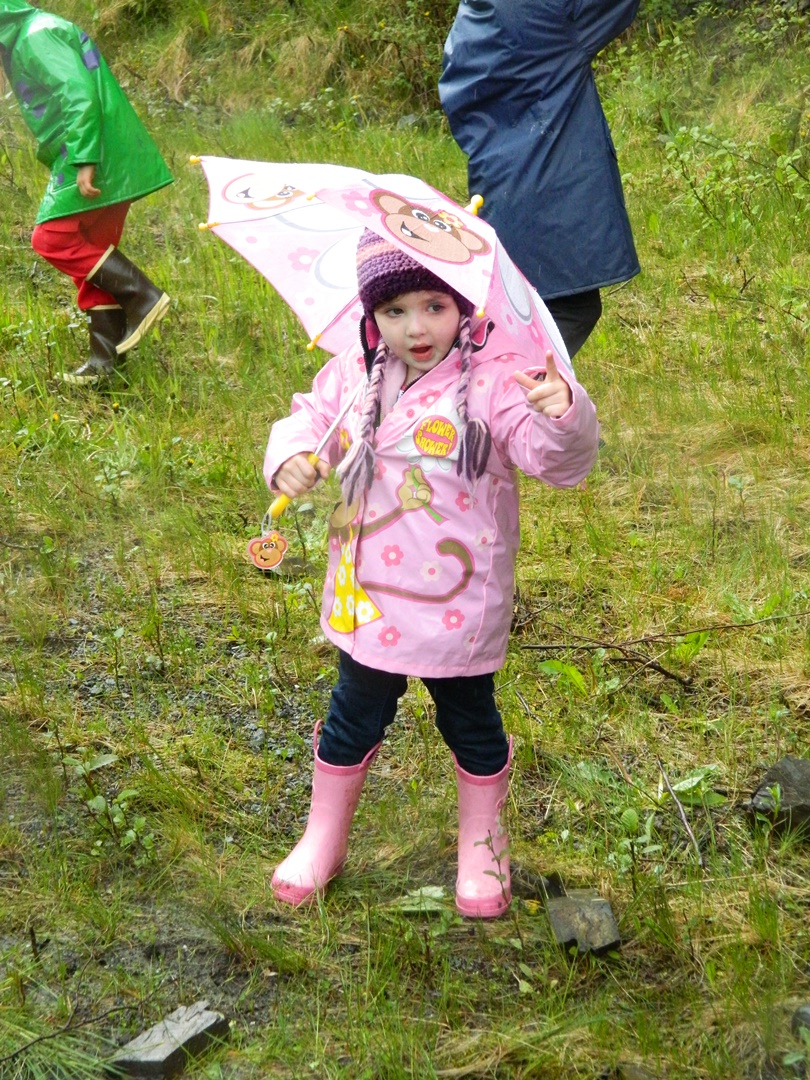
Nearly 2,000 people turned out in Ketchikan Saturday afternoon to break the Guinness World Record for the largest rainboot race.
According to official U.S. Census records, Ketchikan’s population is just shy of 13,800 people. That’s the whole borough, not just the city. A couple hundred at a time will get together for plays or concerts, but it’s very rare – perhaps unprecedented in the community’s history – for nearly 2,000 people in Ketchikan to congregate in one place, at one time for a single purpose.
But, on a beautiful afternoon with just a sprinkling of rain to get people in the proper mood before the clouds lifted, it happened. A sea of people, all wearing rainboots, gathered, mingled, talked, laughed, sang and finally walked – a few ran – to break a record.
The previous record for what’s officially known as the largest Wellington boot race was held by the British county of Lincolnshire, which is about a two-hour drive from London. It’s known for its attractive coastlines, Lincoln Castle, its local recipe for stuffed chine – a brined pork dish – and, until recently, its world record.
That county broke the record in 2009, when 1,366 people marched a mile in their Wellies. Ketchikan’s race more than met that challenge. The number announced after the race, while not confirmed yet by Guinness, was 1,976.
U.S. Forest Service officials and Juneau residents commemorated the opening of the new Juneau Forestry Sciences Laboratory on Saturday.
The dedication of the new facility near the edge of Auke Lake featured the raising of house posts carved by Haines carver Wayne Price.
Forest Service employees assigned to the lab helped raise the posts at the entrance of the building.
The $10 million facility built on federal land is the new, permanent home for the lab’s roughly thirty employees who have worked in at least three other different facilities on a temporary basis over the last 60 years.
Updated story on Saturday’s ceremony:
Two groups of Forest Service employees approached the new Juneau Forestry Sciences Laboratory from opposite directions. Each group, about a dozen people each, carried a thousand-pound yellow cedar log carved into a house post. In front of the lab, each of the ten-foot posts were set down, pivoted on the bottom end, lifted up on a mounting pedestal, and pushed upright into place (see slideshow above).
The dedication of the new lab on Saturday was a mix of the traditional and the modern with more of an emphasis on tradition as participants danced, and paid their respects and honored the Aak’W Kwaan who have traditionally owned and occupied the land around Auke Bay. It included the Carver’s Dance which marks relinquishment of title and ownership of the totems.
The modern part of the dedication came at the very end with a ribbon stretched across the entrance and a half-a-dozen pair of scissors.
“We’re delighted to be here on the ancestral grounds of the Aak’W Kwaan,” said Robert Mangold who is acting director of the Pacific Northwest Research Station that is essentially a group of eleven labs in the region. “They’ve been very helpful and instrumental in design of the building and supporting us.”
Mangold says the 12,000 square foot Juneau lab on the edge of Auke Lake and adjacent to the University of Alaska Southeast campus is about medium in size for their facilities.
Construction on the $10 million building started only three years ago. But it’s has been as much as 60-years in making with the lab’s twenty to thirty employees recently working in at least three different facilities on a temporary basis.
“It’s a tremendous building. It really offers the kind of lab facilities that we never had before,” said Paul Hennon, a forest pathologist with the Station.
Contractors used stone and yellow cedar siding obtained in Southeast Alaska while the interior features hickory trim. Upstairs include the offices while the downstairs is devoted to the lab spaces where the botanists, hydrologists, entomologists, and other scientists can work.
Hennon and his colleagues in other disciplines will work together to tackle everything from forest health to human use of the forest, watershed and young-growth management, and climate change issues.
“So, it’s very common at least in our experience that we team up, kind of mix our disclipines together and are able to take on some broader problems that way,” said Hennon.
The new building will also house the Alaska Coastal Rainforest Center and its location next to UAS should foster more collaboration with faculty and students on research.
Other building construction details include triple-glazed windows, radiant heating, and a ground source heating and cooling system for energy efficiency.
But the house posts will be the first thing that any visitor sees. Master carver Wayne Price of Haines says both posts are carved from the same log of yellow cedar found on Chichagof Island. He says he started on them full-time after the New Year, and finished just hours before getting on the ferry for Juneau. Price says the Eagle post features a mudshark of the Wooshkeetaan and the Raven post includes a dog salmon picked by Aak’W elders.
“I’m just very glad to see the house posts in place. They look a lot better where they belong,” said Price.
“And I’m glad to see all the people that turned out today for this big event and thank the Forest Service for supporting the Native culture and the art. Now that we have these here, all the young people have a constant reminder of the people that were here from the get-go. That ties it all together.”
A Juneau actor, director and performing artist taught Kodiak students theatrical storytelling last week. Ryan Conarro completed a two week artist in schools program that culminated with a presentation on Thursday.
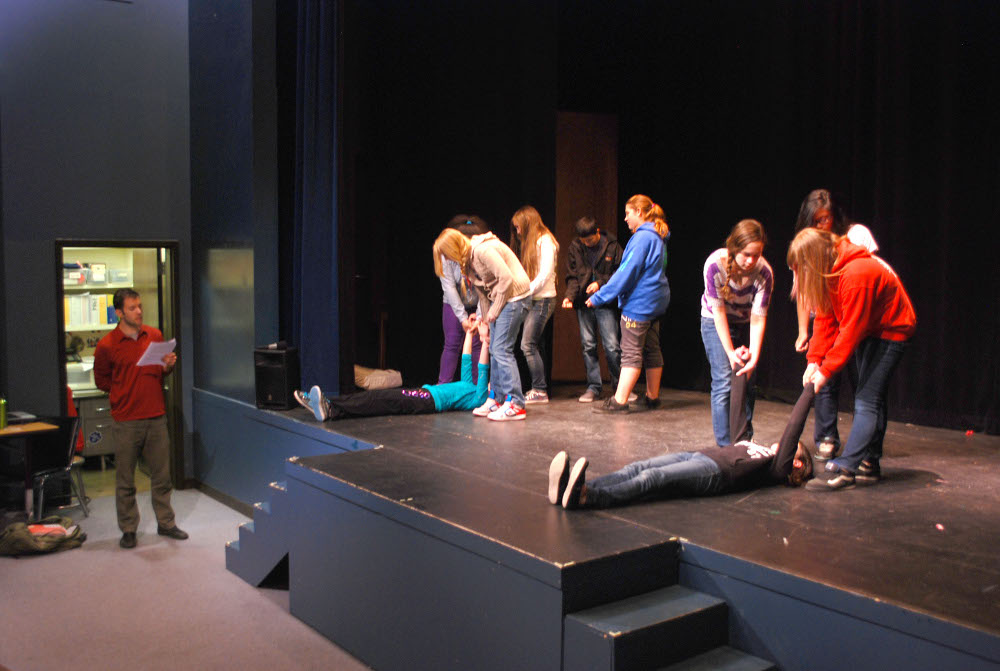
The foyer of the Gerald C. Wilson Auditorium was abuzz with students from Kodiak Middle School. Groups of 7th graders put the finishing touches on a series of tableaux – the final product of two weeks working with visiting teaching artist Conarro.
“I am here as a theater teaching artist and we’re doing a project with middle high and high school classrooms on using drama-based activities for integrating with academic content,” he says.
Conarro has a rich background in theater, both as a teacher and performer. He has worked with the Alaska State Council on the Arts’ Artist in Schools Program for about ten years and taught in districts across the last frontier.
In Kodiak, Conarro had middle school students interview family members about their first job as part of the program.
“That’s related to their unit that’s happening this spring on career preparation,” he says. “And we’ve taken some of the stories from those interviews and dramatizing them.”
The students reenacted the stories through a series of tableaux. But what exactly is a tableau?
“A tableau is basically a picture formed with actors,” says 7th grader Eli Griffin. “It’s still besides the fact that you switch between scenes. You’ll have usually four or five people and you’ll take elements from the story and you’ll act them out silently in a picture.”
Griffin interviewed his dad, Kodiak Island Borough Assemblyman Aaron Griffin.
“He worked at Papa John’s Pizzeria. And then he went into the Air Force,” Eli says.
Griffin said his dad’s past with Papa John’s isn’t the topic of his group’s tableau.
“We’re doing one about a paper boy’s first job,” he says. “I’m a newspaper. I think that I play it awesomely. I just get to sit there.”
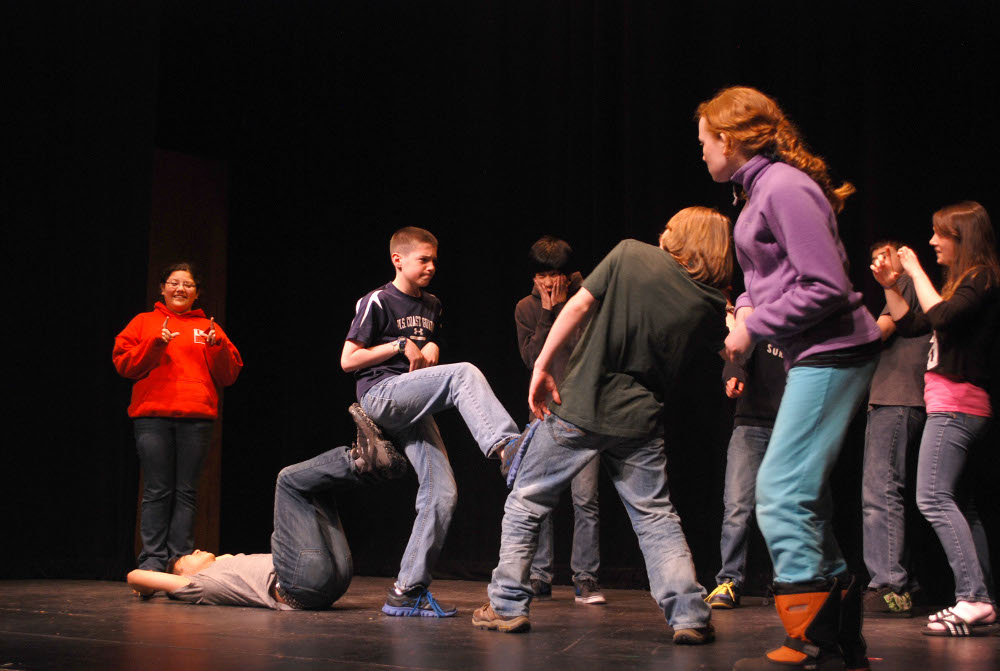
After a few final tweaks, the students hit the stage and their interviews came to life. Conarro narrated the first job accounts as the students shuffled into intricate positions.
For Griffin, the experience opened his eyes to a new form of acting. He said he’s always been a part of theater, but he didn’t realize the power of a solid position.
“I think it’s really cool to be able to act without actually moving and speaking,” he says. “It seems to me like it’s a lot more powerful.”
The Artist in Schools program is funded through the Partners in Education program of the John F. Kennedy Center for the Performing Arts, the Alaska State Legislature, the Rasmuson Foundation and the National Endowment for the Arts, with help from the Kodiak Island Borough School District.
Conarro wrapped up his two week artist residency on Friday. During his time in Kodiak he also worked with high school students on dramatic representations of personal essays.

A Southeast village Native corporation wants to export its cultural tourism expertise. It’s opened a consulting business to build on more than a dozen years in the business.
Huna Totem Corporation has more than 1,300 shareholders with ties to the Tlingit village of Hoonah, about 40 miles west of Juneau.
It places cultural interpreters onboard cruise ships sailing the ancestral homeland of Glacier Bay. It also presents educational programs at the national park’s lodge, the jumping-off point for many visitors.
Now, those efforts have a different name and goals.
“Alaska Native Voices is going to be an expansion of what we are currently working on,” says Mark McKernan, who heads up what Huna Totem used to call its Interpretive Services Department.
“We’re going to now provide consulting services for other cultural interests, Native groups, small communities and what have you. We’ll provide these services to them to help them answer the big questions of how do they start, where do they start and what goals should they be aiming for,” he says.
A number of other Alaska Native corporations and tribal entities use cultural tourism to make money and employ shareholders or members. (Scroll down for links to some other cultural tours.)
But McKernan says others are looking for help.

“What we have learned and what we can pass on is just as relevant in Southeast Alaska as it would be in Costa Rica or somewhere on the East Coast or the Midwest,” he says.
Alaska Native Voices began operations early this month.
McKernan says it has no formalized consulting agreements. But several groups have expressed interest and are discussing options.
Rosita Worl, president of the Juneau-based Sealaska Heritage Institute, says Hoonah Totem is well-equipped for the business.
“I think they have the experience. They’ve got the professional background and business experience in it. And I think they’ve done a great job in terms of trying to educate people about their culture and their history and meanwhile making a profit,” Worl says.
Huna Totem’s heritage guides are scheduled to be on about 200 cruise ships this year. That includes the Holland America Line, which sails large ships, and Alaskan Dream and Lindblad Expeditions, which operate much smaller vessels.
McKernan says cultural tourism programs need to tap traditional knowledge — and not just be another stop on the road.
“We do consult regularly with elders and others in the community and develop resources for these cultural guides to be able to grow and expand their knowledge base,” he says.
Huna Totem operates its own attraction, Icy Strait Point, which expects about 135,000 cruise passengers this year. Traditional culture is part of most of its excursions and programs.
McKernan says Icy Strait managers could also consult with other businesses interested in similar developments.
Learn about some other Alaska Native cultural tourism programs:
Do you want your local cultural tour listed here? Email the website link to ed@coastalaska.org.