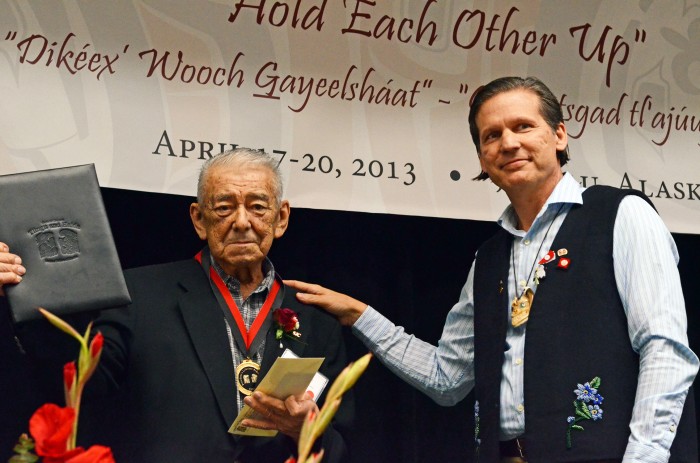
Alaska Sports Hall of Fame inductee and tribal member Herb Didrickson receives the President’s Lifetime Achievement Award from THCC First Vice President Will Micklin during the recent Tribal Assembly. Photo courtesy THCC.
The Tlingit and Haida Central Council expects some hits from sequestration. It also honored tribal members, including a Southeast basketball star.
President Ed Thomas told delegates about projected cuts during the council’s recent Tribal Assembly in Juneau.
“I think pretty much across the board, we’re talking about a 5 percent negative impact. Nobody has come up with anything less than that,” he says.
He says the cut would take about $1.3 million out of the council’s approximately $27 million annual budget.
The federal government provides much of the funding. Council programs provide vocational training, public safety, family and youth services, and tribal courts.
The Tlingit and Haida Central Council also uses interest from an approximately $11 million trust fund. But President Thomas says the earnings need to be saved.
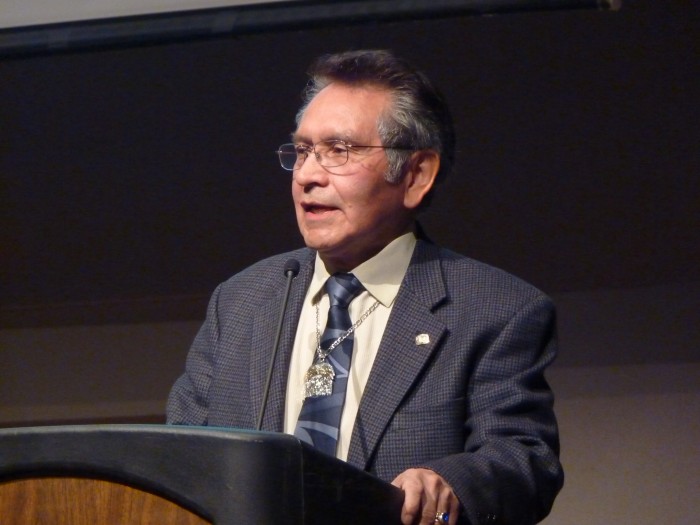
Tlingit-Haida Central Council President Ed Thomas, who told delegates about financial challenges at its recent 78th Annual Tribal Assembly in Juneau.
“All and all, we can’t keep spending the interest and expect to survive for the long term. We have to have at least inflation-proofing. And the only way to do that is to live within our means and not do things that cost money we can’t pay for,” he says.
The Juneau-based council represents more than 28,000 tribal members in Alaska and the Lower 48.
The tribal assembly voted down a proposal reducing the number of voting delegates by around 20 percent.
Rules require one delegate per 150 tribal members. A proposal from Thomas would have only counted members with active addresses that establish their residency.
Thomas says it’s a problem in bigger cities.
“Seattle and Juneau have the largest number of delegates and the largest number of people that we have bad addresses for,” he says.
April’s Tribal Assembly was the council’s 78th. It was held in the Elizabeth Peratrovich Hall in downtown Juneau. (Read the minutes from the meetings.)
Tribal Assembly delegates also:
Heard from Thomas also about succession planning, as he will retire at the end of his term in 2014.
Paid tribute to the late Clarence Jackson, past central council president.
Seated Aurora Lehr of Anchorage and Bob Loescher of Juneau as Tribal Court judges.
Named Shirley Kendall of Anchorage as Citizen of the Year.
Named Konrad Frank of Angoon as Youth Representative.
Honored tribal citizen and Alaska Sports Hall of Fame inductee Herb Didrickson. First Vice President Will Micklin presented him with the President’s Lifetime Achievement Award and a proclamation that declared Friday, April 19, 2013, as Herb Didrickson Day.
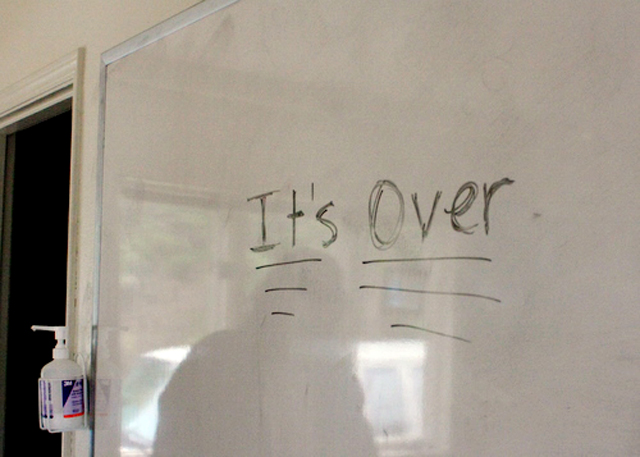
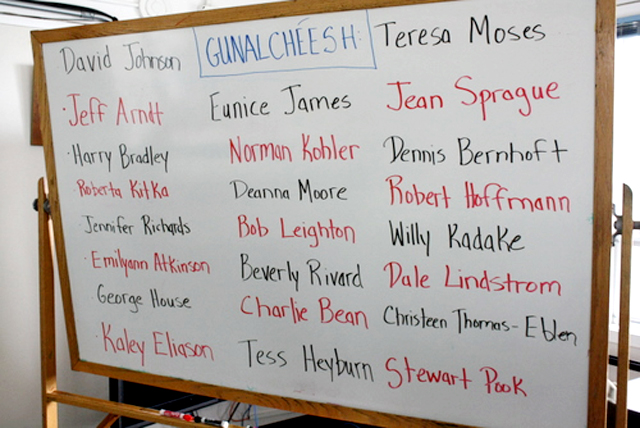
This message was written on a white board inside the house where clients lived during their stay at the residential treatment program. (Photo by Ed Ronco/KCAW)
Yesterday was the last day of operation for the Bill Brady Healing Center. The inpatient drug-and-alcohol rehab program has existed in its current form since 1996. Its closure is blamed on federal budget cutbacks. The center is part of the Southeast Alaska Regional Health Consortium, or SEARHC, which relies heavily on federal money.
Bill Brady’s last class graduated in mid-April, leaving a couple weeks for employees to tie up loose ends. KCAW visited employees as they packed up their desks and looked back at their time working for the center.
In the lobby of SEARHC’s Community Health Building, Doug Osborne leads me over to a red and black blanket hanging on the wall, behind glass.
“This blanket right here, at the end of the courses, they graduate people — maybe 10, 12 people — and at the end of this 40-day program, they do a really great job of honoring people,” Osborne said. “They do a cradling ceremony and sometimes they get wrapped in the blanket. They really know how to send people off. Today it’s about how well we can send them off.”
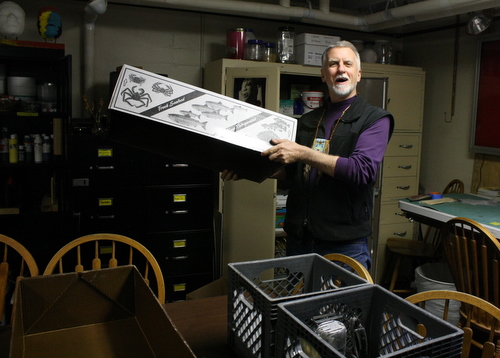
Charlie Bean uses fish boxes to pack up his workspace at the Bill Brady Healing Center. He jokes that people in other states probably don’t use fish boxes like this. (KCAW photo by Ed Ronco)
Osborne’s job at SEARHC includes running the employee recognition program and today, he’s planning a farewell luncheon for the 23 people who work at Bill Brady Healing Center.
“These guys were superstars,” he said. “They are really good, they’re passionate, ethical, dedicated. They worked hard, and did a good job. It’s a very sad day at SEARHC to see these guys go.”
Inside the center’s office building is George House. The bookshelves in his office are almost bare, as is his desk.
“I’ve been working at Bill Brady for 10 years now,” he said. “I started out as a temporary night-awake to earn a couple of bucks, and liked what I saw.”
As a night-awake, it was his job to make sure residents were safe at night — that things were turned off, and that everyone was where they were supposed to be.
“You know, you go through and make sure everything’s turned off, everything’s safe,” he said. “You count noses or toeses.”
And now he’s the evening shift leader. A job that began as simply a way to make some money turned into a calling.
“What I saw here was a lot of caring people helping others find their way,” he said. “I think what made Bill Brady click so well was mutual respect for each other among staff and among the clients that came through. It didn’t matter what your background was. They took you at face value and let you shine, you know?”
Lots of Bill Brady’s now former employees have stories like that.
Charlie Bean is in the basement of the house where clients used to stay. Down here, he led them through art projects. He’s wrapping stuff in plastic and joking about the uniquely Alaskan experience of using fish boxes to pack up your office.
“We’ve given away a lot of stuff,” he said. “Drums, and miscellaneous odds and ends. A lot of it’s going to go to Raven’s Way next door.”
Bean started working at SEARHC in 2001, and at Bill Brady in 2005. He’s definitely had his disagreements with the institution — he laments rules and regulations that he says distract from the day-to-day, hands-on work with clients, and he mentions spending increasing amounts of time doing paperwork. But he also says this is one of the best jobs he’s ever had. This team, he says, is close.
“I’ve never experienced anything like this,” Bean said. “I’ve had close friendships and stuff, but not a group of people like this. You come in and you jump on shift, and somebody’s going out the door, and they’ve got your back, and they know you’ve got their back, and there’s this seamless kind of flow that goes on between the people. That’s been special.”
The employees of the Bill Brady Healing Center were recognized at a private lunch Tuesday. This was in the front of the room. (Photo by Ed Ronco/KCAW)
Bean says he has possibilities for work in Anchorage and New Mexico.
“I’m always going to interact with clients. It’s just part of my life now.,” he said. “It doesn’t matter where I am. My life has turned into service. Wherever I go, I’ll be doing service of some kind.”
Of the three employees KCAW spoke to, Roberta Kitka has the longest tenure. She started here as an intern in 1998.
“I wanted to help people, because I’m in recovery myself,” she said. “I stuck my toe in the door doing my internship.”
Eventually, she put in for a full-time job (“Showed up for an interview and said ‘I’m here to put my Tlingit two cents in,’” she says) and most recently, she’s been in a supervisory role. Kitka says she likes watching the transformation in clients between their first day and the time they graduate.
“We more or less serve the people who are throw-away people,” she said. “People who end up making something of themselves. We had a woman call us up, ‘I’ve got my kids back,’ or ‘I’ve only got 30 credits left and I’ll finish my college degree.’ Things like that. They’re not throw-away people. That’s the way we look at it.”
Now that she’s done working at Bill Brady, she’s moving to Anchorage. Her daughter is up there, and so is Dena a Coy, a treatment center for women and children, where Kitka did her first internship.
“And the two ladies I did it with, worked with, are still there,” she said. “So I’m going to pop my head in and say hi, I’m back.”
Back in the Community Health building, tables and chairs have been set up for the farewell luncheon. Comment cards for people to leave memories are laid out at each place. And Doug Osborne is standing behind a lectern, going over his remarks. Next to him, a dry-erase board with the names of every employee.
Twenty-three names.
“So we’re making this nice, but there’s no way around it,” Osborne said. “This is really a sad day. This is a day of loss.”
The nation’s first online sexual health curriculum aimed at American Indians and Alaska Natives is in the final stages of development in Anchorage.
Sex education begins when parents provide age-appropriate information to their children about their bodies but ages 11 to 14 is a good time to talk with kids about dealing with peer pressure about sex, drugs, and alcohol. That’s according to an HIV/Sexually transmitted disease, or STD program manager, Connie Jessen.
Jessen, with the Alaska Native Tribal Health Consortium, is testing “Natives: It’s Your Game,” the nation’s first computer-based sexual health curriculum targeting Alaska Native and American Indian middle school students:
“In middle school is when there’s quite a few students that are already become sexually active and sometimes when you look at high school students, they’re so much older and already had a lot of these experiences that puts them at risk for these various health outcomes, that it’s important to do it earlier so they have the skills before they actually need them.”
Jessen says the Consortium is in the third year of a 3-year project with the Northwest Portland Area Indian Health Board, Indian Health Council of Arizona, and the University of Texas to develop the program. She says “Natives: It’s Your Game” uses games and music, and encourages creativity, while teaching students about abstinence, sexual health, and good decision-making.
“It also addresses healthy relationships, healthy friendships, sexual behaviors, HIV-STD prevention, alcohol and drug abuse, Internet safety, and a whole host of different topics.”
The Consortium is putting together groups of middle-school students to see how well the program works. Some will go through a science-based course on sexual and behavioral health. The other group will take part in the “It’s Your Game” curriculum. Both will be tested to find out how much they learned. For more information online, go to www.iknowmine.org/iyg
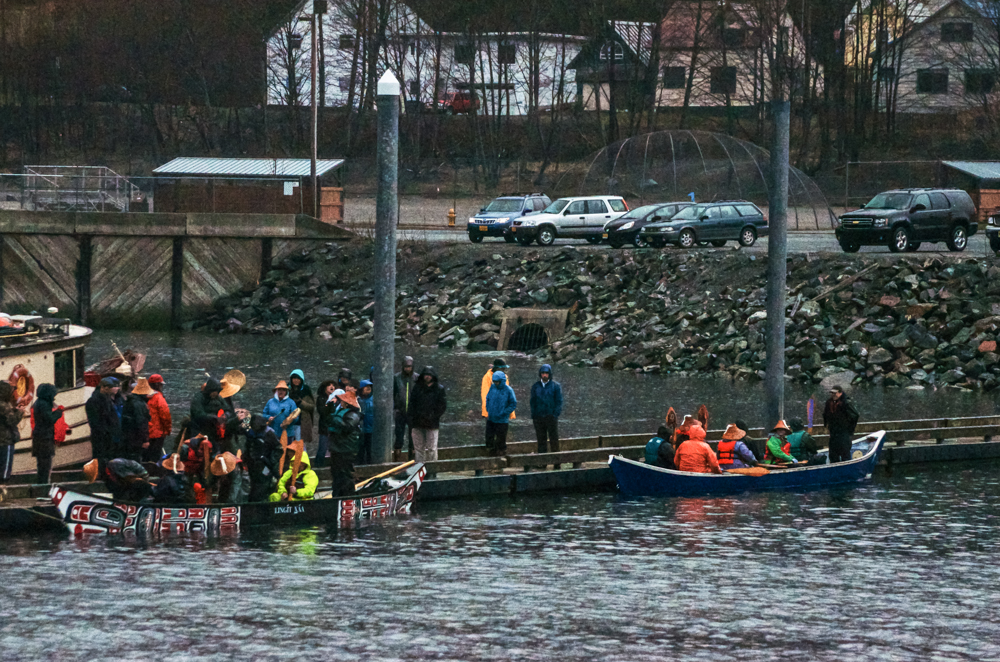
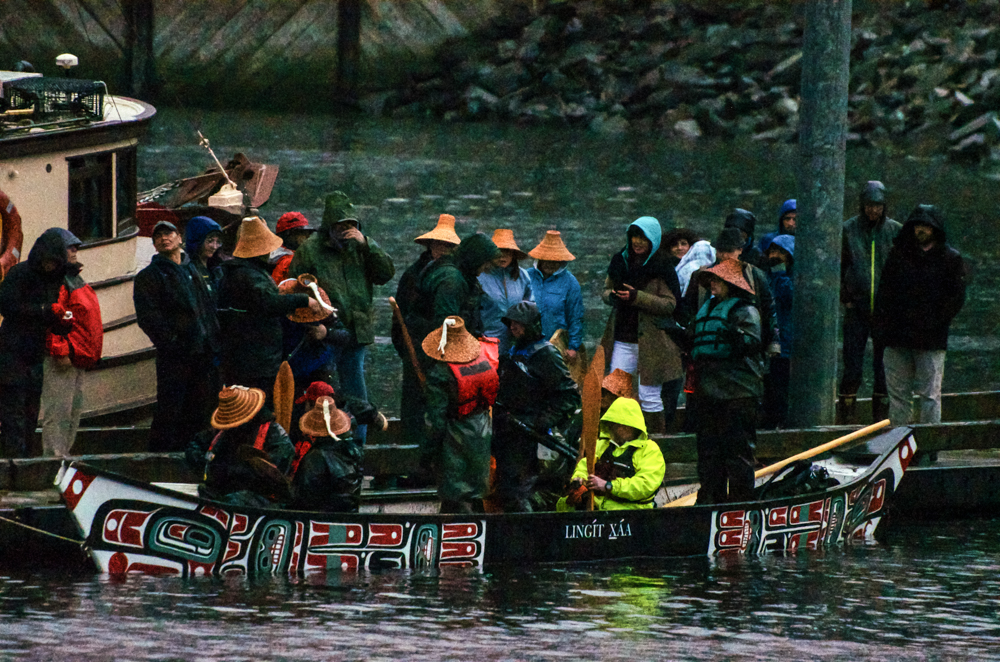
The two canoes prepare to leave Juneau on April 24. (Photo by Kelli Burkinshaw)
Several canoe groups are paddling down the Inside Passage to Wrangell for the Shakes Island Rededication event this week.
Two canoes traveling from Juneau hit bad weather and rough water on Saturday. One canoe was lost.
Both canoes left Juneau on April 24th. They were each accompanied by a support boat.
The Raven canoe belongs to the One People Canoe Society and has paddlers from several Southeast communities and Washington state.
The second canoe is from the Sealaska native corporation and has a Yakutat-based crew.
The crews hit bad weather and high seas in Seymour Canal on Saturday.
Both decided to put the paddlers on the support boats and tow the canoes.
Alicia Chilton is on the board of the One People Canoe Society. She’s also a paddler on the Raven Canoe.
“When we went to turn, the line slacked in, and all the water from the back of the canoe rolled forward. And that’s when she just went down and the line broke. And we watched her drift away from us,” said Chilton.
One of the canoes prepares to depart Juneau on April 24. (Photo by Kelli Burkinshaw)
Both the Raven canoe and the Sealaska canoe snapped their tow lines and were washed away.
The lost Raven Canoe was spotted on a rocky shore where it had beached itself. It was retrieved safely at about 2pm on Saturday.
The Sealaska canoe was found about two hours later.
The plan was to tow both canoes to Kake, where they could be inspected for damage, repaired if necessary, and sent back on their journey.
The Raven canoe made it. The Sealaska canoe did not.
During the recovery, it broke free of its tow line for a second time.
As of this afternoon, a search and recovery effort is in full swing. A Juneau-based plane for the Alaska Department of Fish and Game was sent out. A second plane from Petersburg Fisheries was also dispatched.
There was a possible sighting of the Sealaska canoe this morning.
Wrangell Cooperative Association staff member Renee Claggett is helping coordinate efforts in the water.
She made contact with crewmember Jay Dodge of the Silver Bay Seafoods tender Lady Kate this afternoon.
“Okay the report is from the pilot that it was upside down and actually went up during a high tide. And it’s falling tides now so it’s probably safe. If anybody as the boats are moving in for the Seymour herring fishery, if they could just keep an eye out for it. So if you could just put the word out on the fishing fleet there as they come in. And if it does get into trouble, maybe somebody could grab it and let us know,” said Claggett to Dodge.
The Sealaska canoe’s life vests were also possibly spotted in the area known as the Rock Garden in Seymour Canal.
Meanwhile, the Raven canoe and its crew arrived in Kake late Sunday afternoon.
The Sealaska crew made it to Kake as well.
And, Chilton said, everyone is coming together to make the best of a harrowing experience.
“What’s happening now is that the Juneau and Yakutat crewmembers—we’ve got a total of 18—will be rotating through the Raven canoe. So Juneau and Yakutat are combining into one now,” said Chilton.
The Raven canoe is expected to arrive in Wrangell waters on Wednesday.
The Raven canoe is set to leave Kake for Petersburg Tuesday morning. It had to delay its planned departure this morning due to inclement weather.
Alaska State Museum Exhibit Curator Jackie Manning is confronted by some imposing figures every time she enters its main gallery.
They’re well-armed, well-armored mannequins, displaying years of carving by Sitka Tlingit artist Tommy Joseph.
“And when you first walk in, you’re met by all six of them and they‘re up and they have this presence that I think really gives you the sense of what it would be like to encounter these warriors in life,” she says.
She points to one of the figures, with an abalone-eyed helmet, shelled, protective neck gear and the historic equivalent of a kevlar vest.
“Every time I see it, it leaves quite the impression because it’s fully dressed with the slat armor and the collar and the tunic and the bow and the arrow as well as the dagger. It’s just such a beautiful example of all of the armor on one figure,” she says.
The museum is a popular Juneau tourist destination, catering to cruise-ship passengers and independent travelers, as well as locals.
It, and other parts of the tourist industry, will likely see more people visit the state this year. Larger cruise ships are on their way, bringing visitors through Southeast and across the Gulf of Alaska. Many tourists continue north, riding and flying to the Railbelt and on to places north and west.
This season’s visitors to the state museum will also view Juneau’s Kay Field Parker’s Ravenstail weaving and Sitka’s Nicholas Galanin’s contemporary Tlingit-Aleut art.
“I think the three shows really work together very well and are going to give our all of our visitors a great impression of the kind of artwork that’s done in Alaska,” she says.
The museum is but one of hundreds of attractions and excursions ready for Alaska’s 2013 tourist season.
“It looks excellent,” says John Binkley, president of the Alaska Cruise Association, which represents Princess, Holland America and other large-ship lines sailing Alaska waters.
“It looks like this will be the first time since 2009 that we’ll get back above the 1 million mark for cruise visitors coming to Alaska.”
He says the ships will bring nearly 70,000 more visitors north this season.
They’ll come aboard 28 large ships, one more than last year. And three lines will send larger vessels than last year, making close to 500 separate voyages.
“The indications that we’ve gotten are that the prices are holding steady, which means that there’s less discounting and usually people who are a little more affluent are coming to Alaska. That should be good news for retail merchants as well as those who have shore excursions that hopefully people purchase when they get off the ship,” Binkley says.
“The industry is cautiously optimistic that it will be a great summer and total visitor season,” adds Sarah Leonard, president of the Alaska Travel Industry Association, a statewide tour-business group.
“Last summer we know that visitors reached 1.8 million in Alaska. And that was the first increase we saw in over four years. And then with some new … airline service and new cruise-ship berths, we see positive growth,” Leonard says.
Back at the Alaska State Museum, dozens of Kay Field Parker’s ravenstail weavings are on exhibit, in a summer show called “Playing with Lightning.”
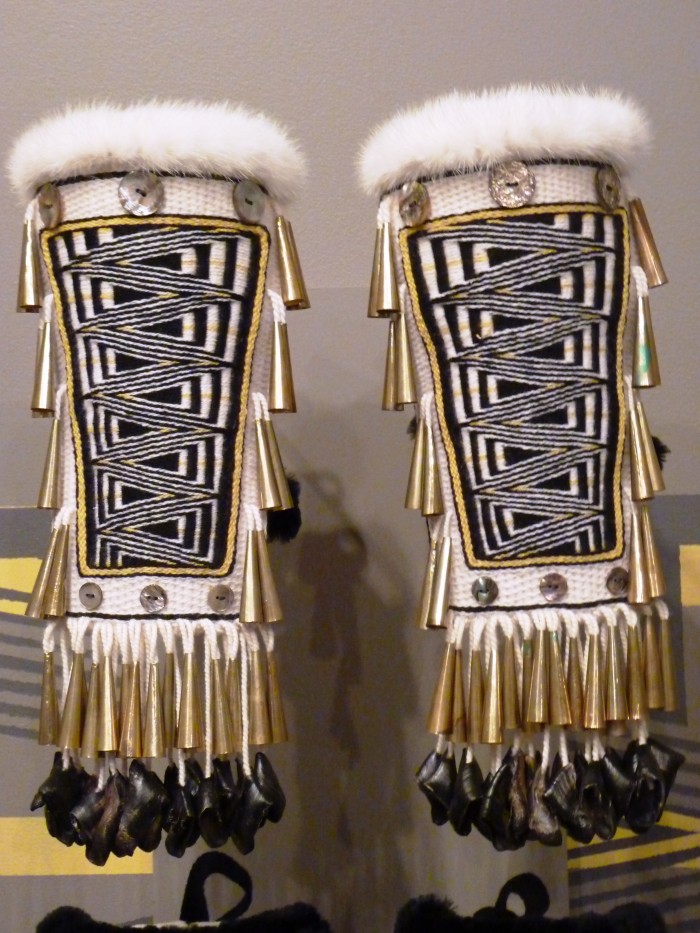
Leggings from the “Playing with Lightning” exhibit.
“Lightning is one of the patterns, a triangle pattern that repeats, but it reverses,” says Manning, the museum curator.
She describes ravenstail as highly geometric. The technique was rediscovered in the 1980s after being out of use for about two centuries. Manning says Parker’s work follows the old ways, with some variations.
“The traditional colors were white and black and yellow. And the majority of Kay’s work reflects those traditional colors. And based on materials, because they’re so hard to come by for weavers that do this kind of work, she also has some other colors she’s introduced,” she says.
This is the final summer exhibits will be on display in this aging museum. It will be torn down next year and eventually replaced with a modern structure including the state library and archives.
Meanwhile, the cruise-and-tourist season continues through late September. In addition to large-ship lines, the number of smaller tour vessels is increasing this year.
Schools from around Southeast Alaska brought their music to the capital city earlier this month at the annual Southeast Music Festival. The three day event featured concert bands, jazz bands, choral music, and instrumental and vocal solos. Each performance was judged and received either written comments or a “superior” rating. Check out this audio postcard from Music Fest.
We heard “Old Churches,” performed by the Craig Concert Band; “Festivo,” from the Juneau Douglas High School Symphonic Band; “Three Ayres From Gloucester,” played by the Petersburg Concert Band; “Vesuvius,” performed by Sitka Symphonic Band; “Inchon,” Thunder Mountain High School Symphonic Band; and “Celebration for Wind and Percussion,” played by the Wrangell High School Band.
We interviewed Kelsey Trojan, a junior percussionist at Craig High School; Mizani Rawhani, a senior bassist and tenor from Petersburg High School; Slush not Snow, a rock band in Juneau; Matt Lenhard, music instructor at Petersburg High School; John Depalatis, music instructor at Sitka High School; Tyree Pini, music instructor at Thunder Mountain High School; and Tasha Morse, music instructor at Wrangell High School.
Our thanks to the JDHS Video crew for helping with this story.
Close
Update notification options
Subscribe to notifications
Subscribe
Get notifications about news related to the topics you care about. You can unsubscribe anytime.