Delegates from around Southeast and a few other areas will hear reports from Sealaska Corporation, the Alaska Native Brotherhood and Sisterhood, and other organizations.
Council President Ed Thomas says this year’s theme is “Hold Each Other Up.”
“We find that so often we spend a lot of time focusing on the negative. So we want to ask people to work together, lift each other up and try to have a positive way forward,” Thomas says.
Delegates also will discuss and vote on resolutions addressing a variety of issues.
They include elder housing, Native language instruction, the Sitka Sound sac roe fishery and sea otter harvests.
“We’re pretty much going to be dealing with the normal agenda. We have some constitutional amendments that I’m proposing and some statutes on tribal courts that will be strengthened,” Thomas says.
Delegates will meet through Saturday at the council’s Elizabeth Peratrovich Hall in downtown Juneau.
The president’s seat is not up for election this year. Thomas, 71, has announced he will retire in 2014, at the end of his term. He’s been in the post more than 25 years.
One issue before delegates is changing some of the rules for electing the council’s president.
A dog took the stage during this year’s Alaska Folk Festival. So did a drum-and-pipe band, a much-traveled singer-songwriter and some Middle-Eastern-style singers and dancers. We spoke with some of the performers at the 39th annual Juneau event, and assembled this audio post card.
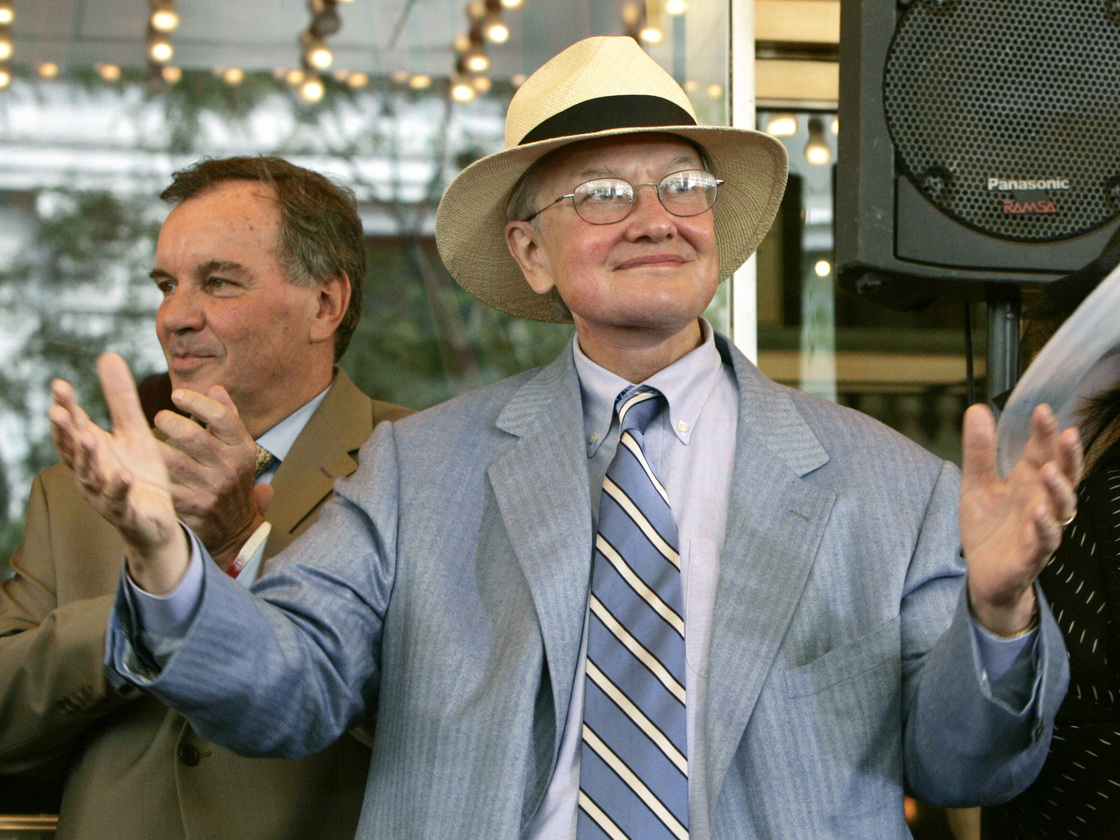
Film critic Roger Ebert acknowleges the applause of those gathered to pay tribute to him at the historic Chicago Theatre on July 18, 2005. Charles Rex Arbogast/AP
He won a Pulitzer Prize for his writing, but just as influential as his print essays were his “thumbs up” and “thumbs down” movie reviews. Film critic Roger Ebert died Thursday after struggling for years with cancer. He was 70 years old.
His thumb may have made him famous on TV, but Ebert was first and foremost a print journalist. He worked on newspapers in grade school, high school and college. With his acumen for writing came a love of movies — and on July 12, 2005, proclaimed Roger Ebert Day by the city of Chicago, he told a crowd of admirers why movies matter.
“If it’s a great movie, it lets you understand a little bit more what it’s like to be a different gender, a different race, a different age, a different economic class,” he said. “It helps us to identify with the people who are sharing this journey with us. And that to me is the most noble thing that good movies can do — and it’s a reason to encourage them and to support them and to go to them.”
Early Days
Ebert was born June 18, 1942. By the time he was 15, he was covering high school sports for his local paper in Champaign-Urbana, Ill. He went on to become a stringer for the Chicago Sun-Times, and when the paper’s film critic left, he was offered the job.
“My mother’s friends never knew what I did,” he recalled. ” ‘And how is Roger?’ They would have sons who were lawyers, doctors. ‘And how is Roger? Is he still just going to the movies?’ ”
Ebert was 24, one of a crop of young critics around the country hired to cover the edgy films being made during the late ’60s — movies like The Graduate,Easy Rider and Bonnie and Clyde. While writing reviews, Ebert also got some firsthand experience in the movie business, writing screenplays for B-movie king Russ Meyer. Ebert wrote the script for Beyond the Valley of the Dolls and, under a pseudonym, Beneath the Valley of the Ultra-Vixens.
In 1975, Ebert became the first film critic ever to receive the Pulitzer Prize for Criticism. Although his movie reviews were syndicated, it was his television work that took the heavyset, bespectacled Ebert to a national audience. In 1978, a three-year-old local film-review show he hosted with his chief Chicago rival, the Tribune‘s Gene Siskel, was picked up for syndication by PBS.
“What Roger brought to the show was a very clear vision of what he was trying to communicate to viewers,” says Thea Flaum, the show’s executive producer. “Not worried about how he appeared. Only worried about getting across what he wanted you, sitting at home watching him, to know. And that’s an enormous strength — maybe it’s the essence of what a great critic really is, and I think that’s what made the show fly.”
The show continued after Siskel’s death from a brain tumor in 1999, with Ebert eventually joined by Richard Roeper. At the height of his career, Ebert wrote as many as 300 reviews a year, published books, and covered the Academy Awards and the major film festivals every year as a working journalist — all this in addition to the show. He also programmed his own film event — Roger Ebert’s Overlooked Film Festival, featuring movies he considered great but ignored.
Ebert not only communicated enthusiasm for mainstream movies but championed singular projects like the small documentary Gates of Heaven. The film, about pet cemeteries, made it onto Ebert’s 10-best list one year. Its director, a then-unknown Errol Morris, says if not for Ebert, he might not have had a career. Ebert’s encouragement about that first directorial effort made an enormous difference for Morris.
“Here I had someone writing about my work who was a true enthusiast,” Morris says. “His enthusiasm has kept me going over the years, and the memory of his enthusiasm will keep me going for as long as I make movies.”
‘A Guy Who Could Joke About Himself’
For all of Ebert’s influence, his trademarked right thumb also brought charges that he was doing a disservice to serious film criticism. Morris says that’s not true.
“It tells you he was a guy who could joke about himself, and if the ‘thumbs up’ and ‘thumbs down’ deal in any way suggests to people this was a person who did not take movies seriously, they are just wrong,” he says.
In addition to winning the Pulitzer, Ebert was the first critic to have a star on Hollywood’s Walk of Fame. During a 2005 interview with NPR, he encouraged audiences to push themselves beyond Hollywood.
“If you only see films about people just like yourself, why even bother to go? Because you already know about yourself,” he said. “You can only find out about yourself by learning about others.”
Ebert was diagnosed with thyroid cancer in early 2002. After several surgeries, he was left unable to speak — but he continued to watch and review movies and carved out a prodigious digital profile on Twitter and on his Sun-Times blog.
In his 2011 memoir, Life Itself, Ebert wrote about the importance of contributing joy to the world — no matter what our problems, our health and circumstances. He was happy, he said, to have lived long enough to find that out.
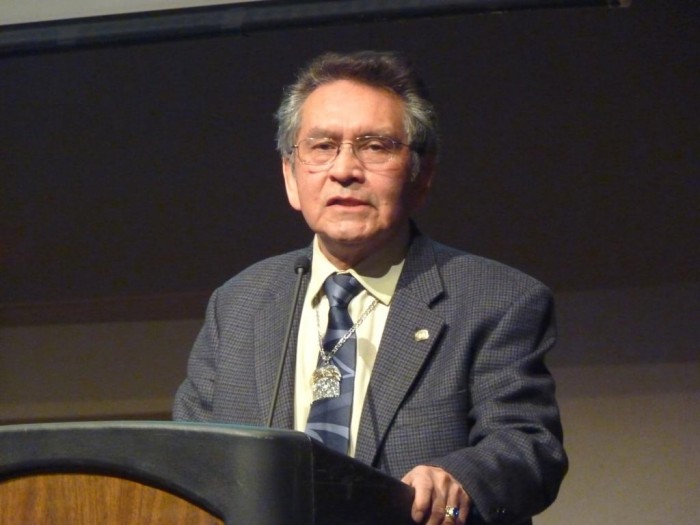
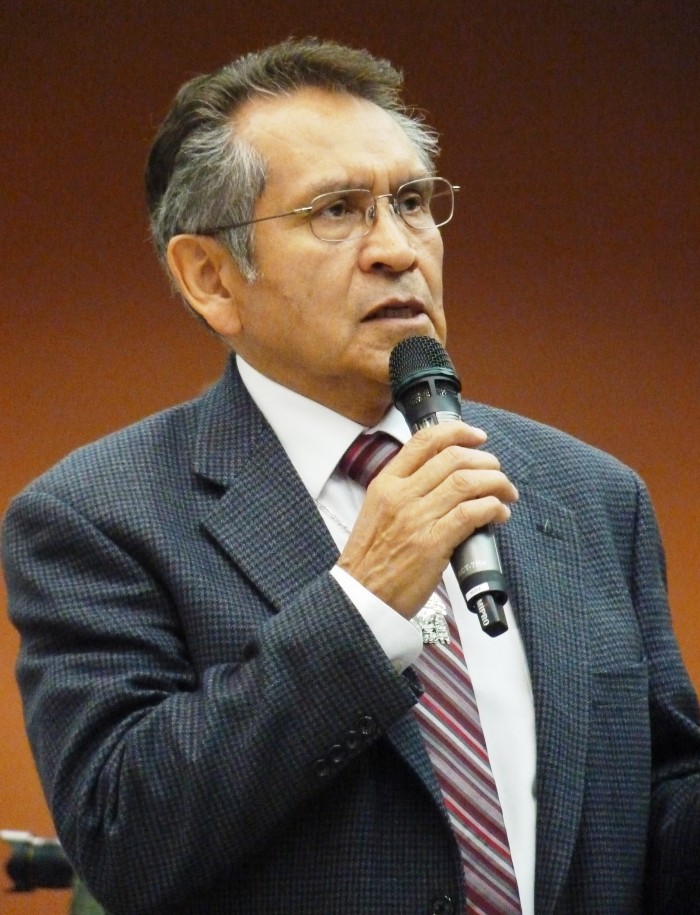
Tlingit-Haida Central Council President Ed Thomas speaks at Wednesday’s Native Issues Forum in Juneau. Thomas plans to step down in 2014. Photo by Ed Schoenfeld/CoastAlaska
He’s telling tribal members that he will not run for re-election when his term ends next year.
Thomas became council president in 1984. He retired on short notice in 2007, but returned to win back the post three years later.
“I’m planning to give people a bit more chance to find my replacement and get more involved and have more of a say in who my successor is, rather than me just walking out,” he said in an interview following a forum at Juneau’s Elizabeth Peratrovich Hall.
The central council’s president has a full-time job, overseeing programs including vocational training, public safety, family and youth services, and tribal courts.
Thomas plays a leadership role in other Native organizations and businesses, including serving on Sealaska corporation’s board of directors.
He says retirement will allow him to continue that work.
“I’m involved in the National Congress of American Indians and the AFN also. So, it gets to be just a little bit challenging to do all that stuff. I’d like to focus on being a board member and helping out the tribe wherever I can,” he says.
The central council is federally recognized, but most member communities have their own tribal governments. The council lists 21 local affiliates, most in Southeast, with others in Anchorage, Seattle and San Francisco.
Thomas says he doesn’t plan to endorse a successor.
“I think it should be wide open. I think the people should decide. I think there’s some good candidates, but there are also some that would create more political issues than positive administrative opportunities for us,” he says.
The central council was founded in 1935. By the time he retires next year, Thomas will have been president for about a third of the organization’s existence.
Sealaska Plaza in Juneau, headquarters of the Southeast regional Native corporation.
Sealaska’s approximately 21,000 shareholders will get their spring dividends around April 12th. Sealaska’s Board of Directors approved the more than $12 million distribution at a meeting today at its Juneau headquarters.
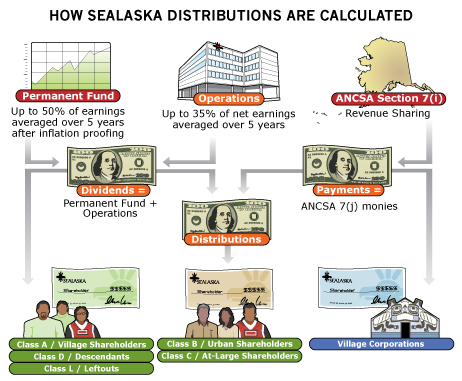
Here are details of how the distribution is divided up. Totals assume ownership of 100 shares, the most common number.
Urban and At-Large Shareholders: $698
Elder Urban and At-Large Shareholders: $852
Non-Elder Village and Leftout Shareholders: $154
Elder Village and Leftout Shareholders: $308
Descendant Shareholders: $154
Here‘s how the shareholder categories are defined:
Urban: Also a shareholder in an urban Native corporation, such as Juneau’s Goldbelt or Sitka’s Shee Atiká.
At-Large: Not a shareholder in any urban or village Native corporation.
Village: Also a shareholder in a village Native corporation, such as Huna Totem, Kake Tribal, Klukwan and Cape Fox corporations.
Elder: Original Sealaska shareholder who has reached the age of 65.
Descendent: Direct descendents of original shareholders who are at least one-quarter Alaska Native.
Here’s where the money comes from, per 100 shares:
$544 from ANCSA Section 7(i) (regional corporation resources earnings) revenue sharing. A $5.44 per share payment will be made.
$100 from corporate earnings. 35 percent of the corporate consolidated net earnings averaged over five years, minus earnings associated with the Permanent Fund. The distribution includes an operations dividend of $1.00 per share.
$54 from dividends from the Marjorie V. Young Permanent Fund, which are based on a percent of market value (POMV) of the fund balance. Based on the POMV calculation, the 2013 April dividend will be $0.54 per share.
Some members of the Juneau-based regional Native corporation have more or fewer than 100 shares due to inheritance or gifting.
Much of the dividend – close to $550 – comes from a pool of regional Native corporation resource earnings. Most of that money comes from Northwest Alaska’s NANA, an owner of the Red Dog Mine.
Sealaska’s urban shareholders receive that part of their dividend directly. The corporation pays village members’ share to their local corporations, which decide whether to pass it on.
Last spring’s distribution was about 20 percent more for urban shareholders and about the same amount less for village members.
Sealaska’s shareholders are mostly of Tlingit, Haida or Tsimshian descent. Close to half live in Southeast.
The recent reauthorization of the Violence Against Women Act had many applauding its new protections for LGBT victims and illegal immigrants.
All three members of Alaska’s Congressional delegation supported the bill.
One of the reauthorization’s new, more controversial provisions – granting tribal courts jurisdiction over non natives for domestic violence crimes committed in Indian Country – has reopened a long-simmering debate about tribal power in Alaska.
Myron Naneng is the president of the Association of Village Council Presidents. He says tribes in the Lower 48 are celebrating the new authority they’ve won.
But not in Alaska because, Naneng says, the state does not recognize tribal powers:
“It’s the state’s position that anyone who moves through the villages who’s not a tribal member should not be handled by a local tribal court. But we move into urban areas ourselves, and we’re subject to state courts.”
The federal government still recognizes Alaska tribes, even though most relinquished aboriginal rights and territory, known as Indian Country, when Congress passed the Alaska Native Claims Settlement Act. Residents in Metlakata opted out of ANCSA. Metlakatla is the only reservation in the state, and the only federally recognized Indian County in Alaska.
Senator Lisa Murkowski inserted an amendment in the Violence Against Women Act that, she says, was clearly designed to ensure Metlakatla’s increased court jurisdiction:
“It was very clear that it was designed to be implemented in Indian Country. In Alaska, the only Indian Country, the only reservation, is Metlakatla. So I wanted to make sure that Metlakatla was going to be treated similarly to all other reservations, to all other land in Indian Country.”
But there’s been push back from Naneng and others who say more should have been done to make sure the new provision applied to all Alaska tribes.
Senator Murkowski says the Violence Against Women Act was not the place to hash out territorial disputes. And to the tribes who were looking to gain increased rights, she says that conversation can be had at a later time.
“I think there are some who saw this as an opportunity to gain an inch, and then build on it from there.”
The U.S. Supreme Court affirmed the state’s lack of Indian County in 1998. Senator Murksowski says Congress would need to amend the Alaska Native Claims Settlement Act to create Indian Country.
John Havelock was the Alaska Attorney General when the Native Claims Settlement Act passed. He says the Act was described as an alternative to what at the time was considered failing reservation system and was not designed to take away tribal authority.
“There was not any side discussion of tribal authority. In fact I think a lot of people assumed that the village corporation system would replace any tribal jurisdiction. But when you think about it and look at it, you say, well wait a minute.”
Mike Geraghty is the current Attorney General for Alaska.
“The state’s position is that we’re in favor of the law as it currently exists and the jurisdiction the tribal courts already have.”
Geraghty says state courts have jurisdiction over the entire state.
“These people, whether they’re members or not members of a tribe, are also citizens of the State of Alaska. They have Constitutional rights under the state constitution.”
In Indian Country, tribal courts have sole jurisdiction within the designated boundaries and state courts have none.
“I’m not in favor of disrupting that balance, and creating, you know 229 checkerboard, 229 tribal court jurisdictions. Where the physical boundaries would be, who knows.”
Because there are not defined borders like the reservation system has. Geraghty says the state cooperates with tribal courts on issues under the Indian Child Welfare Act and child support cases. It also recognizes and enforces protective orders from certain tribal courts.
Senator Murkowski says the state needs to be pushed on the issue of tribal jurisdiction … that the state has for too long feared relinquishing any authority to the tribes.
She says she’s introducing a plan that would “cross deputize” village public safety officers. It would allow them to hand out punishments throughout a village.
“Fines, or forfeiture, or fines, or community service, or even banishment, and it gives them that authority. This is something we’ve tried to get the state to come around on. I think we’ve made huge progress.”
The plan is being reviewed by both tribal leaders and state officials.
And in Murkowski’s eyes, it gives the state a chance to see there is nothing to fear in granting tribes more authority.
Close
Update notification options
Subscribe to notifications
Subscribe
Get notifications about news related to the topics you care about. You can unsubscribe anytime.