Community

Regulatory board will take first look at new marijuana regs

The state Alcoholic Beverage Control Board is expected to review possible regulations for the new marijuana industry.

The board is scheduled to meet Thursday in Anchorage to discuss marijuana regulations.

When voters in November approved a ballot issue legalizing limited recreational marijuana, they also directed the board to develop regulations for commercial and retail marijuana sales and cultivation.

The agenda also includes an update on the timeline for drafting the rules.

In February, the board made an emergency regulation defining the public places where marijuana is prohibited. It will consider making that rule permanent on Thursday.

A new five-member marijuana control board that shares staff and resources with the alcohol board is expected to take over the regulatory work eventually. By mid-day Wednesday, there were 89 applicants for the board.

Alaska senator continues pushback on Hyder issue

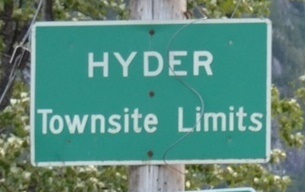
Hyder-signAlaska’s senior senator sent another letter this week to Canada’s ambassador to the United States, Gary Doer, stressing the importance of keeping the border open 24 hours a day between Hyder, Alaska, and Stewart, British Columbia.

Starting April 1, that border crossing has been closed daily between midnight and 8 a.m.

Sen. Lisa Murkowski’s communications director, Matthew Felling, speaking from Washington, D.C., said Wednesday that “Sen. Murkowski is clearly bird-dogging this issue, because Alaskans aren’t done with it. There is no resolution. It’s putting health at risk, and the health of the local community economy at risk.”

The border crossing is the only road connecting the tiny community of Hyder to the outside world. The approximately 100 residents of Hyder depend on nearby Stewart for medical services, among other needs.

In addition, Hyder is home to a popular bear viewing facility, run by the U.S. Forest Service. Because Hyder is so small, tourists usually stay in the larger community of Stewart and drive the short distance to Hyder early in the morning to watch bears.

Felling said the first letter Murkowski penned to Canada’s ambassador was before the new border crossing hours took effect, and warned of the possible repercussions for both communities.

“Now that we’re seeing the actual impacts play out, and it’s actual and not theoretical, Sen. Murkowski wanted to circle back and share with the Canadian government the details of the shortcomings of this we’ll-get-back-to-you approach,” Felling said.

The solution that the Canadian government has provided for after-hours medical service is a telephone connection. Individuals with an emergency need can call Canada Border Services, and get the combination to a lock box that has a key to open the gate.

Felling said that’s insufficient.

“Convenience is not the issue here. Health, well-being and potential lives could be at risk,” he said. “If there is a wound or there is a heart attack, you don’t want to wait for the phone to get answered and you don’t want to wait to figure out how to get the key in the keyhole to lift up this gate on your own.”

Then there’s the economic factor. The U.S. Forest Service has weighed in on this issue. In a response to an inquiry from Murkowski’s office, Forest Service officials said that tourists usually try to arrive at the Fish Creek Observatory early in the morning for the best bear-viewing opportunities; the new border hours will affect that tourist traffic.

Felling said Hyder’s tourism is good for both Alaska and Canada.

“The tourists who go across the border to watch bears come back to spend their money at the inns in Canada, in Stewart,” he said.

In a written response to Murkowski’s first letter of concern, Ambassador Doer said that emergency first responders all have keys to the border gate, and that the closure time – midnight to 8 a.m. — was chosen because of the light traffic during those hours.

Felling said that doesn’t factor in some important considerations.

“That ignores the fact that the people who are crossing the border into Canada are often in an urgent medical rush,” he said. “And the time period where they looked at these numbers was most likely outside of the tourist season, because 6-8 a.m. is the high peak demand hours for tourists to head into Hyder to watch bears, which is the draw.”

Felling said Hyder’s reputation as a tourism destination is at stake, and there could be dire financial repercussions for both Hyder and Stewart in the long run.

Bethel City Council votes to protest liquor licenses

It’s been four decades since Bethel had a liquor store, and for now, that status will continue. The Bethel City Council voted Tuesday to protest two liquor store license applications from the Bethel Native Corporation’s Bethel Spirits and the Alaska Commercial Company.

Council members cited the loud public outcry against having easier access to alcohol, as well as possible violations of rules against being too close to churches and schools.

When the debate entered the weeds, Council member Chuck Herman added a line to the resolution:

“I just want to make it very clear our protest stands based on the community being opposed to it and not based on any technical violations.”

The vote was 4 to 3.

The state’s Alcoholic Beverage Control Board is required to honor protests from governing bodies unless they are found to be arbitrary, capricious, and unreasonable.

Bethel Native Corporation President and CEO Ana Hoffman insisted the proposed store is legally situated and argued that what Bethel has now is not working.

“The presence of illegal sales is undeniable and not a cent of the sales is taxed. We have quite possibly created the most unhealthy environment imaginable. Allowing for the issuance of a liquor licenses enhances control and regulation over the current system of chaos.”

In an October non-binding advisory vote, Bethel citizens will weigh in on whether they support several categories of liquor licenses. In the same election, they can approve a new 12 percent alcohol sales tax.

Marriage equality advocates to governor, AG: ‘Stop in the name of love’

One of the event organizers, Maureen Longworth, speaks to the crowd rallying outside the Dimond Courthouse, across the street from the state capitol. (Photo by David Purdy/KTOO)
One of the event organizers, Maureen Longworth, speaks to the crowd rallying outside the Dimond Courthouse, across the street from the state Capitol. (Photo by David Purdy/KTOO)

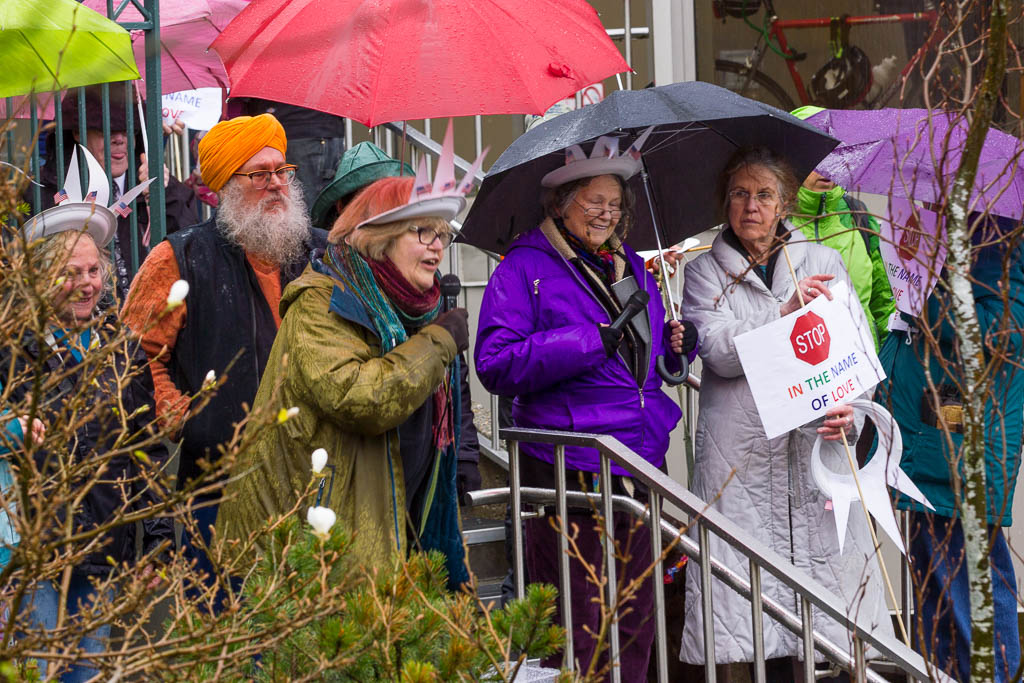
As the U.S. Supreme Court heard oral arguments on marriage equality, around 40 people gathered at the Dimond Courthouse plaza across from the State Capitol in Juneau to rally through song and dance.

The group wants Gov. Bill Walker and Attorney General Craig Richards to end Alaska’s same-sex marriage appeal in one federal case and withdraw its support of gay marriage bans in the Supreme Court case.

With a single speaker wrapped in plastic, two microphones and backup dancers, around 30 people stood in the rain singing, “Stop in the name of love/ Before you break my heart/ Gov’nor Walker, I’m aware of what you do/ After we voted for you/ You signed on the amicus brief/ Against marriage equality/ There’s time before you spend money/ Causing us pain and hurt/ Think it over/ We gave our trust to you…”

Rally participants carried flags and wore Statue of Liberty headpieces. (Photo by David Purdy?KTOO)
Rally participants carried flags and wore Statue of Liberty headpieces. (Photo by David Purdy/KTOO)

At the end of the 5-minute performance, one of the organizers, Maureen Longworth, asked everyone participating and watching to “call Gov. Walker and ask him to stop in the name of love. And have all your family and friends do the same.”

Longworth is referring to the state’s appeal to the federal court decision that legalized same-sex marriage in Alaska. Gov. Sean Parnell’s administration initiated the appeal, and it’s been carried forward by Gov. Walker’s administration.

Longworth and others singing also want the state to withdraw from the amicus brief to the U.S. Supreme Court defending gay marriage bans.

Kimberly Crawford, who voted for Walker, has been doing exactly what Longworth is asking people to do.

“I’ve called him several times, emailed him. I mean, it’s unacceptable in my opinion,” says Crawford, who hasn’t received a reply from the governor.

Kimberly and Marguerite Crawford attended the rally. They were married twice - once outside the Dimond Courthouse in 2012 and again in Connecticut in 2013. (Photo by David Purdy/KTOO)
Kimberly and Marguerite Crawford attended the rally. They were married twice – once outside the Dimond Courthouse in 2012 and again in Connecticut in 2013. (Photo by David Purdy/KTOO)

Kimberly married Marguerite Crawford in 2013 in Connecticut, and their marriage was recognized in Alaska last October when same-sex marriage became legal.

“We had our first marriage, what we consider our real marriage, Aug. 4, 2012, in the courtyard here. Since we couldn’t get married inside the court, we were married outside,” Marguerite Crawford says.

She hopes the singing and dancing will send a message to the governor and attorney general.

“It’s a good lighthearted way to say they are breaking our hearts by denying us the equality that other community members receive,” Crawford says.

Through a spokesperson, the governor says he respects the separation of power from the attorney general; the issue of withdrawing the state’s same-sex marriage appeal or from the amicus brief is up to the attorney general.

Assistant Attorney General Cori Mills says the Department of Law doesn’t plan on withdrawing from either. In January, the Walker administration asked to hold the appeal. Mills says it’s prudent to wait for the Supreme Court decision.

“We haven’t done any work on the case. We have been waiting until the U.S. Supreme makes its decision and the Ninth Circuit granted that stay to wait and see what happens,” she says.

Since the stay was issued, Mills says no money has been spent on litigation. She also says signing onto an amicus brief is a routine department function and didn’t result in additional costs.

As of Tuesday morning, the Department of Health and Social Services reports there have been 134 same-sex marriages in Alaska since it became legal on Oct. 14.

Anchorage Nepalese community reacts to quake

More than 4,000 people in Nepal have died as a result of Saturday’s magnitude 7.8 earthquake. Much of the capital Katmandu and the surrounding villages were destroyed. Some members of Anchorage’s 80-member Nepalese community were visiting at the time. Jeet Tamang’s wife and nephew were among them. He says it took 10 hours to get through to them because phone services were down. His family members, including his siblings who still live there, all survived, but their homes were severely damaged.

“They were physically okay, but they were camping out near by the house in the open area,” Tamang says of his wife and nephew. “Cooking outside and sleeping out there. Which the whole city is going through that.”

Tamang says his family members are nervous to be there, and they’re not sure if they’ll be able to come home this week as planned.

It’s “kind of scary to walk around. Nobody knows if it’s going to fall down or not. Anything is possible. The worst thing is the aftershocks are really making more damages and scaring people around.”

He says so far, no one in Anchorage has reported lost family members. The community is collecting money for the non-profit Helping Hand for Nepal, which runs small-scale aid projects in the country.

Bethel team envisions greywater recycling

Dump the Bucket
A Bethel group is building a greywater recycling system to cut household water and sewer demands. (Logo courtesy of Dump the Bucket)

A Bethel team is re-envisioning how household water is treated. They hope to build and test a custom greywater recycling system for hauled systems in Western Alaska that could steeply cut the amount of water households need to buy and reduce the amount of sewage they produce.

Their “Dump the Bucket” project aims to treat and reuse water in specific parts of the house. Brian Lefferts is director of Environmental Health and Engineering for the Yukon Kuskokwim Health Corporation, which is leading the initiative.

He says a system like this would be much cheaper than building a centralized piped systems.

“In Bethel and the villages the most expensive part of the system is paying someone to drive around and deliver water. We’re hoping to reduce the number of deliveries and ultimately make water more affordable for people,” said Lefferts.

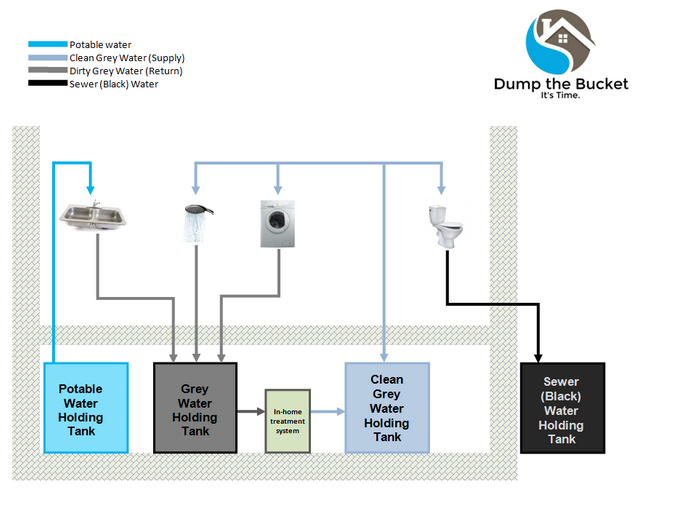
Graphic representing a greywater recycling system separates reusable water from sewage needing traditional treatment.
A greywater recycling system separates reusable water from sewage needing traditional treatment. (Graphic courtesy Dump the Bucket)

Many families on small haul systems end up rationing the amount of water and use a fraction of what’s needed to get the health benefit of clean water for bathing and waste disposal.

A greywater system involves routing plumbing so that waste from the toilet and kitchen sink go to sewage, while water from places like laundry, shower, and bathroom sink could be sent to an in-home treatment system.

“It would go into greywater holding tank that would run though a small treatment system with a really fancy biofiltration unit, and then ozonation or ultraviolet disinfectant, and then back to a gray water holding tank,” said Lefferts.

The water doesn’t have to go to offsite treatment and can be used several times in the home.

“Our plan is to try to retreat greywater in the home and provide it to taps that wouldn’t necessarily need potable water. We’d always have potable water available in the kitchen and bathroom sink from a community water treatment source,” said Lefferts. “We’d retreat greywater to actual drinking water standards, but we’d still classify it as gray water, and then provide it back into the home for other taps.”

The group is raising funds now to build a prototype in a lab setting and run it for a year. They’ll track household water usage and test for bacteria, phosphates, nitrites. They hope to keep the treatment system to about $10,000 but there would also be a certain level of re-plumbing involved. Lefferts says the technology exists for greywater systems, but they need to find out exactly how to build a system that works in rural Alaska.

“Every component is commercially available, but we’re putting it together in a way that’s never been tried before,” said Lefferts.

The group is trying to raise $15,000 on an online fundraising campaign and more for the test. More information is at dumpthebucket.org.

Site notifications
Update notification options
Subscribe to notifications