Community

Bethel teen’s shop offers fashion and socializing

Kate McWilliams
Kate McWilliams is the founder of Arctic Belle Boutique. (Photo courtesy Arctic Belle Boutique)

A Bethel teen has started her own business, a women’s clothing consignment store. The 17-year-old senior at Bethel Regional High School opened ‘Arctic Belle Boutique’ in November, making her one of the community’s youngest entrepreneurs.

Kate McWilliams describes a new item that just arrived in her store as she displays it on a mannequin.

“She was sitting on a gold mine. This is a David Green Furriers Mouton fur jacket. There’s like patterns in cow fur, I’m not even sure – they must have dyed it. The lady bought it for $900 on clearance and I’m selling it for $500,” said McWilliams.

The 17-year-old also has more practical items to like sweaters, jeans and accessories. But she says it’s not just about business, in a town where there are few social venues, the boutique fills a void for women.

“What I like about when there are a bunch of customers at the same time, everyone acts like they know each other. Everyone’s like chatting like, ‘oh that’s cute! If you don’t like that, let me try it on. It’s like a social gathering. I like that this could be the place to escape and do something good for themselves,” said McWilliams.

Arctic Belle Boutique
The shop is mostly open on weekends. (Photo courtesy Arctic Belle Boutique)

Here’s how the shop works: people bring McWilliams their old clothes to sell. She gives them 40% and the store keeps 60%. McWilliams keeps track of the sales and clients can then use revenue from sales of their old clothes to buy new ones.

Her shop is in an unlikely location. A pink sandwich board at the turnoff to her store reads, ‘Arctic Belle Boutique,’ and little pink arrows guide customers down a dirt road to her shop. But the rustic retail locale, at the end of a dead-end road on the edge of town in an unfinished addition to her family’s home, “is really Bethel,” she says.

“I knew it would have to be rustic because the building isn’t finished and I have to work with drywall and plywood floors. It was hard cause I didn’t want it to look gross, I didn’t want it to look trashy. But I think with the peg board displays and the recycled furniture, I think it really comes off as, organic,” said McWilliams.

The boutique is sandwiched between a bed and breakfast, a dog yard and a mini-farm complete with a garden, high tunnel greenhouse and a chicken coop. Her family sells produce and eggs. Surrounded by entrepreneurship, McWilliams says it must have rubbed off on her. The idea for Arctic Belle Boutique started with a yard sale, this past summer, she says, where she was in charge of selling her family’s old clothes.

“I set up like a mini store in our porch and I put up displays and had everything organized. It was so much fun helping our customers find what they wanted,” said McWilliams.

She carefully merchandized sweaters and tops, accessorizing with scarves and jewelry and, to her surprise, they flew off the tables and shelves. The 17-year-old says she knew she was onto something.

McWilliams grew up in Bethel and is a 17-year-old senior at Bethel Regional High School. She balances schoolwork and sports with running her shop, so it’s mostly open on weekends. McWilliams’ success at the yard sale planted the seed for her business. It wasn’t long before she got a business plan together and got some training. She also got a boost from the ‘Best in the West’ small business competition, where she received more training and start-up funds.

“I won $3,000 in grant money, and that’s helped so much with starting the place up. I mean, before I got the money, I thought, I don’t need this money. I’m going to start it up no matter what. I’m so determined, but, wow, I don’t think I could have done this without ‘Best in the West’,” said McWilliams.

Officials say McWilliams is the youngest person ever to win a ‘Best in the West’ grant. Earnings from her shop are going into a college fund. McWilliams says she plans to start university in the fall. But until then, she’s open for business and socializing.


Take steps to avoid bear problems

Bears are coming out of hibernation, and it’s time to take action before they become problems in the neighborhood. Boyd Porter is the Ketchikan Area Wildlife Biologist with the Alaska Department of Fish and Game.

Photo by Heather Bryant / KTOO.

“Whether you’re in the city or in the borough, it’s time to clean up your yard, put the bird feeders away, take the bird seed down, and put the pet food inside away from where bears can have access to it. It’s usually up on your deck where you don’t want the bear to come.”

Porter says it’s also important to wait until the morning of pickup to put out trash. He says to use ratchet straps, not bungee cords, to secure the lids.

“A racket strap is what you’d use to cinch a boat down to a trailer. It clicks when you racket it and it holds the lid securely on the can so the bear cannot get to it. If they work at it a long time, they may, but you’re going to deter them and they’re going to move on to someplace where it’s easier to get to the food.”

Porter says ratchet straps are available at most hardware and marine stores.

Though some have a secure place to keep trash until pickup day, Porter acknowledges many may not have a garage or shed. He says there are other options and ADF&G can help.

“We have some fencing plans and we have some other ideas that you could use to secure your cans while you’re storing the garbage. Things you could do…you could potentially use electric fences to keep bears out of your garbage and moving along in a natural foraging pattern, instead of coming down into town and into residential areas counting on finding really good stuff to eat in our garbage cans.”

Porter says bears that hibernate in town are already coming out of their dens and getting into neighborhood trash. He says those in the natural environment outside of town usually emerge the last week of April or the first part of May. Porter says it’s important to be diligent before bear problems occur.

“Now is the time that you set the pattern for the rest of the beginning of the summer. If you secure things right now, you’re going to avoid all kinds of problems that are going to persist into the summer.”

Porter says bears conditioned to scavenge for trash in neighborhoods eventually will be killed.

“Some people would say, “Who cares? They’re garbage bears.” But we’re creating those and we’re providing the death sentence for those bears.”

He says there are usually just a few people in a neighborhood contributing to the problem, and encourages residents to educate neighbors who may be new to town or unaware of what to do.

Those failing to secure their garbage can be fined. Bear problems in the city should be reported to the Ketchikan Police Department and those in the Borough to the Alaska State Troopers. Porter says concerns can also be reported to ADF&G.

The Blind Spot: beyond no-man’s land

Chart: Behavioral Health System of Care
At the low end, prevention measures costs the State of Alaska $9 per point of contact. Intensive substance abuse treatment costs $49,502 per person on average. (Chart courtesy of the Division of Behavioral Health, DHSS)

In spite of the alarmingly high rates of substance abuse among teens in Anchorage, many officials say there are reasons for optimism.

All this week, as part of our series “The Blind Spot,” we’ve been exploring holes in the safety net for teens struggling with drugs and alcohol. Now, we look toward solutions.

State officials and non-profit workers told us policy measures are dove-tailing with new evidence that perceptions about drinking are starkly different from realities on the ground.

Under the umbrella of the Department of Health and Human Services, the state is currently trying to shift the paradigm on community health in Alaska, developing new tools to measure what’s working. Diane Casto is the Prevention Manager for the Division of Behavioral Health, and is part of finding new means of assessment, ““Just doing a walk-around, and looking at your community.”

The division’s focus has zoomed out, examining health at the social rather than individual level. “What’s the density of alcohol outlets in your community?” Casto asks, “What are the policies and procedures and practices in your community related to alcohol and drug issues?”

Casto has been doing prevention-related work since 1978, and has seen a wide range of approaches pursued in Alaska. The current trend is away from reactive intervention, and towards prevention.

“The more we work on the front-end, and prevent these issues from becoming catastrophic, the better we will be,” Casto said. A part of the Division’s interest is simple economics: when it comes to substance abuse, preventative measures are significantly less expensive than providing treatment, residential care, and continuing assistance. It is a “reap what you sow” approach.

It costs Casto’s Division about $9 per person to put on a promotional event like a health fair. That is a bargain compared to the $49,502 it costs to provide long-term care to an individual working through acute psychiatric care and recovery. That doesn’t mean every person who stops by a health fair will “just say no” for their whole life. Nor are the expenditures perfect analogues: DBH measures prevention measures as points of contact, where as hospitalization could be days or weeks of intensive management. But on balance, Casto sees prevention as sounder policy.

The Alaska Wellness Coalition has a similar aim. The group is trying to prevent underage drinking by changing community-wide perceptions. The Center for Disease Control’s most recent Youth Risk Behavior Survey says that three-quarters of youth reported not drinking in the past month. The Coalition is using that data to show teens that drinking is actually not the norm.

“What this campaign intends to do is start the conversation,” said campaign coordinator Hope Finkelstein. “Even if people don’t believe that 78%of the kids don’t drink, that’s fine. That is okay, because people will start questioning.”

The Coalition finds youth around the state want to talk about alcohol but haven’t been able to. A similar campaign was launched in Homer a few years ago, when data showed that people there didn’t drink nearly as much as was commonly thought. When the data were released people didn’t believe it. However, it got them talking about it.

There is also an effort to get kids in trouble better. Or, at the very least, to develop an improved system from the Minor Consuming Alcohol charges currently on the books. At the state level, Senate Bill 99 this session attempts to amend Title 4, the state’s alcohol code. The legislation did not advance far, but supporters like Cynthia Franklin, Director of the Alcoholic Beverages Control Board, believe its introduction sets the wheels in motion for meaningful reforms next session.

Professor Marny Rivera at University of Alaska Anchorage’s Justice Center works on the issue, and wants the MCA citation to be replaced with a ticket–like the kinds issued for speeding or parking. Rivera has spent the last few years examining state statutes on alcohol, talking with experts, as well as prosecutors and employees within the Division of Juvenile Justice.

“What we realized is that MCA’s are almost like a gap, or a no-man’s land,” Rivera explained in her office, “DJJ doesn’t deal with these youth until they’ve already come to the attention of the criminal justice system three times.”

Though it may sound counter-intuitive, Rivera wants to help at-risk kids by increasing the number of times they get in trouble, and to ensure the sanctions are meaningful rather than arbitrary.

Police and lawyers know what a long, drawn-out process it can be to see an MCA go through the courts, Rivera said. And they have hearts: they know an MCA makes your name pop up in CourtView, which can jeopardize a young person’s future. Prosecutors across the state regularly decline trying MCA cases, explained the ABC Board’s Franklin, herself a former prosecutor. As a result, kids get slapped on the wrist without an official citation ever being issued. And that is exactly the kind of space where addictive behaviors have room to intensify.

“There’re very few cases where you actually see a habitual status offender or a third time Minor Consuming,” Rivera said. She believes that if underage drinking is a simpler offense it will become easier for officers to write those tickets. And the kids getting ticketed all the time will appear on the justice system’s radar, raising the possibility of early detection and treatment that could have significant impact.

But as the many experts told us, there is no silver bullet. Even if the MCA system is improved, some kids will still end up back where this series started: At the McLaughlin Youth Center.

Ross Blocker stands inside one of the aging treatment cottages on the McLaughlin campus, his fingers interwoven like a nest. Originally from southern Georgia, he’s been in charge of McLaughlin’s Transitional Services Unit for a decade. His goal is making sure kids leave the youth center with the skills they need to survive in the chaotic world.

“You just can’t do all that work then pat ‘em on the back, put ‘em out the door, and say ‘have a nice day,’” Blocker said. He and his team take the initial treatment plan developed for a new resident at McLaughlin, and draft yet another blue-print to address that kid’s risks and goals. Then, they figure out how to support those elements once the youth has left McLaughlin for the outside.

“Medical needs, mental health, counseling needs, substance abuse needs,” Blocker rattles off, “if they’ve gone through intensive substance abuse here, it just makes sense that they need some kind of support system there.”

Blocker’s treatment unit works with partners in Anchorage like the school district and the Mental Health Trust, and tries to check in on everyone who went through recovery so that they don’t leave 24-hour-a-day structure and enter a total vacuum. They try to give the youth the support they need to keep them out of the statistics.

AK: The Sitka Sentinel remains a family affair

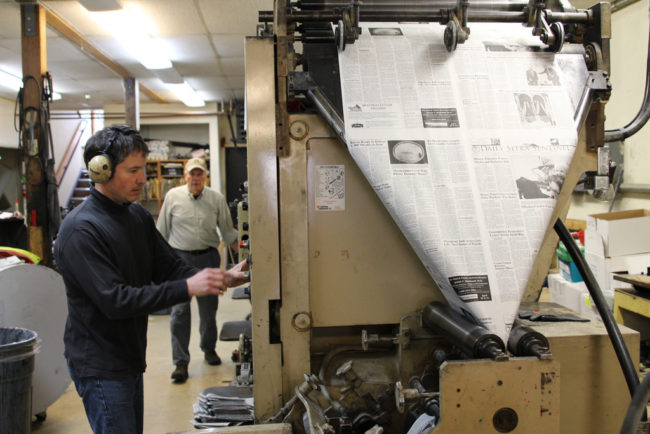
James Poulson and his father Thad operate the printing press
James Poulson and his father Thad operate the printing press, which is the same piece equipment used by the family to print the paper in 1969. James was four years old then and has since become the staff photographer. (Photo by Emily Kwong/KCAW)

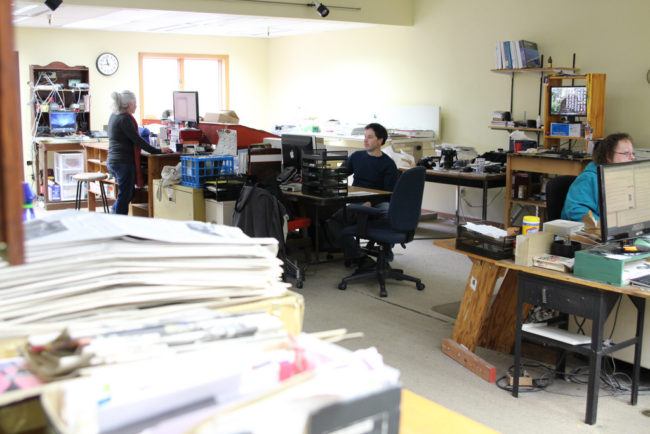
The Sitka Sentinel celebrated its 75th anniversary last year without much fanfare. As many newspapers in big cities have folded or turned into online only operations, the Sentinel steadily churns out five issues a week.

The paper is owned and edited by Thad and Sandy Poulson, reporters who arrived in 1969 and are determined to keep the press running.

“Come on back, there’s something kind of interesting,” Thad Poulson said, winding his way through the print shop.

On our right is a giant orange machine – a printing press that was state of the art when Poulson arrived in 1969 – and continues to churn out every issue of the paper to this day. But that’s not what Poulson is excited about. He motions to the back room, his fingers covered with ink.

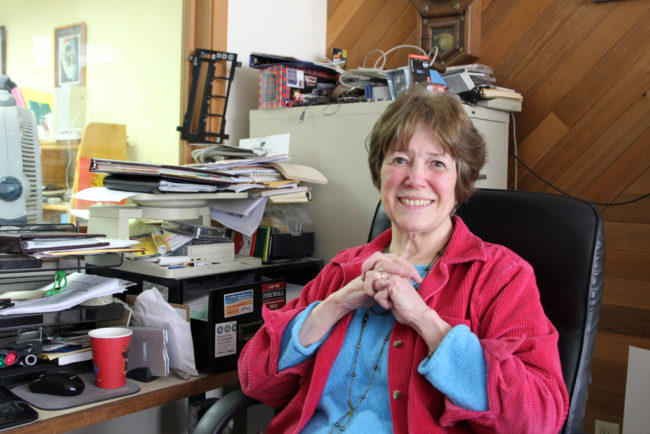
Sandy Poulson
Sandy Poulson is the city editor. She and Thad met while working at newspapers in Oklahoma City, where her first job was to write obituaries. She continues to write them with the care for the Sentinel, saying, “Some newspapers charge for obituaries. I can see that in a big city, but in small towns, it’s news. We try to do a good job.” (Photo by Emily Kwong/KCAW)

“Things are kind of inky back here, so be careful not to touch things,” Thad said.

Before us is their brand new CTP machine, which stands for computer-to-plate. The plate works like a rubber stamp—getting covered with ink and smooshed by the press onto large banks of paper. But instead of rubber, it’s a giant square of aluminum.

“So it’s going to emerge fully developed within three minutes,” Thad said, feeding the plate into the machine. “There it goes!”

Lasers will etch the words and images of the front page onto the plate’s surface. There’s a story about a Coast Guard rescue and Medicaid reform. The lead photo is of a little boy getting his head shaved for St. Baldrick’s, a cancer fundraising event. Transferring his face onto the front page would have been a three step process before, involving cutting and pasting and a lot of manual labor. With the CTP machine, that imaging process is entirely digital.

“This thing takes an hour at least an hour of the production process,” Thad said.

The Sentinel’s first editor was Harold Veatch in 1939. Alaska wasn’t yet a state. Franklin Delano Roosevelt was president. And the reason the paper’s still around – surviving the digital revolution and the folding of papers around the country – is through the steady devotion of one newspaper couple, Thad and Sandy Poulson. They have been working at the paper since 1969.

“It’s all we know how to do. We talk about that sometimes. What if we weren’t here? What if we had something? Well, what else can we do?” Thad said. “This is the path we’ve charted for ourselves, so here we are.”

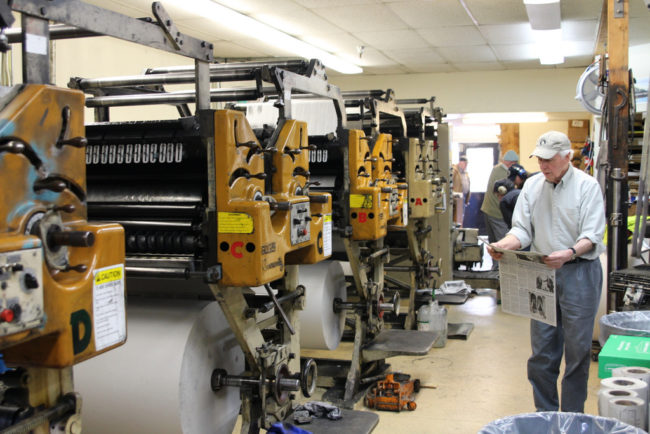
Thad Poulson scrupulously inspects issues of the paper that arrive hot off the press
Thad Poulson scrupulously inspects issues of the paper that arrive hot off the press. Their process has been expedited by a new CTP imaging machine, which the paper bought on their 75th anniversary. (Photo by Emily Kwong/KCAW)

And the Sentinel really is a family production. Thad and Sandy co-edit. They met while working at papers in Oklahoma City. He’s 79 and she’s 75. Their son James Poulson takes all the pictures. There are two general assignment reporters and a handful of additional staff members. In addition to copy editing all the content, Thad runs the press in the basement, just as he did when he was 36.

As issues arrive hot off the press, he flicks them to check for ink spots and clear jams.

As for Thad’s wife Sandy?

“She’s the quarterback of the team,” Thad said. “She decides what’s going to be on the front page and chooses the write stories and writes the headlines.”

Nowadays, Sandy culls national stories from the Associated Press with a few clicks of the mouse. But in the beginning, she was tethered to news of the world through a single wire service that typed at 60 words a minute.

“DEDDEDEDDDEDE – except five times louder,” James Poulson said. He was four years old when his parents took over the paper, called growing up in a 1970s newsroom “tumultuous.”

“When there’s an important breaking story, a bell would go off and I just remember when I was a kid, the bell would go off quite a bit because it was during Watergate,” James said. “Lots of breaking news.”

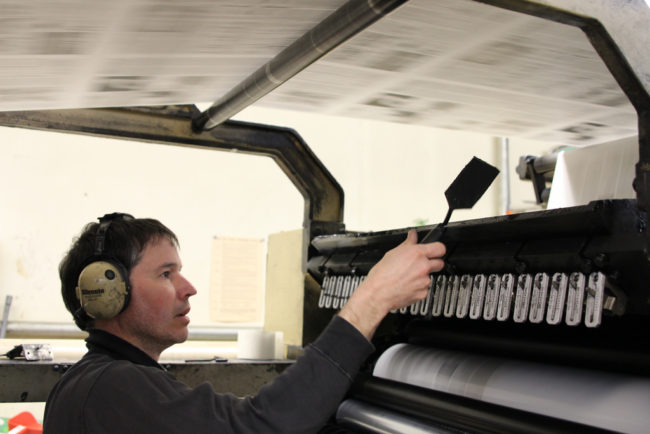
James Poulson makes sure the ink is evenly distributed on the press.
James Poulson makes sure the ink is evenly distributed on the press. The son of two newspaper owners, Poulson grew up to the sounds of teletype machine delivering news from around the world. (Photo by Emily Kwong/KCAW)

James says his parents have tried their best to keep up with technology over the years.

“Dad is kind of an early adopter,” James said. “He was sending out e-mails back when it was like sending out Morse code.”

But that doesn’t mean that it’s been easy to adapt. The CTP machine cost $50,000, which is why it took the Sentinel so long to incorporate it. But the paper is profitable. That’s partly because the operation is mostly a family affair.

“I wouldn’t recommend it for a business model and I’ll tell you why,” Thad said. “What if we want to move on? Do something else? Transfer ownership? The salaries we’ve been paying ourselves on the books won’t cover half of what you have to pay the people who will do it in real life.”

Thad and Sandy met working for city papers in Oklahoma, but had to change their approach to reporting in Sitka. This is especially true with the obituaries, which Sandy takes particular pains to write. She invites the family to weigh in in their own words.

“With age I realize more and more the importance of having some sort of legacy or having your life on record somewhere,” Sandy said.

The Sitka Sentinel is a daily paper that serves a community of 9,000, which owner Thad Poulson considers “extraordinary.” “Sitka has the advantage of its isolation. It’s a good newspaper town.” (Photo by Emily Kwong/KCAW)

It’s the kind of personal touch that only newspaper in a town of 9,000 can bring.

“We are a daily paper in a weekly sized town. It works very well for us, but it’s the exception rather than the rule.”

Within 20 minutes, the print is done. And 2,500 issues are stacked and ready for distribution. Thad looks over me a triumphant grin.

“Another day, another dollar!” he said.

Thad Poulson says circulation is double what it was in the 1970s and that as long as Sitkans still want a daily paper, he intends for the Sentinel to be around.

Soups from 18 Juneau restaurants to fill The Glory Hole’s Empty Bowls

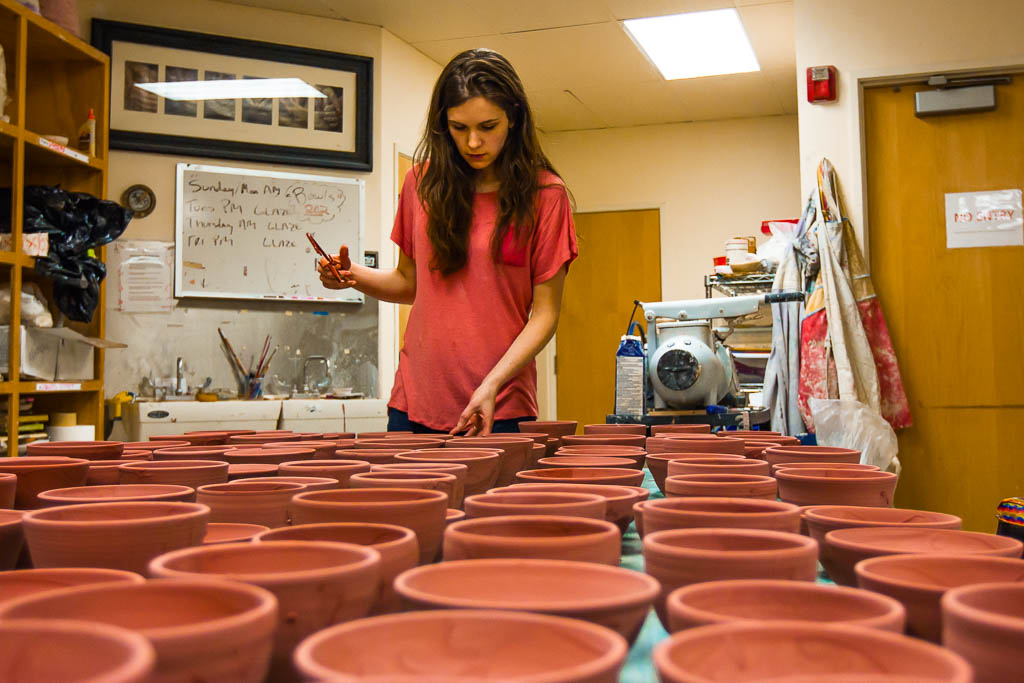
Around 400 bowls have been made for The Glory Hole’s Empty Bowls fundraiser on Sunday. This is the ninth year the soup kitchen and emergency shelter has held the event, which allows participants to eat soup and take home a locally handcrafted bowl. The Canvas Community Art Studio & Gallery  was in the midst of the bowl-making process earlier this week.

Dozens of clay bowls at The Canvas just finished being glazed and waiting for final firing (Photo by David Purdy/KTOO)

“We’re putting them through the first firing right now, the bisque firing,” says Mercedes Muñoz, ceramics studio manager at The Canvas. She was part of a six-person team who made 200 hand-thrown clay bowls in less than a week.

“I made 70 bowls in one day on Saturday, which was quite a bit,” she says.

Muñoz was in the studio for 9 hours that day.

“I just plugged away at them. I was going from doing a bowl in about 10 minutes when I first started to doing a 2-minute bowl at the end,” Muñoz says.

After the bowls come out of the kiln, Muñoz and Canvas Artistic Coordinator Brandon Howard will glaze them before the last firing.

“We have a licorice, which is just a really dark black, and then a waterfall brown, which has some blues and reds in it as well,” she says. “We’re going to have the body of it be black and then the rim dipped in the waterfall brown so get a little bit of that brown trickling down. It’ll be nice.”

Besides The Canvas, The Glory Hole also gets handmade ceramic bowls from the University of Alaska Southeast. A wide selection of wooden bowls comes from the Tongass Turners and other artists in the community.

Mercedes Muñoz glazes clay bowls at The Canvas (Photo by David Purdy/KTOO)

Glory Hole Executive Director Mariya Lovishchuk says Empty Bowls is the shelter’s biggest fundraiser of the year. It brings in up to $40,000, which goes toward staff salaries, utilities and food. The Glory Hole’s total budget is slightly under $500,000 a year.

“We spend a lot of time throughout the year talking about what we do, but we don’t usually get to see all the people who support us, and so a big part of this fundraiser is actually getting everybody together in the same room,” Lovishchuk says.

The Glory Hole relies on community donations throughout the year. In 2014, it provided about 56,000 meals and 10,000 overnight stays. The nonprofit also provides food boxes, activities and assistance with housing and job searches.

Lovishchuk says many Glory Hole clients will be helping at the event.

“They volunteer their time to do a lot of clean up and set up and transferring stuff back and forth. It would be really hard to do without them,” she says.

Lovishchuk says 18 Juneau restaurants are each donating between 5 and 10 gallons of soup. That’s more restaurants than has ever participated before.

Empty Bowls is this Sunday from 5 to 7 p.m. at Centennial Hall. A $30 ticket will get you a handcrafted bowl to take home and all-you-can-eat soup, bread and cookies.

Leaning into the fear: As If! The Alaska State Improv Festival is back

As If! or The Alaska State Improv Festival is back in Juneau this weekend for its third year. Some of the troops are local, from places like Sitka and Talkeetna. Other acts are from the lower 48. Mike Descoteaux and Deana Criess are here with Improv Boston.

Descoteaux is now the artistic director for the group. But earlier in his comedic career, he made a Youtube video of a mock protest, holding up the sign: God Hates Figs. It’s a satirical spoof of the Westboro Baptist Church’s anti-gay slogans.

“The idea being humor allows us to address topics we couldn’t otherwise address. So topics that are so heavily loaded that we just have trouble having a rational dialogue with. We know satire can disarm the audience,” he says.

Subversive humor is still something he uses in his act. Improv Boston’s national touring director Deana Criess says she got her start at an early age.

“At three years old I told my family I wanted to be a stand-up comedian. I thought that meant you would stand on a coffee table and tell jokes. So that’s what I would do at family parties,” she says.

Funny people: Mike Descoteaux and Deana Criess
Funny people: Mike Descoteaux and Deana Criess (Photo by Elizabeth Jenkins/KTOO)

Descoteaux and Criess are visiting with six other members of their improv troop, which relies on gusto and spontaneity for performance.

“So unlike traditional theater we are literally making up everything on the spot. We are out there doing adult make-believe,” she says.

Being script-less on stage with sweaty hands and mounting anxiety is how improv comedy gets made.

“It can be paralyzing for people so just knowing that fear is where you wanna be and leaning into that. It’s transformative for people to think about running into the fear instead of away from it,” she says.

Descoteaux says you walk on stage with an array of life experience.

“And all of this is going to lend itself to the performance,” he says.

Both comedians say they were bullied growing up. It’s part of what influences their comedy.

“I didn’t know what to do. I was the kind of kid who was too paralyzed with fear to say anything. So I turned into a very quiet kid who stopped raising their hand in the classroom, who stopped wanting to do things socially with friends. And it wasn’t until I was in high school that I realized, ‘Oh everyone’s got their own thing. We’re all weird in our own way,'” Criess says.

The experience inspired her to create an improv comedy anti-bullying initiative, where they workshop different scenarios for middle school kids.

“The first thing we tell kids to do is tell them that hurt your feelings, which is really hard when you’re a kid. Because you feel like they just hurt my feelings and I don’t want them to know that. But the reality is, if they already said that to you, they want to hurt your feelings and they’re not going to stop,” she says.

Improv Boston is working on similar programs for people suffering from PTSD and drug recovery. They say comedy is good for a laugh but it’s also good for healing.

At this weekend’s performance in Juneau, Improv Boston says there’s only one thing the audience can expect: the unexpected.

Site notifications
Update notification options
Subscribe to notifications