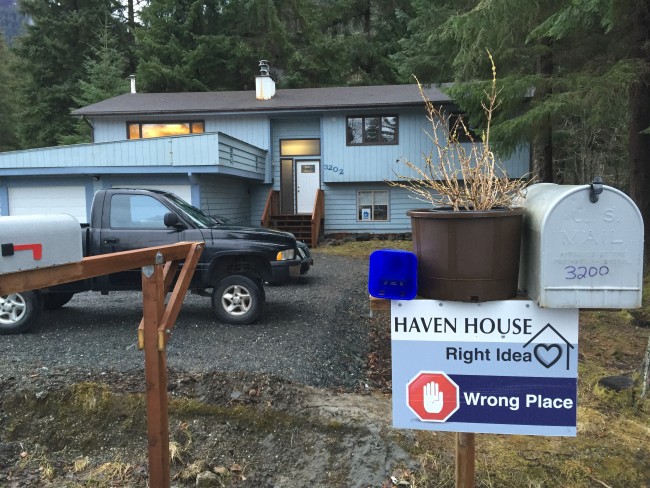
Signs protesting Haven House’s location can be seen all over the Malissa Drive area, even in front of Haven House. (Photo by Lisa Phu/KTOO)
A Juneau neighborhood association is taking its fight against a transitional home for just-released female inmates to court, after exhausting all of its municipal appeal options.
Haven House can continue operating on Malissa Drive in the Mendenhall Valley for now.
The Juneau Assembly denied the Tall Timbers Neighborhood Association’s appeal Monday, upholding the planning commission’s decision to allow permitting for Haven House.
“My clients intend to appeal that decision to the Superior Court,” says attorney Dan Bruce, who represents the neighborhood association.
He wants the state court to overturn the city’s decision. Bruce and his clients continue to argue that Haven House is a halfway house, which under city code, isn’t allowed in typical residential districts, like the area around Malissa Drive.
“Haven House is the only non-single family use in that whole neighborhood,” Bruce says.
Bruce says the home will lower property values and have an adverse effect on the neighborhood. He hopes the legal fight will shut the house down.
Haven House Director Kara Nelson says she isn’t surprised. In the beginning of the Tall Timbers’ protest, she says she took it personally. Nelson herself has been in prison and struggled with addiction. She’s been sober since 2011. Now, she sees the fight as an opportunity.
“It really brings a good challenge for those of us that have been in prison to really show what we know, and that is what we’re being perceived as is not true when we’re living in long-term recovery,” Nelson says.
Haven House is a faith-based non-profit. It provides a structured living situation where residents have to come up with an individual action plan and get the support to follow it through. They must attend some sort of women’s support, recovery or Bible group. Haven House can accept up to nine women transitioning out of prison who can live there for up to 2 years.
Nelson says the Tall Timbers’ perception of what Haven House will do to the neighborhood is an example of the stigma Haven House residents face on a daily basis.
“We’re not going to be ashamed,” Nelson says. “We’re not dismissing the crimes that have been committed, but what we’re saying is addiction is a disease and so we’re focusing on the solution. The solution is long-term recovery and to do that you surround yourself with other people who have done it before you.”
Nelson says it’s been a long journey to get Haven House going and she says an appeal at the Superior Court level is just another step.
The Juneau Assembly approved both the city and school district’s 2016 operating budgets last night.
The City and Borough of Juneau budget totals more than $321 million next year. That includes city enterprises like Bartlett Regional Hospital, Docks and Harbors and Eaglecrest Ski Area.
The Juneau Assembly approved the 2016 city and school district budgets Monday night. (Photo by Elizabeth Jenkins/KTOO)
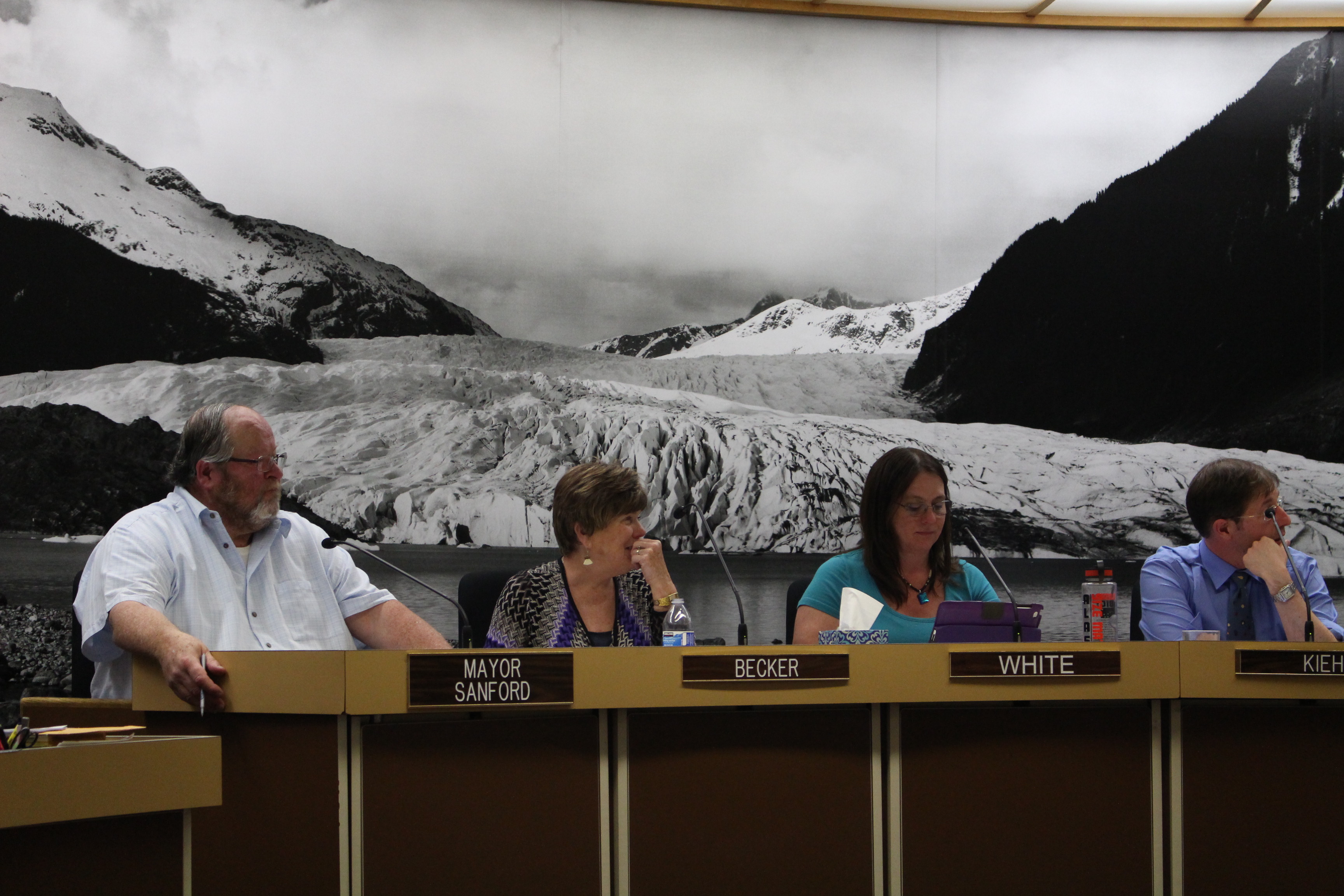
The Juneau School District budget totals more than $85 million. Mayor Merrill Sanford was the only Assembly member to vote no on both items. He said he would have preferred CBJ have more control over how the money set aside for the school district be spent.
“In my mind that money should have went into our budget, the city and borough, and be then be doled out to whoever needs it. And it very possibly could be the school district in the next year or two. But by forwarding it to the school district, we do not have that money available to us for the next two years or the next one year,” Sanford said.
The city unexpectedly received about $600,000 from the federal Secure Rural Schools program recently. Sanford says that money could have offered some security for the the city in uncertain economic times.
“So it takes it off the table for us and gives it to only one part, one segment of our total budget,” he said.
The Secure Rural Schools funds will be counted as revenue in this year’s school district budget, which was the first in recent memory that the Assembly did not fund to the maximum allowed under state law.
No one from the public stepped forward to testify on behalf of either budget item. Both the city and school district budgets take effect July 1.
The Sealaska Heritage Institute unveiled its new structure in downtown Juneau today. It’s called the Walter Soboleff Building after the late Tlingit scholar, elder and religious leader. Inside stands a full-sized replica of a traditional red cedar clan house.
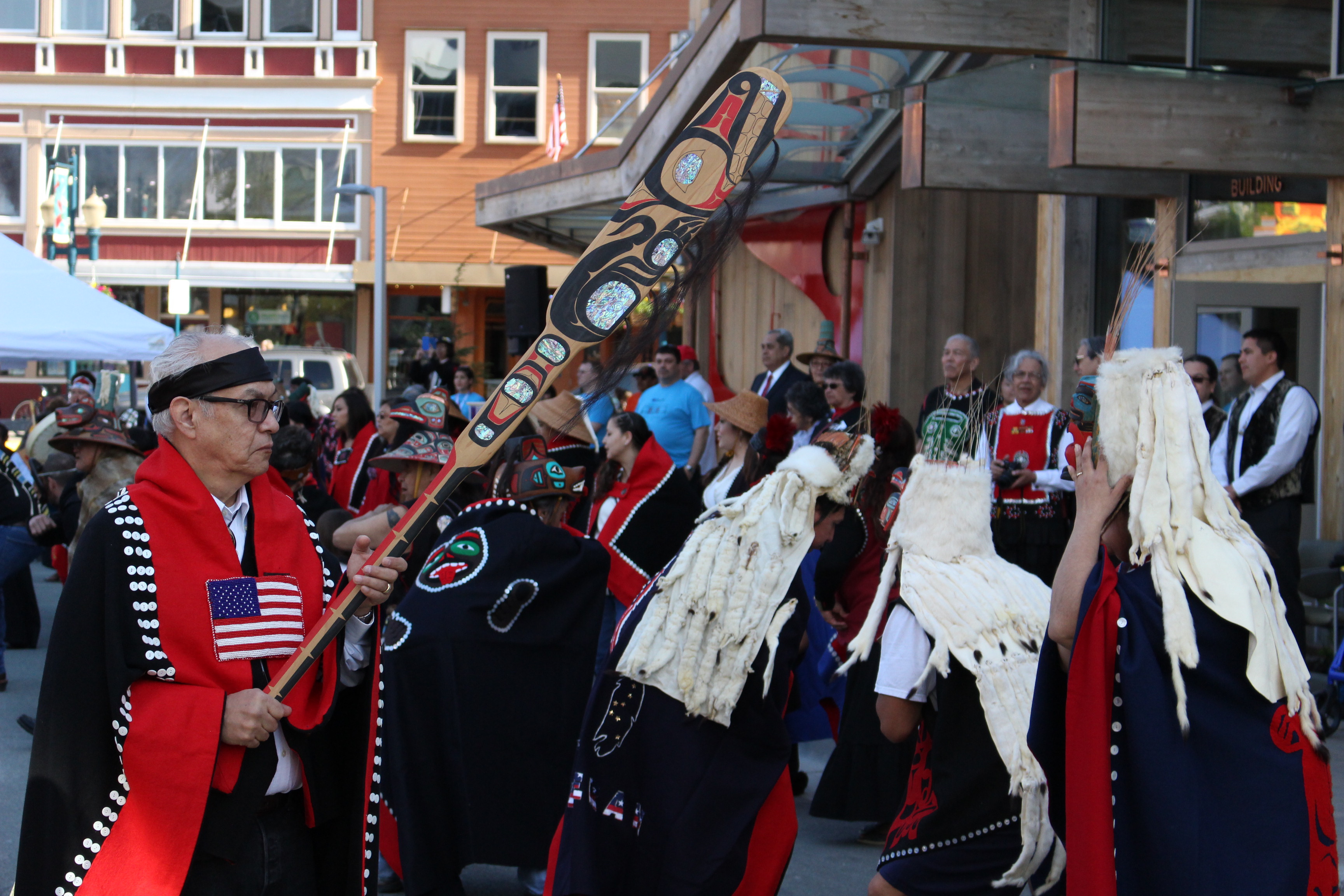
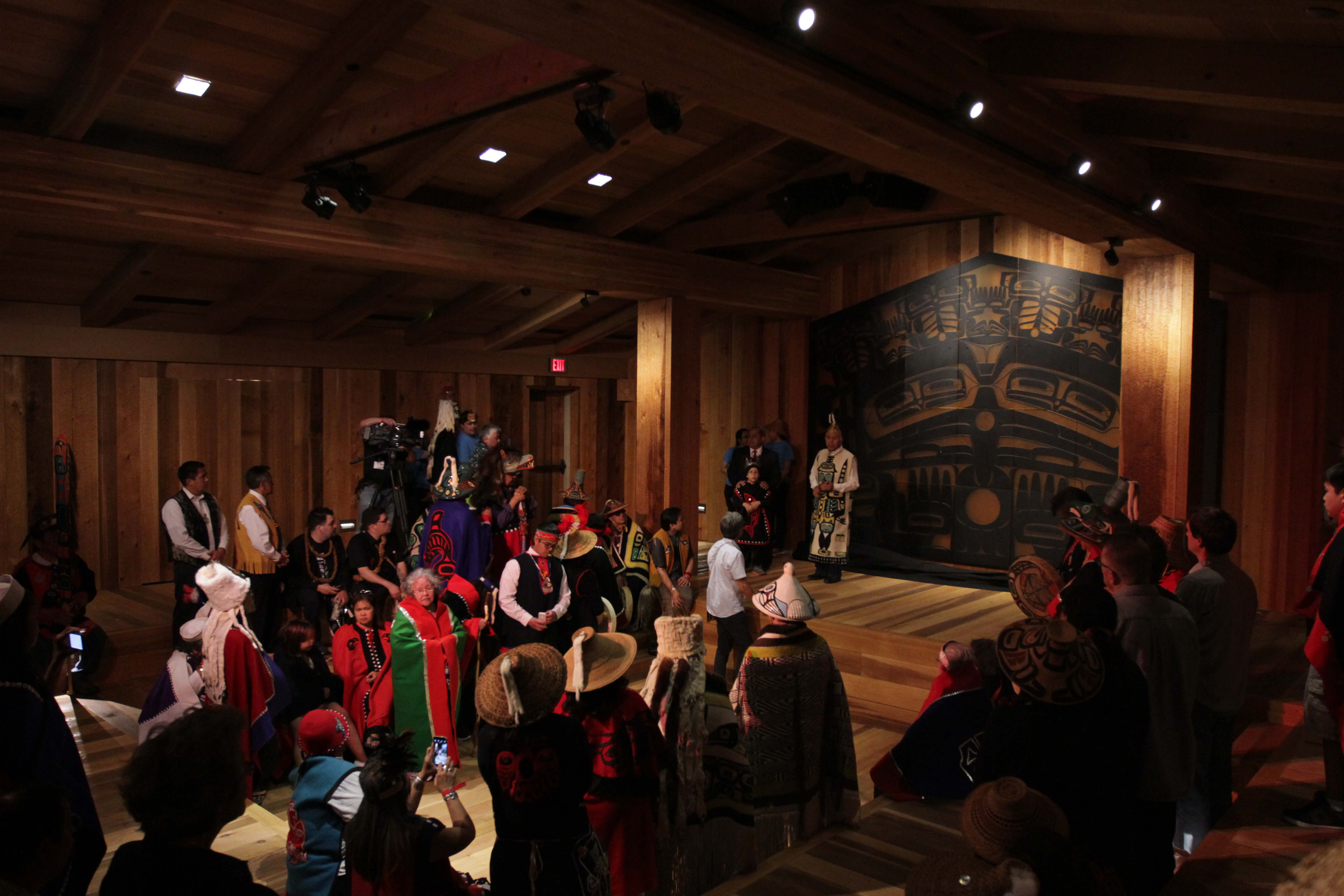
At the opening ceremony, the Aangun Yatx’i dance in their regalia in front of the Walter Soboleff building.
The Aangun Yatx’i dance in front of the Walter Soboleff building. (photo by Elizabeth Jenkins/KTOO)
Davina Cole is the arts assistant here. She clutches her four-month-old baby girl tightly to her chest.
“We’re Yanyeidí from the T’aaku Kwáan area. We’re little wolves. She’s my baby pup,” she says.
Cole says she’s looking forward to what the Soboleff Building will offer her daughter. They’ve already gone to a Baby Raven Reads class before the grand opening. It teaches pre-literacy through Native stories.
“So even right now she’s benefiting from the center because it’s going to be really good for her to be surrounded by that and even have a place to go and learn that,” she says.
The building is a museum for Tlingit, Haida, and Tsimshian artifacts, a space for cultural ceremonies and it houses a gift shop. The building is part of an initiative to turn Juneau into the Northwest Native arts capital. But designing a space that could serve all those functions and reflect the past was difficult.
“When we got the responses, the designs were all very traditional,” Rosita Worl says.
Worl is the president of Sealaska Heritage Institute and a Tlingit from the Eagle moiety. She says the Native artist committee wanted a structure that was more “traditionally inspired.”
“They don’t like the word ‘contemporary,'” she says.
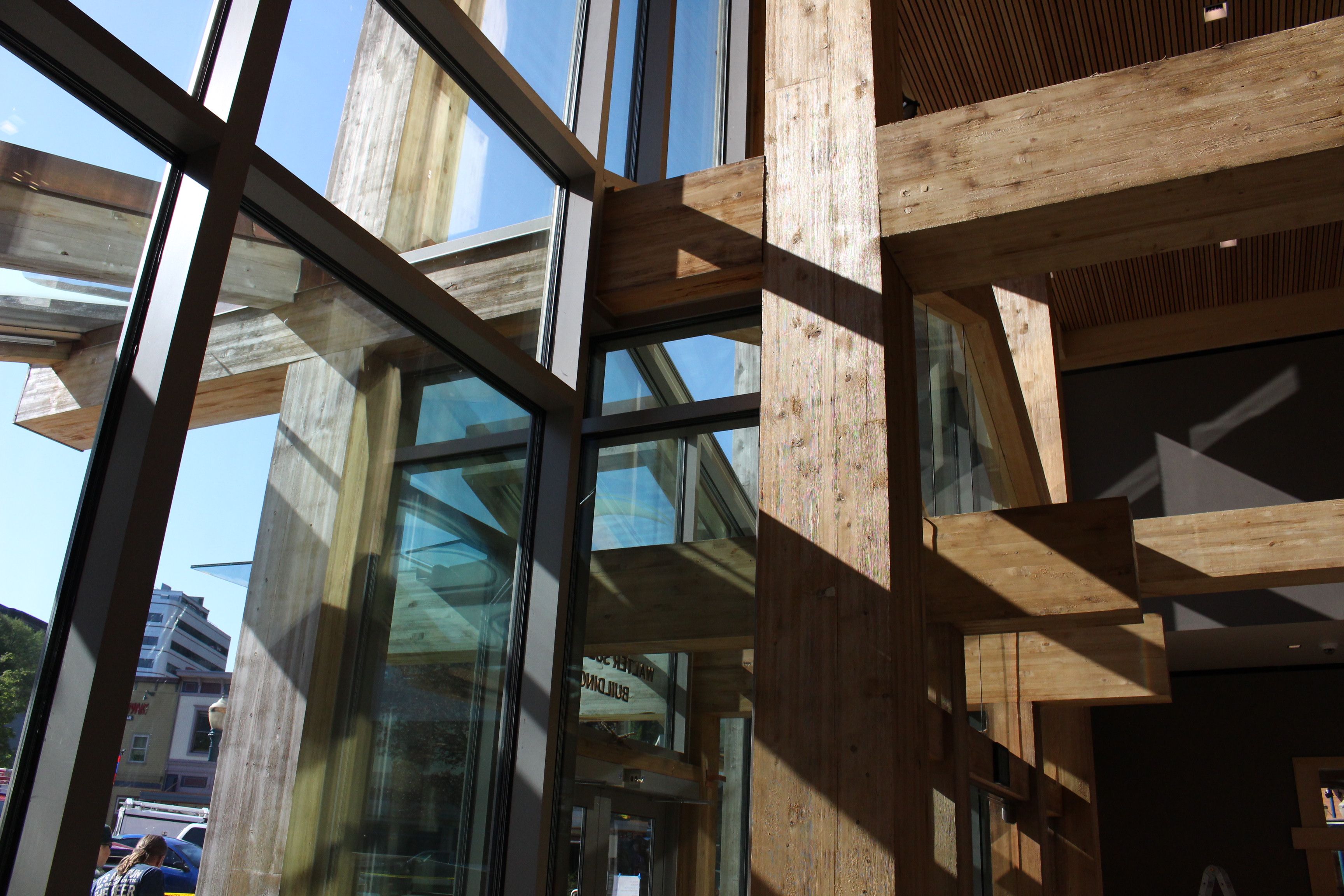
Yellow cedar beams in the entryway of the Walter Sobeloff Building. (photo by Elizabeth Jenkins/KTOO)
SHI sifted through submissions and picked architect Paul Voelckers’. The design was influenced by the form of ceremonial clan houses with chunky beams of yellow cedar. It has an open feel and a wall of glass at the entrance.
“I will tell you that we made the right decision in selecting Paul. It might not have even been the lowest bid. But we all said we got to go with him,” she says.
Voelckers is the president of MRV Architects. The firm’s founder Linn Forrest Sr. specialized in totem pole and clan house reconstruction.
“The firm has sort of tried to maintain that legacy of involvement in the cultural design issues from Southeast ever since,” Voelckers says.
Most recently, MRV worked on a clan house in Kasaan. For the Walter Soboleff Building, Voelckers looked at old photos of clan villages. Some were covered in moss from age.
“But it would have the angles of the house. You know, the big massive beams on the front. And sometimes the old house post inside. That became the essential element that was left in these villages. And so what we tried to do in the new design was capture some of that heavy framework,” he says.
The basement level floor houses the research lab and mechanical room. The whole building is heated using wood pellets.
“It simply flows down like grain or something,” he says.
The building was designed to meet the U.S. Green Building Council’s gold standard for energy efficiency. The wood pellets come mostly from the Sealaska Corp. land on Prince of Wales Island. Rosita Worl says that’s part of keeping the core cultural values in the design.
“Haa Aani: our relationship to the land,” she says.
On the main floor is a full-sized replica of a clan house. It can seat 300 people and fits with tradition: pitched roof, windowless and built with adzed red cedar. The floor is tiered with sunken-in seating. Worl says she knew it would a special place.
The inside of the clan house features a traditional small door to thwart invaders. (Photo by David Purdy/KTOO)
“But what we hadn’t counted on, what I hadn’t thought about was this almost sacred feeling that you get when you go into that clan house.”
Worl says she has a strong connection to her ancestors.
“And it was almost like they were saying to us, ‘Rosita, you know you’re talking about being progressive, you want to move into the 21st century.’ It almost became like their space and they said, ‘This is where we are.’”
At the the Walter Soboleff’s closing ceremony, the clan house was given the name Shuká Hít.
In 2004, an awning patch-job went bad and led to a fire that razed a historic commercial building in the heart of downtown Juneau, where the grand opening of Sealaska Heritage Institute’s Walter Soboleff Building will happen Friday.
In its 108-year history, the two-story, wood-framed building at the corner of Front and Seward streets had gone by many names: The C.W. Young Building, Rusher’s Hardware, the Skinner Building, the Endicott Building and the Town Center Mall.
Oke and Robert Rodman were keeping shop at Percy’s Liquor Store across the street that Sunday afternoon in August 2004. They saw a couple of guys on top of the awning working with tar and a torch.
“I knew it’s bad idea,” Oke Rodman says.
“Well, once they started running around looking for a fire extinguisher, it seemed like a bad day,” Robert Rodman says.
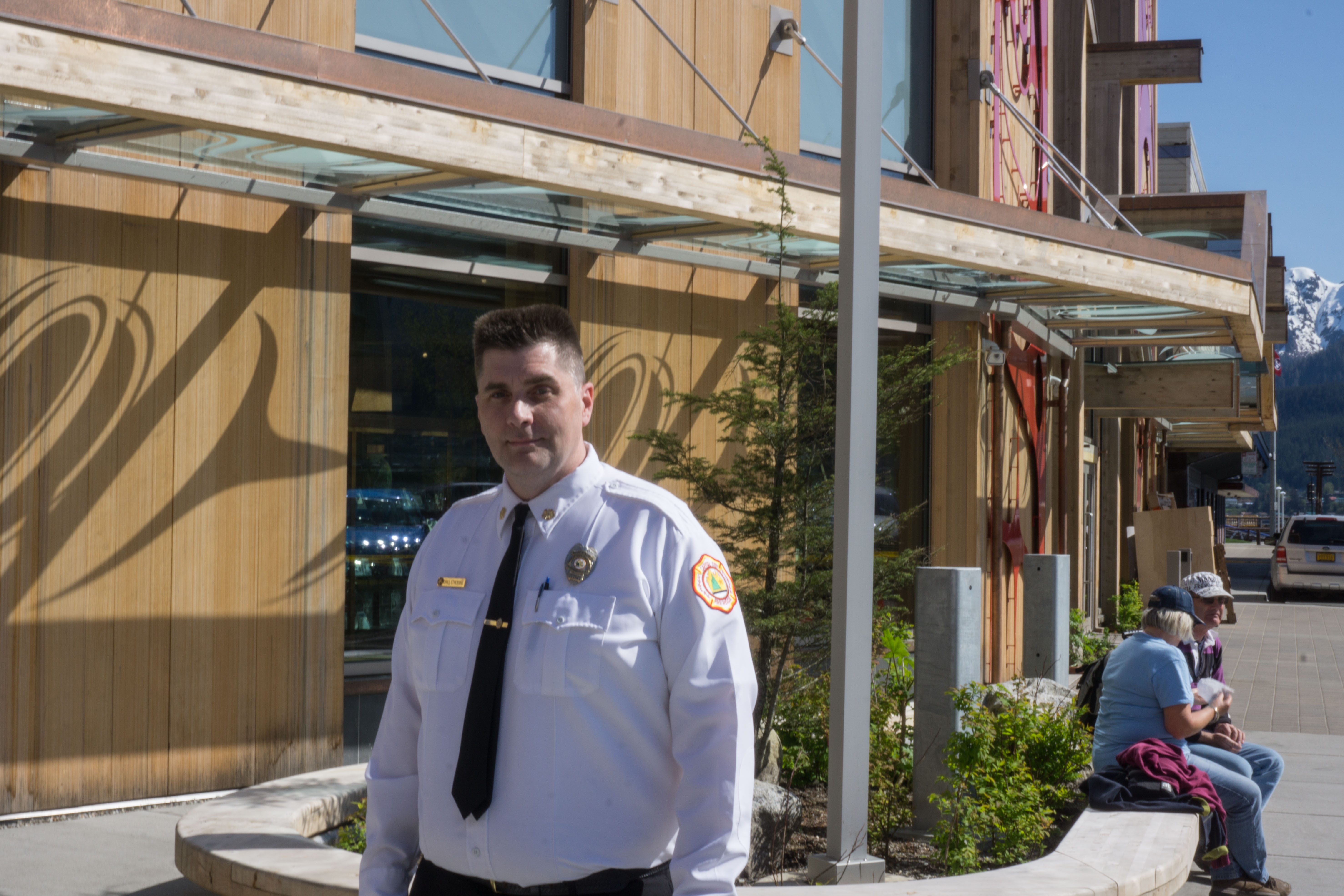
Juneau fire chief Rich Etheridge was fire marshal and acting chief at the time.
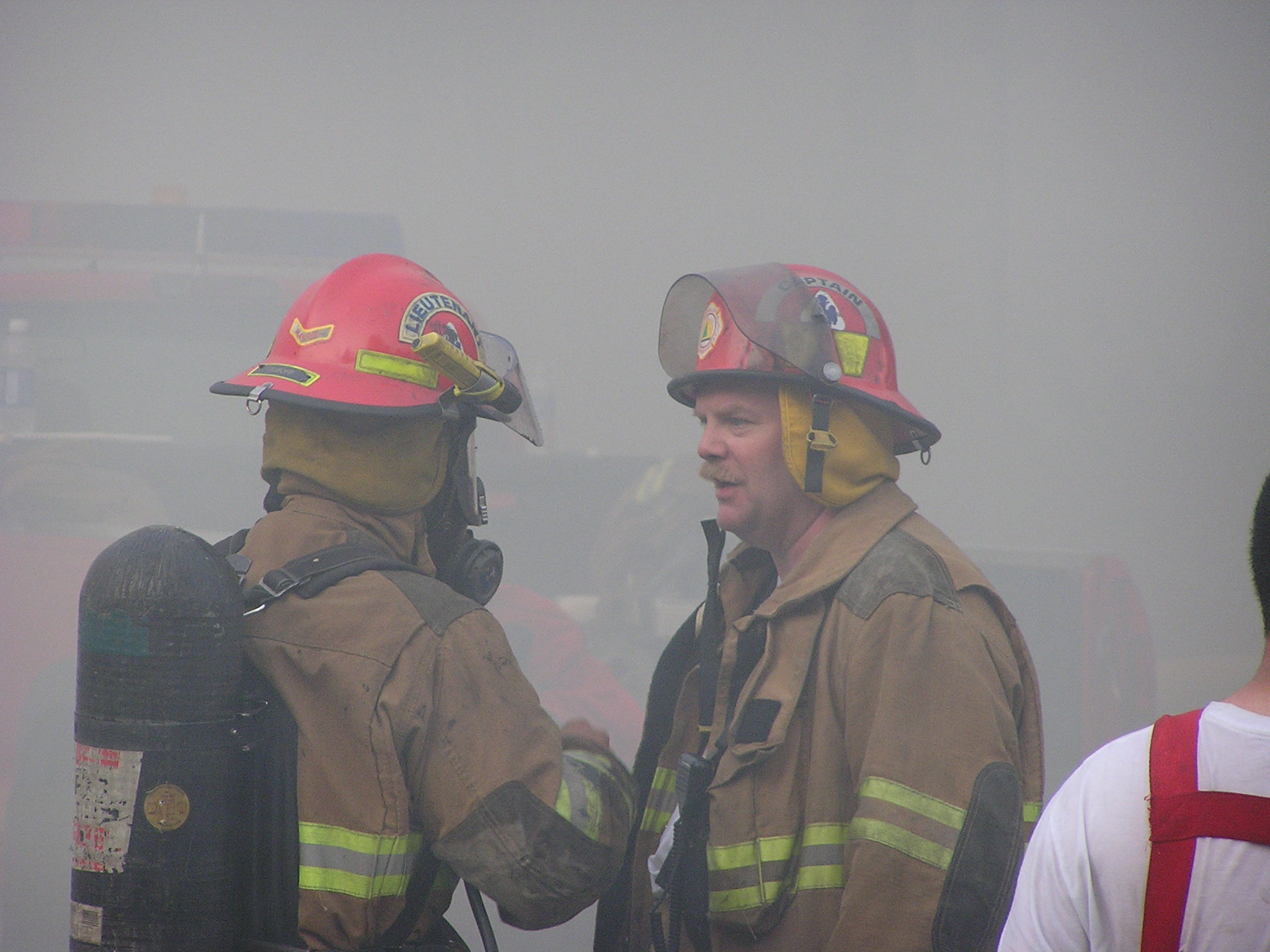
Fire Chief Rich Etheridge was acting chief at the time of the Skinner building fire. He’s standing roughly where he commanded the fire department’s response from in 2004. (Photo by Jeremy Hsieh/KTOO)
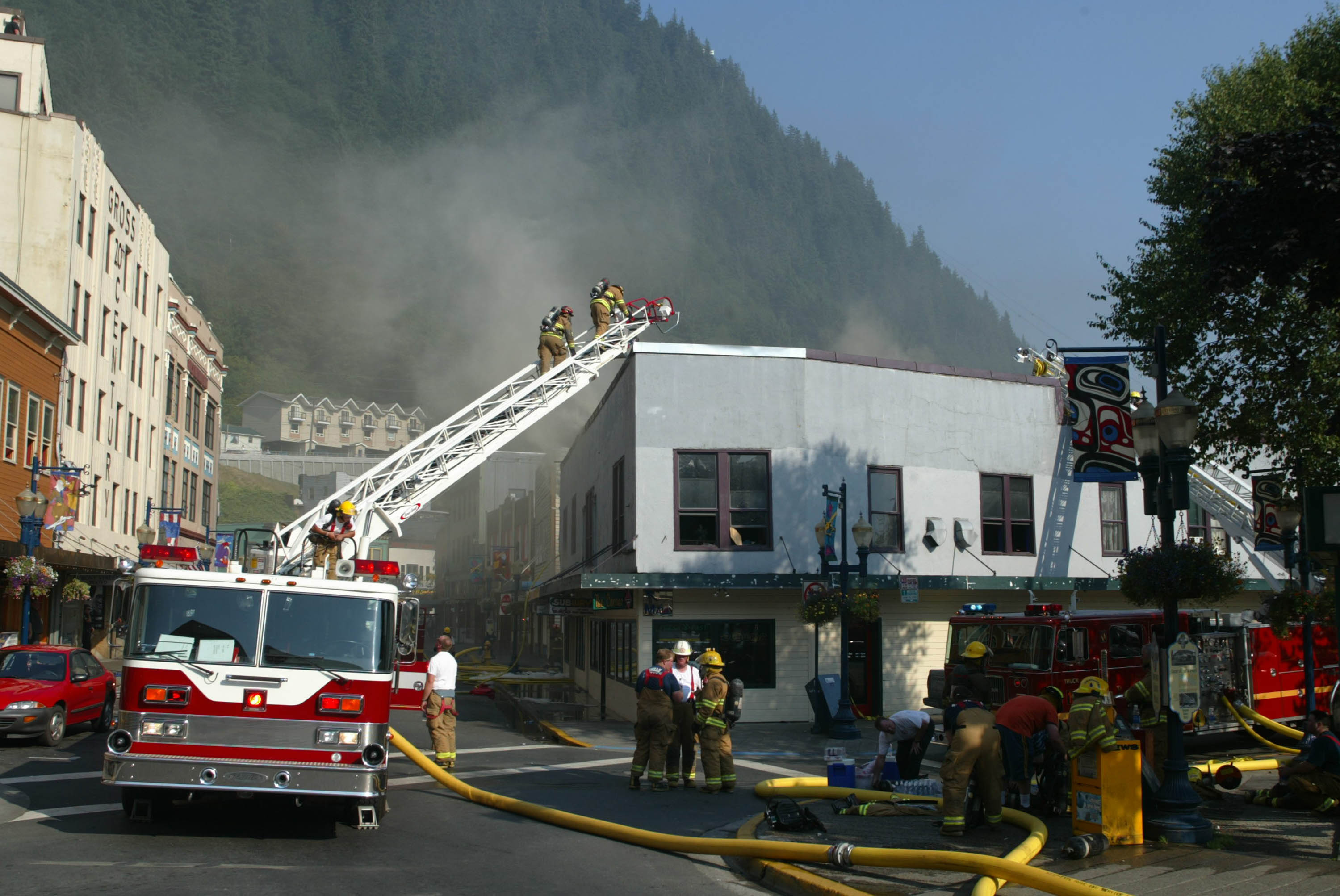
When he arrived, he saw smoke rising from one corner of the building, but no open flames. The fire was burning inside the walls.
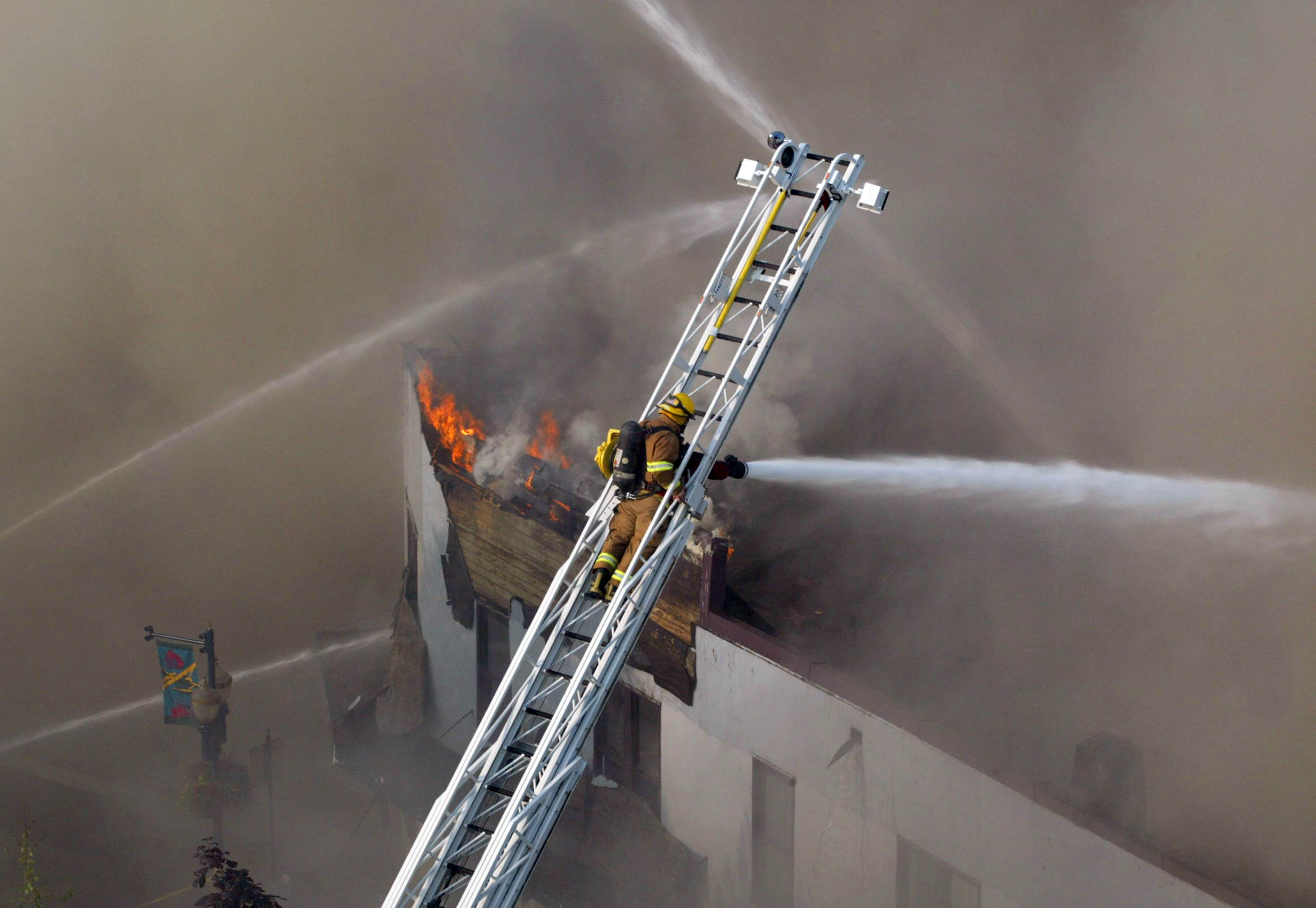
The 2004 Skinner Building fire didn’t appear serious at first. (Photo by Brian Wallace)
“We sent crews in with chainsaws and axes to cut through walls to get to the fire. But they’d cut through one wall, then they’d find another wall, then layers of plywood to another wall, and so they couldn’t get to the spots where things were burning,” Etheridge says. “Because of the old construction, and things that had been added on, what happens is the smoke travels through all those void spaces, and the smoke actually ignites.”
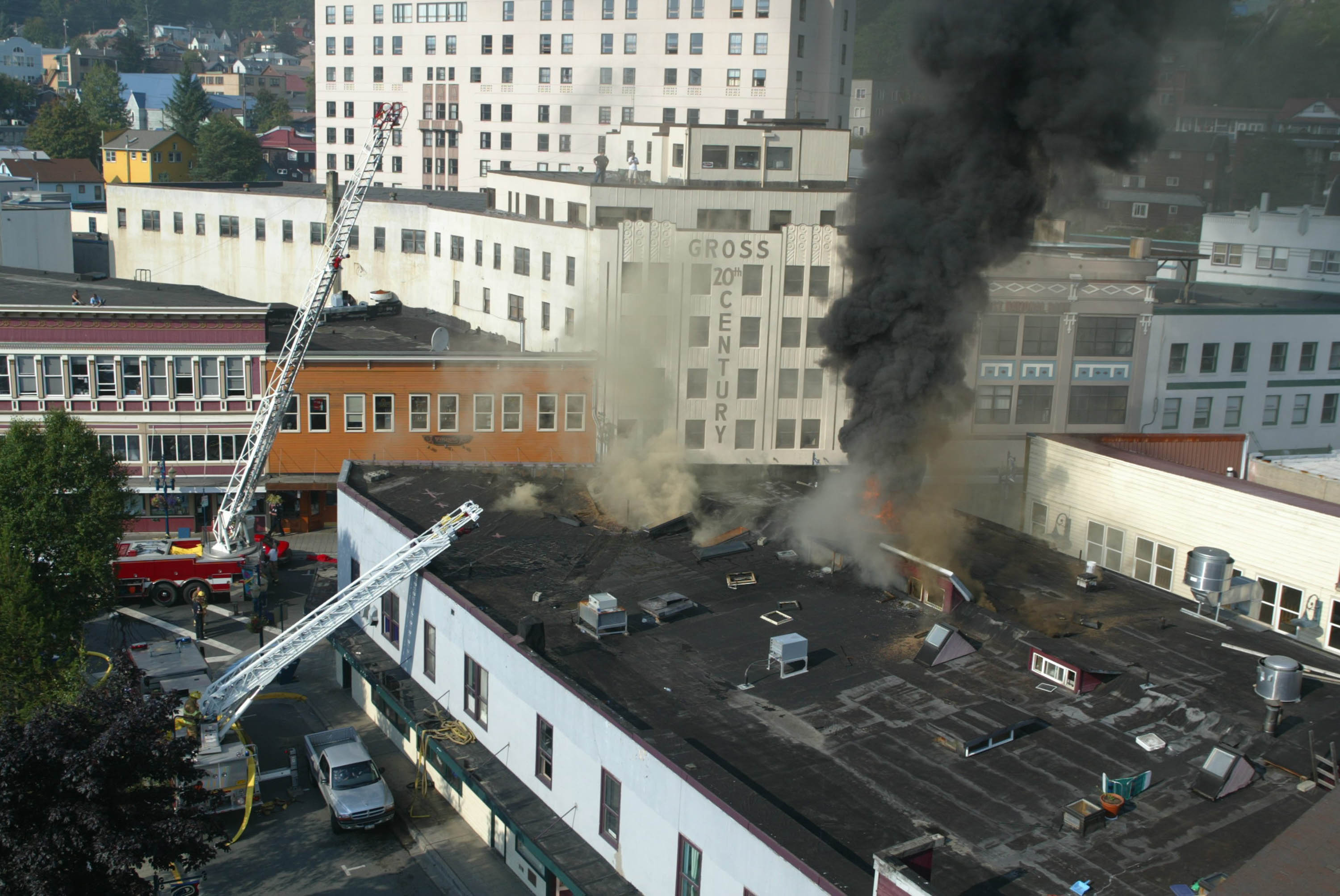
(Photo by Brian Wallace)
With a firefighting crew inside, the building filled with smoke floor to ceiling.
Open flames at the 2004 Skinner Building fire weren’t very apparent, but it dumped smoke everywhere. (Photo by Brian Wallace)
“And smoke explodes also. We had a smoke explosion,” he says. “It was like a low volume explosion. It was more like a big ‘woof.’”
Fortunately, he says there were no serious injuries.
“It was a big, big wave of relief after they called back in on the radio, said they were fine,” he says.
Etheridge put a crew on the roof, hoping to cut a hole in it to let the heat and smoke escape instead of spreading through the building. But that plan was foiled by multiple roofs, layered on over the years.
Meanwhile, the windless, dry weather kept much of the smoke at street level. He says downtown Juneau reminded him that day of eerie scenes in New York City on 9/11.
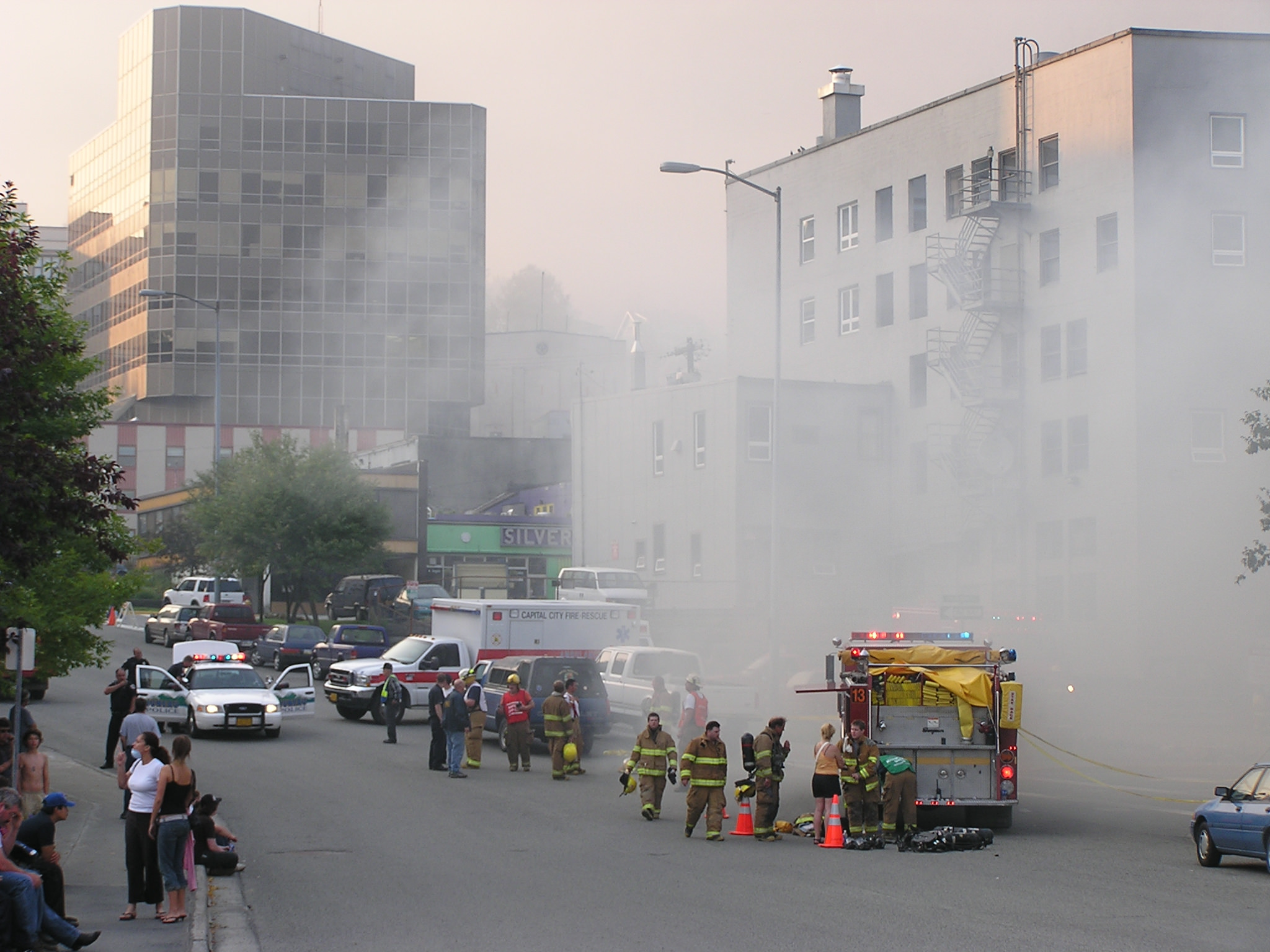
Smoke cuts visibility in downtown Juneau as the historic Skinner Building burns, Aug. 15, 2004. (Creative Commons photo by Gillfoto)
“With just that real thick haze in the air and nobody in the streets — that’s kind of what it looked like.”
He shut down and evacuated several downtown blocks, and the cruise ships left early.
Smoke fills the streets of downtown Juneau as the historic Skinner Building burns, Aug. 15, 2004. (Creative Commons photo by Gillfoto)
Hand tools weren’t cutting it. And it still wasn’t clear where the fire was in the building.
“There wasn’t a lot of active, open flame that you could see, it was just lots and lots of smoke, and all the flames were concealed where it was real difficult,” he says.
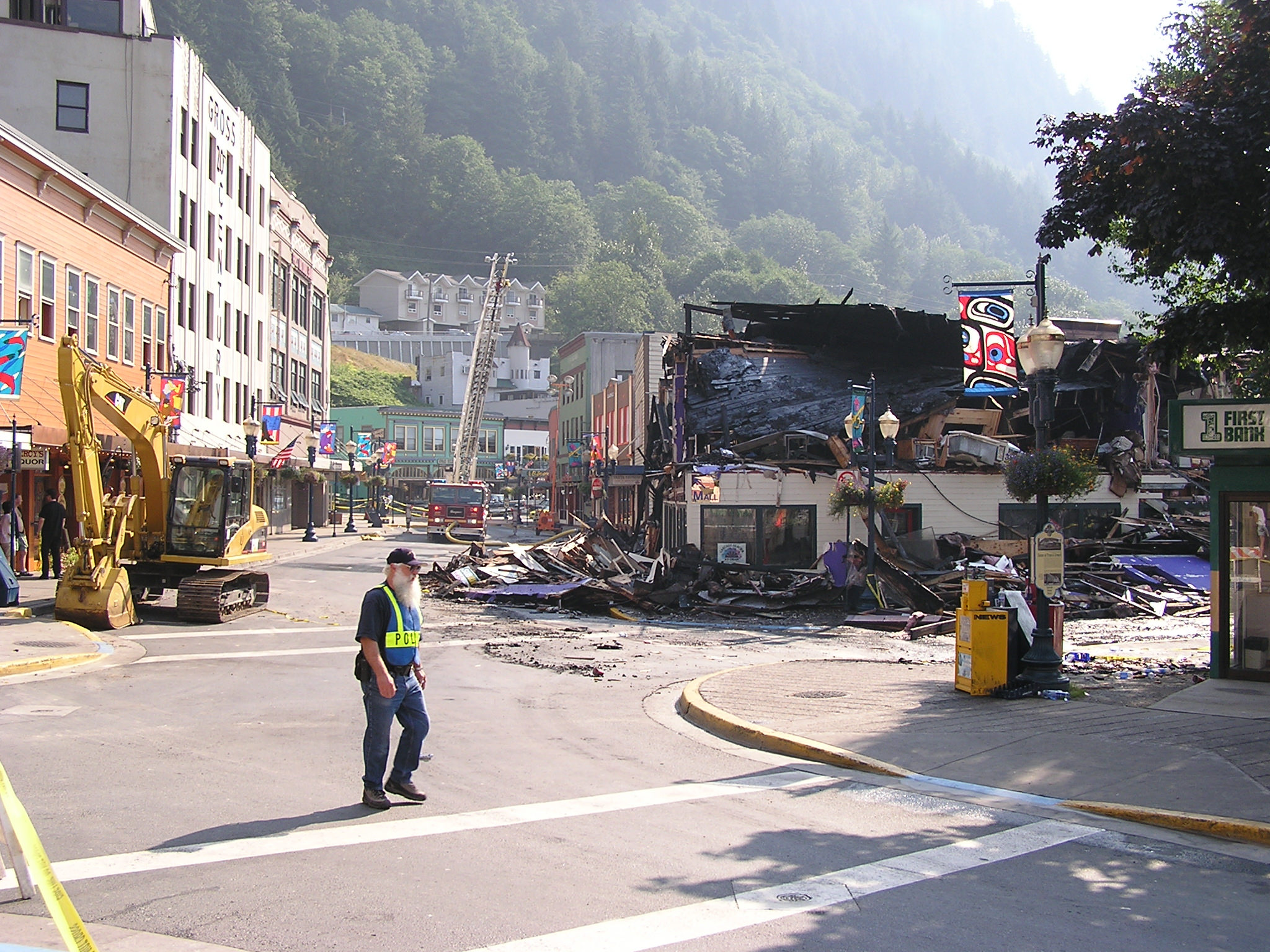
So Etheridge brought in an excavator to peel the walls down and keep the fire from spreading to other buildings.
The aftermath of the 2004 fire that destroyed the Skinner Building. (Creative Commons photo by Gillfoto)
By the next morning, just about every firefighter in town had worked the blaze. When the smoke cleared, the second story was gone. Rubble from the 18 businesses that occupied the building was all over the streets.
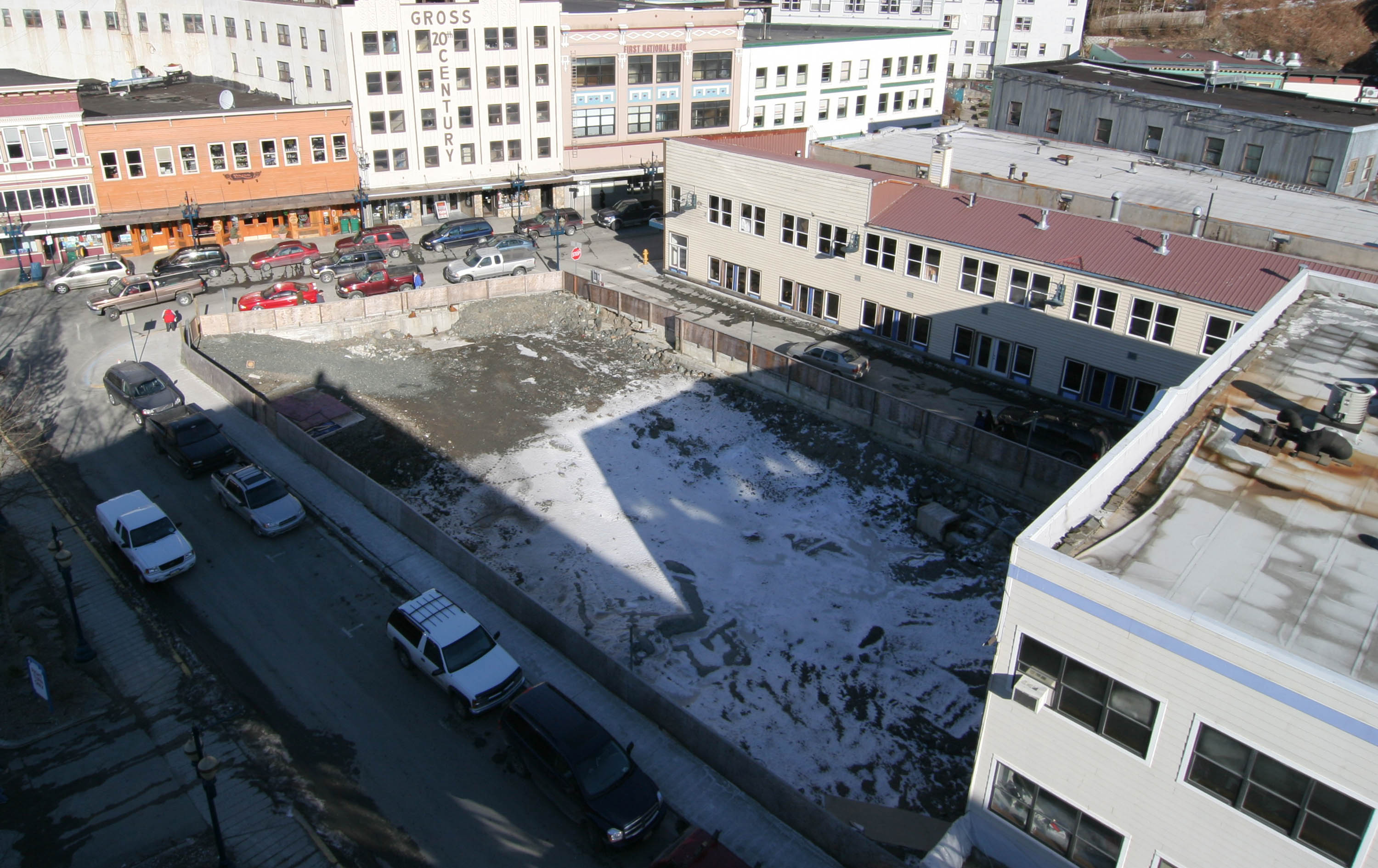
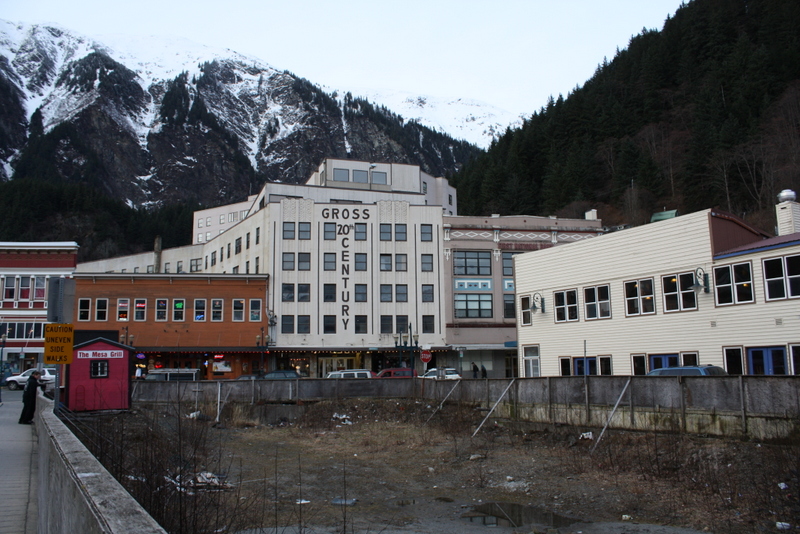
The site was cleared by December that year; debris with asbestos in it had been scooped out to below street level, and a new eyesore was taking shape.
By the end of 2004, the debris from the Skinner Building fire had been cleared to below street level, creating “the pit.” (Photo by Brian Wallace)
The pit in March 2010. (Photo courtesy Candice Bressler)
Candice Bressler moved to Juneau in 2009.
Candice Bressler founded the Facebook page Fix the Pit in 2010. Now the Soboleff Building stands where the pit was. (Photo by Jeremy Hsieh/KTOO)
“So when I arrived, it was already ‘the pit,’” she says. “It was filled with anything from beer cans to cigarette butts to old newspapers. A lot of things.”
In early 2010, Bressler and other United Way volunteers started a public advocacy campaign for a solution. They started a Facebook page called “Fix the Pit.” Almost overnight, it drew hundreds of fans.
About that same time, city officials threatened the lot’s owners with a six-figure lawsuit, not because of the eyesore, but because the pit was literally undermining the city’s surrounding sidewalks, curbs and streets.
Before it went to court, Sealaska Corp. stepped in paid $800,000 for the 9,500 square-foot lot, which is across the street from its headquarters. Sealaska filled the pit and addressed the city’s issues. When temporary landscaping went in, Bressler declared the pit fixed.
It’s been more than 10 years since the fire, and Sealaska Heritage Institute’s new cultural center is just opening at the corner of Front and Seward streets.
“I think it’s sad that such an eyesore existed for so long. And I think it’s sad that millions of tourists got to walk past it over the years and see, basically, what people called the Ground Zero of Juneau,” Bressler says.
Standing outside the new Walter Soboleff Building, Bressler wasn’t so bleak.
“Just looking at this magnificent building. Just, it’s so spectacular to look at. And just to see that it’s filled with beauty and with development and with culture! So exciting,” she says.
Just down the street in another prime downtown spot, the husk of the Gastineau Apartments still stands after a 2012 fire. If the recovery timelines parallel, it’ll be about 2023 before something new opens its doors there.
The application period for the Juneau Economic Development Council’s Storefront Star Awards ends soon. It’s a friendly competition among downtown businesses to beautify storefronts. Improvements can be as simple as planting flowers or as extensive as painting the exterior of a building — whatever the owner sees fit.
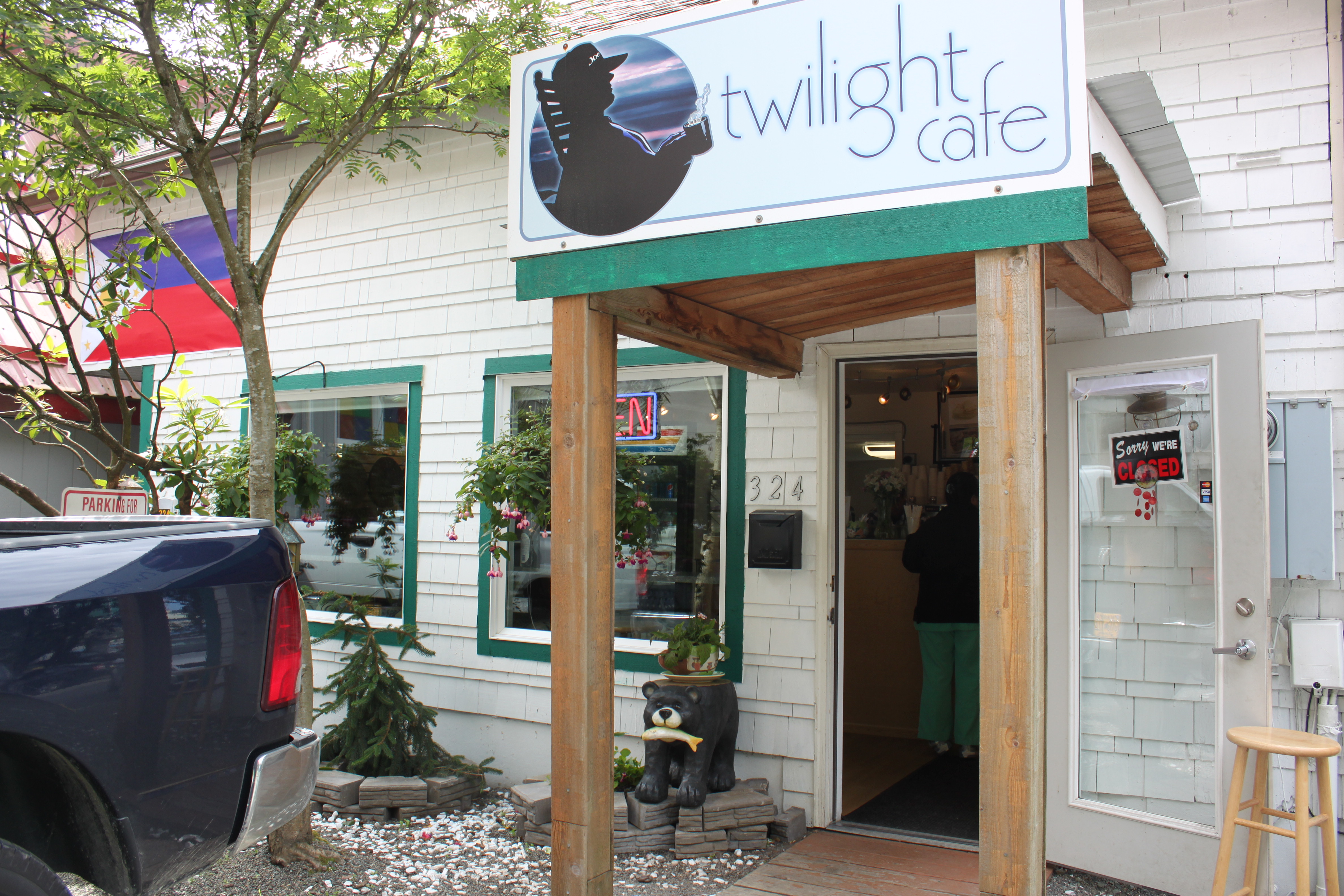
Twilight Cafe won last year after adding decorative plants. (Photo by Lisa Phu/KTOO)
“It’s a simple program but it’s a way to encourage and recognize those businesses that are making a special effort to make downtown Juneau more attractive to locals and visitors alike,” says Brian Holst, the JEDC’s executive director.
The winner will receive $400 and a Storefront Stars plaque. There will also be runners-up and people’s choice awards. Last year, Twilight Café won the competition by removing a concrete parking barrier and adding outdoor plants.
Sponsors of the competition include Princess Cruises and Tourism Best Management Practices.
The deadline to apply is Friday, May 15. Winners will be announced in June.
Juneau’s first co-working space recently opened its doors downtown. It’s called The Boardroom but the modern decor and open layout feel far from corporate.
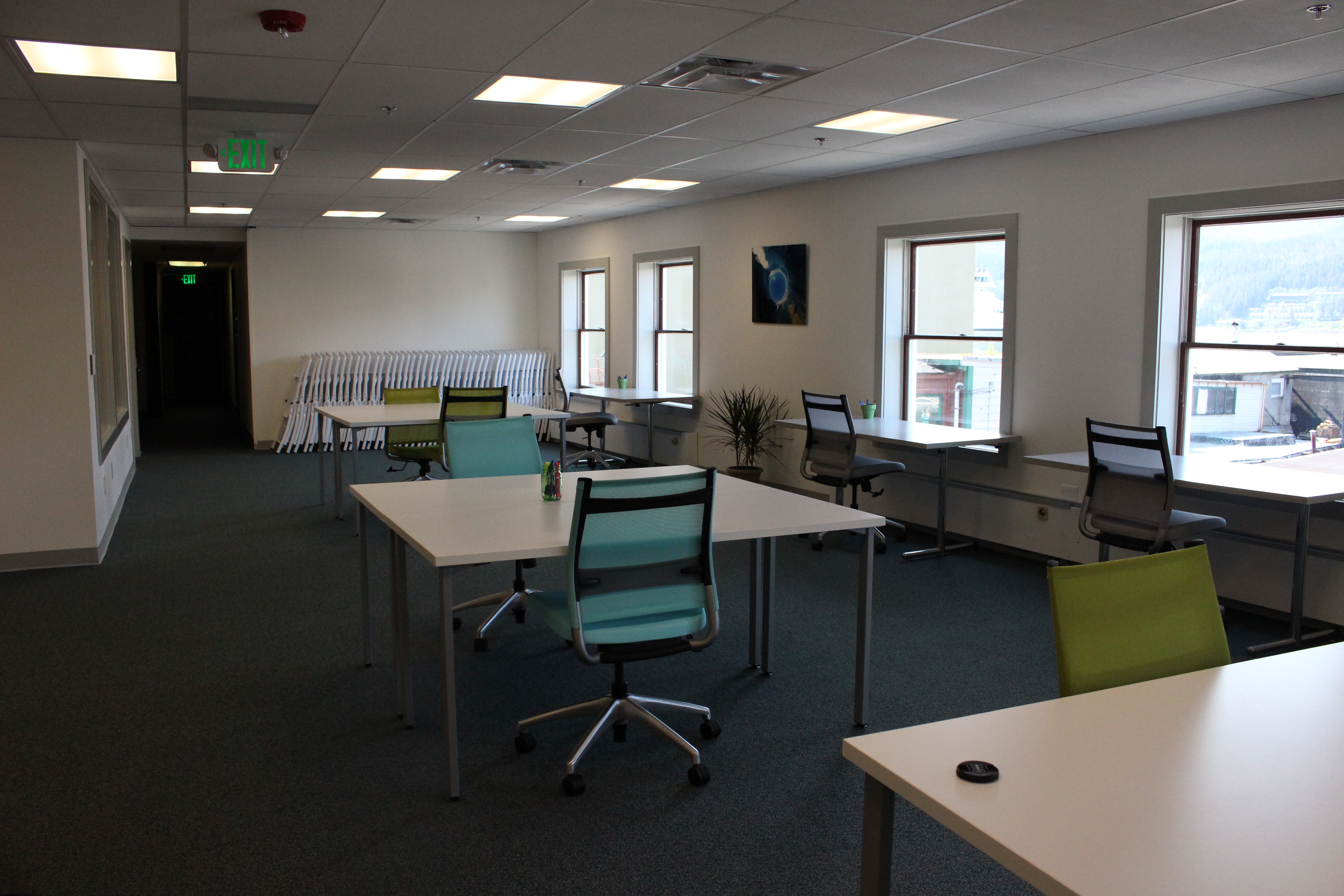
Inside the shared work space, 20 chairs are configured into different formations. Some are clustered around white tables. Others are rolled under stand-alone desks. It kind of looks like the office in an Ikea catalog.
The Boardroom has enough work stations for 20 people. (photo by Elizabeth Jenkins/KTOO)
“We’re going for that sleek modern yet fun look so we have green glass mason jars, green chairs, blue chairs,” Ray Friedlander says, the community manager at The Boardroom.
Since its soft launch this month, she says the company has had three people show interest: a civil engineer, a PR contractor, and an ice cream shop owner.
“I guess the space brings together lines of work that you don’t see in the mainstream or you don’t think about when saying, ‘what do I want to be when I grow up?’ because you’re getting to meet people who think outside of the office box,” she says.
A day pass to the Board Room is $25. Full membership costs $300 a month. Computers aren’t provided but there’s Wi-Fi access, printers and fax machines—even a Keurig coffee maker.
The company is targeting clientele from various backgrounds. Entrepreneurs and cruise ship travelers to busy stay-at-home moms. Pretty much anyone who wants to get away from their regular work environment or doesn’t want to commit to an office lease.
“I would want to work here. If I was tired of sitting in really uncomfortable, wooden wobbly coffee shop chairs or the couch in my living room. Coming here would be a total upgrade,” she says.
The company started in Anchorage about two years ago and was founded by Brit Szymoniak and a business partner.
“We were watching a lot of our bright friends leave Alaska to head out to large cities. And we wanted to do something that would help keep them local and attract young talent and we starting looking at different options and one of the things we came across was this big boom in co-working,” Szymoniak says.
Since its launch, the Anchorage branch has gained about 100 members. Szymoniak says last year 7,000 people came through its door. She’s hoping to find some of the same momentum among professionals here.
“Juneau also has this great energy. It’s really in the process of growing and building. There’s a lot of new young, businesses popping up downtown and young people moving back into the community,” she says.
Brian Holst agrees. He’s the executive director for the Juneau Economic Development Council. He says the addition of co-workspace is meeting a need in the community. It’s part of the trend towards a sharing economy.
“It is people moving away from owning everything for themselves and sharing resources,” he says.
For example, the vacation rental company Airbnb has 38 listings in Juneau which are usually spare rooms.
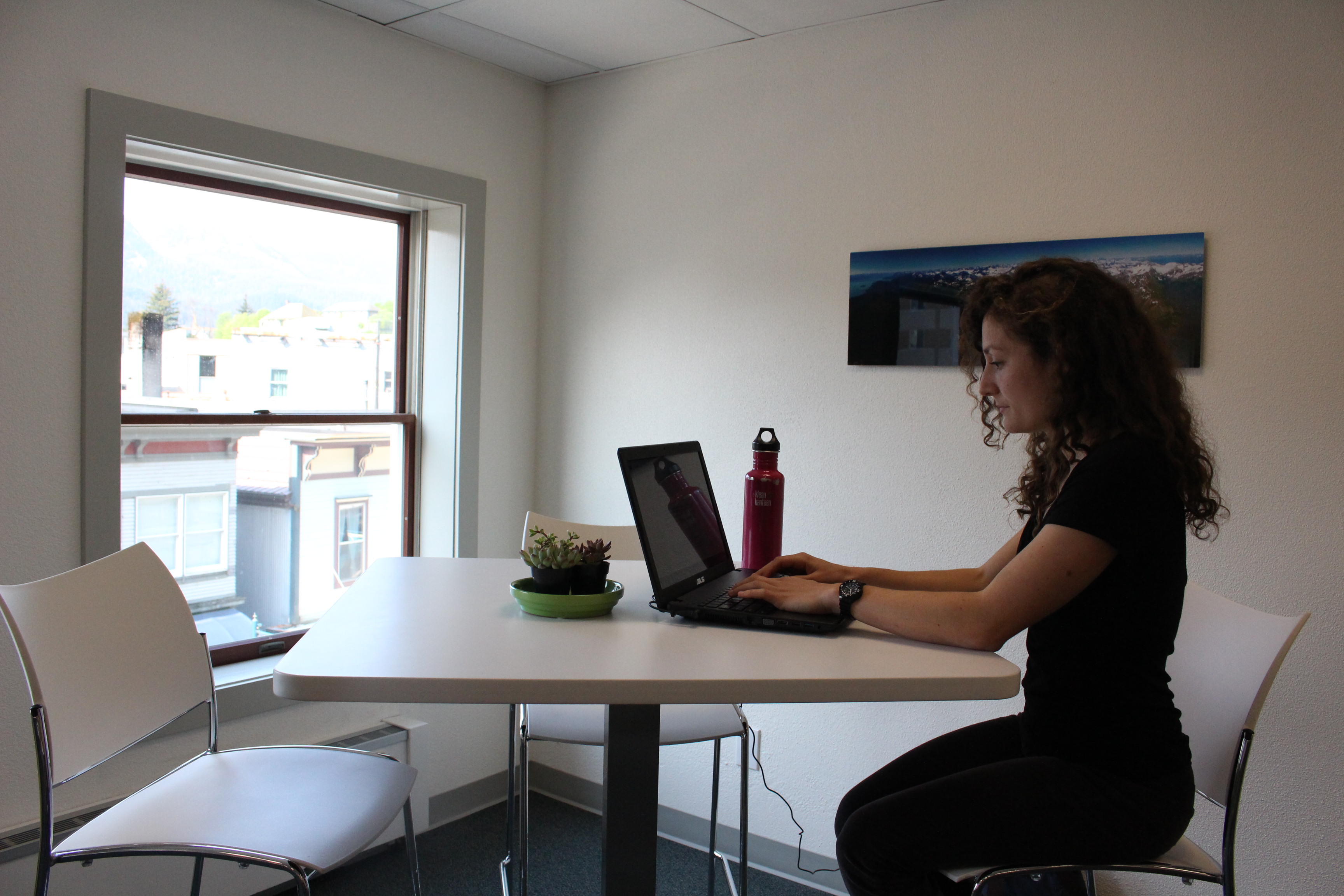
Ray Friedlander sends an email at her desk at The Boardroom. (photo by Elizabeth Jenkins/KTOO)
“We do know that’s a national trend and there’s no reason to believe that it’s not happening to some degree here in Juneau,” he says.
Holst says Zipcar has also expressed an interest in coming to Juneau. It’s become a popular option for people who don’t want the full-time burden of owning a vehicle.
Back at The Boardroom, Ray Friedlander is the only person in the office. But she hopes with word-of-mouth more people will join soon. An open house is planned for early next month.
“I’ve been told Juneau has a flier culture. I came from Sitka. So fliers are another way in a small Alaskan town to get the word out,” she says.
The Boardroom says it’s interested in spreading to other cities in Alaska, like Sitka and Bethel.
Editor’s note: The Boardroom is located on the third floor of the Senate Mall building.
Close
Update notification options
Subscribe to notifications
Subscribe
Get notifications about news related to the topics you care about. You can unsubscribe anytime.