Community

Tracking state layoff notices from the mailroom to the mailbox

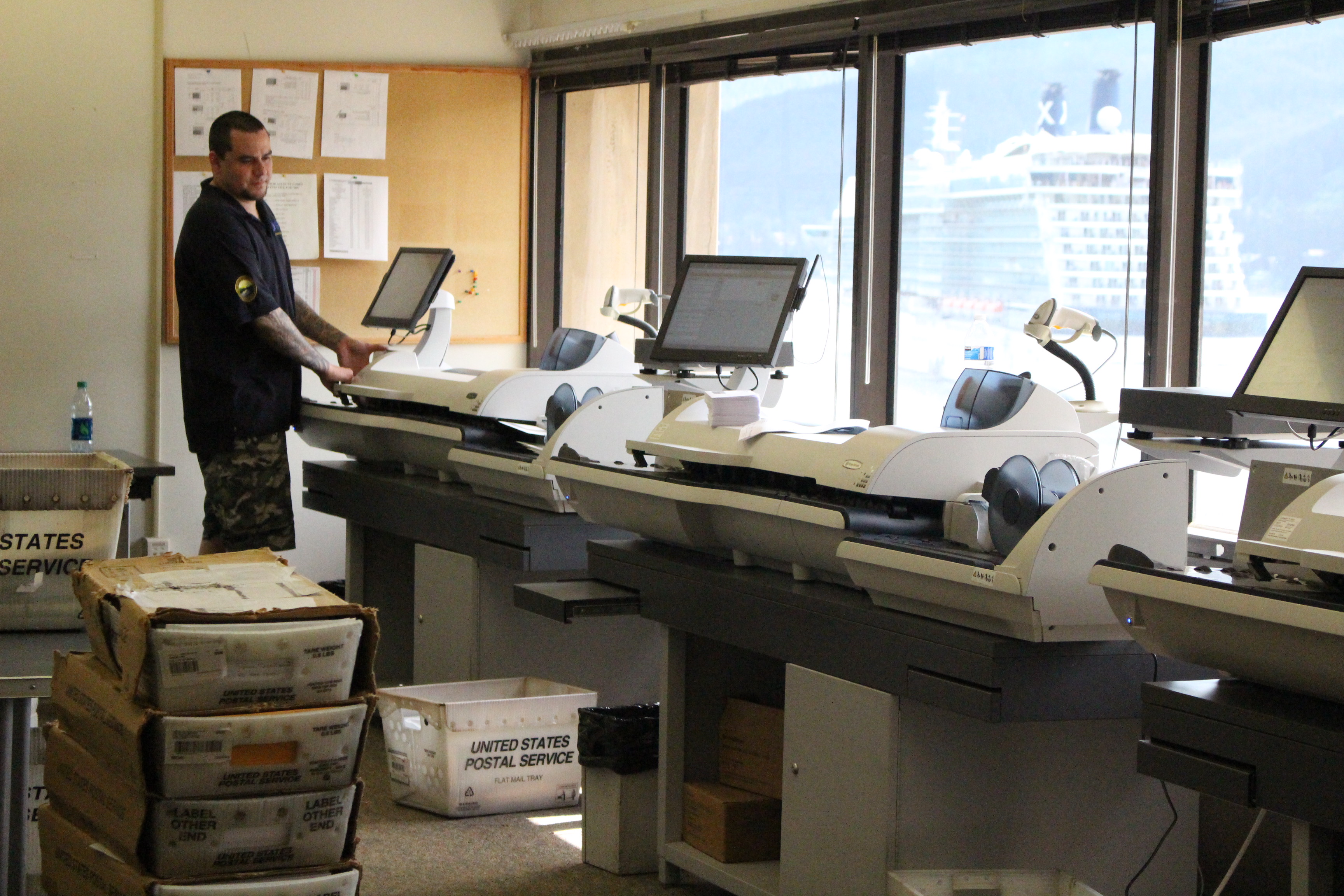
Jeremy Duncan runs letters through a postage machine  at the State Office Building. (Photo by Elizabeth Jenkins)
Jeremy Duncan runs letters through a postage machine at the State Office Building. (Photo by Elizabeth Jenkins/KTOO)

A lot of unhappy letters are arriving this week at state workers’ homes, following the announcement of mass layoffs if the legislature can’t pass a budget by July 1.

In the State Office Building’s mailroom, it’s almost the end of the day. Jeremy Duncan and a co-worker are running letters through a postage machine. He’s been a mail courier for about 12 years. And he knows one of those white envelopes might be his.

Alaska Government Shutdown

For more about Alaska’s possible government shutdown and layoffs, visit the 360 North government shutdown page.

“Layoff notifications. I’m sure I have one in there, too,” he says.

There’s a clock ticking closer to 3 p.m. on the wall. That’s the time the mail goes out.

“We’re waiting for a stay of execution type of phone call, huh?” he says. “That’s what it feels like.”

The phone call doesn’t come and, at 3 o’clock, several boxes are loaded onto a cart and wheeled to the mail truck.

In total, the state spent over $6,000 on sending the layoff notices–something they were contractually obligated to do. About 3,000 went to Anchorage, 1,100 to Fairbanks, and 3,000 to other places. About 2,500 were sent in Juneau. And it’s all because legislators haven’t agreed yet on a fully funded budget.

The layoff letters were the last to be loaded on the mail truck. (Photo by Elizabeth Jenkins)
The layoff letters were the last to be loaded on the mail truck. (Photo by Elizabeth Jenkins/KTOO)

At Switzer Village, Cierra Kendrick opens her mailbox with a key.

“I’ve got what appears to the layoff notices for me and my partner and a couple of pieces of junk mail,” she says. “I just really hoped they would figure it out before it got this far.”

She works for the Alaska Department of Commerce and her partner works for the Department of Transportation. She had a meeting at work and knew the letters were being sent. She’s heard some of her neighbors are avoiding the mail.

“They just don’t want to. They’d rather wait until  we hear something. They send someone to check the mail so they don’t have to see the letter,” she says.

If the legislature fails to pass a budget in time, a small number of workers could still come back. But there are a lot of unknowns and layoff details vary by department and division. The one thing that is sure, the government will be operating with less funding next year.

Kendrick says it’s been a stressful and confusing time for her family.

“Am I going to have insurance come August, depending on what they do? I have two high-needs kids that rely heavily on our insurance and we can’t afford to go without it,” she says.

State workers last day of work could be July 1. Their health insurance will last through the end of the month. After that, they won’t be covered. Summer was supposed be a special time for Kendrick and her partner.

“We are planning our wedding in July and that’s kind of been put on the back burner because those are expensive.”

Thankfully, they have already bought her partner’s dress, but they’re still trying to figure out how to pay for everything else.

“We’re budgeting for it but there’s only so much you can do. We may have to reevaluate and downsize,” she says.

Cierra Kendrick just received disappointing mail: a layoff notice from her state job. (Photo by Elizabeth Jenkins)
Cierra Kendrick just received disappointing mail: a layoff notice from her state job. (Photo by Elizabeth Jenkins/KTOO)

The day-to-day expenses, Kendrick says, would be difficult to manage if they lose their pay. They also have two car payments. There are expenses like cable and internet.

“We may shut it off to save the 150 bucks,” she says.

The legislature’s budget negotiations are still ongoing. Kendrick says she’s tired of lawmakers waffling.

“It’s a game of chicken is all it is,” she says. “It’s ridiculous that a group of adults is playing a game like this. To them, there is no consequence. But it’s a make or break situation for a lot of people.”

For now, all her family can do is wait until a budget is passed or isn’t.

“It all depends on what pretty little pieces of paper we get in the mail and when they happen to get here,” she says.

Kendrick says she’s currently looking for other employment.

Update: Mendenhall jökulhlaup waters peak below flood levels

Update | 12:44 p.m. June 3, 2015

The Mendenhall jökulhlaup has ended. Water levels in Mendenhall Lake and Mendenhall River peaked at about 11:30 p.m. Tuesday below flood levels.

A National Weather Service hydrograph shows water levels peaked in Mendenhall Lake at about 11:30 p.m. Tuesday after a glacier dam release. High water levels forecast later this week are related to precipitation, not another jokulhlaup event.
A National Weather Service hydrograph shows water levels peaked in Mendenhall Lake at about 11:30 p.m. Tuesday after a glacier dam release. High water levels forecast later this week are related to precipitation, not another release.


Original Post | 8:54 p.m. June 2, 2015

A National Weather Service graph shows observed and forecast Mendenhall Lake water levels during a glacier dam release. (Image courtesy National Weather Service)

The National Weather Service in Juneau says a glacier dam release is causing high water levels in Mendenhall Lake and Mendenhall River. It’s the earliest glacier dam release from Suicide Basin on record by a month.

“A lot of our scientists are monitoring this, caught us a little bit off guard just due to how early it released,” says weather service hydrologist Aaron Jacobs. “Compared to previous years, the earliest one prior to this was right around July 4 in 2012.”

The phenomena, also known by the Icelandic term jökulhlaup, began Sunday. Lake and river levels are expected to crest at 8.7 feet around 10 a.m. Wednesday, just below the weather service’s benchmark for “minor flood stage.” That’s when Glacier Spur and Skaters Cabin roads flood. Historically, private property along View Drive has been the most susceptible to flooding.

Seasonal jökulhlaups in the Mendenhall Valley began occurring regularly in 2011. Water collects in Suicide Basin, which is about a mile upstream from the face of the Mendenhall Glacier. If enough water accumulates, it literally lifts the glacier up, kind of like an ice cube in a glass of water. As water flows out, it also bores a hole in the ice.

Jacobs says one hypothesis for why jökulhlaups have become fairly regular is the glacier’s shrinkage.

“How warm the temperatures have been the past winters, stuff like that, not having enough snow and ice accumulations, that, over time, the weight of the Mendenhall Glacier is losing that much mass and that much weight that maybe it won’t need as much water pressure to actually lift it up.”

Jacobs says forecasting Mendenhall jökulhlaups is challenging because there are several hard to measure variables, including the mass of ice in the basin, the mass of the glacier and the volume of water in the basin.

Troy Quinn named new Juneau Symphony conductor

Conductor Troy Quinn leads the Juneau Symphony during rehearsal at the Juneau-Douglas High School auditorium. (Photo by Lisa Phu/KTOO)

The Juneau Symphony has named Troy Quinn its newest conductor. While Quinn has an advanced degree in conducting, he’s also game to bring pop culture to the orchestra.

Quinn has sung backup for The Rolling Stones and has even been on the popular TV show “Glee.” Growing up in Connecticut, he says he was influenced by his parents’ taste in music, everything from Barry Manilow to Motown.

“And my brother and I would do a little show with combs as microphones, set up in the living room and perform for our friends,” he says.

Quinn lives in Los Angeles and plans to split his time between there and Juneau. He says as a kid he loved learning new songs, but his background is different from most of his colleagues.

“I didn’t start taking formal training in music and formal lessons until I was in college,” he says. “That’s kind of a well-kept secret.”

He calls his piano playing skills “proficient” and has been a longtime member of the choir but he didn’t think of music as a viable career. That is, until a professor at Providence College called on him to conduct in class.

“And I had no idea what I was doing but I was just feeling the music,” he says. “You know, I’m of the belief conducting is innate. You either have it or you don’t.”

Quinn had it and his career took off from there. He would go on to earn a doctorate in conducting at the University of California’s Thornton School of Music. Juneau Symphony board President Bev Smith says Quinn’s charisma stood out on stage.

“I just love watching his hands and his graceful way he conducted. He was very engaging with everyone that he met,” she says.

In that performance, Quinn conducted the orchestra without a score — no sheet music to guide him, only the feel. Executive Director Sara Radke Brown says that’s something the audience remembers.

“Not only was it impressive, but it allowed him to be expressive,” she says. “And he may not do that for every concert. He was certainly able to make a more impactful connection with them for that reason.”

New Juneau Symphony Conductor Troy Quinn. (Photo courtesy Troy Quinn)

After the last conductor, Kyle Wiley Pickett, left for a new job, the Juneau Symphony received about 70 applications for the position. Three of those were selected to perform their own concert in Juneau, including Quinn. Radke Brown says they were looking for a conductor who could appeal to a diverse audience.

“So many people say that classical music is dying,” she says. “Opera is dying, orchestras are dying. I think people like Troy are going to remind people that it’s still alive and there’s a lot to offer.”

At 31, Quinn says he’s comfortable navigating social media, like Facebook, to bring new appreciation to the music.

“Because I think that’s what’s going to reach new audiences so that’s vital to the survival of orchestras in the 21st century and beyond,” he says.

He hopes to introduce a new audience to the symphony by taking an interdisciplinary approach. In the classical world, there’s a movement to shake things up.

“The music of Led Zeppelin in an orchestral setting,” he says. “You know, that’s all great because people come in and we offer them a Beethoven symphony as well and that’s how they may get involved.”

Quinn says he’s interested in incorporating film clips or having dancers perform to the symphony’s music. Whenever possible, he wants the arts community in Juneau to be a part of that.

And if his iTunes playlist is any indication, what he’ll bring is eclectic.

“Beethoven five is on my iPod, Usher and Alicia Keys. It’s all music, it’s all good. We just need a common denominator so people can be exposed to the classics,” he says.

Quinn starts the new season as conductor with the Juneau symphony in October.

Front page banner photo by Olivia Zhang.

Heroin Hits Home: ‘If you see something, say something’

Officials seized nearly 10 times as much heroin in 2014 compared to 2013. (Graphic by Ben Matheson / KYUK)

This is part 3 of a 3-part series from KYUK in Bethel. 

State law enforcement officials say heroin gets into Bethel mainly on low-security, small airline passenger flights.

Bethel City Manager, Ann Capela, says the trouble heroin is causing in Bethel requires a coordinated campaign not unlike the one that the U.S. Department of Homeland Security developed with the goal of rooting out terrorists. Although Bethel’s heroin campaign is on a smaller scale, it uses the same slogan:

“If you see something, say something,” said Capela.

Capela, who was hired about six months ago, says the city doesn’t have the capacity to take on multinational drug rings, so the community must work together to root out dealers and traffickers, who have set in motion a slew of problems impacting everything from OCS cases to fire and police calls.

Ann Capela, Bethel City Manager. (Photo by Geraldine Brink/KYUK)

“We need the information from the community. We don’t have the manpower to be, but we need to be our eyes and ears [about] what’s going on. They need to let us know,” said Capela.

Capela says the idea is to support a grassroots effort already brewing in the community. One aspect of the campaign promotes a tip line that goes straight to the Alaska State Troopers Western Alaska Alcohol & Narcotics Team – or WAANT. Capela says the city also hopes to work with social services and health care providers, tribes and others to get addicts the help they need to quit.

At a meeting in which the Bethel City Council tasked city administration with making a heroin action plan, Councilmember Mark Springer said the heroin problems have gotten so bad, that they need to call in reinforcements.

“We would be happy to see as much law enforcement pressure as possible against people who are importing narcotics into Bethel and selling them here. As I said before, it’s criminal conspiracy, it’s organized crime in no uncertain terms,” said Springer.

Alan Wilson, a supervisor with the Drug Enforcement Administration in Anchorage, says law enforcement needs tips from people on the ground in Bethel to help.

Wilson says it’s happening across the country. After regulators cracked down on prescription drugs, like Oxycontin, and reformulated them to be less attractive to addicts, heroin found a market again.

Heroin confiscated by law enforcement. (Photo courtesy of Alaska State Troopers)

“We have drug traffickers that we know have contacts in Mexico and they purchase their heroin either in Mexico or on the border of Mexico in the United States and they ship it up to Alaska,” said Wilson.

Todd Moehring is an investigator with WAANT. He says heroin makes its way to Bethel and other bush communities, in smaller quantities.

“We’re not receiving pounds directly from Mexico on a freight aircraft or something like that, but we’re receiving user amounts. Typically what we’ve learned so far is that most of the dealers have roughly a gram of heroin or more, so that’s usually around 10 hits on a user level, maybe up to an ounce or so – again, because we are at the end of the line,” said Moehring.

Moehring says they’re after source dealers and traffickers. He says it’s coming through mail, freight services and the port. But he says a lot comes in simply on passengers on smaller airlines serving Bethel.

“Smaller airlines that operate under different federal rules, and the security screening is not the same as we get for your larger commercial jets. So folks are carrying drugs in their baggage, they’re carrying it on their person, in their clothing, they’re also doing it on internal body carry,” said Moehring.

Under federal regulation small airlines, which carry less than 50 passengers, are not required to participate in TSA screening. A spokesperson for RAVN Alaska, the main smaller airline that serves Bethel, declined to go on tape. She said via email: “It’s not our policy to search bags. If we have reasonable suspicion that someone may have an illegal substance or item in their bag, we pull the bag and call the troopers or local police authority.” City Manager Capela says she wonders if a drug dog would help.

“I don’t know whether we would require a K-9 unit that looks at the cargo when it comes down. A K-9 unit just as people are going by,” said Capela.

Troopers with the WAANT team say they have requested a drug dog for their Bethel office, but state of Alaska officials say they don’t have the resources to provide one. Moehring says the Anchorage WAANT office just got a drug dog to stop the flow of heroin and other narcotics out of the city. The dog is funded by the North Slope Borough, and will focus on that region but could also be used to follow up on tips from Bethel.


Heroin Hits Home: City of Bethel forms heroin task force

Officials seized nearly 10 times as much heroin in 2014 compared to 2013. (Graphic by Ben Matheson / KYUK)

This is part 2 of a 3-part series from KYUK in Bethel. 

Heroin imported to Alaska quickly reaches rural communities. Those communities are now pushing back. The City of Bethel is organizing a multi-agency heroin task force.

Heroin-related calls are putting a strain on city services and the Bethel Police, according to Chief Andre Achee. He says the department isn’t intercepting much heroin on the streets, but they are responding to an increasing number of thefts.

Heroin-1-200x200“What we’re dealing with is the events that are sort of a nexus to heroin: the thefts, the burglaries, the domestic disturbances, stuff being soldthrough various individuals online, offline, things being stolen even from family members,” said Achee.

He says addicts steal things they can turn over for quick cash.

“Anything from fire arms to vehicles – any type of property that people could sell,” said Achee.

Achee says, sometimes thieves resort to stealing traditional Alaska Native subsistence foods.

“We’ve had thefts of berries: salmonberries, blueberries being sold just for people to get enough money for their dependency,” said Achee.

When the victims are family members, they often don’t want to press charges, says Achee, they just want their items back, which he says perpetuates the cycle and keeps the understaffed police department racing from call-to-call. The fire department’s ambulance crew is also seeing more heroin-related calls, according to city officials. Heroin is also taking a toll on children and families according to Fennisha Gardner, who has worked in and out of the Office of Children’s Services in Bethel since 1999. She says she had never seen the drug come up in their cases until recently.

“I didn’t even see the presence of heroin when I was here the first time or the second time. It has been an explosion of heroin coming into this community and affecting the families,” said Gardner.

The result, Gardner says, is more neglect and other situations that put kids in danger.

“Using substances while having your children in the household, having a criminal element in the household while using with your children there. We also have had children born with heroin in their system,” said Gardner.

The Western office of OCS is handling an increasing number of cases involving babies withdrawing from heroin, Gardner says, and trying to ensure they get proper treatment once they’re born.

The City Council has taken notice of the problems and one council member, Byron Maczynski, has been using his position to work on the issue, bringing it up in discussion at city council meetings. That recently resulted in a threat. One morning he found a type-written note in the driver’s seat of his Jeep. It said:

“You’d better back off the heroin issue before you end up killing yourself. If you call the police we will know about it, haha and the next time I see you walking outside your shop, you won’t make it back in,” said Maczynski.

Police are investigating. He says the threat was unnerving, but it just made him want to push harder. At a recent Bethel City Council meeting he did just that.

“Next on the agenda, Action Memorandum 1516, Community Action against heroin and other elicit drugs,” said Bethel Mayor Rick Robb

Bethel Mayor Rick Robb introduced Maczynski’s Action Memorandum, directing the administration to work with community groups to address the heroin problem. Maczynski read a list of possible things the city could work on:

Bethel City Council Member Byron Maczynski brought heroin problems to the attention of the City of Bethel at a recent meeting. (Photo by Dean Swope/KYUK)

“Provide anti-drug education in middle school and high schools, disseminate information to community members on how to obtain help, educate community members about what to look for to determine drug use and sales, to include how and where to report,” said Maczynski.

Maczynski called on the city to act.

“Sometimes it’s too late, but it’s not too late for a lot of people out there. And we could really help these people. I hope this community could come together. It’s sad. We need to do something,” said Maczynski.

Council Members discussed the need for a treatment center specifically for heroin addiction in Bethel and agreed the city needs to work with law enforcement to crack down on drug dealers. Since the meeting, Bethel’s City Manager, Ann Capella, says she has been working on putting together a multi-agency community task force to address Bethel’s heroin problems.


Heroin Hits Home: One woman’s struggle to get clean in Bethel

Officials seized nearly 10 times as much heroin in 2014 compared to 2013. (Graphic by Ben Matheson / KYUK)

This is part 1 of a 3-part series from KYUK in Bethel. 

Federal officials say in 2014 they intercepted nearly ten times as much heroin coming into Alaska than in 2013. The growing use of the drug is impacting urban and rural areas. This is the first in a series of three stories about the impacts of heroin in Bethel and how the community is fighting it. It begins with one woman’s struggle to get clean in Bethel.

Don’t be fooled by Tracy Faulkner’s 5’4” frame. The small brunette with thick hair and the nickname Malaggai, which means “fur hat” in Yup’ik, is a former wrestling champion.

She competed against boys in high school, going all the way to state and national competition. But in her off time she hid a dark secret.

“When I wasn’t training I would go and use — steal my parents’ booze, you know, find weed. It eventually progressed to taking pills,” said Faulkner.

That started when she was 12. One semester into college drugs started taking a priority over schoolwork. She dropped out and returned to Bethel where she tried school again, but her drug use intervened. She started a food truck business, but couldn’t maintain that either. That’s when Faulkner’s need for escape escalated.

“I got addicted to Tramadol – started taking that, eventually it wasn’t doing the trick for me anymore – I wanted that same high which I first got in the beginning. Then went to OxyContin, and then went to using heroin,” said Faulkner.

Tracy Faulkner. (Photo by Dean Swope/KYUK)

Faulkner smoked it. Others inject. She couldn’t hold a job and was stealing to support her habit. Each high, or ‘nifty’ as they’re called, cost $100 here.

There are no treatment programs specifically for heroin addiction in Bethel. Treatment centers in Anchorage have waiting lists. Rick Robb is Bethel’s Mayor and also runs residential facilities for the Yukon-Kuskokwim Health Corporation.  “It seems like a few years ago it would be non-existent to rare, but now we’re seeing full-blown heroin and we’re seeing it more and more. So the numbers are definitely increasing,” said Robb.

YKHC’s behavioral health division offers outpatient and inpatient treatment for those struggling to get off drugs and alcohol. But there are only 16 beds at the local center and they’re not equipped to handle heroin withdrawal. Sometimes, Robb says, people endure the painful process in the hospital emergency room or at home.

“People can come in if they have a problem, and we’re gonna do the best we can with the resources we have to get people the help they need. I think we have to. There’s some emphasis on us. We have to improve our programing specifically for heroin and we have to learn more about it,” said Robb.

Faulkner says she distinctly remembers the day this winter when she gazed out the window at a friend’s house and realized she wanted to make a change.

“I remember looking out on the river and just seeing everybody living life and I was stuck in this dark place,” said Faulkner.

But with no detox facility in Bethel, Faulkner realized it would have to be cold turkey. She reached out to an uncle for help. He cared for her as she went through withdrawal.

“You get sick to your bones; I mean you want to crawl out of your skin. You lay in bed all day. You have the shakes, the sweats, you know. You’re puking, out the other end, you know it’s bad to where I couldn’t get out of bed,” said Faulkner.

Rick Robb, YKHC Residential Facilities Director. (Photo courtesy of Dean Swope/KYUK)

After detox at home, she was ready to check herself into the local treatment program run by YKHC. But it wasn’t an easy process. YKHC told her it could take weeks to get an assessment necessary to access treatment. Instead of waiting she got the assessment at a local primary care clinic and was able to check in to in-patient treatment through YKHC within a few days. Robb, with YKHC, says he knows they need to do a better job of getting patients quickly into treatment. Now Faulkner is done with her treatment program. She says she gains strength from her ancestors and from her young son, who she says deserves to grow up in a healthy environment.

“It’s our younger generation that’s going to be most affected by this. I mean, our heritage, our culture is gonna be lost. For me, looking at my own child, I don’t want him to grow up in this kind of community. I want him to grow up in the community that I was raised in. Where we showed love for each other, where we cared for each other, where we stood as one,” said Faulkner.

Faulkner says she knows she’s in a unique position to help unite people in the region around the issue, and now that she’s clean that will be her focus.

Site notifications
Update notification options
Subscribe to notifications