
Community

Pakistani student in Juneau reflects on mass school shooting

Hassam Bazil says he was devastated by the school shooting in Pakistan last week. He thanks the Juneau community for giving him support through the hard time. (Photo by Lisa Phu/KTOO)

More than a hundred students from Pakistan are studying in the U.S. through a federal study abroad program. Hassam Bazil, 16, is one of them. He lives in Juneau.

When Taliban gunmen killed at least 145 people in a school shooting in his home country, Hassam felt faraway and helpless. But through the help and support of his friends and host family, Hassam found a way to feel better.

Hassam Bazil woke up last Tuesday morning to a text from his best friend from Pakistan who told him the news.

“His name is Faran. He’s exchange student in Chicago right now, but he’s from Peshawar, same state where this thing happened. I called him and he was crying on phone. Then he told me that he actually knew a lot of people and they died in that attack,” Hassam says.

He was in his host home in the Mendenhall Valley, but he instantly felt connected more than 6,000 miles away.

“Then I talked to my mom and she was crying so hard. It was like the first time she was crying on the phone after, like, four or five months I came to America. She was crying. She was like, ‘A lot of parents just lost their kids.’ It was pretty hard for all of us,'” Hassam says.

Back at his hometown in Talagang, Hassam didn’t live in fear of the Taliban.

“We are the victims of terrorism. A lot of attacks happen in Pakistan, like suicide bombings and stuff, but they never killed innocent kids who just went to school and never came back,” Hassam says.

At home, Hassam attends a private military school, just like the one where the shooting occurred. The Taliban’s attack of the school was an assault on Pakistan’s military, but Hassam says many students come from civilian families.

Hassam felt helpless being so far away from his family and country. So he and other Pakistani exchange students in the U.S. decided the best thing they could do is make people aware of what happened.

“I just took some ribbons and stuff and I went to my school. Then I shared those black ribbons and everyone wore them and it was like, this showed that we all know what’s going on in Pakistan,” Hassam says.

Thunder Mountain High School students and staff wore black ribbons last week in support of Hassam and those affected by the mass school shooting in Peshawar, Pakistan. (Photo courtesy Hassam Bazil)

People around the world wore black bands of ribbon around their wrists and arms to show support for those affected by the school shooting in Pakistan.

“That’s the thing which made me feel good, that I could do something and I did,” he says.

Hassam’s host father Dave Ringle says having Hassam around has made the faraway tragedy more personal.

“When I talk to Hassam and realized he was connected to people who were directly affected by the massacre, that just puts a different spin on it,” he says.

Hassam with his host parents, Valerie Ringle and Dave Ringle. (Photo by Lisa Phu/KTOO)

Since being in Juneau, Hassam has given several presentations on Pakistan. He wants his peers and host family to know what he eats at home – often it’s spicy curry with rice and flatbread. He’s worn a traditional shalwar kameez, which is a long shirt and loose pants, to school a few times.

Host mother Valerie Ringle says Hassam has taught her there’s so much more to Pakistan than the conflict.

“We think of Pakistan as this war-torn country that has all this violence because that’s what we hear in the news. We don’t hear about the good things. Having met Hassam, I’ve learned about some really amazing inventors and intellectual feats that have been accomplished by Pakistani natives,” Ringle says.

Hassam says he’s lucky to be in the U.S. to represent Pakistan.

“I feel really good that I’m here so I can give a better image of Pakistan, my people. I can tell my peers in America that – what do we want? We want peace,” he says.

Hassam says a lot of people he’s met in Juneau don’t even know where Pakistan is. Now, more people do.
Community hopes to keep much-loved Eagle Valley Center alive

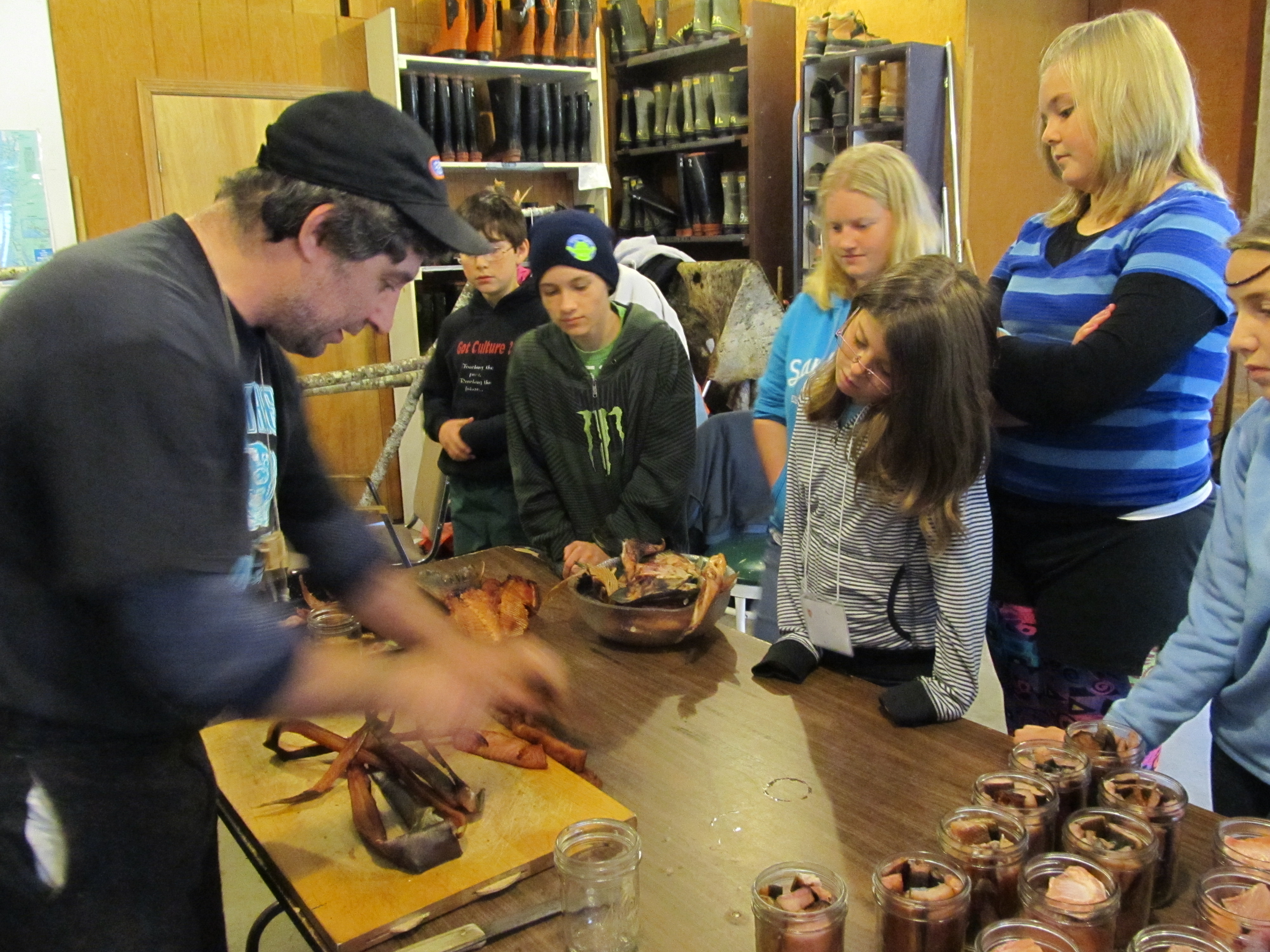
John Smith (left) demonstrates smoking and jarring fish during the 4-H Alaska Experience Camp at the Eagle Valley Center. (Photo courtesy Darren Snyder/UAF Cooperative Extension)
John Smith demonstrates smoking and jarring fish during the 4-H Alaska Experience Camp at the Eagle Valley Center. (Photo courtesy Darren Snyder/UAF Cooperative Extension)

A community group wants to ensure the Eagle Valley Center continues to be used if Southeast Alaska Guidance Association is no longer running it. SAGA is facing major financial problems.

The center is an outdoor education and retreat facility located out the road in Juneau’s Amalga Meadows Park.

Community groups, schools and nonprofits use the Eagle Valley Center for all sorts of activities. The lodge, which can sleep up to 20, can be rented and used as a conference retreat center. SAGA ran a variety of programs there, like a ropes course, sea kayaking and snowshoeing.

Darren Snyder runs 4-H programs for the University of Alaska Fairbanks Cooperative Extension. For years, 4-H held its Alaska Experience Camp at the Eagle Valley Center. He says the kids would be lodged upstairs and the downstairs was used for activities.

“We’ve done a lot of fish processing with our camps where we’re down there filleting fish and teaching kids about that. We’re down there dressing deer,” Snyder says.

Various community groups have benefited greatly from the Eagle Valley Center’s year-round opportunities, he says.

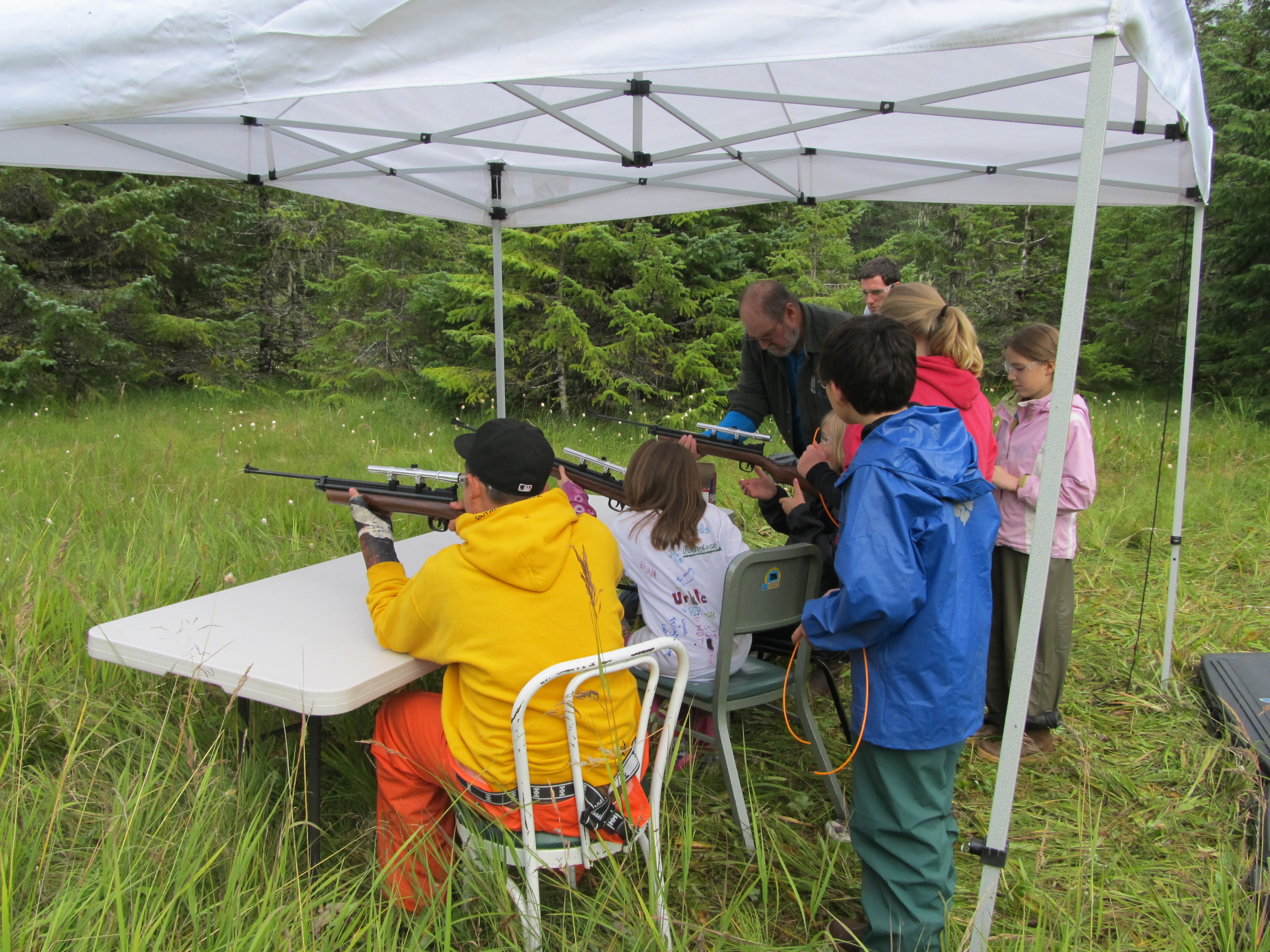
4-H members learn about gun safety with Ken Coate during camp at the Eagle Valley Center. (Photo courtesy Darren Snyder/UAF Cooperative Extension)

“Our 4-H cross-country skiing folks have been out there. I’ve been with different school groups and gone out there and that was where I built my first igloo ever with a group of kids, but I had a great time doing it as well. It’s just a really peaceful valley and the access to the ocean right there and the salt chuck; it is just a really special place,” Snyder says.

The City and Borough of Juneau owns the Eagle Valley Center and has had a use agreement with SAGA since 1992. The agreement waived rent for the nonprofit in exchange for ongoing maintenance of the facility and other services. The latest agreement goes through 2016.

SAGA is $350,000 in debt. It recently transferred its AmeriCorps program to another nonprofit. The city said in November that SAGA was having trouble meeting terms of the use agreement and asked to renegotiate.

Nate Heck worked at SAGA until October and was in charge of the Eagle Valley Center for six years. He’s reached out to the community to discuss its future.

“Right now, it’s finding an organization or group that can take over the management,” Heck says. “And it might look different. Maybe somebody just takes over the management of the building and the lease itself and using it as a rental facility, and then also looking at, are there agencies and organizations that are available to take over some of the programming that was offered, like the ropes course or the kayaking?”

Heck organized a meeting earlier this month that brought together around 20 interested community members. But he welcomes more people to join the discussion, anyone who’s interested in seeing the Eagle Valley Center continue.

A second meeting takes place 7 o’clock tonight at the downtown library.

Sitka AmeriCorps takes over SAGA volunteers

Sitka AmeriCorps is taking over the volunteer program long run by a Juneau non-profit.

Southeast Alaska Guidance Association, or SAGA, has been bringing AmeriCorps volunteers to Alaska for 20 years to work on service projects on public lands and volunteer with schools and nonprofits.

The organization told 19 volunteers serving around the state last week it was ceasing operation of its program due to financial troubles. The volunteers in Anchorage, Juneau, Homer, Seward and Cordova had contracts through the end of July.

Sitka AmeriCorps Coordinator Faith Lee says she’s thrilled the organization can help out.

“These kiddos are going to get to finish and complete their term of service and feel valued,” Lee says.

The Sitka School District runs the community’s AmeriCorps program. Lee says taking on SAGA’s volunteers will require hiring an additional part-time staff member to help out with reporting, filing, payroll and health insurance.

She says the arrangement will last through August, when the grant cycle ends.

SAGA received a $250,000 federal grant to help run the AmeriCorps program.

Will there be a second season of Alaska Robotics News?

U.S. Sen. Mark Begich is Alaska Robotics' highest profile guest to appear on their satirical news show. (Screen capture courtesy Alaska Robotics)
U.S. Sen. Mark Begich is Alaska Robotics’ highest profile guest to appear on their satirical news show. (Screen capture courtesy Alaska Robotics)

Juneau-based video collective Alaska Robotics is once again raising money for its satirical series Alaska Robotics News.

This year, the series poked fun at the Alaska Legislature and the 2014 midterm elections, thanks to more than $8,000 raised on Kickstarter.

But because of Kickstarter’s all-or-nothing fundraising requirement, the second season of Alaska Robotics News might not happen.

Not only do Pat Race and his team design websites, create art, and run a comic shop and gallery on the side – they also make videos.

After years of doing periodic, political comedy videos, Alaska Robotics News debuted during this year’s legislative session.

“We produced over 70 minutes of satire news,” Race says. “It resulted in five episodes and six short episodes that were focused on the election.”

Monday is the Kickstarter deadline for next year’s series, and as of Thursday they were $5,700 short of their $8,000 goal.

“Last year fundraising began a little bit earlier than this year and fundraising this year is not going great and I think it’s maybe because of our timing,” says Race. “But it’s also maybe because it’s the second time we’ve tried to do this, and so maybe the enthusiasm isn’t quite as high.”

The way Kickstarter works is it’s all or nothing when it comes to fundraising.

“You pledge to donate a certain amount and if the overall goal is not met, then no one has to donate anything and the project just doesn’t happen,” Race says.

He hopes Alaska Robotics can still pull it together at the last minute.

“Some of the people who donated last year have donated again and I’ve had a lot of people stop me on the street and be like ‘Oh, your thing’s happening, your fundraising’s going on, I need to contribute to that and I haven’t. I need to sit down and do that,'” says Race. “So we’ve got a lot of those people floating around out there.”

One of those people is Nolan Davis. The Juneau dentist says he was out of town and just got an email about the fundraiser. He donated $1,000 last year and says he’ll wait until the end of the drive to see how close they are to their goal.

“I might be influenced to donate more if they’ve just got a little bit more to go,” Davis says.

He says he likes Alaska Robotics News because it’s fun, but also informative. He says politics can be pretty boring and one way to make it interesting to a younger audience is to make fun of it.

“It’s kind of become the national norm at least for the age groups from say, 19 to 30,” Davis says. “What I’ve read, I think 25 percent of that age group gets their daily political news from shows like The Daily Show and The Colbert Report.”

Race says the series has built an audience around the state, but most of the people who have donated to the Kickstarter campaign live in Juneau. If they don’t make their goal, Race says Alaska Robotics will find another project.

SAGA to cease AmeriCorps program, hopes another org will save it

SAGA AmeriCorps volunteer Maia Wolf (second from right) poses with other AmeriCorps members last year. (Photo courtesy Maia Wolf)

Nineteen AmeriCorps volunteers throughout the state were told this week their positions, including stipends and benefits, could end on Monday.

As a second year AmeriCorps member, Maia Wolf volunteers at Discovery Southeast, a nature education nonprofit. She got the news the same way fellow AmeriCorps volunteers in Juneau, Anchorage, Homer, Seward and Cordova did – in a teleconference Tuesday.

The volunteers thought they had secure positions through July. Wolf says they’re frustrated.

“It’s financially difficult for a lot of people. We’re coming out of college. We don’t have a lot of savings and so not having something lined up and having so little time to look for a new position is difficult,” Wolf says.

The volunteers affected are specifically AmeriCorps members with Southeast Alaska Guidance Association, or SAGA. The Juneau nonprofit is ceasing operation of its AmeriCorps program due to financial troubles, and hopes another program in the state can take it over. SAGA has been bringing AmeriCorps volunteers to Alaska for 20 years to work on service projects on public lands and volunteer with schools and nonprofits.

Discovery Southeast Executive Director Shawn Eisele says the organization plans to support Wolf for the full length of her contract, regardless of what happens to the AmeriCorps program. AWARE hopes to do the same for its AmeriCorps volunteer.

Saralyn Tabachnick is the executive director of Juneau’s domestic abuse and sexual assault prevention nonprofit. She says the AmeriCorps volunteer at AWARE serves as a children’s advocate and fills a real need.

“She works with kids who are living in shelter, acclimates them to shelter, spends time with them, safety plans with them, facilitates groups for them, helps them feel like the unique people that they are,” Tabachnick says.

She says if SAGA’s AmeriCorps program doesn’t get picked up by another organization, AWARE will try to raise funds to keep its volunteer on as long as possible.

Faith Lee is the coordinator of Sitka AmeriCorps, the program that might take on SAGA’s volunteers. If it’s financially viable, Lee says Sitka AmeriCorps could ensure SAGA members had support to complete their terms.

“We would take on all of the reporting, filing, payroll, health insurance,” Lee says.

The Sitka School District runs the community’s AmeriCorps program. Lee says the administration is figuring out what the budget implication of doubling the number of AmeriCorps members will be to the district.

SAGA receives $250,000 in federal funds as well as community contributions to run its 11-month AmeriCorps program.

Lee hopes Sitka AmeriCorps can help out.

“I felt really bad that 19 young adults were maybe not going to have an advocate and that’s something that I really take to heart because I want them to have a great experience. I want them to leave a footprint and make an impact and feel good about their service. And hopefully continue to volunteer for the rest of their lives,” Lee says.

Sitka’s 6-year-old AmeriCorps program and SAGA’s have had a great relationship in the past, Lee says.

“They actually mentored us and shared everything when we first took on AmeriCorps. They were wonderful. Without them, we would’ve really struggled. SAGA has contributed to our state for many years. If I can help in any way, I’m more than happy to put that extra time in,” she says.

SAGA board member George McGuan says faced with a $350,000 debt and no way of repaying it, the board is seeking legal counsel to figure out what to do next.

Editor’s Note: The story has been updated to clarify Maia Wolf’s future with Discovery Southeast. 

Juneau welcomes new governor at holiday open house

Bill Walker, Byron Mallott, holiday open house
Gov. Bill Walker (middle, kneeling), Lt. Gov. Byron Mallott (standing, left) and their wives greet visitors at the annual Governor’s Mansion holiday open house. (Photo by Kayla Desroches/KTOO)

The line stretched around the block last night for the annual holiday open house at the Governor’s Mansion in Juneau.

Gov. Bill Walker, Lt. Gov. Byron Mallott and their families greeted capital city residents, who took the opportunity to eat plates full of cookies, chocolate and fudge.

Just days after Juneau welcomed Walker into the Governor’s Mansion, he returned the favor. The new governor says he’s happy that Alaskans have the chance to see inside the historic site. He’s also grateful to be there himself.

“This isn’t the governor’s house. It’s the people’s house,” Walker said. “So we’re humbled to be a guest in the people’s house while we’re in Juneau.”

Mallott has taken part in the holiday open house before as a member of Gov. Bill Egan’s staff. The new lieutenant governor says he’s happy his responsibilities now involve shaking hands and posing for pictures.

“The rookie cabinet officer or the most recently appointed was given the responsibility of ladling punch for hours,” Mallott said with a laugh. “And I found myself in that circumstance once and I’m glad I’m not there to repeat it.”

Chef Abby Roha of Abby’s Kitchen has catered the event for the past five years. She says the baking process starts with a list of cookies from the governor’s office.

cookies, open house
The spread at the Governor’s Mansion holiday open house. (Photo by Kayla Desroches/KTOO)

“They give us the flavors and then we start making them,” Roha said. “It took us about three weeks, a month, to make them, and we make them and then wrap them really tightly in boxes and then put them in deep freeze. So they’re froze at like negative 25 degrees to keep fresh.”

There are those who show up for the cookies, the model train set, or just to meet the governor. Catherine Allen is a long-time Juneau resident and came for the familiar faces.

“This is the third time I’ve been here and it’s always nice to see all the different people from around town,” Allen said. “I’ve here since 1972, so I know a few people here.”

Students from the Juneau Douglas High School band program played holiday tunes as the guests mingled.

Site notifications
Update notification options
Subscribe to notifications