Community

‘Catching babies’ is midwife Madi Nolan Grimes’ calling

Portrait of Madi Nolan Grimes (Courtesy of Madi Nolan Grimes)
Madi Nolan Grimes (Photo courtesy Madi Nolan Grimes)

Most people in their early 20s go through a period of adjustment, where they figure out what they want to do for work. But a young Juneau midwife already knows what she wants to be and is doing it. At 23, Madi Nolan Grimes is clinical director at the Juneau Family Health and Birth Center. She’s been practicing midwifery since she was 19.

Madi Grimes says women in labor “roar their babies out.” That wasn’t something she expected when she watched her first birth as a midwifery apprentice.

“I remember sitting on the floor next to the midwife who was getting ready to catch the baby,” says Grimes. “And this woman was just so loud. It’s like ‘OK, this is not something I saw in the birth videos.’”

Grimes says she was surprised at how slow the birth process seemed. Even though, she says, it was probably only 3 minutes.

“I just kept thinking, this is not gonna work,” Grimes says. “There’s just more and more and more coming. And then when the baby came out, it was like it had all been this magic trick.”

Her first experience “catching a baby,” as midwives call it, was with a third-time mother.

“Her baby just kind of ended up sliding out quickly and we dried the baby off and got the baby up on mom’s chest and I remember being like ‘OK, well, that’s not too bad. It’s kind of like grabbing a greased watermelon that’s got handles on it.”

Grimes says her emotional reaction to that delivery was not as strong as when she watched her first birth as an apprentice.

“I think part of that is because I was so engrossed in making sure everybody was still OK.”

The Juneau Family Health and Birth Center offers various spaces and tools to help women through the labor process. That includes bathtubs and birthing stools that use gravity to aid in delivery. Some women choose the toilet or the bed.

A room in the Juneau Family Health and Birth Center (By Kayla Desroches/KTOO)
A room in the Juneau Family Health and Birth Center. (Photo by Kayla Desroches/KTOO)

The Birth Center charges $12,000 for a package that includes prenatal visits, delivery and postpartum care. Most insurance companies pay about 80 percent of that. Medicaid covers the entire amount. Grimes says they get moms and couples from all walks of life.

She says her own mom gave birth to four children at home. But she really became interested in midwifery after seeing the documentary “The Business of Being Born,” which is about modern maternity care in the United States.

“I was really disturbed by the idea that not all women have access to a reliable midwife who’s got good skills and so I was really motivated to become that midwife.”

After high school, she showed up at the Birth Center and asked to speak with then-clinical director Kaye Kanne.

“She was really kind of shocked when I walked in and said ‘I want to be an apprentice and start tomorrow,” says Grimes.

Kanne remembers that day, too.

“And I said, ‘Well maybe it would be a good idea for you to come back when you’re a little bit older,’” Kanne recalls. “And she said, ‘No. I really know that this is what I want to do.’”

Kanne accepted Grimes as an apprentice, and guided her through her course work at the National College of Midwifery in New Mexico.

The two traditional paths to becoming a midwife are to be an apprentice or go to nursing school.

Kanne says Grimes had a strong resolve to be a midwife that never wavered during the apprenticeship.

Grimes obtained her degree and state license in 2013. If she needed any more affirmation that she was on the right path, she found out during her apprenticeship that her grandmother and great-grandmother were both midwives in England.

“In some ways it makes me feel like midwifery is in my blood.”

Glory Hole likely closed through mid-January, still needs Christmas donations

the Glory Hole, McPhetres Hall
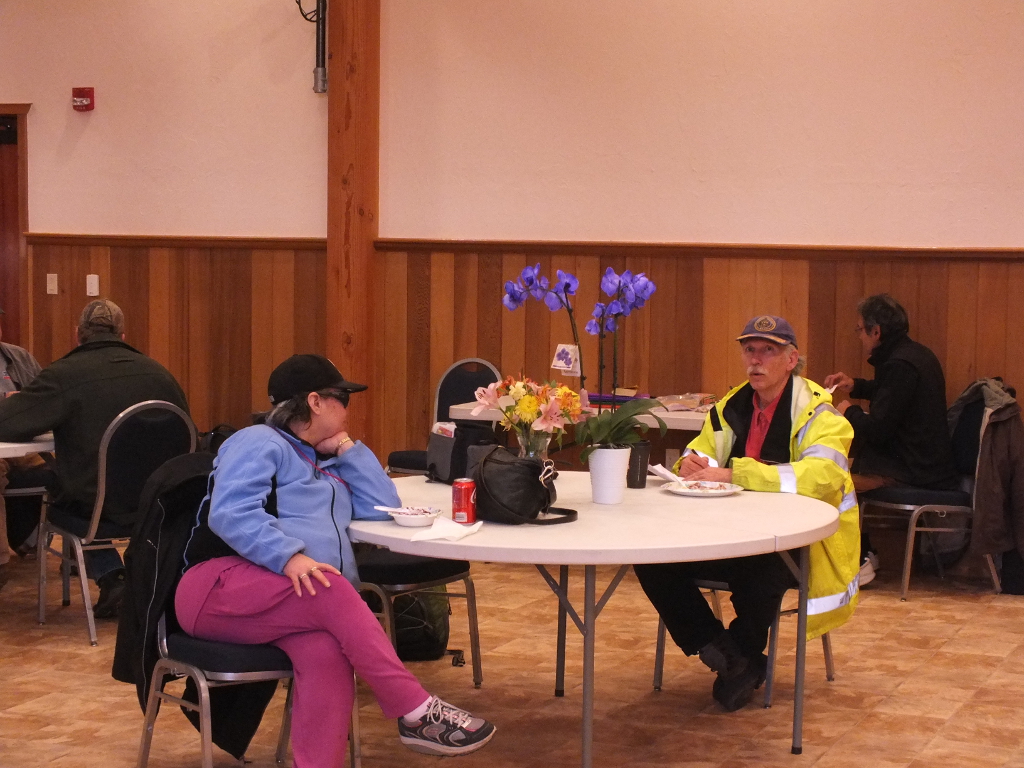
The door to Holy Trinity Church’s McPhetres Hall, where the Glory Hole’s soup kitchen is temporarily operating while the shelter is closed for repairs following a flood last month. (Photo by Casey Kelly/KTOO)

About 30 patrons of the Glory Hole homeless shelter in Juneau will spend a little longer than originally expected in temporary emergency housing.

The facility closed after a busted water pipe caused a major flood on Nov. 30. The initial estimate for repairs was about a month, but executive director Mariya Lovishchuk now says it could take until mid-January.

“Most of the ceilings and most of the floors, everywhere except for on the first floor, were damaged and need to be completely replaced. A lot of the sheetrock on the walls needs to be replaced, and things have to be painted,” Lovishchuk says. “The electrical and plumbing is mostly done, and then a bunch of fixtures still have to be replaced.”

Lovishchuk says there are other challenges besides building repairs that need to be dealt with before the shelter reopens.

“For instance, a lot of our bunk beds were destroyed and so now we are trying to find industrial grade bunk beds,” she says. “And it’s actually not as easy as originally anticipated.”

the Glory Hole, McPhetres Hall
Glory Hole patrons eat lunch at McPhetres Hall on Tuesday. (Photo by Casey Kelly/KTOO)

Most of the Glory Hole’s regular clients are currently housed at Juneau International Hostel. Meals are being served at Holy Trinity Church, which is also providing office space for staff. Lovishchuk says the soup kitchen will need to find another location in January, when the church has a conflict. But she’s hopeful the hostel will continue to provide housing until the shelter resumes operations.

She was initially worried the closure would affect cash donations during the holiday giving season, but she says that’s no longer a concern. Due to the closure, the Glory Hole is not accepting as many donations of food and clothing as usual, but Lovishchuk says Christmas gifts are still needed for patrons on Thursday.

“Presents that could be given to anybody, like especially things like warm gloves and warm hats would be, I think, very helpful,” Lovishchuk says.

She says those types of donations can be dropped off at Holy Trinity’s McPhetres Hall or at the hostel during normal business hours.

Alaska ranks 10th in U.S. for volunteerism

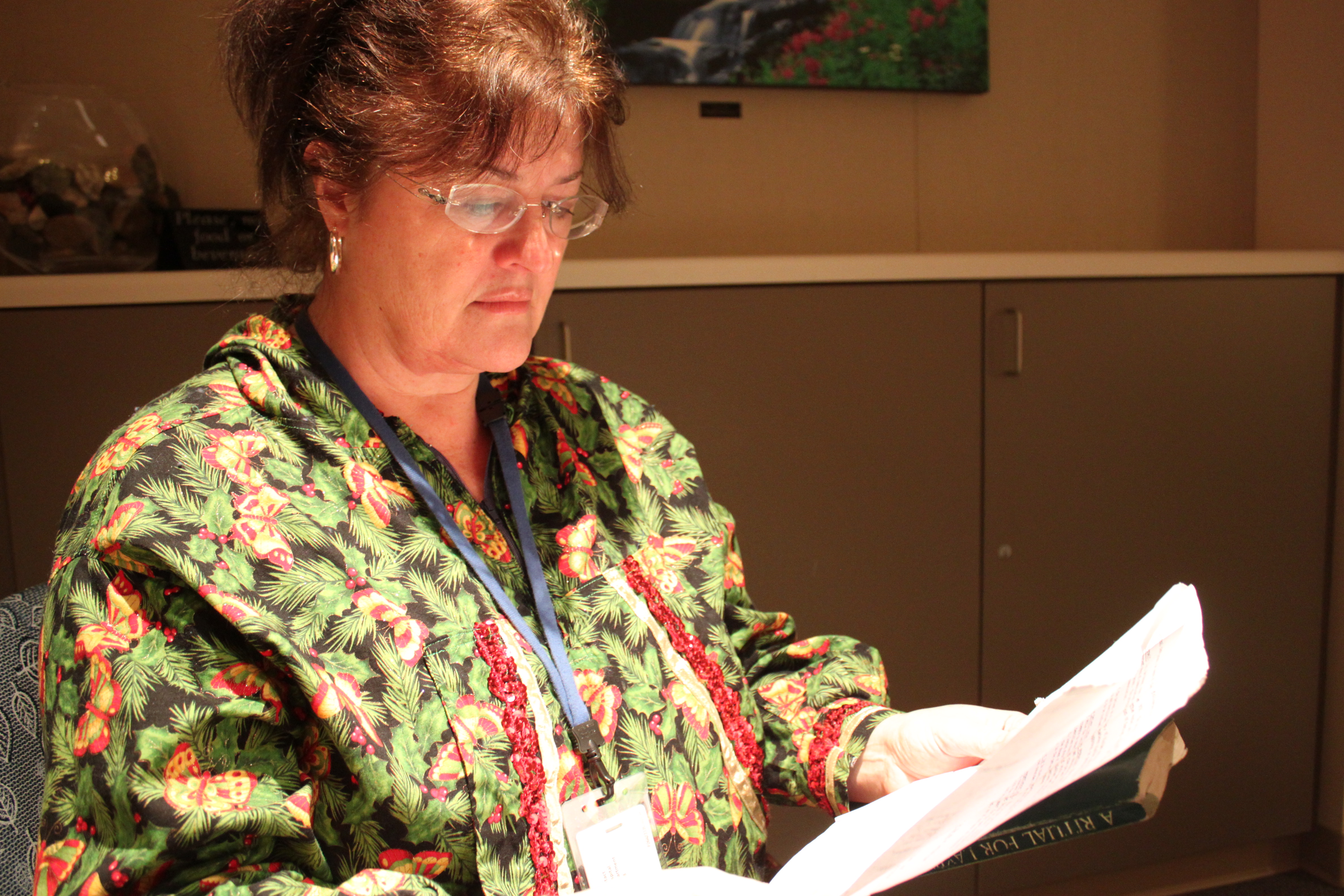
Claire Richardson is a volunteer chaplain at Bartlett Regional Hospital. She sits in the hospital's Prayer and Meditation room to collect herself before starting her volunteer shift. (Photo by Lisa Phu/KTOO)
Claire Richardson is a volunteer chaplain at Bartlett Regional Hospital. She sits in the hospital’s Prayer and Meditation room to collect herself before starting her volunteer shift. (Photo by Lisa Phu/KTOO)

When it comes to volunteering, Alaska ranks 10th in the country, according to a recently released federal report.

In 2013, about a third of Alaska residents volunteered through an organization. More than 62 percent participated in informal volunteering, like helping neighbors.

Claire Richardson is one of thousands of volunteers in Alaska represented in the report. As a volunteer chaplain at Bartlett Regional Hospital, she provides spiritual care for patients, staff and visitors.

“I’ve been called to ER in the middle of the night. Sometimes there’s a new baby and the parents want a blessing. Sometimes there are families mourning either bad news or the death of a loved one, and we sometimes go over to the recovery unit and work with people who are working on sobriety,” Richardson says.

Bartlett has up to 20 volunteer chaplains that rotate each week. Every day of this week, Richardson will go to the hospital and do the rounds. She chooses to volunteer during Christmas, which can be a difficult time of year for a lot of patients. Richardson says it gives her perspective.

“You are with people when they’re their most vulnerable and for them to share with you, to invite you in, to ask you to pray for them, to pray with them, it’s a pretty amazing experience and it grounds me. When I’m thinking about ‘Oh Christmas! I’ve got to do this and I’ve got to do that and I’ve got to buy this and I’ve got to wrap that,’ and you come here and you take a deep breath and you say, ‘OK, this is really what it’s all about, it’s relationships,'” Richardson says.

Richardson came to Alaska in 1986 as a Jesuit volunteer. Despite full-time jobs – she’s Lt. Gov. Byron Mallott’s special assistant – Richardson has stayed in the volunteer world. Besides her service as a chaplain, she’s a Big Sister for Big Brothers Big Sisters of Alaska, the vice president of Juneau’s Foundation for the End of Life Care and she volunteers in her neighborhood.

Richardson is not alone in her service.

“One in three Alaskans are volunteering so it’s well above the national average,” says Wendy Spencer.

Spencer heads the federal agency Corporation for National and Community Service that administers AmeriCorps, Senior Corps and other programs.

“Nearly 200,000 Alaskans volunteered formally through an organization last year and they volunteered over 25 million hours,” Spencer says.

The Corporation for National and Community Service works closely with the U.S. Census Bureau and Bureau of Labor Statistics to assess the state of volunteerism in an annual report.

It looks at two major areas – volunteering through an organization, which is how the states are ranked, and informal volunteering.

“You’re really good at helping your neighbors, just doing things not necessarily formally through an organization, but being there to help individuals in your community, so Alaska’s got a lot to be proud of,” Spencer says.

In a decade of looking closely at volunteerism in the U.S., this is the first year Alaska has ranked in the top 10, up two spots from last year.

Richardson says the act of volunteering comes natural in Alaska.

“It’s that type of community where, you know, one year you may get a lot of fish, the next year you may not, and you may hope that your neighbor is as generous to you as you were to them, so I think that it’s a no-brainer that Alaska has a large group of volunteers. They’re everywhere,” she says.

Richardson says the big secret about volunteering is you get way more out of it than you put in.

Rabbi Dov: Feeding hungry souls via Skype

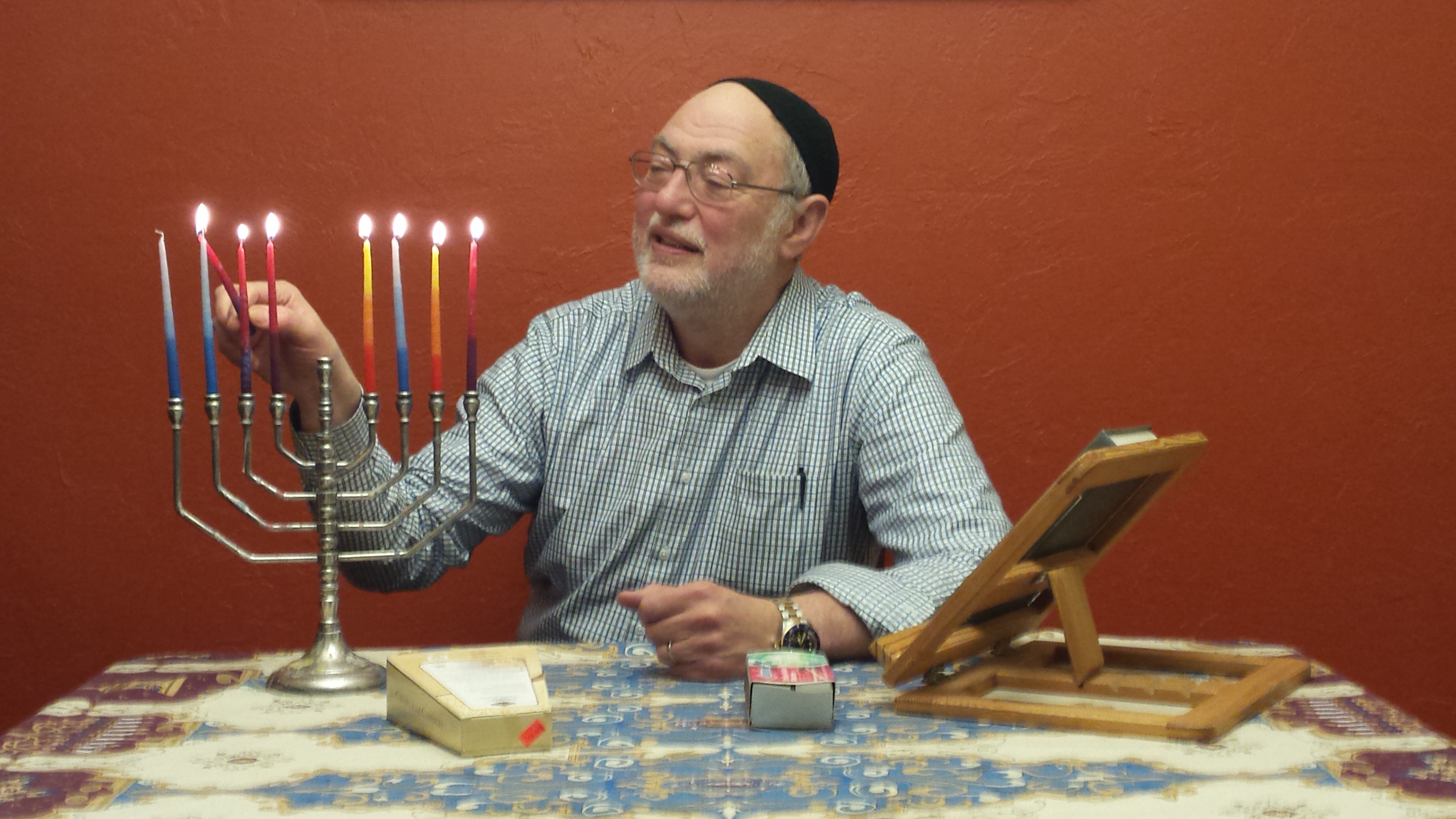
Rabbi Dov lights the menorah for Hanukkah (Photo by Kayla Desroches/KTOO)
Rabbi Dov Gartenberg lights the menorah for Hanukkah. (Photo by Kayla Desroches/KTOO)

Juneau’s Dov Gartenberg says he’s one of a handful of rabbis in Alaska. He plans to continue his rabbinic work from Seattle when he moves in March–at least through the internet.

He ran a year-long online course called “Engaging Judaism” that ended in September. He has another one planned for 2015.

Cathy Cooley from Ketchikan took Rabbi Dov’s class last year. She says she’d tried another online course before, but it wasn’t a good fit.

It was different with Rabbi Dov, who’d she’d known before the class. He’d assisted in her conversion.

“A big part of Judaism is about community,” Cooley says. “It certainly made sense to be working with a rabbi whose face was familiar to me, who I knew and trusted and respected.”

She says she and 10 other students would read at least one book per month that addressed Jewish thought, culture and belief. Then Rabbi Dov would lead discussions over Skype twice-monthly and answer questions.

Patricia Custard was another student last year. She lives in Eagle River and is in the process of conversion.

And like Cooley, Custard says that being Jewish in places like Juneau, Ketchikan and smaller communities can be a challenge.

“You just don’t have the critical mass available to have offerings that a larger city would,” Custard says. “You have to be able to avail yourself to things like Dov’s class and also be self-initiated. Do a lot of reading on your own and just really seeking out people who will discuss readings with you.”

Rabbi Dov says one of the class’s purposes is to provide students with a background in Judaism they would usually find through traditional means.

“If you live in a place where you can’t even get a minyan, which is a quorum for 10 Jews, how do you learn about prayer? Or there are no ongoing prayer services. I could say ‘Well go to the local synagogue and participate in the services.’ I can’t tell someone to do that.”

The class’s aim is not to replace community.

“What you’re trying to do is to help people create a personal life that’s Jewish, not necessarily a communal life that’s Jewish.”

Rabbi Dov calls Judaism a “textual religion.”

“They have a great literature,” he says. “And the study of those texts is considered a religious act. So what I’m doing with people is giving them skills that they can use to study those texts. And that’s something you can do in Alaska.”

Some of his students have turned to the internet for other religious needs. Gregg Browngoetz lives in Fairbanks, but has spent time in a few small towns in Alaska.

“I’ve participated in some online communities with other congregations outside of Alaska in terms of attending Shabbat service and high holiday services online.

Streamed services and internet classes are not ideal for everyone. For instance, Skype either melds with your learning style, or it doesn’t.

“I learn better when I’m physically in a group of people and can scan and see how people are reacting,” Custard says. “With Skype, you know, you just see one little face at a time. But for what, you know, it was the best that we could do and because of that it is effective.”

In other words, it does the trick.

And Custard says she consumed all the material Rabbi Dov assigned.

“It was like feeding a hungry soul.”

The second year of Rabbi Dov’s class begins in January and will be called “Doing and Being Jewish in Alaska.”

Editor’s Note: A previous version said Rabbi Dov Gartenberg was one of three rabbis in Alaska. KTOO has since learned that there are at least four.

Avista Corp. donates $100,000 to Juneau organizations

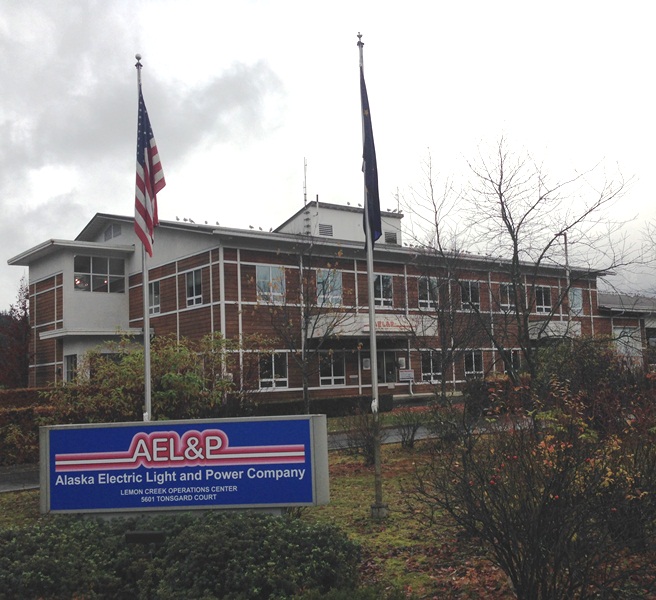
AEL&P headquarters in Lemon Creek. (Photo by Casey Kelly/KTOO)

Alaska Electric Light and Power’s parent company today announced $100,000 in donations to six Juneau organizations.

“Everybody benefits when the community does well, when its citizens do well,” says Jessie Wuerst, a spokesperson for Spokane, Wash.-based Avista Corp., which merged with AEL&P on July 1.

The organizations that received money are the Juneau Arts & Humanities Council, the Salvation Army, the Glory Hole, the United Way of Southeast Alaska, Bartlett Regional Hospital Foundation, and the University of Alaska Southeast.

The $12,000 donation to the Glory Hole comes after a burst water pipe temporarily put the shelter out of commission earlier this month.

United Way President and CEO Wayne Stevens says the organization hasn’t decided where to invest the $12,000 it received, but he says there’s always a need.

“It’s hard to commit to where money’s going until you have the pile collected,” Stevens says. “You can always make sure that contributions are directed to the area of greatest need. And that changes moment to moment almost.”

Wuerst says Avista Corp. representatives will fly to Juneau in January to present checks to each of the organizations.

Avista Corp. donations to Juneau organizations

  • Juneau Arts & Humanities Council – $4,000
  • Juneau Salvation Army – $10,000
  • The Glory Hole – $12,000
  • United Way of Southeast Alaska – $12,000
  • Bartlett Regional Hospital Foundation – $12,000
  • University of Alaska Southeast – $50,000
Site notifications
Update notification options
Subscribe to notifications