Community

School safety moves beyond the lockdown

A memorial to the victims of the 2006 shooting at Dawson College, Montreal. One person was killed and 18 wounded in Canada’s third school shooting. (Creative Commons Photo by Doug)

Researchers are developing new strategies to counter shootings at schools and other public places, and they’re not what you might expect. The Sitka School Board at it’s regular meeting this week heard a presentation on the ALICE program, which represents a radical departure for personal safety in life-threatening situations.

A school shooting is difficult to contemplate, much less talk about, but an important component of ALICE, which stands for Alert, Lockdown, Inform, Counter, and Evacuate is just that — talking about this horrific scenario and knowing how to respond.

Blatchley Middle School principal Ben White attended a two-day training in Juneau to get his ALICE certification, along with Baranof principal Mark Lee, EMS captain Rob Janik, and Sitka police officers Brad Wheeler and Walter Smith.

White told the board that law enforcement strategists had concluded that the lockdown should not be the universal response to an active shooter. In fact, just the opposite may be safer.

“One of the things they talked a lot about was empowering staff and students to make a decision for themselves in the moment.”

In other words, escape may be the better option.

White said schools often rely on procedures, which look good on paper, but may be counter-productive in the case of an active shooter situation. He said ALICE trainers illustrated their point with something we’re all familiar with: The fire drill.

“If there is a fire in the school, everyone knows what to do. But if you go to the fire exit, and the fire is in the fire exit, you don’t go out the fire exit, you turn and go out another fire exit. That’s kind of the essence of ALICE program: Depending on where an active shooter is in the building, that will influence your what your decision is, and how you go about dealing with that.”

White also reported that ALICE discourages districts from adopting procedures that can be confusing. He said districts often approach their policies with an eye to protecting themselves from liability, but every single school where a shooting has occurred has been sued. So ALICE, he said, focuses on saving lives.

“One of the big things they talk about in the training is real time information. Whatever plan a school has, it shouldn’t be in code words. If there’s a gunman in the building, you should get on the intercom and say, We have a person with a gun in the lunch room. Tell everybody where that person is. That also serves a dual role of alerting the aggressor that you know where he or she is, and you’re also informing the staff so they can make their real time decision as to what is best for them. For a given classroom that may mean diving out a window. For another it may be locking themselves in the classroom.”

White said he was surprised by the hands-on nature of the training. He went expecting lectures and discussions, but instead found himself role-playing as a shooter with training weapons.

Shooting something and hitting it is harder than it looks, especially when the target is moving. White’s instructor provided him with the most vivid demonstration possible.

“He gave me two guns with 16 shots each. 32 shots. And we’re in a room not as big as this library. And I shot at everybody running around the room and hit one lady in the hand. And missed the other 31 shots.”

White said it really wasn’t a matter of marksmanship. The instructor gave a tactically-trained police officer the same opportunity in a room the size of an office with 20 people. He hit only 5.

White said that shooters at institutions which went into lockdown — like Virginia Tech, Columbine, and Newtown — had far higher rates: 80-percent of their targets hit (often at very close range), fifty-percent of whom died.

The school board took no action on adopting the ALICE program at this meeting. Superintendent Mary Wegner explained that this recent training was just the first step toward adopting district policy, and updating its partnership with police, fire and Mt. Edgecumbe High School. Formal adoption would probably happen later this spring, with implementation at the start of school next fall.

School board president Lon Garrison favored moving ahead on the program.

“It’s something that has worried me for several years. It always seems like it’s one of those things that until a crisis comes up, you don’t really think about it. But this can happen absolutely anywhere.”


Juneau’s Inaugural Gala for Gov. Walker, Lt. Gov. Mallott Saturday

Emcees for Juneau's Inaugural Gala are Sen. Dennis Egan and Rep. Cathy Munoz.
Emcees for Juneau’s Inaugural Gala are Sen. Dennis Egan and Rep. Cathy Munoz.

Juneau’s Inaugural Gala for Gov. Bill Walker and Lt. Gov. Byron Mallott is Saturday night. This is the second of eight events going on around the state organized by the Alaska Inaugural Ball Committee.

Festivities start at 8 p.m. with a no-host bar and live music at Centennial Hall and the Juneau Arts and Culture Center. There will be a dessert bar at 10 p.m. The gala ends at midnight, with an after-party at the JACC until 2 in the morning.

Coordinator Samantha Weinstein says attendees shouldn’t expect any big speeches. The event is for Juneau residents and visitors to engage with the new governor and lieutenant governor. She says Walker and Mallott will be escorted into the ball around 8:30 by the Yees Ku Oo dance group.

“And we may let them say a few words before the dance performance commences, but we really want the night to be about mingling, so that’s what the night’s about,” Weinstein says.

And attendees don’t need to stress about a dress code.

“It’s Alaska formal. You don’t have to go out and rent a tux. If you don’t want to buy a new dress, don’t worry about it. Just show up and have fun,” Weinstein says.

Of 610 total tickets for Juneau’s Inaugural Gala, $75 tickets for reserved table seating sold out early this week, but people can still purchase $35 general admission tickets. All attendees will receive commemorative pins. Those sitting at tables will take home Rie Muñoz prints.

Weinstein says the budget for Juneau’s gala is less than $35,000. Ticket sales go toward that; the difference is made up by donations and sponsorships. Any leftover money will go to local nonprofits. A dozen volunteers have organized the ball; about 60 more will be helping this weekend.

Downtown Juneau will have free parking Saturday night. Two buses for the ball are leaving from the Nugget Mall around 7:45 and 8:30, and will return 10:30 and midnight.

An LGBTQ renaissance in Juneau

SEAGLA members get together to march in Juneau's 2014 July 4th parade. (Photo courtesy James Hoagland)
SEAGLA members get together to march in Juneau’s 2014 July 4th parade. (Photo courtesy James Hoagland)

Juneau’s alliance group for lesbian, gay, bisexual, transgender and queer people has been going through a renaissance with new board members and energy. Now, with recent grant funding, SEAGLA hopes to increase visibility and awareness in the capital city and beyond.

SEAGLA has been around since the early 1980s providing support for the LGBTQ community in Juneau. The name used to be an acronym for Southeast Alaska Gay and Lesbian Alliance, but it’s moved away from that strict definition to be more inclusive.

For years, SEAGLA’s programming consisted of a weekly Friday night social and an annual picnic. Last year, SEAGLA organized a first ever Pride Week in Juneau with several events.

“We did a film festival, a hike, a kickball game, a karaoke night, a big dance and a picnic,” says James Hoagland, one of eight volunteer board members. “All sorts of different kinds of events because we wanted to see who was out there, who our community was and what they needed from us, and we found that they liked all the events and they said, ‘We need more of this and we need to do it even bigger.'”

Kickball was one of several events during SEAGLA's Pride Week last June.  (Photo courtesy James Hoagland)
Kickball was one of several events during SEAGLA’s Pride Week last June. (Photo courtesy James Hoagland)

The annual picnic last year drew about 200 people, the biggest attendance in the organization’s history.

It recently received a $5,000 grant from the Pride Foundation, which supports LGBTQ groups in the Northwest. It awarded funds to 56 organizations – three in Alaska. This is the largest grant SEAGLA has ever received.

The money will help expand programming.

“We know that there are hundreds of people out there who just even locally want to get together and do things and build community in all sorts of ways,” Hoagland says.

SEAGLA is meant to be an alliance group for all of Southeast Alaska, but it’s historically served just Juneau. The grant will allow the nonprofit to bridge gaps and offer services to other Southeast communities. Hoagland says individuals in Ketchikan, Haines, Sitka and Skagway have reached out to SEAGLA.

Josh Hemsath with Pride Foundation in Anchorage says the organization gave funding to SEAGLA for this very reason. Anchorage-based Identity Inc. also received a grant to bring students from rural areas to a youth leadership summit at Birchwood Camp.

“The need that we were seeing was how best to address serving individuals, whether they be youth or people who experience geographic isolation because they live in rural and remote communities,” Hemsath says.

Outside of grant funding, Hoagland hopes SEAGLA can grow in other ways.

“It’ll be particularly interesting during the legislative session and figuring out how to plug SEAGLA into the really dynamic political landscape that’s going on right now in Alaska for LGBT people,” Hoagland says.

With the legalization of same-sex marriage, Hoagland says other issues are ripe for change. Representatives Cathy Muñoz, a Republican, and Democrat Andy Josephson have pre-filed bills to add sexual orientation to the state’s anti-discrimination laws. Hoagland says SEAGLA can play a role in education. He says many Alaskans don’t even realize that people can get fired from a job because of sexual orientation.

“They thought that maybe we’re protected under another law or something like that and it’s just not the case and I think that most people understand that that’s just not fair. And just opening up their eyes to the importance of putting that on the books in writing so that we can make sure that people don’t experience a really tragic situation like losing your job just because of the person you love,” Hoagland says.

Hoagland says making a political impact will be a natural outcome of expanding membership and strengthening SEAGLA.

Pajinag takes the reins of Front Street Community Health Center

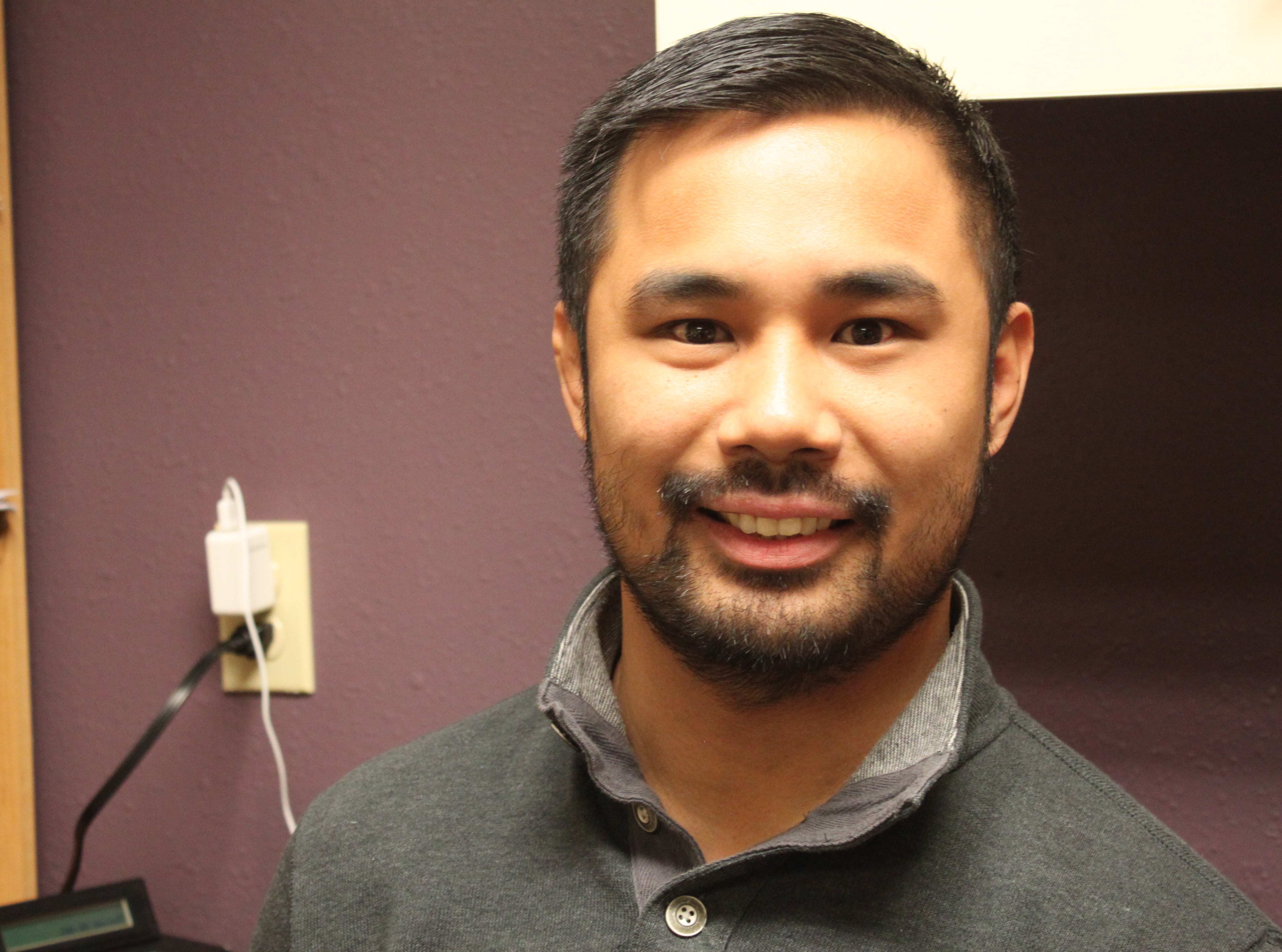
Kelly Pajinag grew up in Juneau and graduated from Juneau-Douglas High School in 2000. He joined Hospice & Homecare of Juneau in the summer of 2013. (Photo by Lisa Phu/KTOO)
Kelly Pajinag grew up in Juneau and graduated from Juneau-Douglas High School in 2000. He joined Hospice & Home Care of Juneau in the summer of 2013. (Photo by Lisa Phu/KTOO)

Kelly Pajinag is the new interim executive director of Front Street Community Health Center as of Jan. 1. He’s also the program manager of Catholic Community Services’ Hospice & Home Care of Juneau.

As he juggles two jobs, Pajinag hopes to help the homeless clinic get through some growing pains.

Kelly Pajinag, 33, says he doesn’t have much of a social life these days. His dual leadership positions have similar responsibilities.

“In regards to some of the things that I’ve experienced at Hospice & Home Care of Juneau with implementing more of the administrative business backbone to the program, I kind of saw a relationship here at the Front Street Community Health Center in regards to recruitment, the staffing, the billing platforms to be implemented and put into place,” Pajinag says.

He’s the second executive director of Front Street Community Health Center since last May when it left umbrella organization Southeast Alaska Regional Health Consortium. Pajinag says the clinic, which has offered medical, dental and behavioral health services, is going through a challenging transition.

“We’re still in the works of really trying to pick up the pieces of having the luxury of a large organization provide your billing, your payroll, your human resources. These are all things that we have to do at the clinic level now,” Pajinag says.

The Front Street Community Health Center is located downtown in the Miners' Mercantile building.(Photo by Lisa Phu/KTOO)
The Front Street Community Health Center is located downtown in the Miners’ Mercantile building.(Photo by Lisa Phu/KTOO)

Pajinag sat on the board of the health center prior to becoming its interim executive director. He has three months to fulfill some big goals. One is continuing to diversify its clientele; Front Street has long been a homeless clinic and still receives a large chunk of its federal funding for that purpose. It hopes to provide care for patients from all walks of life.

“‘Cause there is a need for thousands of people in our community, so my goal is to make it efficient and effective and available for people to access, whether it’s the homeless population, uninsured, underserved or someone that’s conveniently located nearby,” he says.

Another goal is figuring out the clinic’s staffing shortage. Two of its three main care providers are no longer there. Nurse practitioner Janna Brewster, who also served as the clinic’s manager, resigned in November and dentist Ed Linsell retired. The health center is actively recruiting for both medical positions.

In the meantime, Pajinag says part-time nurse practitioners are filling the gap as Front Street continues to provide medical and behavioral health services. Linsell is providing dental care one week a month.

Pajinag says the health center will soon implement billing and get reimbursements from Medicaid, Medicare and private insurance. The goal is to get a third of its revenue this way.

At the end of March, the Front Street Community Health Center board will reevaluate Pajinag’s position. Dr. Carlton Heine is a board member.

“Does he have the capacity to do this job with his other job or do we need to look for a different person for executive director?” Heine says.

Until then, Pajinag says he’s confident, with the help of staff and community members, the health center will get through the tough transition and start offering patient-centered care to more of Juneau’s population.

Early study shows surprising optimism among homeless Alaska Natives

Grand Entrance to Celebration. (Photo by Heather Bryant/KTOO)
A University of Washington researcher says a strong desire to pass down traditional knowledge may be related to high levels of optimism that he’s found among homeless Alaska Native elders. (Photo by Heather Bryant/KTOO)

A University of Washington professor has found high levels of optimism among homeless Alaska Native elders living in Seattle, and he’s connected the finding to a strong desire to pass on knowledge and experiences to future generations.

As an Aleut who grew up in Naknek, Jordan Lewis knows a little something about Alaska Native culture. Whenever he’s back home, Lewis says he likes to talk to elders and soak up traditional knowledge.

“They tell stories about how Naknek used to be when they were kids, because it’s changing so much now,” he says. “And I think just the fact that they talk to you and share their experiences, and pass on recipes, or how they used to make things, or where they used to pick berries, is this idea that they are hopeful that you’ll take that knowledge and use it to benefit your own life, but then pass it on again.”

Lewis is an assistant professor at the University of Washington’s School of Social Work. His research focuses on Alaska Native communities and generativity, a concept developed by psychologist Erik Erikson. It says that as we grow older, humans tend to want to pass on their experiences and knowledge to future generations.

“The first generative act most people have in their lives is having kids,” Lewis says. “That’s going to secure your future. But as you grow older there’s this need to pass on your legacy, write your memoirs, storytelling for elders, and passing down stories you heard to your grand kids.”

Lewis has studied how generativity helps Alaska Natives age well and become role models, as well as overcome addictions.

He says he became interested in the homeless because it’s an underserved and often overlooked population. Years ago, he says, his family had a relative involved with the Chief Seattle Club, a nonprofit that provides meals, housing assistance and other services to low-income and homeless Alaska Natives and American Indians. That’s where he and a student interviewed 14 Alaska Native elders last year. He says the results surprised even him.

“All of the elders talked about the importance of giving back and teaching others,” he says. “Whether it’s through sharing a sandwich, giving extra change if they had extra change to someone who wasn’t doing as well as they were. Volunteering at the Chief Seattle Club was almost everybody’s response. That’s what made them happy, that’s what got them up every day. And they all said that they did that because it’s going to come back to them in a positive way.”

He says other themes of the interviews included the importance of laughter and religion.

In addition, each of the elders – ages 45 to 70 – filled out surveys to measure generativity and optimism. Lewis says 12 of the 14 individuals scored very high in both.

“That kind of complimented the qualitative interviews. So I could say, you know, 85 percent of the people I interviewed are very optimistic and like to give back and teach the young people, and then here we have specific examples of what they do to do that,” Lewis says.

While he’s excited about the early results, Lewis admits more research is needed to confirm his findings. He’d like to do more than 100 interviews, and has considered expanding to include American Indians.

He’s planning to present his research at the Chief Seattle Club, and ask officials there for ideas on how to do a broader study of Native homelessness.

“How could we either help the people who are homeless, or how do we prevent homelessness, or how do we make their lives more enjoyable from these experiences of what these elders are doing for themselves,” he says.

Lewis also hopes to publish his findings in a peer-reviewed journal. The initial study was part of an online Stanford University program on successful aging that he participated in last year.

Alaska centenarians in national photo project

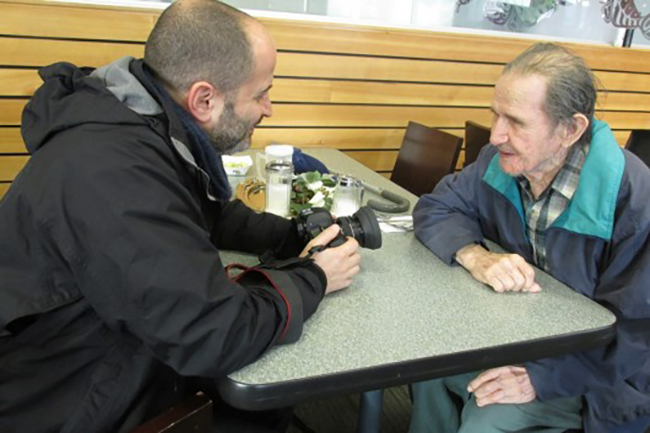
Photographer Danny Goldfield talks with centenarian Henry Neligan at the Ketchikan Indian Community cafeteria.

A New York photographer wants to create portraits of a 100-year-old man and a 100-year-old woman from each of the 50 states. He’s calling the project “To Live 10,000 years,” and he recently checked a couple hundred of those years off his list during a trip to Ketchikan.

Danny Goldfield thought that Alaska would be the most difficult state to find centenarians, especially a man. But, it turned out to be pretty easy. Goldfield knew someone from Alaska, and one connection is all you really need in a state where everyone is closely connected.

So, he sent an email, his friend made a call, and there you have it.

“It was kind of amazing that the first day of the project, that I had a lead, at least, for what was going to be the hardest subject to find: A man in Alaska who is over 100,” he said.

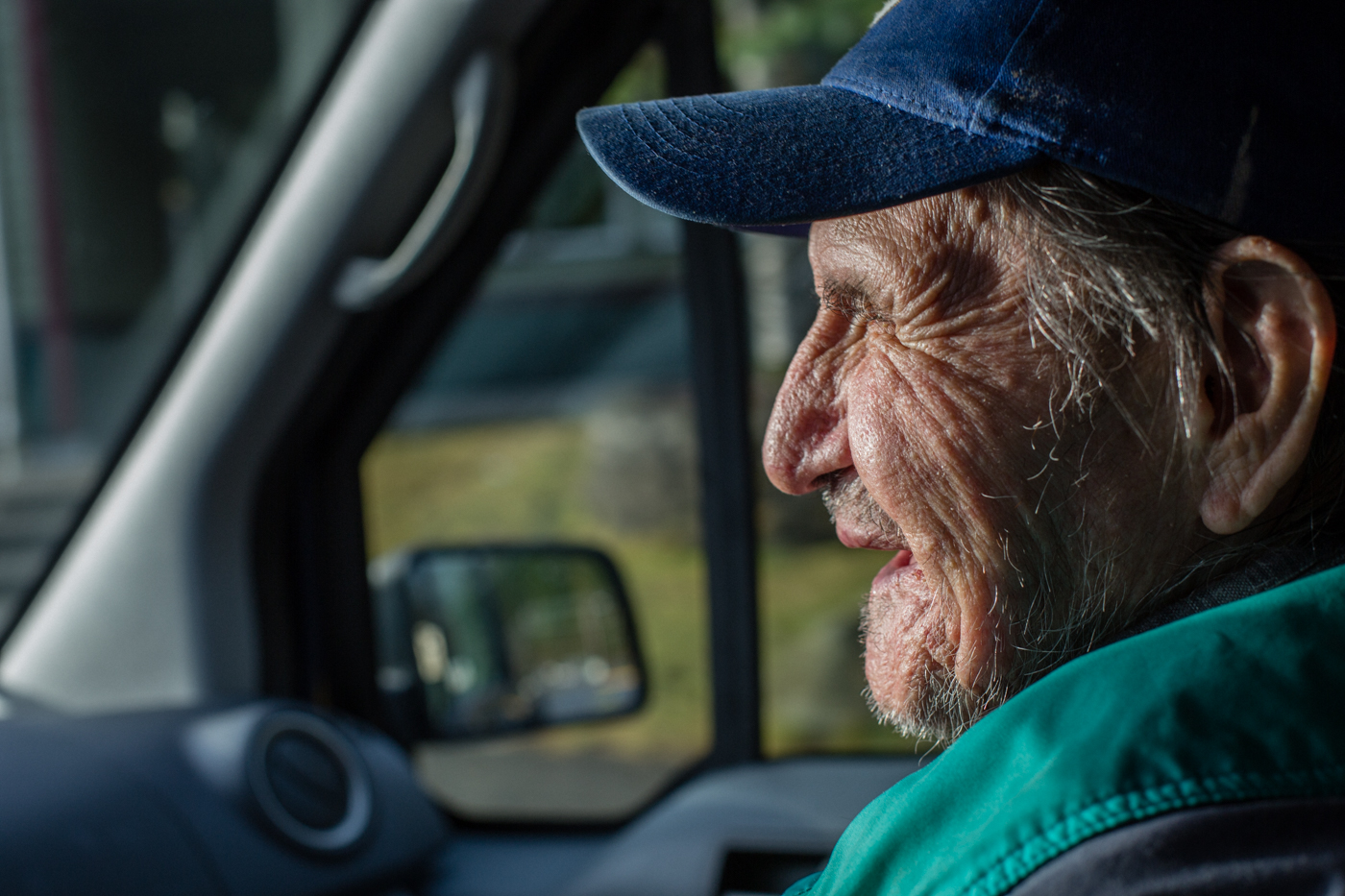
That 100-year-old man is Henry Neligan, an Alaska Native who also is a veteran of the World War II-era Alaska Territorial Guard.

Neligan eats lunch almost every day at the Ketchikan Indian Community cafeteria. Goldfield joined him there for soup, salad and sandwiches, as well as conversation and, of course, photographs.

Henry Neligan. (Photo by Danny Goldfield)

Conversation is part of the process. Goldfield said he’s naturally curious about people, and enjoys talking with each of his subjects.

“I don’t really have much of an agenda or questions that I need answered,” he said. “I’m just happy to be with them and wait and hear what they have to offer, what they have to say and let their stream of consciousness inform the conversation. It’s the same way with the photography. I don’t have any expectations of what kind of images I’m going to get. I just wait and let things happen and try to make it as natural as possible. In a perfect situation, I’m almost invisible.”

Goldfield said he started this project in part because his own parents are getting older. That made him think about aging in the United States, so he decided to focus his lens on the growing community of older Americans.

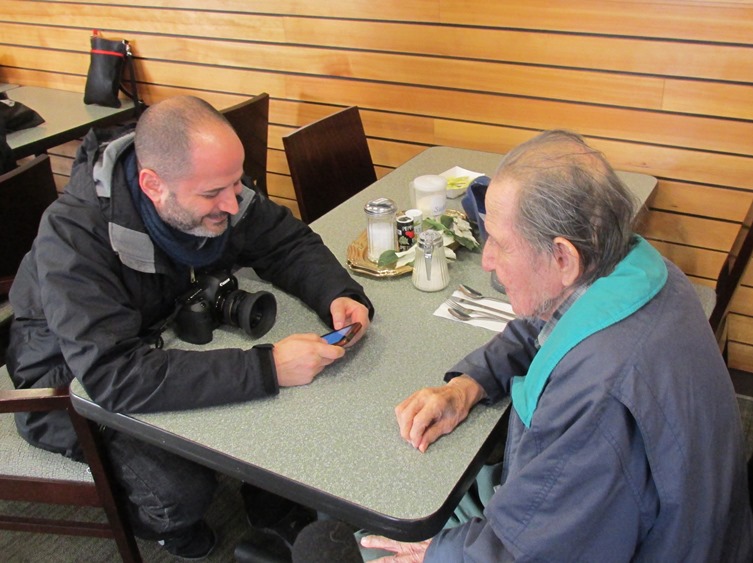
Photographer Danny Goldfield shows centenarian Henry Neligan some apps on his smartphone while talking at the Ketchikan Indian Community cafeteria.

It’s early days still for Goldfield’s project, which he expects will take about two years to complete. Before coming to Ketchikan, he photographed centenarians in Maryland, Connecticut and New Hampshire, and after Alaska, Goldfield planned some more West Coast stops.

This has been a learning experience for Goldfield. He said that before starting this project, he had a pretty bleak view of what it was like to be an older American. Now, though, he has a different picture of that world.

“There’s a lot of people out there looking out for the elders in our communities and it’s really been actually more encouraging than discouraging, which is nice, right?” he said.

Goldfield acknowledged that his project probably leads him to seniors who are well cared for.

Another lesson learned is that the senior community is a woman’s world.

“You know, 80 percent of centenarians are women, most older adults are women,” he said. “It’ll be a daughter, inevitably, that’s caring for an elder in a family. A lot of people working in different organizations are women. So, sometimes you hear that ‘the politics of gender. It’s a man’s world.’ Well, I have found a world that is definitely a woman’s world and it’s the world of older adults.”

Margaret McCombs. Photo by Danny Goldfield.

Speaking of women, Goldfield was able to find an Alaska woman in Ketchikan to photograph, as well: 107-year-old Margaret McCombs, who lives at the Ketchikan Pioneers Home.

Goldfield’s photographs of 100-year-old men and women can be seen online at tolive10000years.com. Goldfield also shares his images through Instagram, Facebook and Twitter.

Site notifications
Update notification options
Subscribe to notifications