Community

Pick. Click. Give. donations up, number of donors taper

pick click give

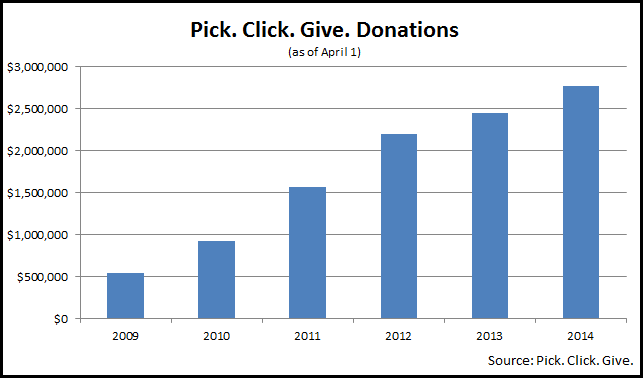
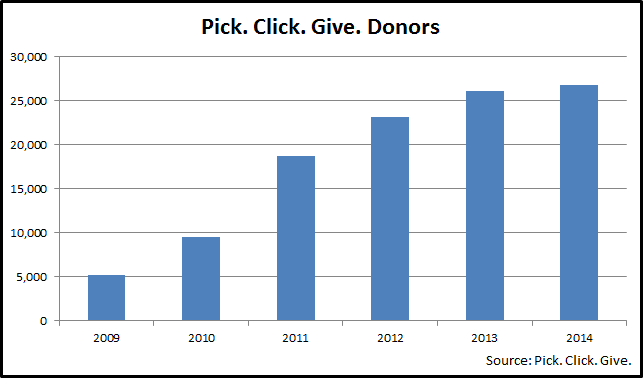
Annual giving in the Pick. Click. Give. program has grown robustly since its 2009 launch, though the total number of donors appears to be tapering off.

This year, program officials have brought back the Double Your Dividend sweepstakes to attract donors, and organizations will be charged a new 7 percent administrative fee.

There’s been double-digit percentage growth in the amount given to Alaska nonprofits through Pick. Click. Give. since its launch.
(Graphic by Jeremy Hsieh/KTOO)

The program makes it easy for Alaskans to give part of their Permanent Fund Dividends to charities. Almost 27,000 people donated about $2.8 million in 2014.

However, the growth in the number of people giving is down.

“So we sometimes wonder if people are thinking back to the dividend that they just received a couple of months earlier,” says Pick. Click. Give. program manager Heather Beaty of the Alaska Community Foundation.
(Graphic by Jeremy Hsieh/KTOO)

The payout in 2013 was about half of last year’s, the third biggest in the history of dividends.

“We have speculated that having a lower PFD amount may have affected the rate of participation,” Beaty says.

Tim Blust is a bookkeeper with Discovery Southeast, a Juneau nonprofit with an outdoor education mission. Last year, he goosed his organization’s books a little with a personal donation through Pick. Click. Give.

In the fall, he got a coy phone message from Beaty.

“My 12-year-old son immediately said, ‘Dad, you must have won.’ And I said, “Won what?”

His son was right. Blust was one of 10 winners of the Double Your Dividend drawing that Pick. Click. Give. donors entered.

The sweepstakes launched last March, the final month of the dividend sign-up period. It was meant to counter low giving caused by technical problems in what’s usually a busy January.

It’s hard to suss out exactly what effect the sweepstakes had.

But, Beaty says, “We did see Pick. Click. Give. participation go up quite a bit while we were promoting the sweepstakes. So we decided to go ahead and implement it again this year hoping that it continues to encourage more Alaskans to make donations through Pick. Click. Give.”

One change this year affecting participating organizations is a new 7 percent administrative fee. The fee is meant to replace temporary grant funding, largely from the Rasmuson Foundation, used to get the program going. Organizations will continue to pay a separate $250 filing fee.

Last year, the legislature unanimously created the new fee while also relaxing some requirements.

The sentiment among several local nonprofit officials was that it’s too bad to lose the revenue, but worth the convenience.

Rasmuson President and CEO Diane Kaplan said in a recent blog post that the new fee is a sign of the program’s sustainability and maturity.

Dividends are expected to grow again in 2015. The value of the dividend is based on a rolling, 5-year average of Permanent Fund investment gains and losses.

Full disclosure: KTOO participates in Pick. Click. Give.

Juneau’s first baby of 2015!

Fanning Family
The Fanning Family, left to right: Luke, Logan, Christine, Adele and Baby Fanning. (Photo courtesy Bartlett Regional Hospital)

Update | Sunday Jan. 4, 2015

The boy’s name is Elliot Michael Fanning, according to Bartlett Regional Hospital.

Original post:

It’s a boy!

The first baby born at Juneau’s Bartlett Regional Hospital in 2015 arrived just after noon today. The little baby boy is the third child for Luke and Christine Fanning, joining older brother Logan and older sister Adele.

The little guy still didn’t have a name as of late this afternoon. He weighed in at 8 pounds, 12 ounces, and was 21 inches tall.

Juneau’s biggest stories of 2014

Beth Kerttula, Alaska Native languages, Richard Dauenhauer, Delta
Top left: Former Juneau Rep. Beth Kerttula. Top right: Alaska Native language advocates stage a sit-in at the Capitol. Bottom right: Tlingit scholar Richard Dauenhauer. Bottom left: A Delta plane lands at Juneau International Airport.

A longtime state lawmaker resigned, Alaska Native languages were recognized as official state languages, and a little competition sparked a price war for airline tickets to and from Juneau. Those were just a few of the top stories of 2014 in the capital city.

The year started with the unexpected resignation of one of the state’s longest tenured politicians. After 15 years representing Juneau in the State House, Democratic Minority Leader Beth Kerttula stepped down in the first week of this year’s session. She’d been chosen for an ocean policy fellowship at Stanford University. Kerttula acknowledged the timing was tough, but said it was an opportunity she couldn’t pass up.

“Oceans have been part of my life for a long time and I’ve always had a special place in my heart for these issues,” she said.

The Stanford fellowship led to Kerttula’s current position as director of the National Ocean Council Office for the Obama administration. Sam Kito III was appointed to her old seat and elected in his own right this past November.

During the legislative session, Juneau residents were at the forefront as lawmakers officially recognized Alaska’s indigenous languages. Supporters staged a sit-in protest at the Capitol on Easter. After the bill passed, University of Alaska Southeast Professor Lance Twitchell summed up the feeling in Tlingit.

“We succeeded, we attained,” he said.

As inevitably happens every year, a handful of prominent Juneauites passed away in 2014, including Tlingit scholar and linguist Richard Dauenhauer and journalist Bob Tkacz. Hiker Sharon Buis went missing on Mt. Roberts and was never found, despite weeks of searching.

As befitting the capital city, Juneau residents figured prominently in this year’s elections. Former mayor and Sealaska official Byron Mallott started out as the Democratic nominee for governor, before joining the eventual winning ticket as candidate for lieutenant governor alongside Republican-turned-Independent Bill Walker.

Facing a multimillion dollar budget shortfall, city officials sought to cut spending, but faced backlash over a proposal to close the Augustus Brown Swimming Pool. The pool stayed open, but for the first time in recent memory the Juneau Assembly opted not to fund the Juneau School District to the maximum amount allowed under state law.

There was a change at the top of the school district, with Mark Miller replacing Glenn Gelbrich as superintendent in July. In his first six months, Miller has dealt with the fallout from a high school hazing scandal and made the decision to replace four controversial elementary school texts that some found offensive to Alaska Natives and Native Americans.

A group of concerned residents formed Juneau Votes to increase turnout in the capital city. Voter participation in this year’s municipal election was up 10 points over 2013.

The Assembly is majority female for the first time in city history, after Debbie White and Maria Gladziszewski were elected in October. However, for the first time in more than a decade there’s no Alaska Native representation, as White and Gladziszewski replaced Randy Wanamaker and Carlton Smith.

This summer marked the first time in nearly 20 years that a major air carrier other than Alaska Airlines served Juneau International Airport. Delta provided daily service to the city from the end of May through August. The competition is good for consumers, says Alaska travel analyst Scott McMurren.

“The moment Delta’s rubber hits the tarmac in Juneau, fares will be at historic lows,” McMurren said.

Delta plans to return to Juneau in 2015.

Also this past summer, more than 100 volunteers helped clean up downtown Juneau. The event was organized by the Downtown Improvement Group, a coalition that formed this year to address some of the seedier elements of Juneau and make the city a more attractive place to be. The group plans to continue its efforts in 2015.

Mining, timber, elections top 2014 Southeast news

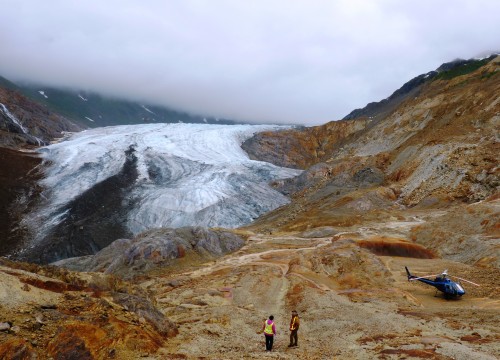
Oxidized rock colors a valley where one of Seabridge Gold’s KSM project’s open pit mines will be dug. in British Columbia. (Photo by Ed Schoenfeld/ CoastAlaska News)
Oxidized rock colors a valley where one of Seabridge Gold’s KSM project’s open pit mines will be dug in British Columbia. (Photo by Ed Schoenfeld/ CoastAlaska News)

One of 2014’s largest Southeast Alaska issues didn’t even start in the state.

It happened just across the border, in British Columbia. There, mining companies were searching for gold and making plans to dig it – and other valuable metals – out of the ground.

Annita McPhee is a tribal activist critical of mining near her Northern B.C. home.

“We don’t want our livelihood destroyed. We don’t want our watershed destroyed. It’s a very sacred place to us,” McPhee said.

She joined Southeast tribal leaders in a spring forum raising the profile of transboundary mine threats.

Concern spread on this side of the border, as fisheries, environmental groups and some cities lobbied for action against the mines.

But developers said they’d be careful.

“The guiding principal behind the design of the KSM project was the protection of the downstream environments,” said Brent Murphy, president of Seabridge Gold. Seabridge owns a large exploration site northwest of Ketchikan.

At year’s end, the only mine close to opening was the Red Chris, upstream from Wrangell and Petersburg. Its start was delayed after a dam break at its sister mine, the Mount Polley, to the east.

2014 saw several major developments in the timber industry.

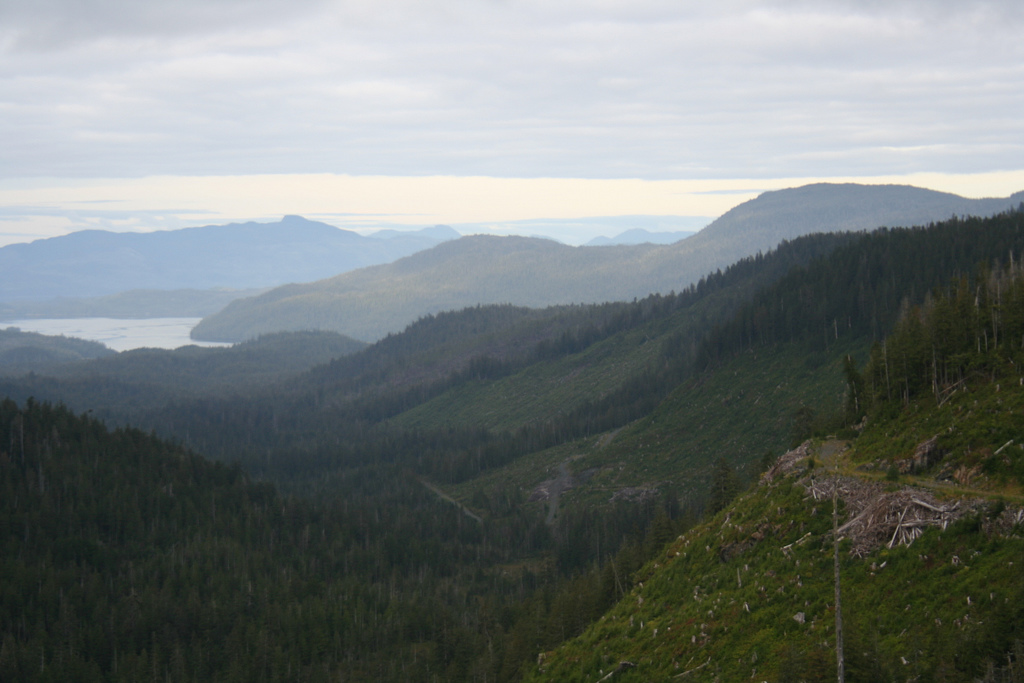
Clearcuts and old-growth forests are part of the view of Indian Valley on Prince of Wales Island. The Forest Service just announced three more timber sales in the Island's Big Thorne area.
Clearcuts and old-growth forests are part of the view of Indian Valley on Prince of Wales Island. The Forest Service just announced three more timber sales in the Island’s Big Thorne area. (Nick Bonzey, Flick Creative Commons)

The Forest Service began the year by forming a citizens’ committee to help map a transition from logging older trees to younger stands of timber. The fall brought a large timber sale, Big Thorne, on Prince of Wales Island. That of course is tied up in the courts.

The industry got a huge boost in December, when Congress passed a bill transferring 70,000 acres of the Tongass National Forest to the Sealaska regional Native corporation.

Most of the land is for logging, which brought opposition from fishing, conservation and other groups concerned about impacts.

During a congressional hearing, General Counsel Jaeleen Araujo said the corporation would take care of the land.

“My people have loved this place, lived in this place, savored this place for longer than your lifetimes, and mine,” Araujo said.

2014 saw some changes in Southeast’s legislative delegation.

Ketchikan Independent Dan Ortiz narrowly won a House seat that had been held for years by a Republican.

And Juneau Democrat Sam Kito III won one of the capital city’s House seats after being appointed to fill in for a retiring lawmaker earlier in the year.

Among other top regional news of 2014:

  • Work began in Ketchikan on new ferries that will sail northern Southeast.
  • And, cruise-ship tourism remained about the same, with about a million people sailing through Southeast waters.

Juneau Assembly pledges to support Housing First project

Housing First
This concept drawing by MRV Architects shows the proposed Housing First project in Juneau. The facility would be built in Lemon Creek on land donated by Tlingit-Haida Regional Housing Authority.

The Juneau Assembly last night unofficially committed $1.5 million to help fund a Housing First project in the capital city.

Supporters hope the project – which would be the third of its kind in Alaska – will provide a stable place to live for about 30 chronically homeless people. They also hope it eventually will house nonprofits and social service agencies to help individuals out of homelessness.

Housing First proponents say if you give a homeless person a permanent, stable place to live, it’s easier to address what’s causing them to be on the streets in the first place. Whether it’s lack of income, drug or alcohol addiction, mental health issues, or something else, studies have shown the approach reduces the amount of time and money spent on expensive emergency services for the homeless.

But Mandy O’Neal-Cole with the Juneau Homeless Coalition says that’s not the best reason to support it.

“There are a lot of economic reasons to make this happen, but there are more human reasons to make this happen,” O’Neal-Cole told the Juneau Assembly Committee of the Whole.

The homeless coalition is one of several groups that have been working on a Housing First project in Juneau for the better part of two years. O’Neal-Cole works for AWARE, Juneau’s domestic violence and sexual assault prevention nonprofit.

“It’s a lot of people with a lot of different agendas. And the fact is that we all came together with this similar agenda to recognize that this is bigger than any one of us,” she said. “It’s more about all of us and what our responsibilities are to the people who need the most help.”

The Glory Hole emergency homeless shelter recently agreed to be the lead agency for the project, and Tlingit-Haida Regional Housing Authority agreed to donate land next to its offices in Lemon Creek where the facility could be built.

“We know this model works in other cities and we’re absolutely certain it’s going to work here in Juneau,” said housing authority president and CEO Ricardo Worl.

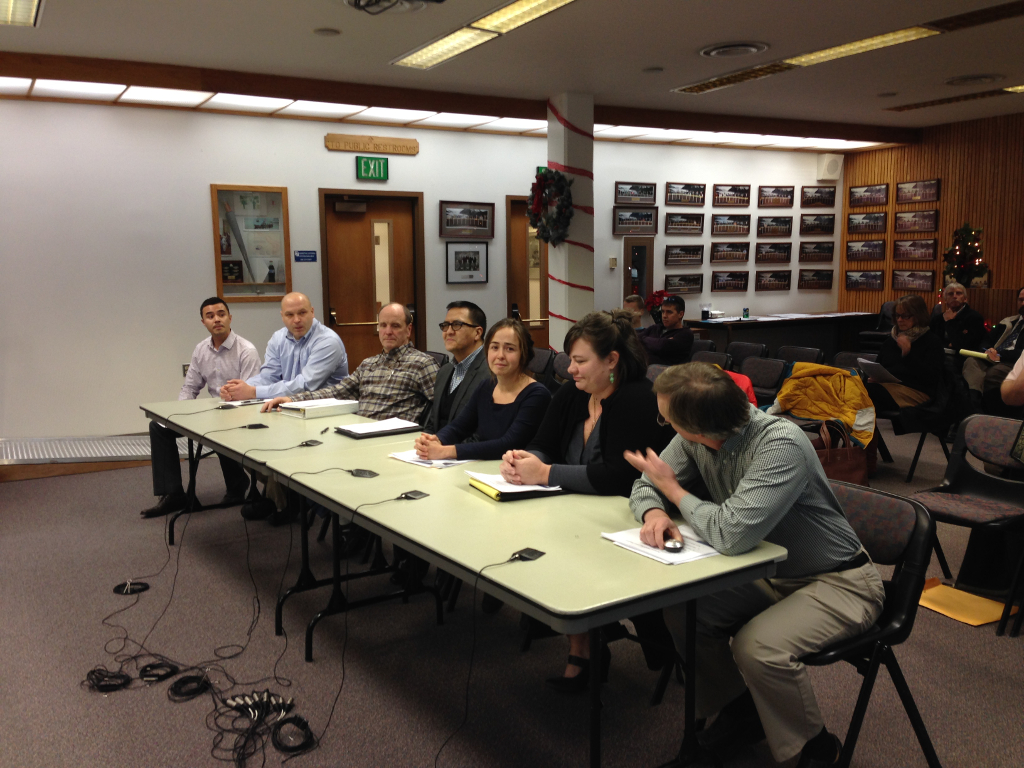
Members of the Juneau Housing First working group ask the Juneau Assembly to support their project. From right to left: Paul Voelckers of MRV Architects, Mandy O'Neal-Cole from the Juneau Homeless Coalition and AWARE, Glory Hole Executive Director Mariya Lovishchuk, Tlingit-Haida Regional Housing Authority president and CEO Ricardo Worl, Bruce Denton with the Glory Hole board of directors, Scott Ciambor with the Alaska Coalition on Housing and Homelessness, and Norton Gregory with the Juneau Affordable Housing Commission and THRHA. (Photo by Casey Kelly/KTOO)
Members of the Juneau Housing First working group ask the Juneau Assembly to support their project. From right to left: Paul Voelckers of MRV Architects, Mandy O’Neal-Cole from the Juneau Homeless Coalition and AWARE, Glory Hole Executive Director Mariya Lovishchuk, Tlingit-Haida Regional Housing Authority president and CEO Ricardo Worl, Bruce Denton with the Glory Hole board of directors, Scott Ciambor with the Alaska Coalition on Housing and Homelessness, and Norton Gregory with the Juneau Affordable Housing Commission and THRHA. (Photo by Casey Kelly/KTOO)

The proposed building would be constructed in two phases, with 32 efficiency apartments, a commercial kitchen and clinic space built in the first phase. Another 22 apartments as well as office space for social service nonprofits would be part of phase two.

The group estimates it needs $6.6 million to build phase one and $9.1 million to do both phases.

Glory Hole Executive Director Mariya Lovishchuk says they hope to get the project started with a $3.5 million Special Needs Housing Grant from the Alaska Housing Finance Corp. That money is in this year’s state budget, but Lovishchuk says it’s unlikely to be available again for the foreseeable future, given the state’s projected deficit of more than $3 billion.

“The time for this project is really now,” Lovishchuk said.

Anchorage and Fairbanks already have Housing First projects, which Lovishchuk says also bodes well for this being Juneau’s year to receive funding.

The Special Needs Housing Grant application is due Feb. 20.

The Assembly Committee of the Whole last night asked the City Manager’s office to prepare a resolution pledging $1.5 million for the project. While the Assembly still needs to vote to approve the resolution at its first regular meeting of 2015, members left little doubt that the vote would be just a formality.

“You have your commitment,” said Assemblywoman Karen Crane.

The Housing First group is also hoping to get funding for the project from the Rasmuson Foundation and other charitable organizations.

The facility is expected to cost about $870,000 a year to operate. More than half of the projected operating costs would come from AHFC vouchers, rental income and the Juneau Community Foundation.

$41,000 raised for victims of Christmas day crash

Angelica Haakenson (Photo Courtesy of gofundme.com/angelicahaakenson)

An Anchor Point girl is in stable condition after losing both of her legs in a traffic accident on Christmas Day.

That’s according to a post by her aunt, Emily Haakenson, on a gofundme.com account she started to raise money for the girl’s medical treatment.

11-year old Angelica Haakenson and her pregnant mother, 29-year old Mathany Christine Satterwhite, were driving on Sterling Highway on Thursday when their truck broke down.

The Peninsula Clarion reported Nathan Sargeant was helping family jump the truck when Anchor Point resident Larry Pyatt slid into them with his vehicle.

Both Sargeant and Pyatt suffered minor injuries and Satterwhite was thrown into a ditch. Haakenson was pinned between two of the vehicles, resulting in multiple spinal fractures and severe trauma to her legs.

The mother and daughter were flown to Anchorage for emergency treatment. Satterwhite and her unborn child survived. Both of Haakenson’s legs were amputated above the knee.

By Monday afternoon, the online campaign had raised more than $41,000 from about 600 donors, including local residents, peninsula businesses, and area emergency services.

The site’s creator, Emily Haakenson, wrote earlier today: “Words cannot describe how thankful we are for every one of you. We are so thankful for all the prayers, thoughts, encouragement, and generosity for our beautiful girl.”

Angelica Haakenson is a sixth-grader at Chapman Elementary School in Anchor Point.

You can find out more at http://www.gofundme.com/angelicahaakenson.

Site notifications
Update notification options
Subscribe to notifications