Community

The Glory Hole homeless shelter to be closed at least a month

Mike Ricker, The Glory Hole
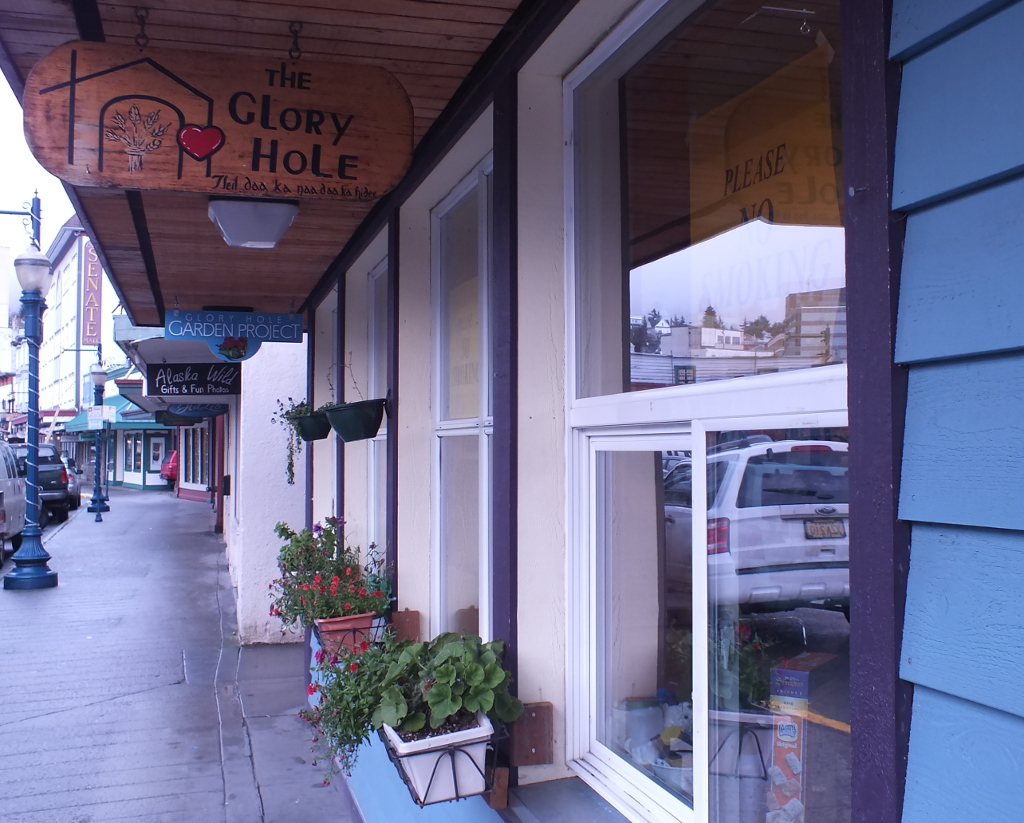
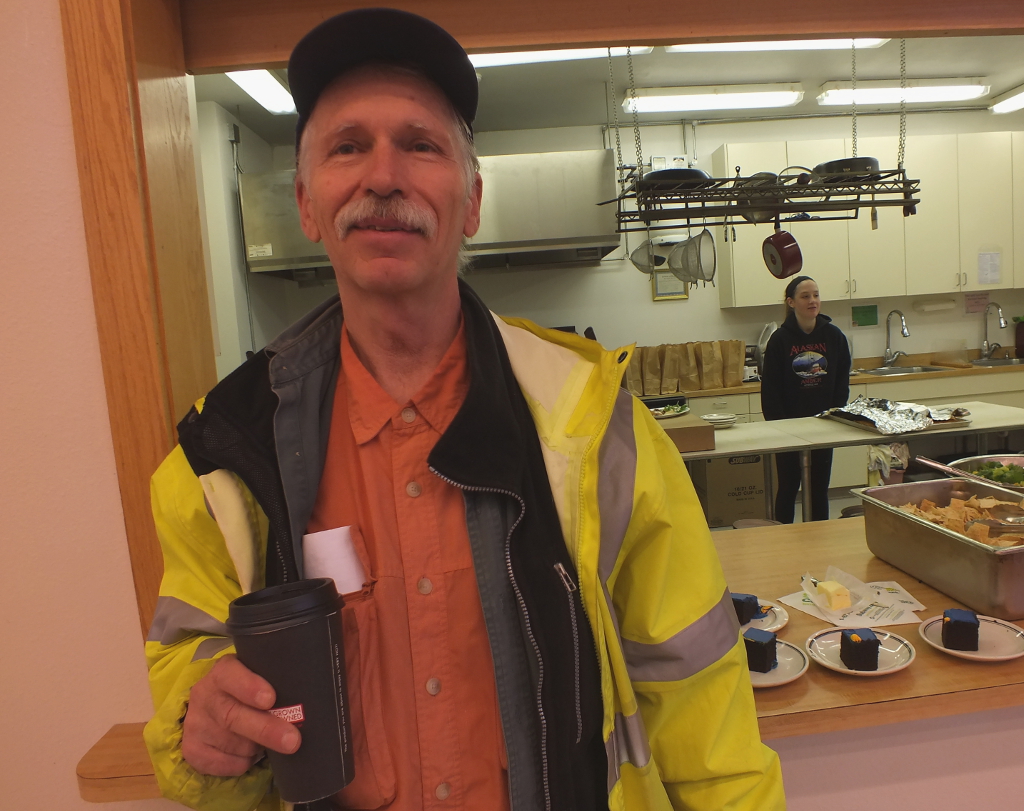
Mike Ricker is a long-term resident of the Glory Hole, Juneau’s nonprofit homeless shelter, which was damaged by a flood last weekend. (Photo by Casey Kelly/KTOO)

Juneau’s nonprofit homeless shelter, the Glory Hole, will be closed at least a month after a burst water pipe caused major flood damage last weekend.

Patrons and staff were adjusting to that new reality Tuesday.

Mike Ricker was about to go to sleep Sunday when the water started pouring down on top of him.

“It came down through the Sheetrock in the ceilings three floors, because it was in the ceiling of the third floor, and down through the light fixtures,” Ricker says. “The lights were on and the water was just pouring down out of them.”

Even though it’s technically an emergency shelter, Ricker has lived at the Glory Hole for about a year. He says he ended up homeless after getting behind on a number of bills. Now he’s working odd jobs and trying to get his life back on track.

Ricker and about 20 other Glory Hole patrons are housed at Juneau International Hostel for the time being. St. Ann’s Parish Hall downtown is hosting the shelter’s regular breakfast, lunch and dinner service.

Ricker says he’s grateful to the hostel and church for stepping up on short notice.

“If they weren’t open, then what option would we have, you know?” Ricker asks. “We’d be in a pretty tough situation. Thank God for them.”

Glory Hole cook Katie Parrott says the whole situation is stressful for both staff and clients.

“We just want to make sure that people know that we’re still serving food and handing out sack lunches, so we’re still operating to the best of our ability,” she says.

Parrott served about 10 people lunch on Tuesday, a smaller crowd than normal. She says the breakfast service for 21 patrons was about average.

“So it could be just, you know, a lot of people will be doing things throughout the day, maybe won’t be here for lunch but will be here for dinner,” Parrott says. “It could be that people are trying to find somewhere to store their things. Who knows?”

The closure of the shelter comes after the first big snowstorm of winter hit Juneau over the weekend. Glory Hole Executive Director Mariya Lovishchuk says the broken pipe had frozen before it sprung the leak.

Lovishchuk says insurance will cover the cost of repairs, but she worries people will forget about the shelter while it’s closed during the holidays – a time when the Glory Hole typically receives a lot of donations.

“One of the concerns that I have is that, you know, our fundraising efforts this year will not be as great,” Lovishchuk says. “So, you know, our operating funds for next year will be jeopardized.”

She says contractor North Pacific Erectors is already working on getting the shelter back in business, and the public can help by continuing to donate money and food.

Burst water pipe, flood temporarily shut down the Glory Hole

The Glory Hole
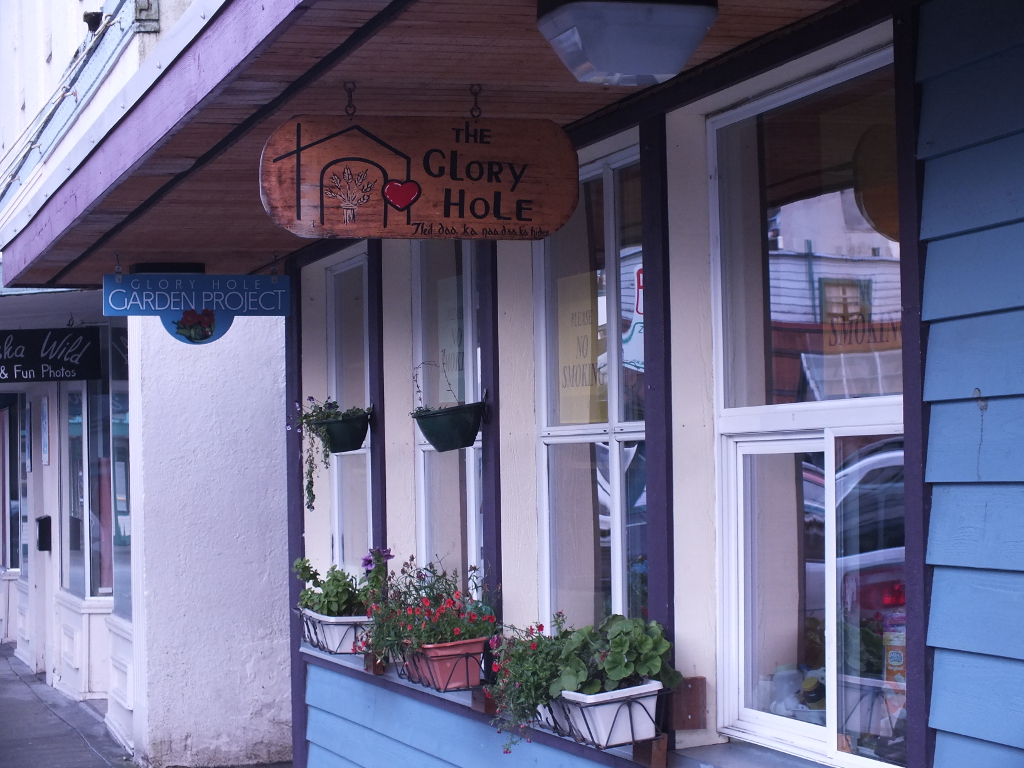
The Glory Hole, Juneau’s emergency homeless shelter and soup kitchen, is temporarily closed due to a burst pipe and flood Sunday night. (Photo by Casey Kelly/KTOO)

The Glory Hole, Juneau’s emergency homeless shelter and soup kitchen, is temporarily out of commission following a burst water pipe and flood at the downtown facility Sunday evening.

Executive Director Mariya Lovishchuk says 21 patrons and an overnight staff member were at the shelter when the pipe burst.

“I was not there, but from what I heard, you know, the flood gates opened and everybody got really cold and wet,” Lovishchuk says.

City and Borough of Juneau Emergency Management officials set up a temporary shelter at the Downtown Transportation Center. Patrons and staff were later relocated to the city’s Zach Gordon Youth Center.

Lovishchuk says Juneau International Hostel will provide rooms to Glory Hole clients while a contractor assesses the damage to the shelter. Downtown Juneau’s Cathedral of the Nativity of the Blessed Virgin Mary has temporarily offered its parish hall for meal services.

“Everybody was amazingly helpful,” Lovishchuk says. “The city, the Red Cross, the local churches, the Glory Hole board – just lots of really, really helpful entities.”

Lovishchuk says she won’t know until Tuesday what caused the water pipe to burst or how long the shelter will be closed.

Juneau Four A’s to hold World AIDS Day vigil tonight

(Creative Commons photo by ChiLam Ly)

Juneau’s Alaskan AIDS Assistance Association, or Four A’s, is holding a candle light vigil tonight in honor of World AIDS Day.

Four A’s provides direct services to people living with HIV or AIDS. James Hoagland is the coordinator of Southeast services. He says World AIDS Day is an opportunity for people to come together and pay respect to those who’ve died to the AIDS epidemic since it began in the early 1980s.

“Most people of a certain age have been touched by this disease in one way or another. Most people I know, know somebody personally, have lost somebody personally in their family or their friends or work colleague, or just someone at some point. And that just shows how this disease has spread throughout communities and across all kinds of lines of race, class, gender, sexuality,” Hoagland says.

In Southeast, Hoagland says Four A’s has 26 clients, about half in Juneau. The roughly 300 clients statewide represent a portion of the total number of people in Alaska living with HIV or AIDS. Hoagland says World AIDS Day is a chance to honor them as well.

“It’s no longer a death sentence to get diagnosed with HIV and that means there are a lot of people living with the disease. The national statistic is 1.1 million people in the U.S. living with HIV, right? And so that number is huge and it’s only growing because fewer people are dying of the disease,” Hoagland says.

The rate of people contracting HIV has slowed, he says, but not enough to make a big difference. Hoagland says people in the prevention community realize messages put out over the past 25 years aren’t working as well as they should.

“Certainly people now know about the importance of protecting yourself when it comes to sex, but they’re not doing it enough to really slow down the rate of infection,” he says.

The World AIDS Day vigil is tonight at 6 p.m. in McPhetres Hall. The free event features talks by Dr. George Brown and Deacon Charles Rohrbacher and music by the Juneau Pride Chorus. The vigil will conclude with a ceremonial name reading of people who’ve died of HIV or AIDS in Alaska.

JDHS hockey team sweeps Kenai at Treadwell Ice Arena

The Juneau Douglas High School ice hockey team swept visiting Kenai, 5-2 and 2-1 over the weekend at Treadwell Ice Arena. It was the home opening series for the Crimson Bears.

All photos by Steven Quinn.

Anchorage residents demonstrate in solidarity with Ferguson, MO

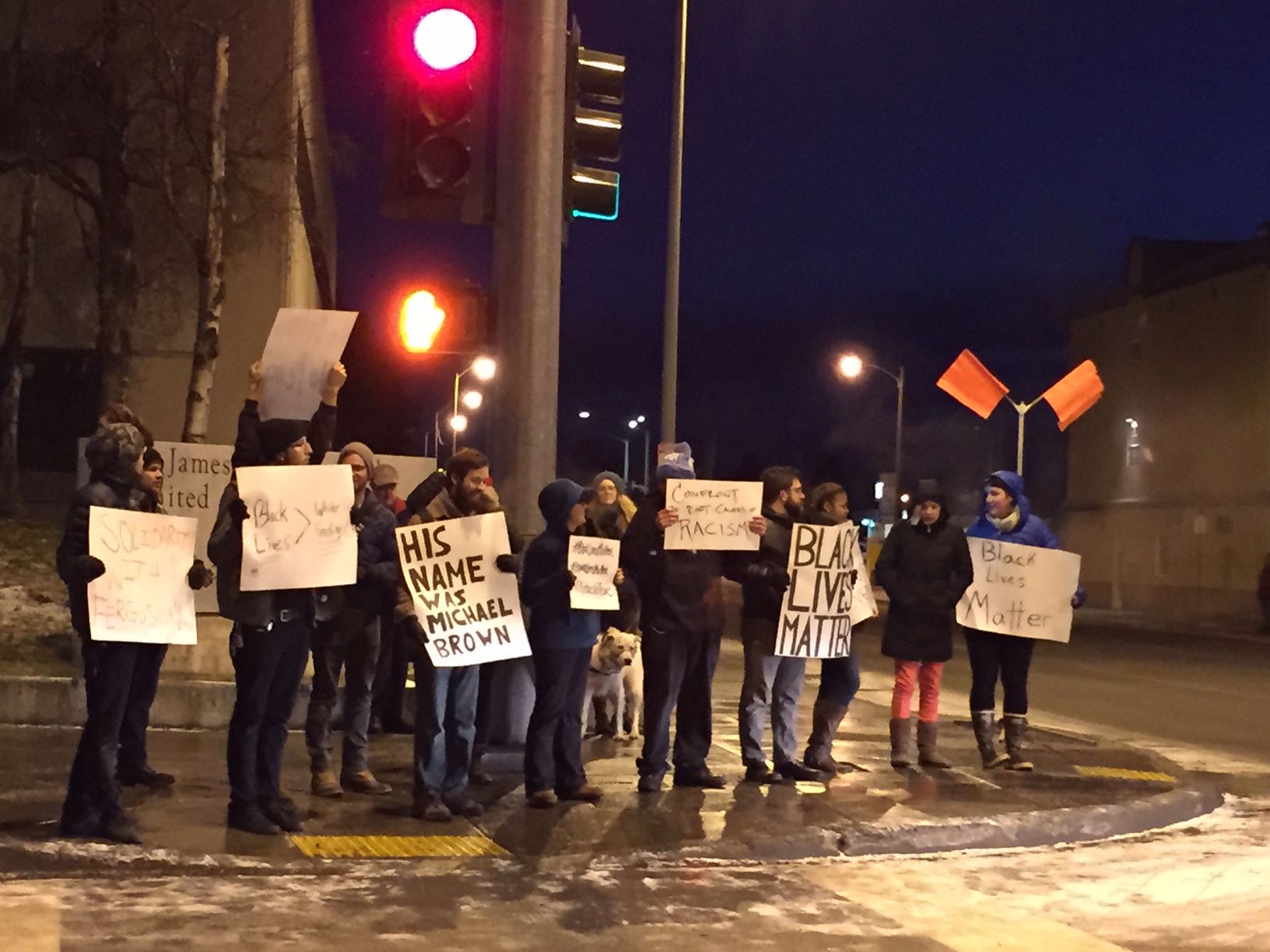
People gathered in downtown Anchorage to show their solidarity with the community of Ferguson, Missouri. (Photo by Anne Hillman/ KSKA)

About 25 people stood on the corner of C and 7th in downtown Anchorage on Wednesday evening holding signs reading “Black lives matter” and “His name was Michael Brown.” They gathered to stand in solidarity with the people of Ferguson, Missouri. The white police officer who shot an unarmed black teenager in August was acquitted earlier this week. The ruling set off renewed protests and riots in Missouri and around the country.

Michael Patterson put out the call for the gathering on Facebook. He says the shooting of the teen, Michael Brown, impacts him personally and highlights racism against all people of color.

“I’m African-American and I live in a country where property is valued over my life and over my people,” he says.  “And I think particularly in Alaska there’s a historical precedence of taking people’s land and then developing it and disenfranchising them from the democratic process.”

Patterson says the reaction of protestors and rioters around the country is understandable. Michael Brown’s shooting was a tipping point. He says the rioters are following a historical precedent.

“Everyone talks about the Boston Tea Party like it’s a great thing. It’s literally the same thing that’s happening” right now in response to the ruling in Ferguson, he says. “People are revolting against the system by destroying property because property is valued more than human life in this country.”

Community member Arenza Thigpen Jr. attended the event. He says the police and justice systems need to change or protests and riots will continue. He suggests starting Community Review Boards to examine police actions, even here in Alaska.

“Allow the community to be involved in a way that has not really been touched off yet. Because after all, police are protecting that community and those residents need to be involved in the process of determining if action was sufficient.”

Thigpen says he thinks race relations between African-Americans and the police are better in Anchorage than in other areas, but he still thinks there needs to be more cultural training within the force.

Many participants said they were at the event because they thought Alaska Natives were sometimes treated unfairly by law enforcement agents in Anchorage. They said all inequalities in the state needed to be addressed.

Juneau Housing First project inches closer to reality

The Glory Hole
The Glory Hole, Juneau’s emergency homeless shelter and soup kitchen, will lead the effort to build a Housing First project to serve the capital city’s chronically homeless population. (Photo by Casey Kelly/KTOO)

Juneau is getting closer to becoming the third community in Alaska with a Housing First project to provide the chronically homeless with housing. Organizers told the Juneau Assembly on Monday that the project is moving from the concept stage to the design stage.

The Glory Hole Emergency Shelter and Soup Kitchen has taken the lead role in planning a Housing First project in the capital city. Scott Ciambor is chair of the Alaska Coalition on Housing and Homelessness and one of the volunteers leading the effort to build the project.

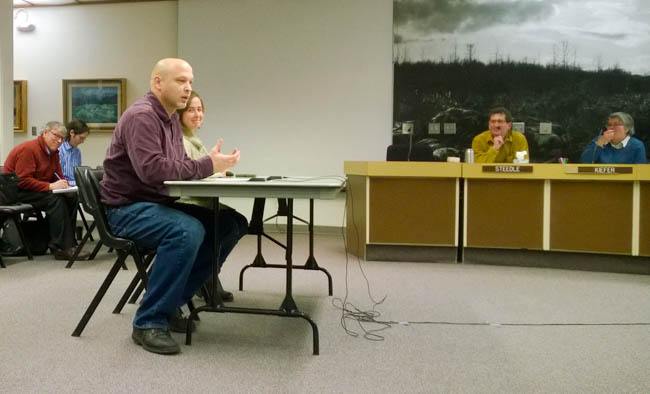
Scott Ciambor and Mariya Lovischuk describe their plans for a Housing First project in Juneau on Monday. (Photo by Jeremy Hsieh/KTOO)

“Right now we are basically transitioning from kind of a theoretical project to an actual development of a project,” Ciambor said.

In recent decades many communities have turned to the Housing First model to address chronic homelessness. The idea is that if you give people a permanent, stable place to live, it’s easier to address why they’re on the streets. Anchorage and Fairbanks have had success with Housing First projects, and the Juneau group has been in the planning stages for about two years.

In addition to the Glory Hole becoming the lead agency, Ciambor said Tlingit-Haida Regional Housing Authority has offered several parcels of land and Juneau-based MRV Architects has produced a series of conceptual drawings.

Ciambor said there are two things the city could provide to make the project a reality.

“Community support, plus community resources,” he said. “You know, what real resources is the community providing to get an affordable housing project done?”

On average, he said it takes eight funding sources to build an affordable housing project. The municipality has an Affordable Housing Fund, and Ciambor said it could secure additional money from the state’s Community Development Block Grant Program. The Housing First group is also hoping to set up a dedicated fund with the Juneau Community Foundation to raise money for the project.

One potentially significant source of funding is the Special Needs Housing Grant program from the Alaska Housing Finance Corp. Glory Hole Executive Director Mariya Lovischuk said the deadline to apply for one of those grants is Feb. 20.

“We will need to figure out a site by that point,” Lovischuk said. “We will need to figure out where most of the capital funding will come from.”

Lovischuk said facility will likely serve about 40 people, and operating costs could total about $950,000 a year.

The Assembly heard the project update as part of its annual retreat on Monday. Among the other topics: How to encourage more housing in general.

Site notifications
Update notification options
Subscribe to notifications