Signs mark the end of Juneau’s Glacier Highway in 2013. A state transportation plan calls for extending the road north 47 miles to a new ferry terminal. (Photo by Heather Bryant/KTOO)
Tuesday is the last day to weigh in on the latest environment document on the Juneau Access Project, commonly called the Juneau Road. The state has received tens-of-thousands of comments so far on the project, according to state Department of Transportation spokesman Jeremy Woodrow, a number the department expected.
“We were anticipating a large volume of comments coming in for this project based on the comment history based on the previous comment period for the project in 2006,” Woodrow says.
A revised Supplemental Environmental Impact Statement was released on the project in September. It examines ways to improve access between Juneau and Northern Lynn Canal communities.
The state Department of Transportation favors extending a road north of Juneau to the Katzehin River where an unmanned ferry terminal would be built. Ferries would transport vehicles and passengers between Katzehin, Haines and Skagway.
That option is estimated to cost about $523 million for road construction, and new ferry terminal and vessel construction another $51 million.
The DOT held meetings in the three communities about the impact statement. People registered their comments on the project at those meetings but the bulk of the comments have come in written form. Woodrow says many of those submissions are from national advocacy groups, like Sierra Club, whose members submitted form letters and signed online petitions. Woodrow says DOT was expecting a delivery of 20- to 40,000 comments from the group Earthjustice on Monday.
DOT does not have to respond to each comment individually, but it does have to respond to each issue raised, Woodrow says.
“Responding to the comments is really responding to the information presented in the comments. If the information is similar to other comments, then responding to those questions or concerns in one response meets the criteria of responding to those comments,” he says.
DOT estimates it will take about a year to incorporate all the comments into the final environmental impact statement.
Gov. Sean Parnell has favored the road alternative and pushed its progress through his term. Incoming governor Bill Walker has said he questions the project’s costs.
One of those couples is former KTOO employee Kelli Burkinshaw and her partner Megan Ahleman. They’re getting married tomorrow in Juneau.
The two had talked about marriage before, but they didn’t get engaged until a federal judge decided October 12 that Alaska’s same-sex marriage ban was unconstitutional. It was important they marry in a state that meant something to both of them.
Megan and Kelli had a conversation at KTOO last Sunday about their relationship and getting married. In the tradition of StoryCorps, here’s an excerpt of their conversation:
Every Thanksgiving, Juneau charities reach out to the public with requests for turkeys and other food to feed hungry families. And they say that every year the donations come at the last minute. This year, food drive organizers hope Juneau residents will step up just a little bit earlier.
On a recent afternoon at The Glory Hole, Juneau’s emergency homeless shelter and soup kitchen, the main course for lunch is white rice, salmon and corn.
But for Thanksgiving, you’ll find most patrons at The Hangar on the Wharf for The Salvation Army’s community celebration. Salvation Army Lt. Dana Walters says there’ll be turkey, pie and other holiday staples.
“Sometimes you go to a free meal and it kinda tastes like a free meal,” says Walters. “This is top notch. Everything is freshly made. It’s just an incredible meal.”
The event will go from 11:30 a.m. to 1:30 p.m.on Nov. 27. Other charities will offer Thanksgiving packages for clients to take home. Families sign up for boxes with The Glory Hole and then pick up their orders at the Salvation Army Corps Community Center. This year, their list is already growing.
Less than 20 turkeys alongside other food in The Glory Hole freezer on Nov. 17, 2014. The shelter needs to send out about 200 Thanksgiving packages each with a turkey. (Photo by Kayla Desroches/KTOO)
Mariya Lovishchuk manages The Glory Hole. For Thanksgiving boxes, she says the nonprofit needs turkeys.
“Things show up kind of at the last minute, so we all always feel like we’re going to fall short,” Lovishchuk says. “And then last year things did not show up until, like, the day of distribution. So it would just be really, really helpful to get things a little farther in advance this year.”
Southeast Alaska Food Bank What: Food drive Where: Foodland IGA, 615 West Willoughby Ave. When: 6 a.m. – 6 p.m. Friday
Or, call (907) 789-6184, or manager Darren Adams at (907) 209-7801. There are also drop boxes at Rainbow Foods and Pavitt Health and Fitness.
St. Vincent de Paul is a shelter in the Mendenhall Valley that also organizes Thanksgiving packages. There are three volunteers on St. Vincent’s holiday team.
“We have been together almost 12 years,” says volunteer Rena Sims. “We started out when St. Vincent only gave out 25 baskets.”
Sims says the charity now gives baskets to over 600 families.
Louise Wertheimer is another volunteer. She credits the community and the participation of young people for their success.
“With all of these kids that come in, we’re more or less able to direct. More so than having to do the physical work like we’ve done in the past,” says Wertheimer.
And Paula Sumdum says the volunteers get a lot from their involvement.
“I’ve seen some really tough kids have tears in their eyes as they help out to the car with turkeys,” she says.
Darren Adams is the Southeast Alaska Food Bank manager. The organization receives most of its donations from supermarkets’ unused stock and provides small nonprofits around Juneau with Thanksgiving products. Adams says they got about 200 turkeys last year, most of which arrived at the last minute.
“It’s kinda nice to be able to go from having no turkeys one day to having four of five freezers full the next. And I’m very thankful for any donation regardless of when they come in,” he says.
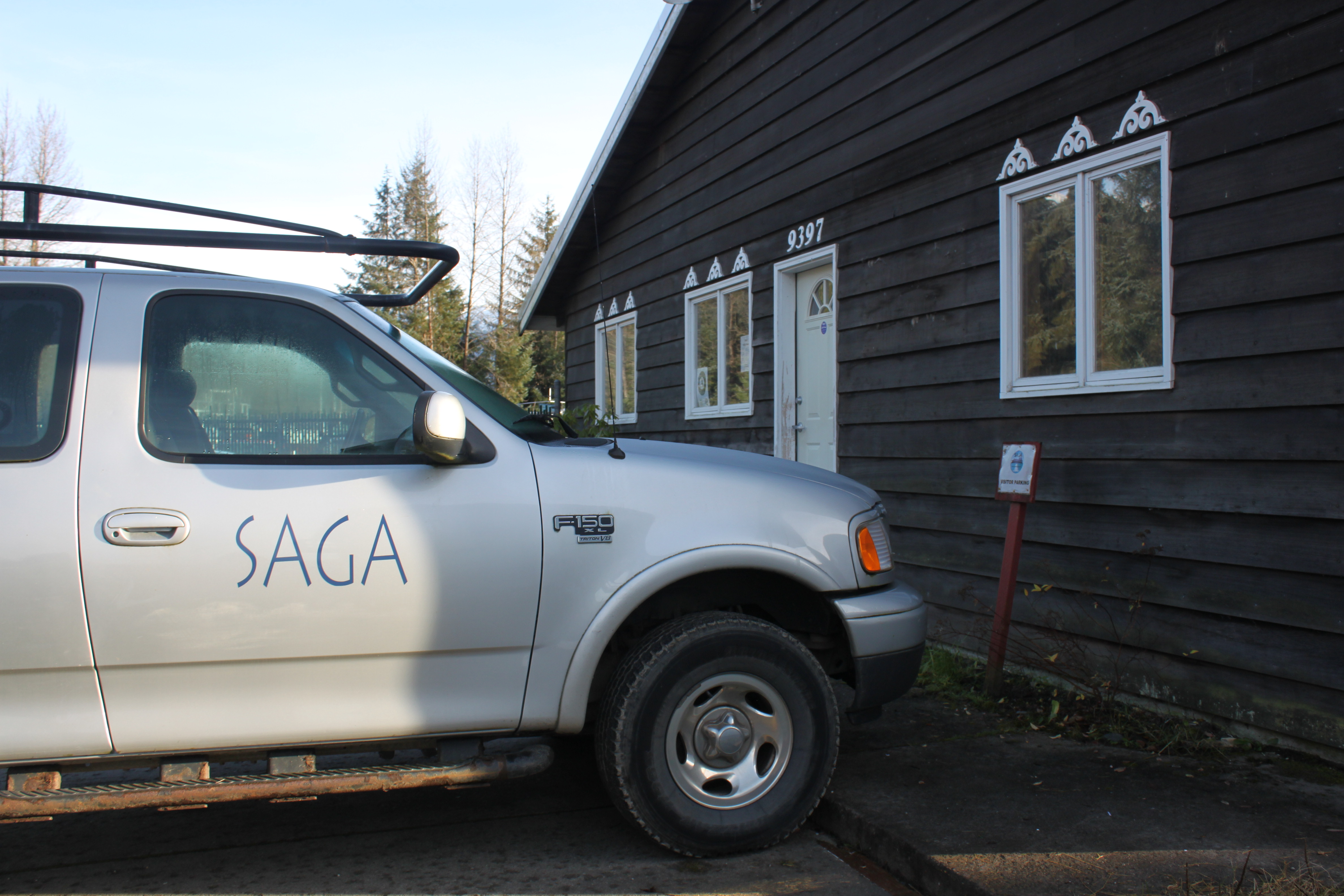
SAGA is in the process of moving out of its main office and shop on LaPerouse Avenue in Juneau. (Photo by Lisa Phu/KTOO)
Longtime Juneau service agency Southeast Alaska Guidance Association, or SAGA, may not have enough money to keep operating.
The nonprofit has 18 AmeriCorps members in Anchorage, Juneau, Seward, Cordova and Yakutat. It also works outdoors with young people through programs that are now in a state of flux.
SAGA recently lost staff members after a series of resignations and layoffs and is in the process of moving out of its main shop and office.
When George McGuan joined SAGA’s board of directors in March, he had no idea the organization was in a financial hole. He says the board informed him in July that SAGA was $250,000 in debt.
“I was blown away. I was like, ‘OK, we’re a non-profit. How are we $250,000 in debt?’ And they just kind of seemed like, ‘Well, that’s how we operate,'” McGuan says.
SAGA was founded in 1986 with a mission to foster development through hands-on learning. Its programs, Alaska Service Corps and Connections, bring AmeriCorps volunteers to Alaska. That’s how McGuan first came to Juneau in 2005.
He says the debt stems from many years ago, but the organization started falling apart this year. McGuan describes the process as people jumping ship.
“Our board of directors had our president quit and the organization itself had three people leave right in the middle of the summer. And then our executive director decided to quit because of the stress level, so we were kind of left holding the bag there with no real organization left,” McGuan says.
SAGA staff who left included an office coordinator and finance manager. When Executive Director Beverly Schoonover gave her letter of resignation in July, McGuan says the board tried at first to find a replacement, but that search has stopped.
Schoonover left in October for a state job after two and a half years with SAGA. Longtime employee Justin Fantasia also left around the same time. He had worked for SAGA since 2003.
“I was just really concerned that there wasn’t going to be a transition from executive director to executive director and that there was a lot of uncertainty whether the organization is going to continue on. I was not formally in a director position but I was in a leadership position. I didn’t want to find myself at the helm when things were going down,” Fantasia says.
Justin Fantasia had worked for SAGA since 2003. He left in October. (Photo by Lisa Phu/KTOO)
Most recently, Fantasia was the manager of SAGA’s House Build program, a partnership with Juneau-Douglas High School, the school district and Juneau Housing Trust. Its goal is to build affordable housing.
He was the general contractor and experiential educator for high school students. Funding for his position came from the school district.
“When the House Build program wasn’t able to find land, which was not SAGA’s responsibility, but it was just sort of the partnership as a whole, I let everybody know that I was totally ready to be laid off if it was necessary,” Fantasia says. “It’s hard for SAGA to carry me as a staff person without that program revenue.”
SAGA is no longer part of the House Build program, which is moving forward and working with the city to purchase land. Fantasia, now an adjunct instructor at University of Alaska Southeast, still plans to help lead the construction.
SAGA’s AmeriCorps program Connections is funded through next September. The federal grant of $250,000 goes through the state commission Serve Alaska.
SAGA’s board has been trying to find another organization to take over Connections and its AmeriCorps members. Lawrence Blood with the Division of Community and Regional Affairs, which supports Serve Alaska, says any nonprofit or city government would be eligible, but a transfer would have to be approved.
“Hopefully, the discussions that the board is having has as little impact on the members as possible. And if it does change to a different organization, we hope to make that process as seamless as possible,” Blood says.
The board also doesn’t know if it’ll continue to operate Juneau’s Eagle Valley Center, an outdoor education and retreat facility located out the road. The City and Borough of Juneau owns the center and has had a use agreement with SAGA since 1992. The latest agreement goes through 2016.
The city’s parks and landscape superintendent George Schaaf says SAGA has had trouble meeting terms of the agreement and asked to renegotiate. SAGA has talked to other organizations about partnering to run the center.
“I know that they’re going through some stuff right now and basically they’ve just assured me that they’re taking care of the building, keeping the heat on, keeping the road plowed, that kind of thing,” Schaaf says.
Fantasia describes SAGA’s turbulence as a culmination of many factors associated with the non-profit world – the rollercoaster of grant funding, administrative burdens of grants, high turnover of staff.
“There’s been no questionable use of finances. It’s just a long history of trying to get by,” Fantasia says.
He says SAGA’s outlook is grim, but Fantasia is hopeful its legacy will continue with or without SAGA.
“What they’ve done for 25 years is provide young people with a chance to get out and work on meaningful hands-on projects in a different environment, so go out and work on trails projects, get out to different parts of the state, come in from the villages and work in these teams of young people, have some positive role models in their life,” Fantasia says.
Acting board chair Matt Smith says the board is fighting as hard as it can to keep SAGA alive but he doesn’t know if it’ll be operating after this year. When asked if he feels any responsibility for SAGA’s current trouble, Smith had no comment.
Full disclosure: George Schaaf is a member of the KTOO Board of Directors.
This Killer Whale Clan silver medal was produced by the U.S. Mint to honor World War II Tlingit code talkers. (Photo by Casey Kelly/KTOO)
First lady Sandy Parnell and Governor Sean Parnell listen during Veterans Day observances at Centennial Hall on Nov. 11, 2014. A Coast Guard color guard stands at parade rest in the foreground. (Photo by Matt Miller/KTOO)
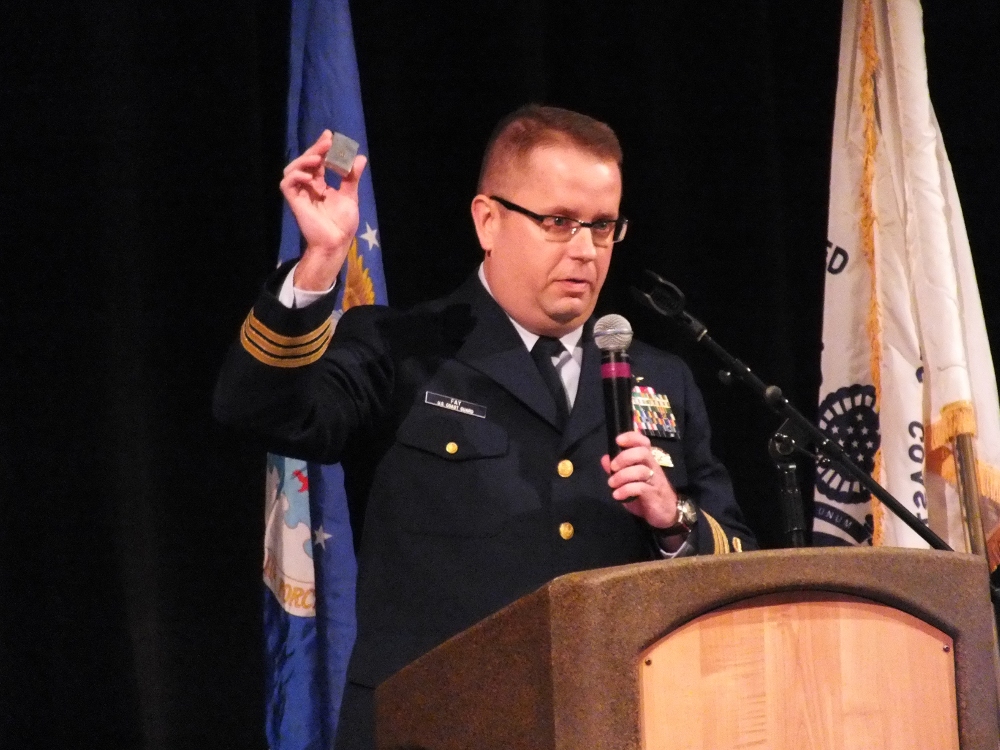
Cmdr. Matt Fay of the U.S. Coast Guard holds up a lighter used by his father. (Photo by Matt Miller/KTOO)
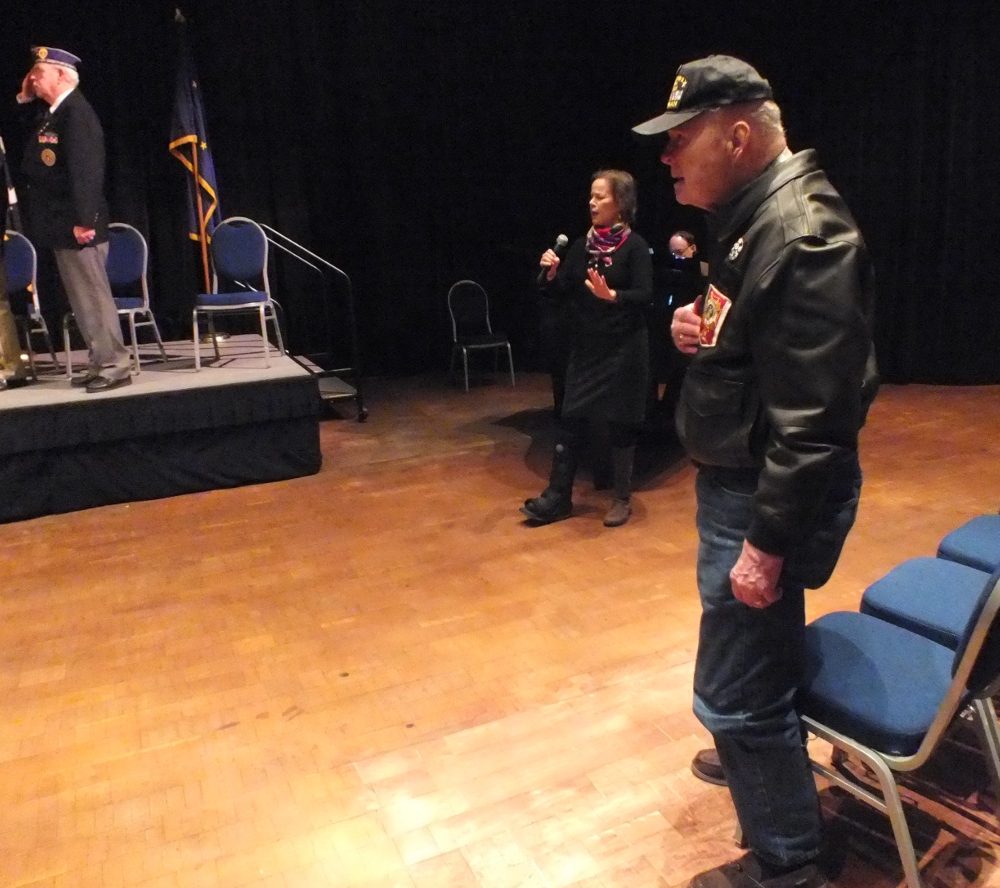
Veterans salute the colors as Kathleen Wayne sings the Star Spangled Banner during Veterans Day observances at Centennial Hall on Nov. 11, 2014. . (Photo by Matt Miller/KTOO)
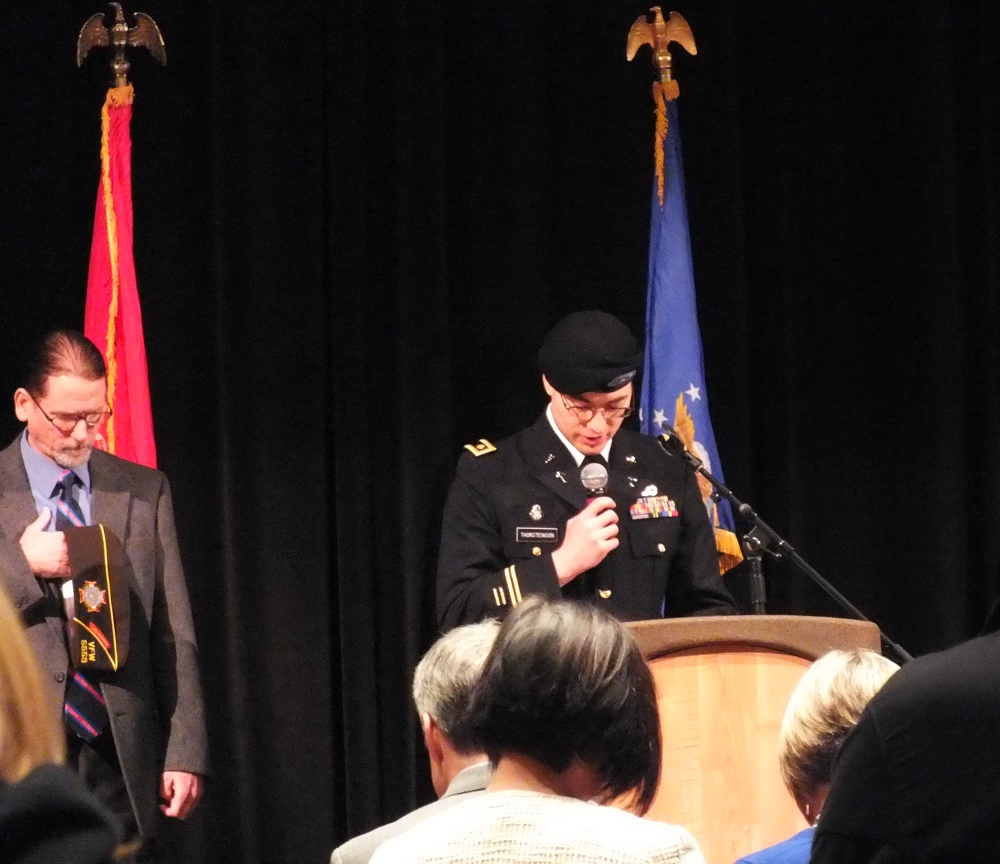
Chaplain Kirk Thorsteinson delivers the invocation as Cmdr. Dan McCrummen of VFW Post 5559 listens during Veterans Day observances at Centennial Hall on Nov. 11, 2014. (Photo by Matt Miller/KTOO)
More than 100 people attended a Southeast Alaska Native Veterans ceremony Tuesday, honoring Tlingit code talkers who served during World War II.
The families of five men received medals and Congressional certificates recognizing their service at a packed Veterans Day event at Elizabeth Peratrovich Hall.
Tony Jacobs’ dad and uncle were among the soldiers who used the Tlingit language to relay important information during the war.
“The Tlingit Indians had their own Tlingit names for various places around Southeast,” Jacobs said. “And that’s what they were used for is to let the ship’s captain or quartermasters know where they were located secretly actually, where enemy forces would not be able to ID their location.”
Jacobs said he was overcome with emotion at the recognition for his father and uncle. He said he served in the Navy himself during 1970s, and would recommend military service to anyone.
“You get benefits – health benefits, education benefits – and you get to see the country and/or the world,” Jacobs said.
Gov. Sean Parnell and first lady Sandy Parnell were among those attending a separate Veterans Day ceremony.
The governor sat in the audience, but did not speak during the event, organized by the Veterans of Foreign Wars Taku Post 5559.
Audio postcard of Veterans Day observance at Centennial Hall:
Voices and sounds include Chaplain Kirk Thorsteinson, Kathleen Wayne (accompanied by J. Allan McKinnon on piano), Commander Dan McCrummen of VFW Taku Post 5559, and Commander Matt Fay of the U.S. Coast Guard.
Coast Guard Commander Matt Fay was the featured speaker. He acknowledged the many sacrifices veterans have already made for their country, while urging them to give a little more by inspiring others to serve.
“As you spend time with your families today, over the holidays, I ask that you share some things about your service,” Fay said. “I also ask that you consider other means of preserving your story.”
Fay is staff judge advocate with the Coast Guard’s District 17 headquarters in Juneau. He encouraged veterans to participate in the Library of Congress’ Veterans History Project.
The VFW event was held at Centennial Hall at the traditional time when Veterans Day ceremonies take place – the 11th hour of the 11th day of the 11th month. That’s the date and time an armistice went into effect between the Allies and Germany in 1918, ending World War I.
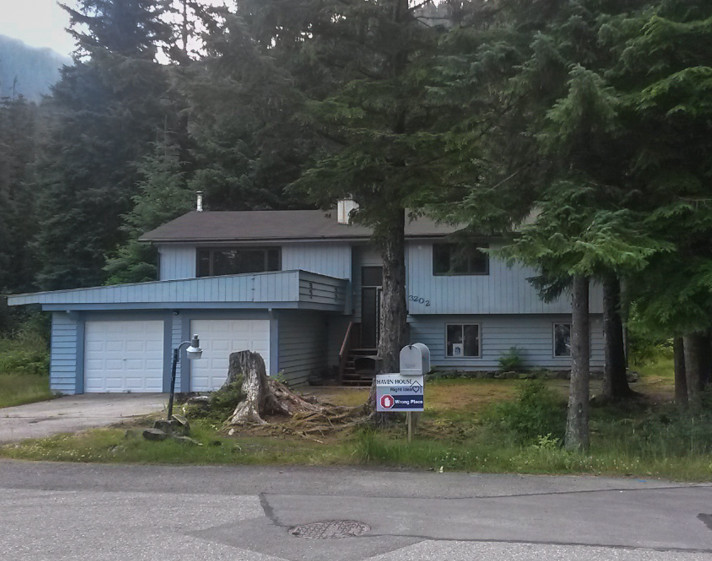
Haven House at 3202 Malissa Drive. (Photo by Greg Culley)
The Juneau Assembly agreed last night to hear an appeal that could block a transitional home for female ex-cons from opening in the Mendenhall Valley.
In its appeal, the Tall Timbers Neighborhood Association asserts that the Juneau Planning Commission erred in its decision to grant Haven House a conditional use permit to operate on Malissa Drive. The association also says the underlying ordinance the decision was based on is unconstitutional.
The Assembly opted to handle the appeal itself. Assemblyman Jerry Nankervis will preside over the appeal hearing.
Haven House wants to operate with a live-in residence manager and take in as many as nine women for up to two years at a time.
Close
Update notification options
Subscribe to notifications
Subscribe
Get notifications about news related to the topics you care about. You can unsubscribe anytime.