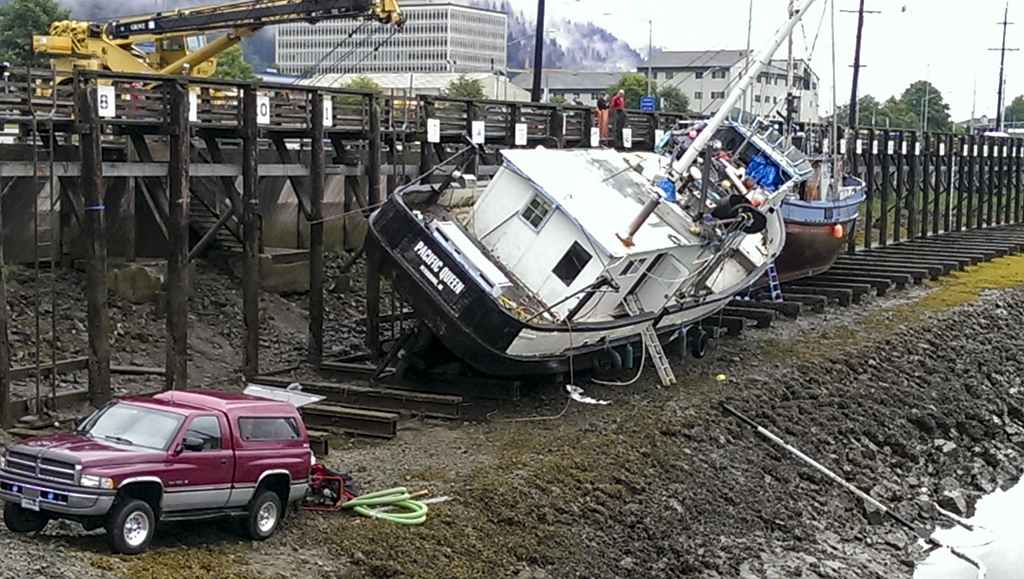
The Pacific Queen tipped over in Harris Harbor on Tuesday. (Photo courtesy Scott Simonson)
The Pacific Queen tipped over in Harris Harbor early this morning. Larry Coleman, a 67-year-old retired logger originally from Petersburg, owns and lives aboard the 63-foot ocean dragger.
Coleman says he put the boat up on the grid yesterday for routine maintenance. Around 4 a.m. today, he was thrown out of bed–the boat had slipped off the grid during low tide and fell on its side.
“As the tide went out, it just started snapping the ropes,” Coleman says.
The boat sustained a minor hole and a small amount of diesel spilled, according to the Coast Guard.
Coleman and a group of friends were able to right the boat using flotation bags and styrofoam logs, among other things. But the boat flooded during high tide.
The interior is now “like a swimming pool,” Coleman says.
The water destroyed a deep freezer, two guitars, a flat screen TV, and other possessions, Coleman says.
He lives in Douglas Harbor and has lived in the boat for about 14 years. He built a house on it about 10 years ago and hopes to salvage it.
Juneau Docks and Harbor oversaw the situation and the Coast Guard managed the diesel spill.
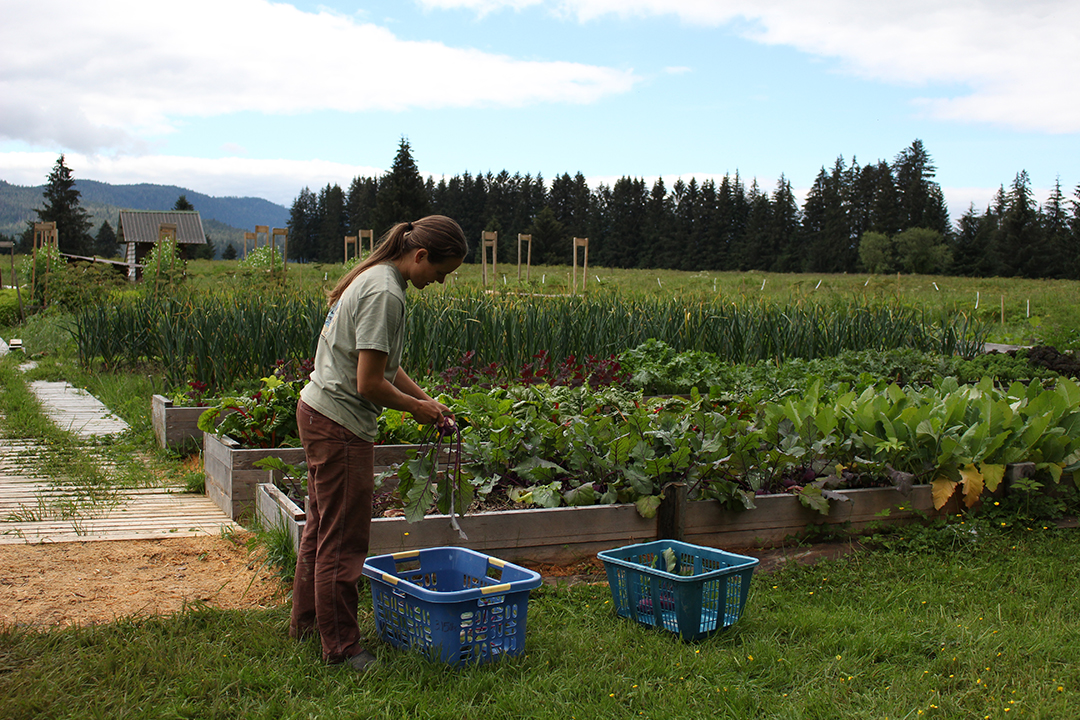
Marja Smets preps kohlrabi for the farmer’s market. (Photo by Elizabeth Jenkins/KFSK)
It’s peak season for farmer’s markets across the country right now. Transporting goods usually means loading up a truck with produce, but selling in Southeast Alaska presents some unique challenges.
Scott Roberge navigates his skiff to Farragut Bay. He’s the owner of Tongass Kayak Adventures, a company that gives tours and charters tourists to remote locations. Today, we’re visiting an off-the-grid farm that supplies its produce to the Petersburg farmers market, grocery store, school cafeteria, and a local restaurant. It’s more than just a little off the beaten path; it takes us about an hour to there.
“They’re gonna take about four and half hours. “They don’t use as much fuel as we’re using today. But we’re gonna get there quicker,” says Roberge.
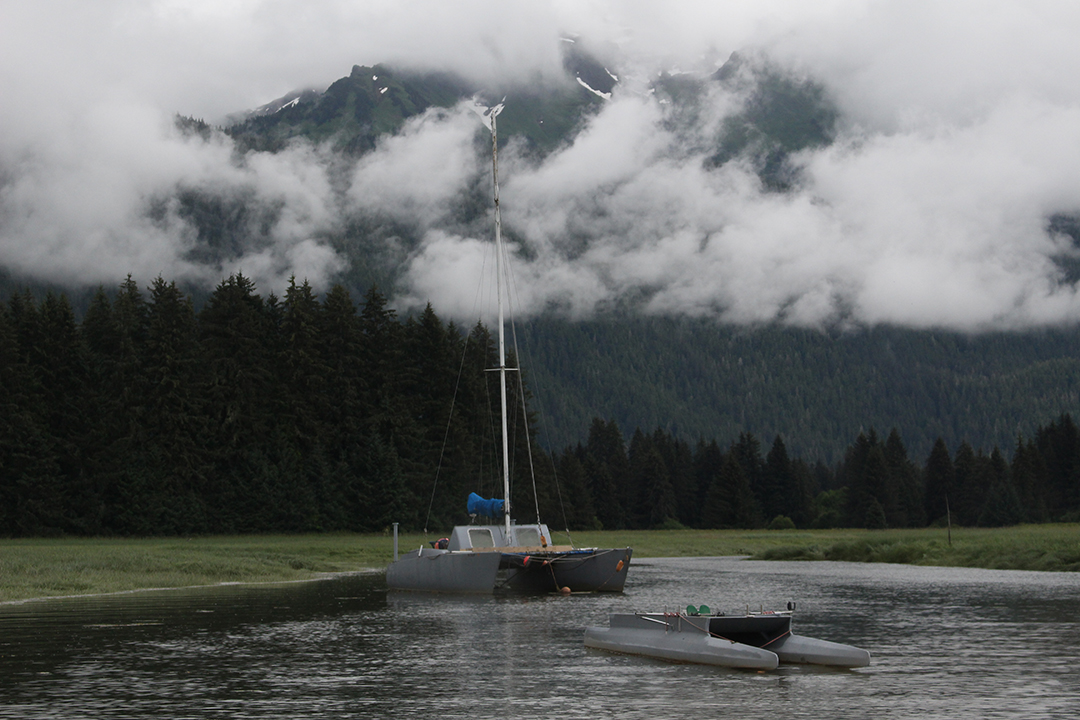
We cruise into shallow water, passing a sailboat catamaran that Farragut Farms uses to transport up to 1,000 pounds of vegetables every other week, but the trip’s not over yet. “We have to go to a little side slough. Then we’ll anchor the boat and hike into the farm.”
After a short walk through spongy marsh, we arrive at Bo Varsano and Marja Smets homestead. The electricity runs entirely off solar panels. There’s no sewer system or running water. They have a rain catchment for bathing, doing dishes, and watering plants. Varsano has lived at the location for about 20 years, and they’ve been farming about five.
“Yeah, I definitely fell in love with the place before I fell in love with him,” Smets says with a laugh. Almost everything at the farm, they’ve built. Like a special gate and electric fence to keep the moose out.
“We’re kind of in a unique position of there’s just two of us and we’re remote enough. We can’t hire anybody. We have to get creative.” says Varsano.
That’s meant designing greenhouse on wheels and inventing vessels to transport the goods. Varsano says Southeast Alaska can be a tricky place to farm. There’s inclement weather, a lack of tenable land, stretches of wet decomposing soil or muskeg.
“It’s pretty hard to grow a garden in that. And that’s pretty common in Southeast. A lot of people who try to grow gardens, who even have farms, run into that.”
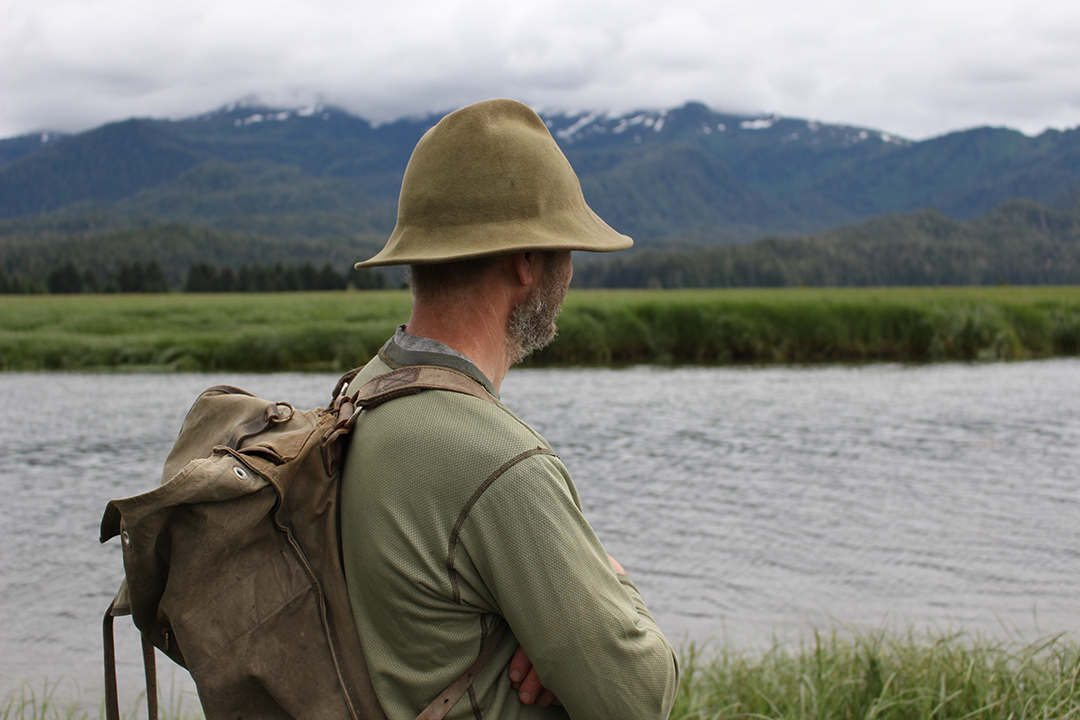
Bo Varsano looks out at the slough on Farragut Bay. (Photo by Elizabeth Jenkins/KFSK)
Despite those challenges, there’s a growing demand for fresh, local food. Farragut Farms transport their produce about 30 miles to Petersburg. It may seem like a long trip, but the bulk of grocery store products travel thousands of miles to Southeast Alaska.
Lisa Sadleir-Hart is the president of the Sitka Local Foods Network and serves on the Alaska Food Policy Council. She says as recently as 50 years ago, Alaskans were providing about 50 percent of what they ate. Now, an estimated 95 percent of food comes from somewhere else. There are environmental and health implications to that, but Sadleir-Hart says the area’s remoteness is also fueling the local foods movement.
“It wouldn’t take much for our food supply to be pretty impacted in the case of natural disaster or in Seattle if they couldn’t get the barges in. We would all be in pretty deep in in terms of food security.”
Creating local food systems can also mean more economic independence for Alaskans. The Petersburg Economic Development Council recently applied for a $25,000 grant from the USDA to fund farmer’s market promotions. Liz Cabrera, the coordinator for the PEDC, says she looks at it as growing one small business at a time.
“It adds an element of economic diversity to our local economy. It also adds, in general, an increased sense of resilience where we’re not as dependent on something being brought in from down south.”
Part of the grant money, if awarded, would go toward hiring a part-time market organizer and developing a Southeast Alaska Growers conference in Petersburg. As it stands, there aren’t any networking opportunities to discuss the unique challenge farmers face in the region.
“Mostly we’re isolated in our own towns doing our own thing and not really talking to each other that much,” says Varsano.
Varsano and Smets’ catamaran sailboat. (Photo by Elizabeth Jenkins/KFSK)
The couple hopes by communicating with other small growers in the area, the local foods movement will continue to thrive.
“We’re not alone. There’s a lot of other people who are starting up or running small farms. To be able to be able to put all our heads together and learn from one another would be really, really valuable,” says Smets.
Varsano and Smets finish packing the rest of the kohlrabi for the farmer’s market. To make it on time, they’re leaving on their catamaran sailboat at midnight. Farming in Alaska is hard work, but Varsano insists they wouldn’t have it any other way.
“Although we complain about it and it’s long and sometimes cold and rainy. It’s beautiful. It’s pretty easy to kind of invent your own life here.”
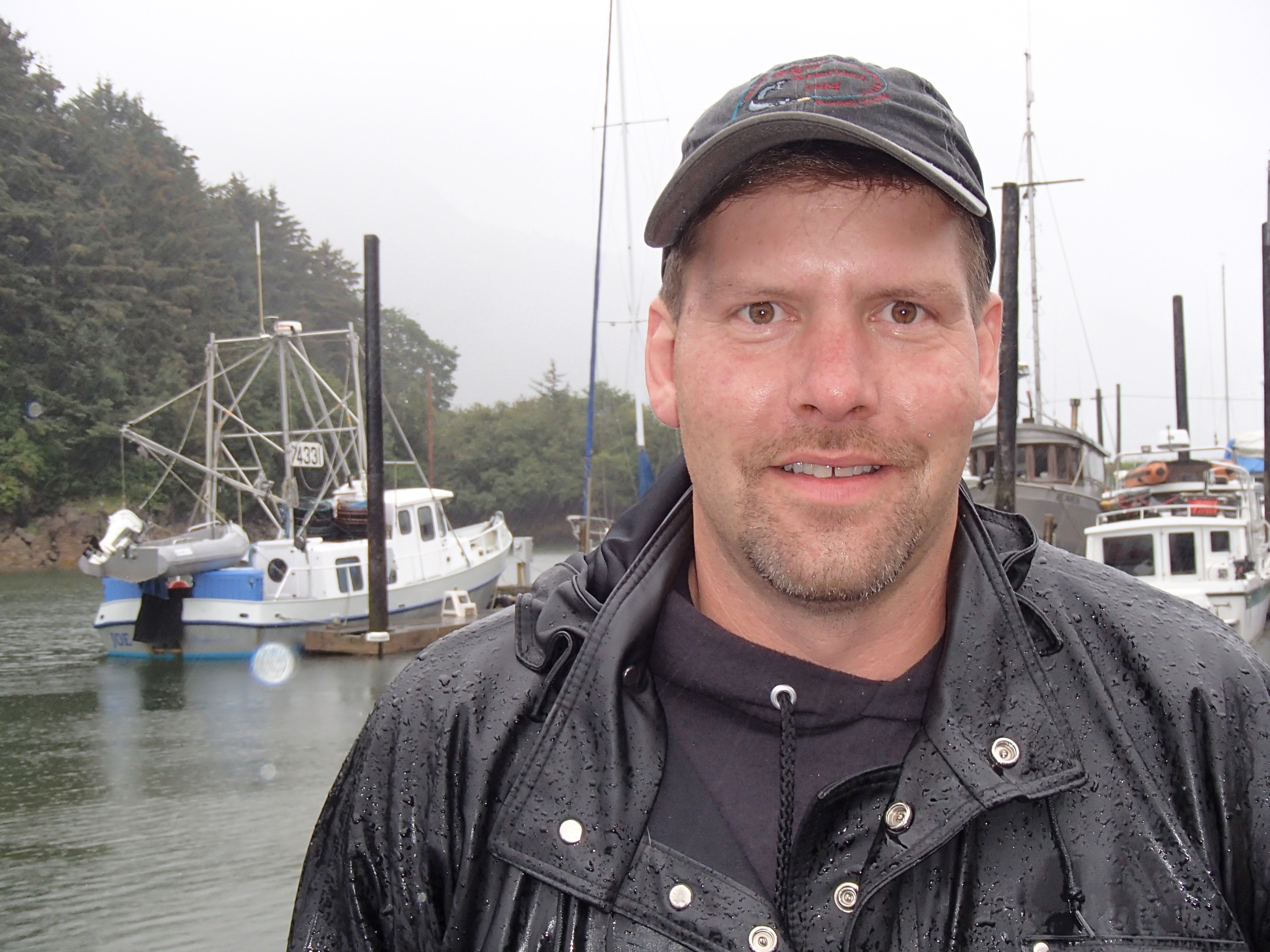
Jonathan Gunstrom is a past recipient of a Territorial Sportsmen scholarship. Now, he's the volunteer dock foreman in Douglas for the derby. (Photo by Lisa Phu/KTOO)
The Golden North Salmon Derby has three official stations - Douglas, Auke Bay and Amalga Harbor. (Photo by Lisa Phu/KTOO)
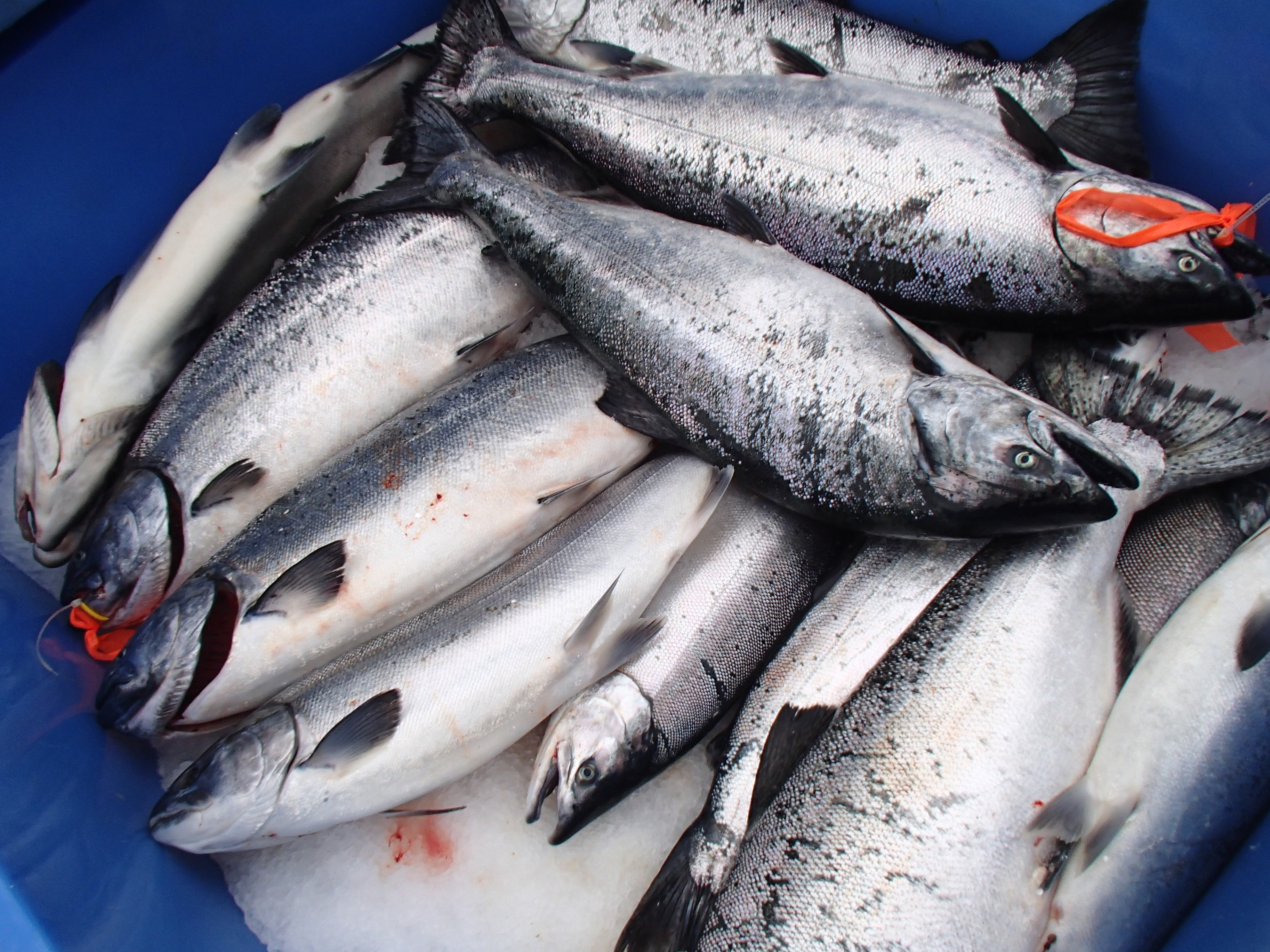
Derby participants caught 15,000 pounds less coho this year than last year. (Photo by Lisa Phu/KTOO)
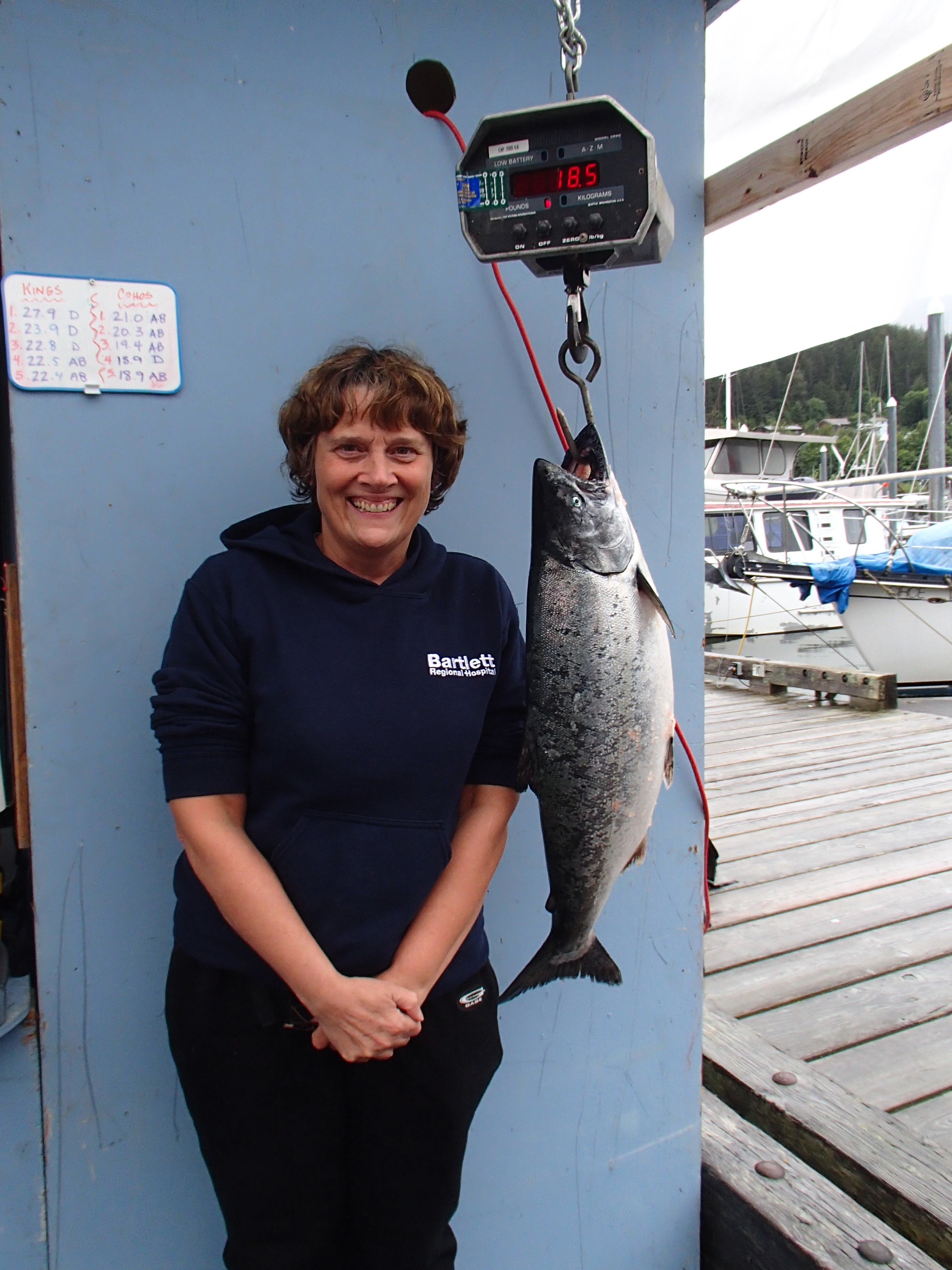
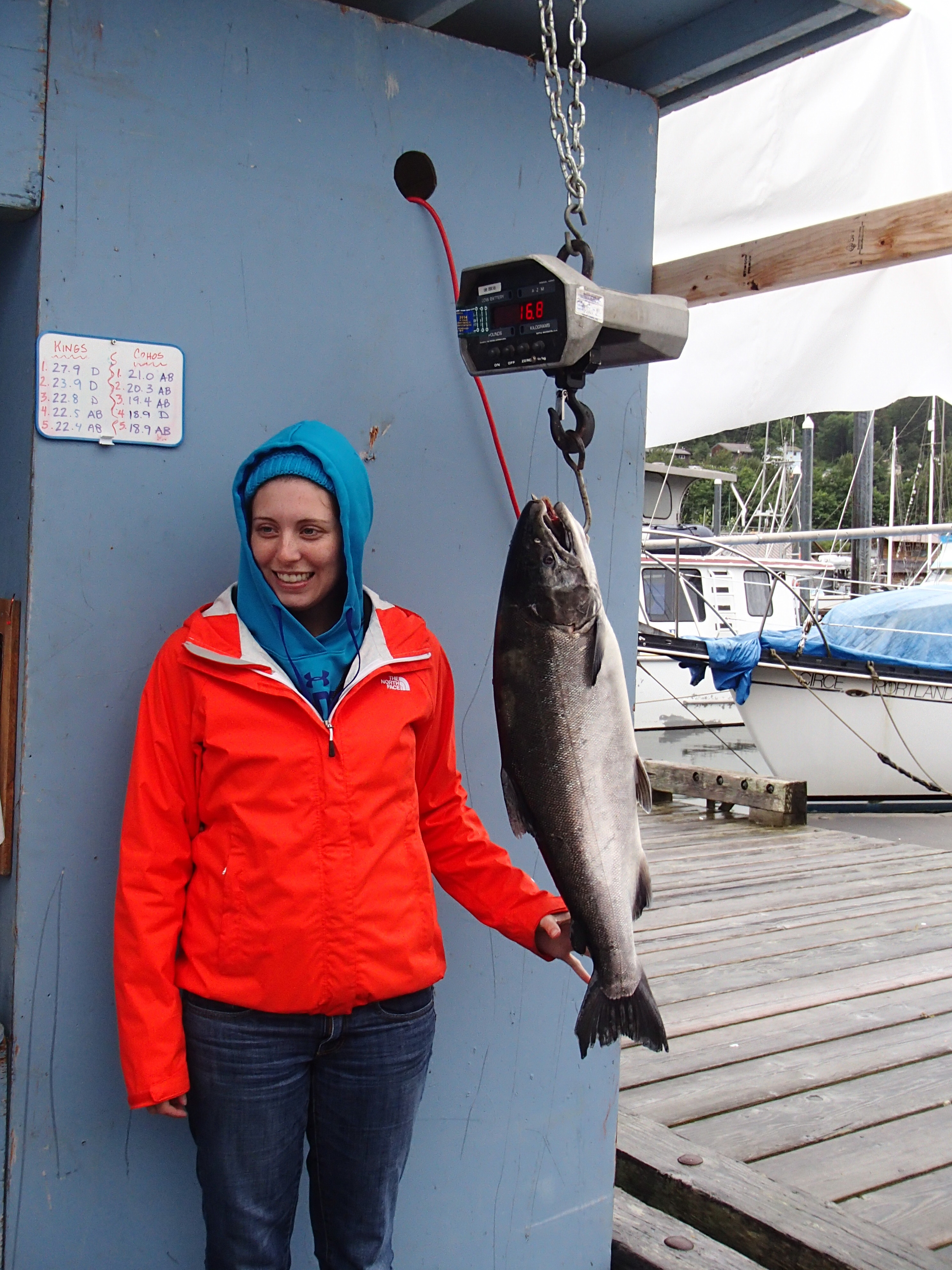
Jackie Dimond weighs in her 18.5-pound salmon in Douglas around 4:15 Sunday. (Photo by Lisa Phu/KTOO)
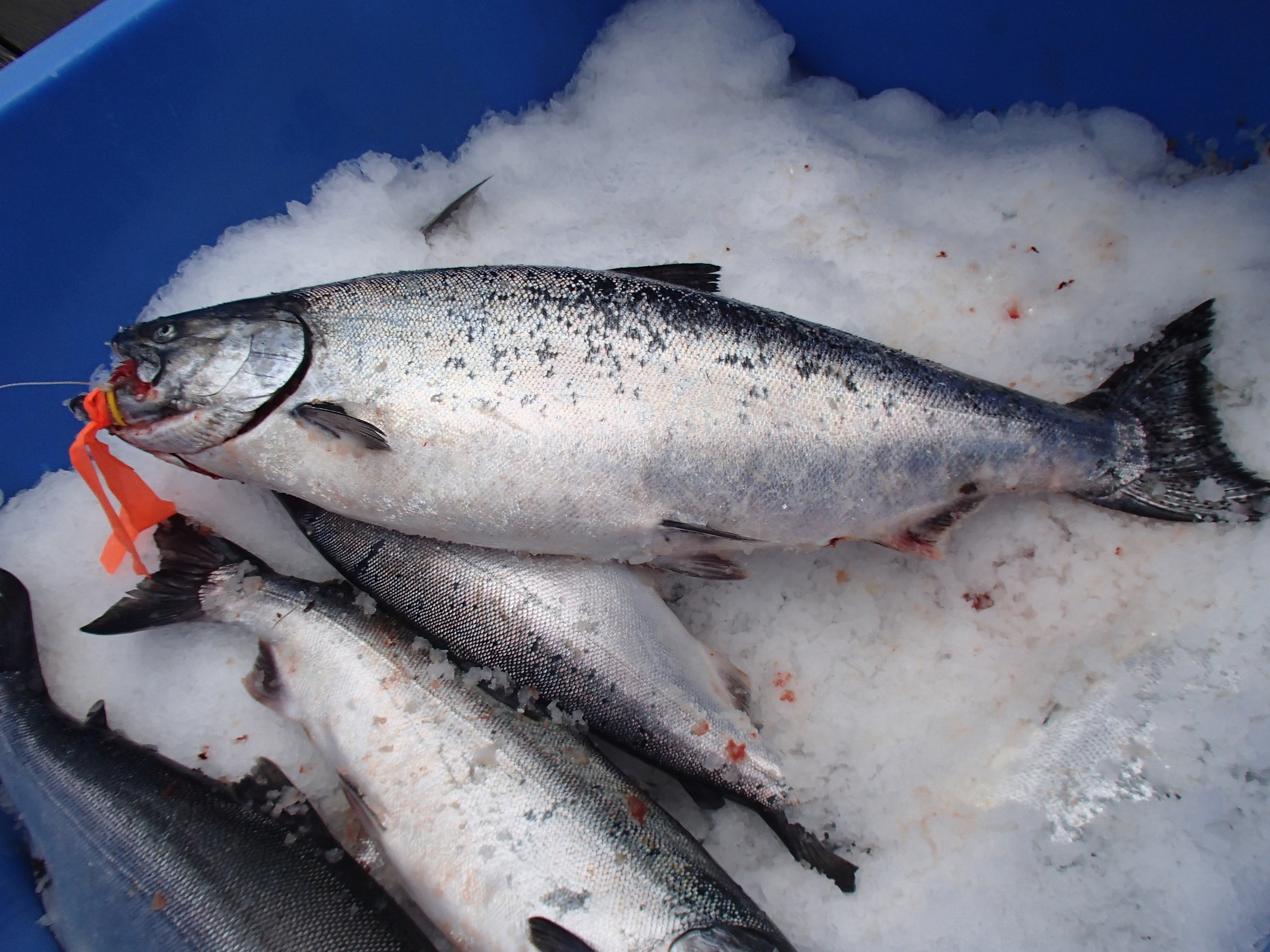
Mark Pusich's 23.9-pound king salmon is unofficially in second place. (Photo by Lisa Phu/KTOO)
Alexsandra Firestack poses near her 16.8-pound coho at the Douglas weigh station. (Photo by Lisa Phu/KTOO)
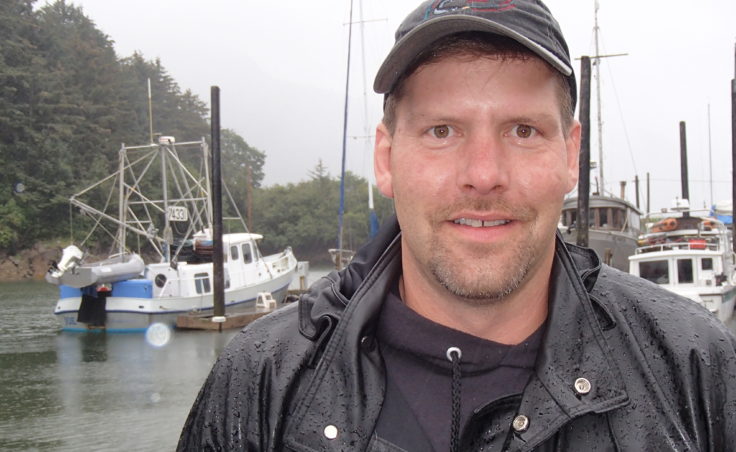
Gunstrom says this derby was a little slower than past years due to the weather, but the fish were just as big. (Photo by Lisa
For most people, the three-day Golden North Salmon Derby is about catching the biggest fish. For Jonathan Gunstrom, the derby is about giving back.
In 1991, Gunstrom received a Territorial Sportsmen scholarship when he graduated from Juneau-Douglas High School. It helped him go to Acadia University in Canada, where he studied marine biology.
Now, he’s a volunteer for the derby.
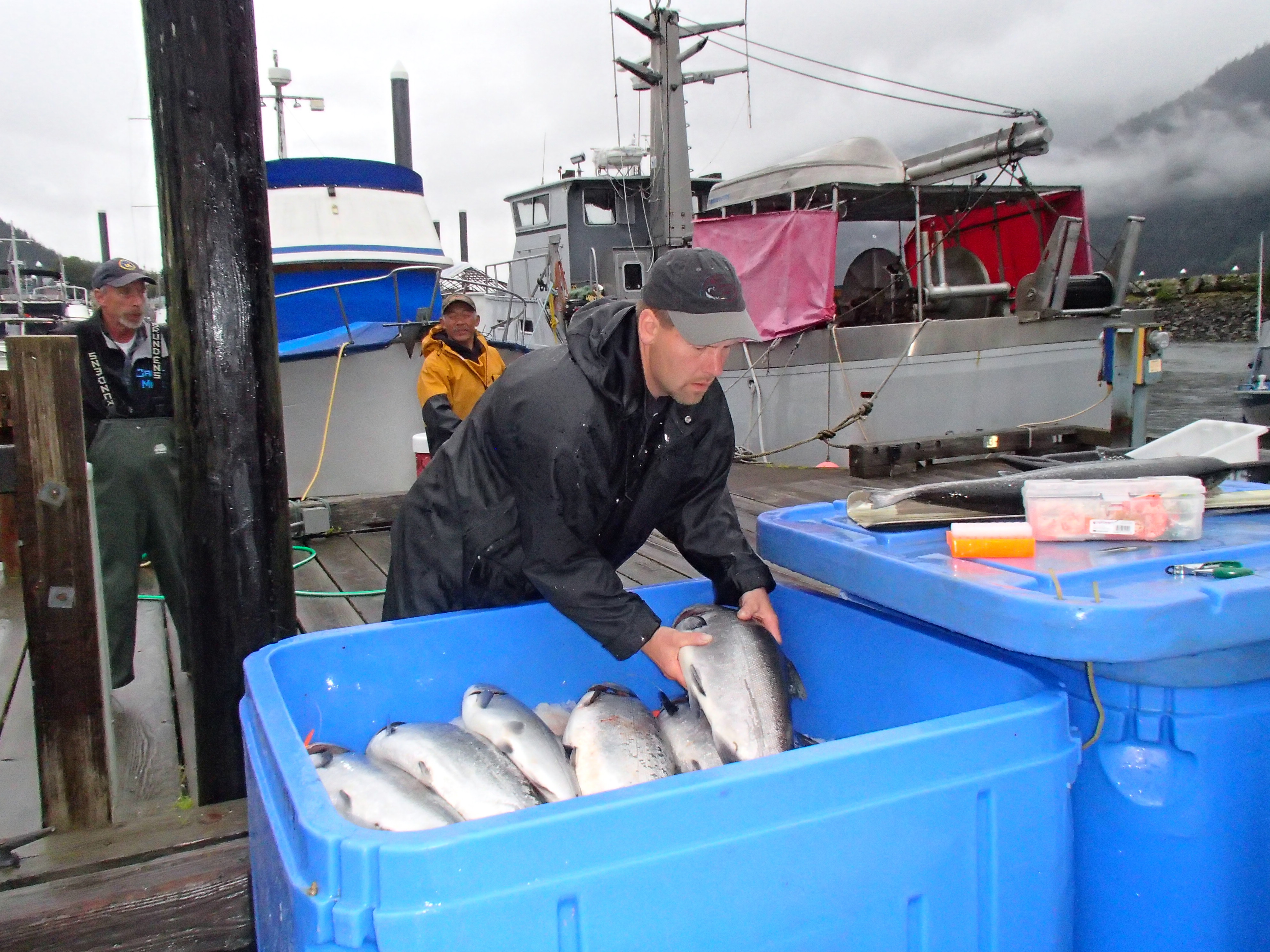
Jonathan Gunstrom is the dock foreman at the Douglas weigh station. He and his crew volunteer 12-14 hours each day, Friday through Sunday. Duties include handling, weighing and icing all the fish.
It’s Gunstrom’s fourth derby. Most of his crew have been volunteering for at least that long.
“We kind of have our own little set up where us guys are the fish mongers and tie up the boats and weigh the fish and take all the fish from the boats,” Gunstrom says. “And the gals have been recording all the weights and giving out scholarship tickets and prizes.”
Gunstrom says the derby has been slower year this year due to the weather. He says there might not be as many fish as past years, but the fish they are seeing are good sized.
“It’s always fun to have the big fish and to see the excitement in the people when they bring them in. They’re all hyped up because, hey, they might win the big prize,” Gunstrom says.
All the derby fish are sold to Alaska Glacier Seafoods. Proceeds go toward the Territorial Sportsmen Scholarship Fund, which awards up to five college and three vocational scholarships to local high school graduates.
“I was a recipient of the scholarship,” says Gunstrom, who went to college in Novia Scotia, Canada. “My friends 4,000 miles away in college didn’t know why I was getting the scholarship or what it was about and to get to explain to them the whole process of the salmon derby and what it was for, it was really neat, to be able to receive it. And now it’s just fun to give back and be a part of it.”
Unofficial derby results:
A 27.9-pound king salmon is the unofficial winner of the 68th Golden North Salmon Derby. That was caught by Max Mielke on Friday at 2:44 p.m. and turned in at the Douglas weigh station.
In other unofficial results, Mark Pusich came in second with a 23.9-pound king caught Sunday just after 1 p.m. In third place is a 22.8-pound chinook caught by Gerald Voss at 11:20 Saturday morning. Both were also weighed in at Douglas.
The 68th biggest fish weighed in at 16.3 pounds caught by Brian Geottler on Friday.
About 1,100 people participated in the derby, which started Friday morning and ended yesterday (Sunday) evening. Results will be certified tomorrow.
Awards night is Thursday at 7:00 p.m. in Centennial Hall. Prizes go to the 68 biggest fish and there will also be drawings for those who turned in scholarship fish.
The Managing Editor of the Alaska Dispatch News says a Western Alaska Bureau should be up and running by the end of the month. The new bureau will be based in Bethel and will be staffed by veteran reporter Lisa Demer.
“Lisa’s been a reporter in Alaska for 20 years and has covered a lot of different topics. And the thing about Lisa, I’d say that whatever she’s covered politics, she covered social issues, extensively,” says David Hulen. “And she does it with accuracy, nuance, depth – she listens. She’s very enthusiastic about doing it.”
Editor David Hulen. (Photo courtesy Alaska Dispatch News)
Demer worked for the Anchorage Daily News until the online news outlet, Alaska Dispatch, bought the paper from McClatchy Newspapers for $34 million in April. The organizations combined and changed the name to, ‘Alaska Dispatch News’ in July. Hulen says basing a reporter in Bethel is part of an overall shift in strategy for the news organization.
“You know when the two staffs combined we essentially had double the number of reporters/photographers as either operation had on their own. And so we’re really able to cover things that we could not have done before, separately. And one of the things that we’re really committed to doing is just better and deeper statewide and rural coverage,” Hulen says.
The Alaska Dispatch News is considering setting up additional bureaus in remote Alaska, he says. Hulen could not confirm locations, but discussed Barrow and Nome as potential sites for future bureaus.
Juneau Police Chief Bryce Johnson at the Chamber of Commerce Thursday in the Alaska Room of the Juneau Airport. (Photo by Rosemarie Alexander/KTOO)
Alaskans will decide in November whether the state should tax and regulate the production, sale and use of marijuana.
If Ballot Measure 2 passes, people age 21 and older could legally buy and use pot, and even grow a certain amount. But the drug could not be used in public.
Colorado and Washington now regulate pot, and Alaska authorities, like Juneau Police Chief Bryce Johnson, are looking to those states for guidance.
Johnson told the Juneau Chamber of Commerce Thursday that enforcement of driving under the influence laws could be a challenge.
“When we talk about DWI, all of our officers are trained for alcohol detection and stand and field sobriety tests,” Johnson said. “When you go to a drug-based DUI it requires additional training and right now we only have two people who are trained to do that, so we will have to expand our capacity to be able to investigate those things.”
Both driving under the influence and the underage use of marijuana have increased in Colorado since recreational use of the drug became legal, Johnson said. Juneau could have a similar experience if the marijuana initiative passes, he said.
The “Yes on 2” campaign recently put out a press release declaring teenage marijuana use is down in Colorado since the state legalized the drug. However, the 2 percent change between 2011 and 2013 is not statistically significant, according to the Colorado Department of Health and Environment. A state of Colorado survey shows fewer youth think pot is risky.
Johnson has been Juneau police chief for a little more than a year. When he joined the force the department had a number of vacancies and still needs ten officers.
Prospective officers must pass a physical and written test as well as background investigation.
“Every time we run a test we have six to eight people that will apply. And if we have six to eight people that apply we usually get one or two of them that will pass every stage of the testing,” he said.
JPD recently hired two people, who are now at the Public Safety Training Academy in Sitka. It will be about ten months before they’ll be officers on the street.
Johnson says departments across the country are finding it difficult to recruit officers, and he expects Juneau is about two years from filling all the vacancies.
Sheila Short, left, accepted money from Ildi Nylen, right, and Sophia Nylen, center, on Saturday. Sophia gave $1,562 in cash and two gift certificates in a cookie jar to Short, the grandmother to the family whose Twin Lakes home burned down last month. (Photo courtesy Ildi Nylen)
Juneau’s young busker with a cause raised more than $1,500 for a local family who lost their house to a fire.
Sophia Nylen, 8, played the violin in downtown Juneau for 10 hours last week over six days.
Besides the cash, Sophia’s mother Ildi Nylen says people also gave gift certificates.
“Tourists mostly gave the small change and locals gave the big amounts. The biggest one was the $200 gift certificate and the $200 in cash from one individual whom I could not catch. I asked Sophie if she remembers and she said, ‘Somebody who was wearing a blue sweatshirt and a big smile,'” Nylen says.
Through Facebook, Sophia’s busking effort spread outside of Juneau. Donations came from Wasilla, Seattle, Pittsburgh and Reno, Nevada.
On Saturday, Sophia presented the money to Sheila Short, the mother of Amber Schneider. Schneider and husband Lucas Schneider lost their Twin Lakes home to a fire last month. They have three sons.
“I don’t think she expected anything but I think the amount exceeded what anybody could hope for from Sophie, so she could not stop saying, ‘Thank you,'” says Nylen.
Sophia didn’t come away from the experience empty-handed. Some listeners brought her gelato and hot chocolate. She says she even found surprises in her donation can.
“I found a $5 Canadian in there. I found lots of cool coins. My mom exchanges what I want to keep if it’s, like, really special, like the Canada $5 is really special, so I kept that,” Sophia says.
Sophia is taking a break from busking. If she does it any more this summer, it’ll just be for fun.
Close
Update notification options
Subscribe to notifications
Subscribe
Get notifications about news related to the topics you care about. You can unsubscribe anytime.